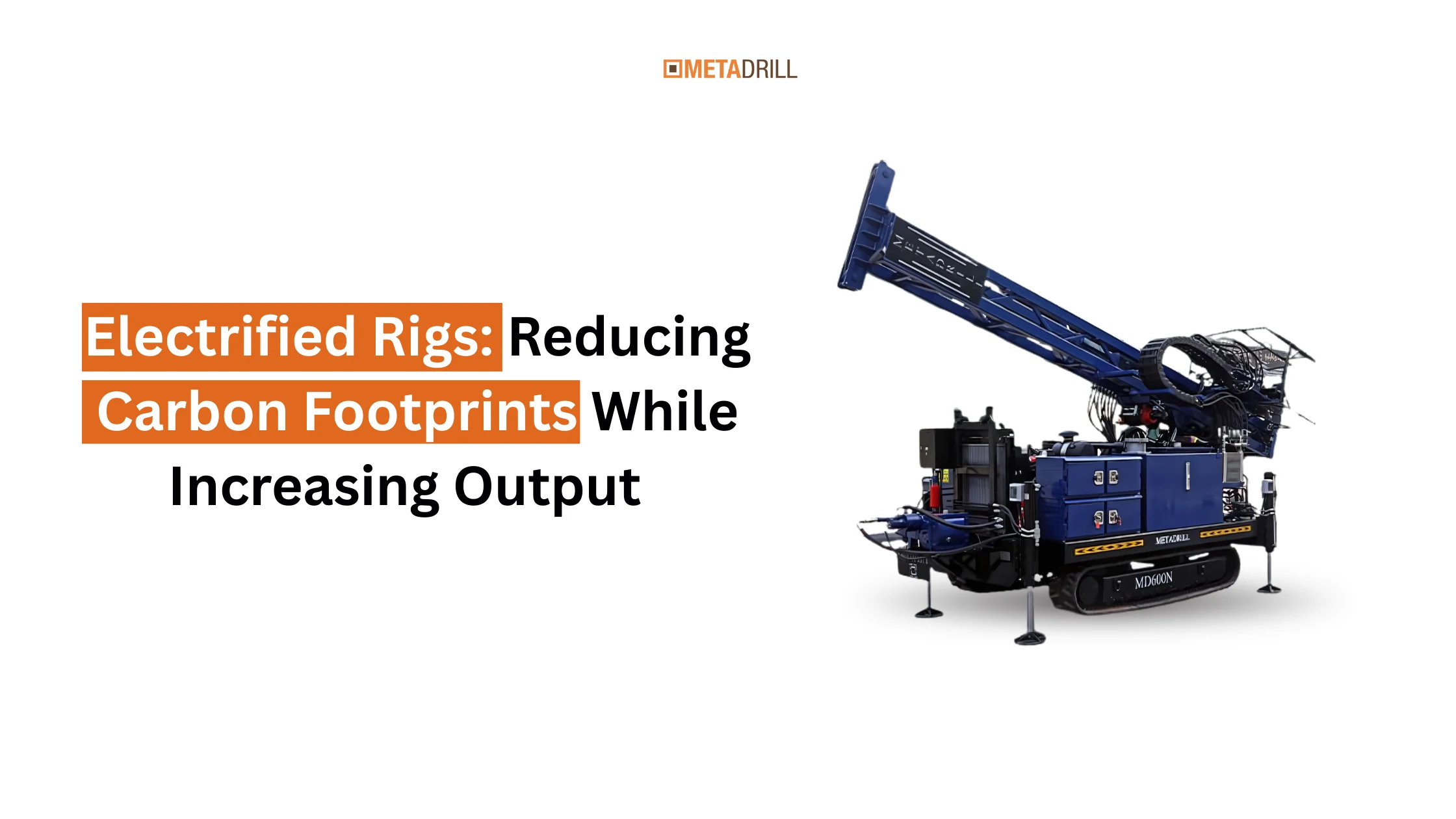
Blog | Geotechnical Drilling Insights - MetaDrill
NEWS & INSIGHTS
Stay up-to-date with the latest trends
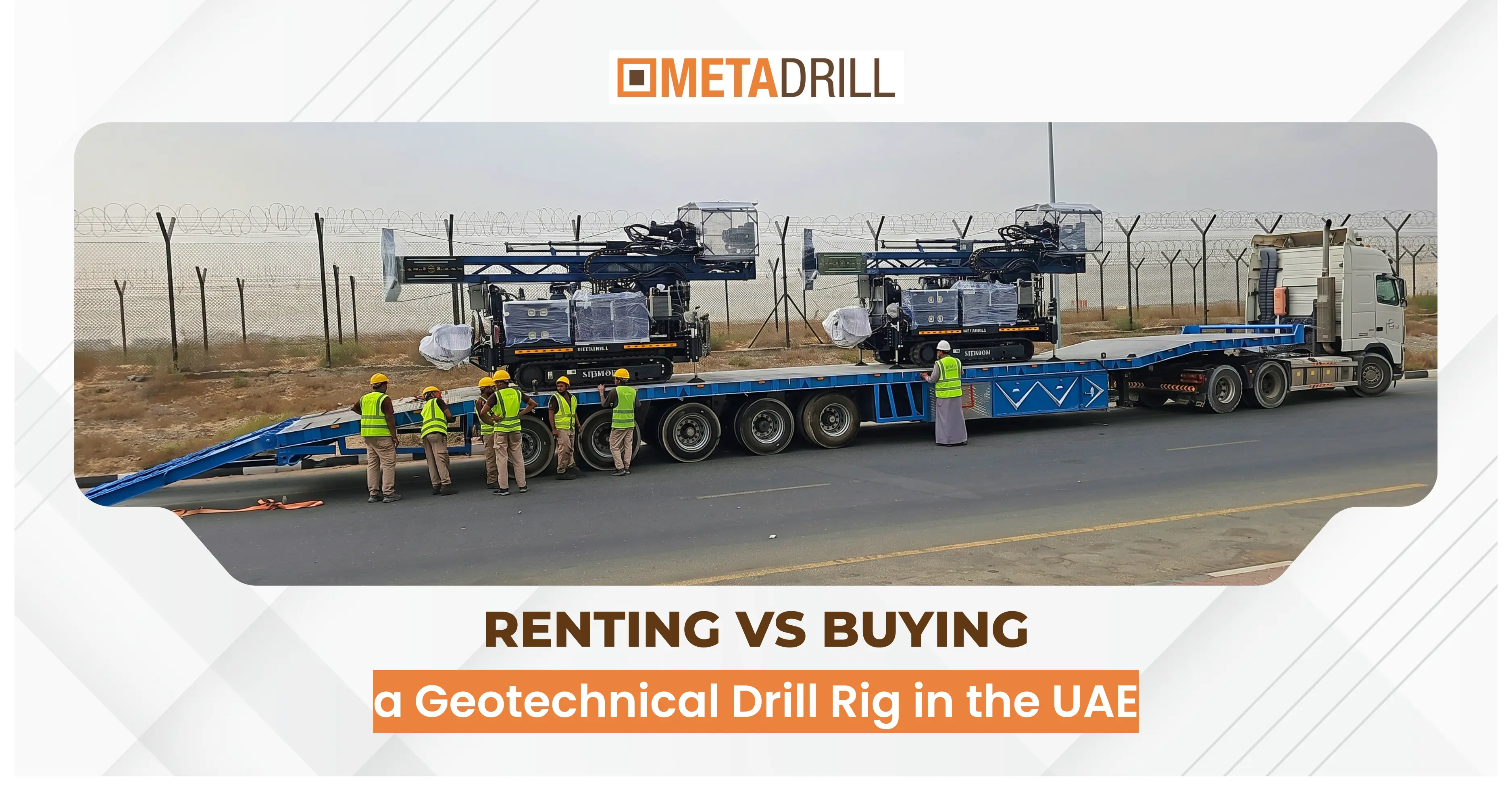
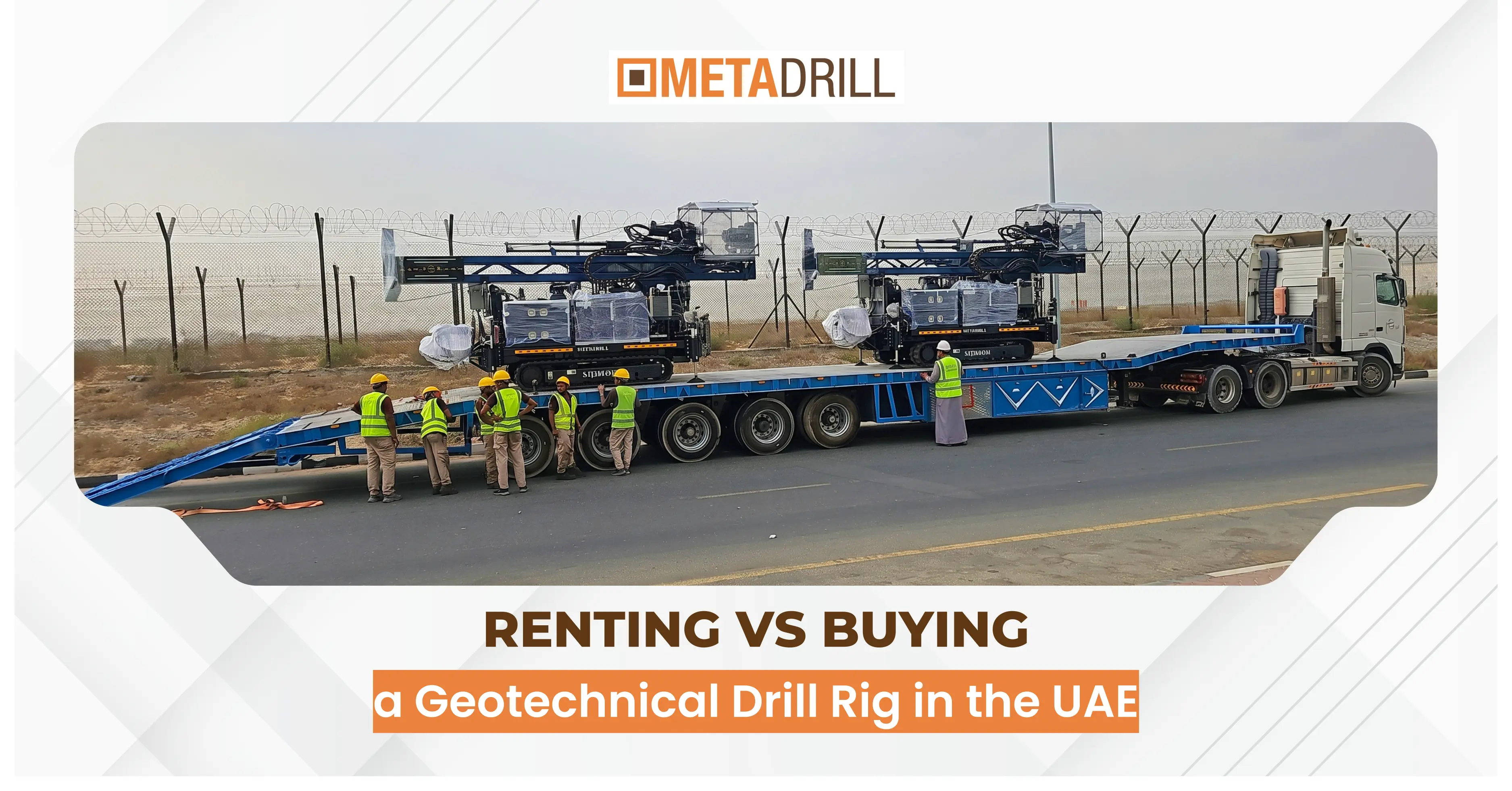
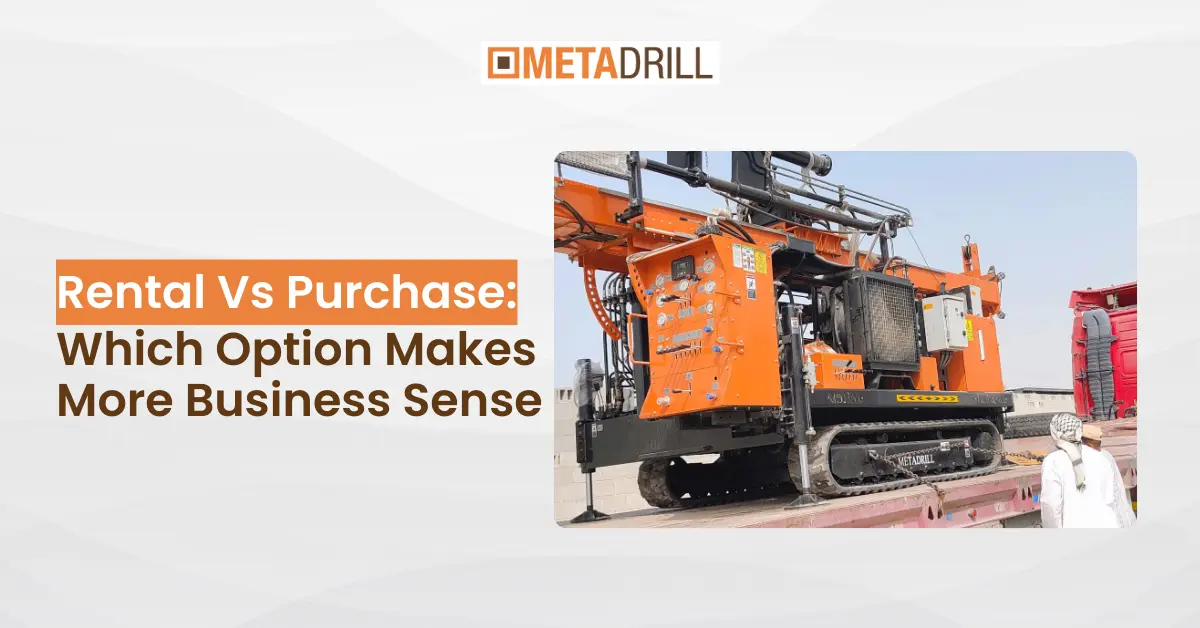
Renting vs Buying a Geotechnical Drill Rig in the UAE

Opening: the utilization question comes first

A UAE contractor can make a good technical choice and still make a poor commercial one. Picture a team that wins a six-month site-investigation package in Abu Dhabi, hires two extra drillers and immediately starts looking for a geotech drill rig for sale UAE suppliers can deliver quickly. Buying feels logical because the machine will be used every day.

But what happens when that contract ends and the rig sits for three months? The opposite mistake happens too: a contractor rents repeatedly for long programmes and ends up paying more than ownership would have cost. The right decision starts with utilization, not with whether buying sounds more professional. In the UAE, transport, summer heat, maintenance access, project approvals and the speed of local support can change the economics substantially.

When drill rig rental makes more sense

Drill rig rental is often the cleaner option for short-term campaigns, specialist scopes or uncertain pipelines. A consultant may need a crawler rig for a four-week investigation on soft reclaimed land near the coast, then return to lighter work on prepared urban plots. Renting avoids tying cash into a machine that may not match the next project.

It can also be useful when a project requires a capability that your existing fleet doesn't have, such as deeper coring, automatic SPT or a different mounting configuration. The catch is availability. During busy infrastructure periods across Dubai and Abu Dhabi, the exact rig and tooling you want may already be committed. Rental contracts should therefore define mobilization, operator responsibility, maintenance, damage, consumables and standby time clearly.

When ownership starts to pay

Buying makes more sense when a rig will stay productive across a reliable pipeline. Contractors handling recurring geotechnical drilling for buildings, roads, utilities or industrial sites can spread ownership cost over far more drilled metres. A purchased machine also gives the fleet manager control over setup, tooling, preventive maintenance and operator training. That control matters in the UAE, where a poorly maintained cooling system can become a serious problem during sustained summer work. If you are comparing geotechnical drilling rigs for sale, look beyond the invoice price. Finance cost, insurance, transport, parts, consumables, resale value and the cost of downtime all belong in the calculation.

UAE heat changes the ownership equation

A rig working through July in Dubai is not living the same life as a rig operating in a mild European climate. High ambient temperature increases the load on cooling systems and can expose weak maintenance habits quickly. Fine airborne dust adds another layer of wear.

Buyers should ask how easily radiators, filters, hydraulic components and service points can be accessed during daily checks. Renters should ask who is responsible if overheating is caused by clogged coolers or neglected filters. Either way, the operating plan needs to be written for Gulf conditions. A machine that loses half a shift to heat-related stoppages can erase a cheap rental rate or a low purchase price surprisingly fast.

Desert, urban and coastal sites need different mobility

The UAE is often described as desert, but site access varies dramatically. Loose sand outside Al Ain may favour a tracked machine with strong flotation and self-mobility. A constrained plot in Business Bay may put more value on compact dimensions and fast setup.

Coastal and marine-adjacent projects around Jebel Ali, Dubai Harbour or Abu Dhabi islands introduce saturated ground, saline exposure and more demanding wash-down routines. This is where generic comparisons fall apart. The best geotechnical drilling equipment is the equipment that matches the ground, access and sampling method you actually use. Before renting or buying, map the next twelve months of likely jobs and score the rig against those conditions.

GCC procurement: support can be worth more than a discount

Many UAE fleets eventually travel. A rig bought in Sharjah today may be mobilized to Saudi Arabia or Oman next year. That makes regional support a purchasing issue, not an afterthought. Ask where common spares are stocked, how quickly technical advice is available and whether technicians can support the machine outside the UAE. MetaDrill, based in Sharjah, positions its rigs around field serviceability, training, spare-parts availability and remote monitoring. Those factors are useful to compare with any supplier because a delayed seal kit or hydraulic component on a remote GCC project can cost far more than the saving achieved during purchase negotiation.

Regulatory and project requirements still apply

Neither renting nor buying removes the contractor's responsibility to work to project specifications and applicable authority requirements. Dubai Municipality publishes building regulations and soil and foundation testing requirements, while Abu Dhabi projects may fall under DMT, developer, free-zone or other project-specific controls. Port and industrial sites can add their own access, HSE and environmental procedures. The practical point is simple: confirm that the proposed rig, SPT system, tooling and work method suit the approved investigation plan before mobilization. A technically capable machine is still the wrong choice if it cannot be used within the site's access or testing requirements.

A simple decision framework

If utilization is likely to be low or the scope is specialist, rental usually deserves the first look. If the rig will be busy for most of the year, the case for ownership becomes stronger. Then test that decision against four questions. Can your team maintain the machine properly in UAE heat?

Is the rig versatile enough for the work you expect to win? Can you obtain parts and support quickly? And is the total cost per productive drilling day lower over the period you expect to keep it? Those questions are more useful than comparing monthly rental rates with purchase price alone.

A note on fleet planning

One practical way to make the decision less subjective is to review twelve months of rig utilization by project type. Separate productive drilling days from transport, standby and maintenance. Then estimate what proportion of next year's work can genuinely use the same machine configuration. UAE contractors sometimes discover that their most frequently requested rig is not their deepest rig but the one that mobilizes fastest, fits more sites and can be serviced by their own crew. That operational pattern is useful evidence when deciding whether to own, rent or maintain a blended fleet.

Final view

For most established UAE geotechnical contractors, the answer isn't purely renting or buying. A core owned fleet provides consistency, while rental fills temporary capacity gaps and specialist requirements. If you're reviewing a geotech drill rig for sale UAE options should be judged against real utilization, climate, terrain and support—not brochure specifications in isolation. MetaDrill manufactures and supports geotechnical drilling equipment from Sharjah and also offers rental and service options, so contractors can compare ownership and short-term access within the same regional context. The best decision is the one that keeps crews drilling, not the one that simply looks cheapest on day one.

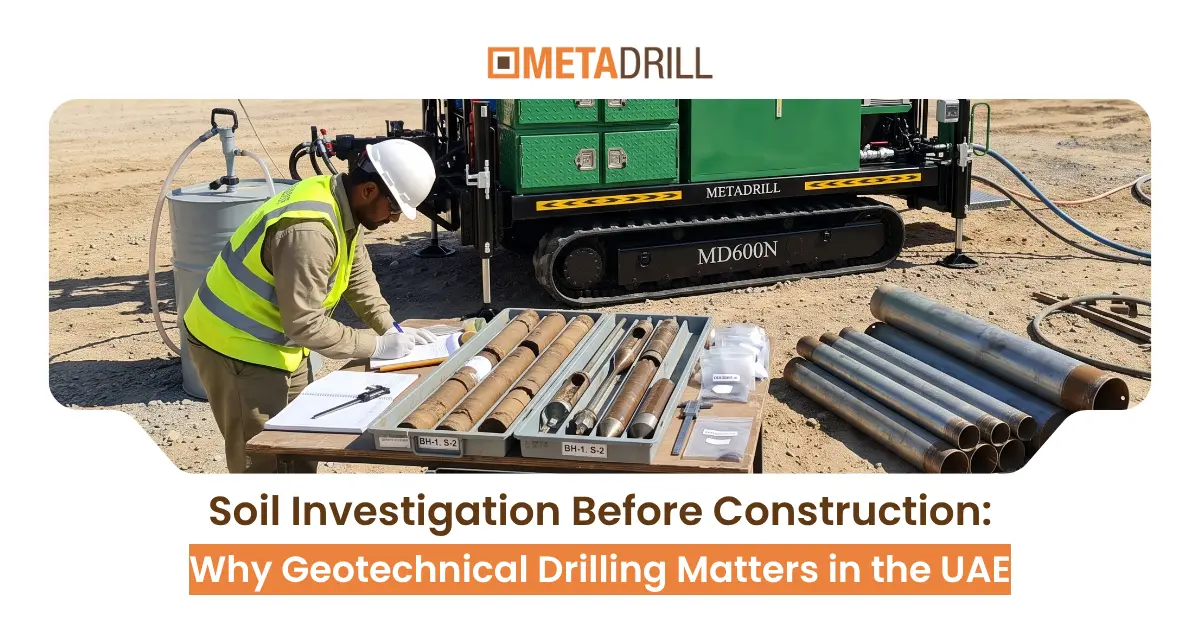
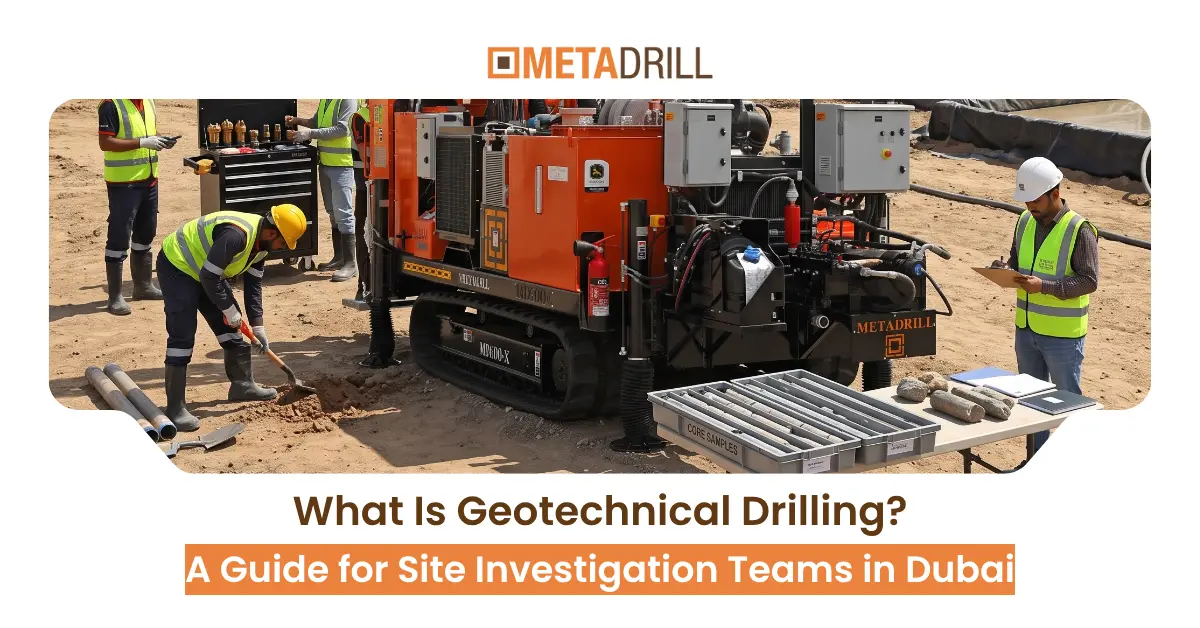
What Is Geotechnical Drilling? A Guide for Site Investigation Teams in Dubai

Before the foundation design, someone has to prove what is underground

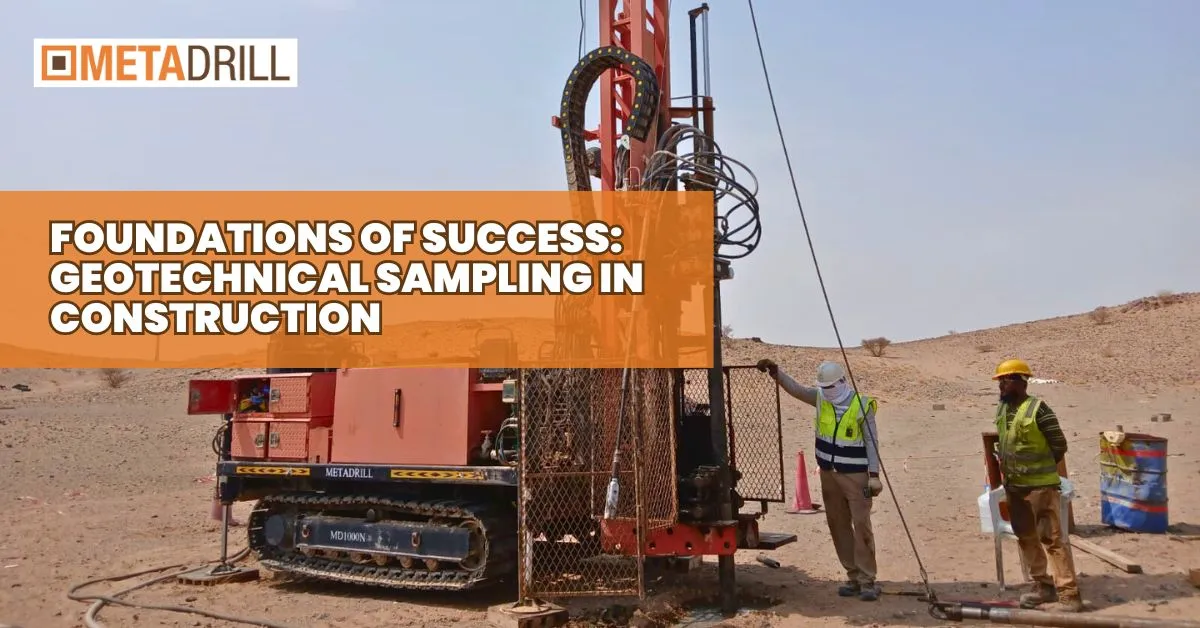
A plot can look perfectly level and still hide a difficult foundation problem. That is why geotechnical drilling in Dubai happens before piling, shoring or major excavation on many projects. The drilling crew's job is not simply to make a hole.

It is to recover reliable information about soil, rock and groundwater so the geotechnical engineer can decide how the ground is likely to behave under the proposed structure. On a high-rise site that may mean identifying dense sand over weak rock. On reclaimed coastal ground it may mean tracking loose fills and shallow groundwater. The quality of those observations influences foundation depth, temporary works and sometimes the entire construction sequence.

What geotechnical drilling actually does

Geotechnical drilling creates controlled access to the subsurface. Boreholes are advanced to planned depths, samples are recovered, in-situ tests are completed and the borehole log records how the ground changes with depth. Depending on the scope, a team may use wash boring, rotary drilling, core drilling, SPT sampling or a combination of methods. The objective is evidence. Engineers need to know what materials are present, where groundwater sits, how resistant the soil is to penetration and what the rock core says about strength and fracture condition. That data becomes part of the site investigation report rather than remaining a visual impression from the ground surface.

Why Dubai ground conditions deserve site-specific investigation

Dubai is famous for sand, but describing every project as a sand site is too simplistic. Natural aeolian and marine deposits, cemented layers, fill, reclaimed ground and carbonate rock can all appear within the same metropolitan area. Conditions near the coast can change over short distances because of historical shoreline development and reclamation. Inland sites may have dense sand layers or cemented horizons that affect penetration and sampling. That variability is precisely why geotechnical drilling in Dubai should follow the project investigation plan instead of relying on assumptions from a neighbouring plot.

SPT, sampling and coring: what the crew is trying to collect

For many building investigations, the Standard Penetration Test is one of the most familiar field tests. A split-spoon sampler is driven using a standardized hammer system and the recorded blows provide an indication of soil resistance when the procedure is correctly controlled. Where rock is encountered, coring can recover continuous material for logging and laboratory testing. Disturbed and undisturbed soil samples may also be specified. The choice depends on the engineering questions being asked. Good geotechnical drilling equipment should help the crew control drilling, handle rods safely and perform the required sampling method without unnecessary disturbance.

Heat, dust and productivity

The investigation programme may be designed on paper in an air-conditioned office, but the rig works outside. Dubai summer heat changes daily operating routines. Cooling systems, hydraulic oil, filters and hoses need closer attention, and drillers have to watch both equipment temperature and crew exposure. Dust compounds the problem by loading filters and collecting around moving components. None of this changes the principles of soil investigation, but it does affect how reliably the work can be executed. A rig with sensible service access and strong cooling can help the team protect productivity during long summer shifts.

Marine and coastal projects add another layer

Coastal Dubai introduces conditions that inland teams do not always face. Reclaimed land may contain variable fill; groundwater can be shallow; saline water raises corrosion concerns; access platforms may have strict loading and environmental controls. Marine works can also require specialized positioning, casing and fluid-management procedures. That is why coastal site investigation should be planned with the same care as the drilling itself. The rig configuration, sampling method and support equipment all need to match the approved work platform and the geotechnical objectives.

How regulations fit into the work

Dubai Municipality's building framework includes soil and foundation testing requirements, and building permit procedures refer to submission of soil-test information for relevant projects. In practice, consultants and contractors also work to project specifications, approved method statements and commonly referenced standards such as ASTM or BS procedures where specified. The important point for a site team is not to improvise the test method. Sampling intervals, SPT procedure, borehole depth, groundwater observations and reporting should follow the investigation scope and the governing requirements for that project.

Choosing equipment for a Dubai investigation

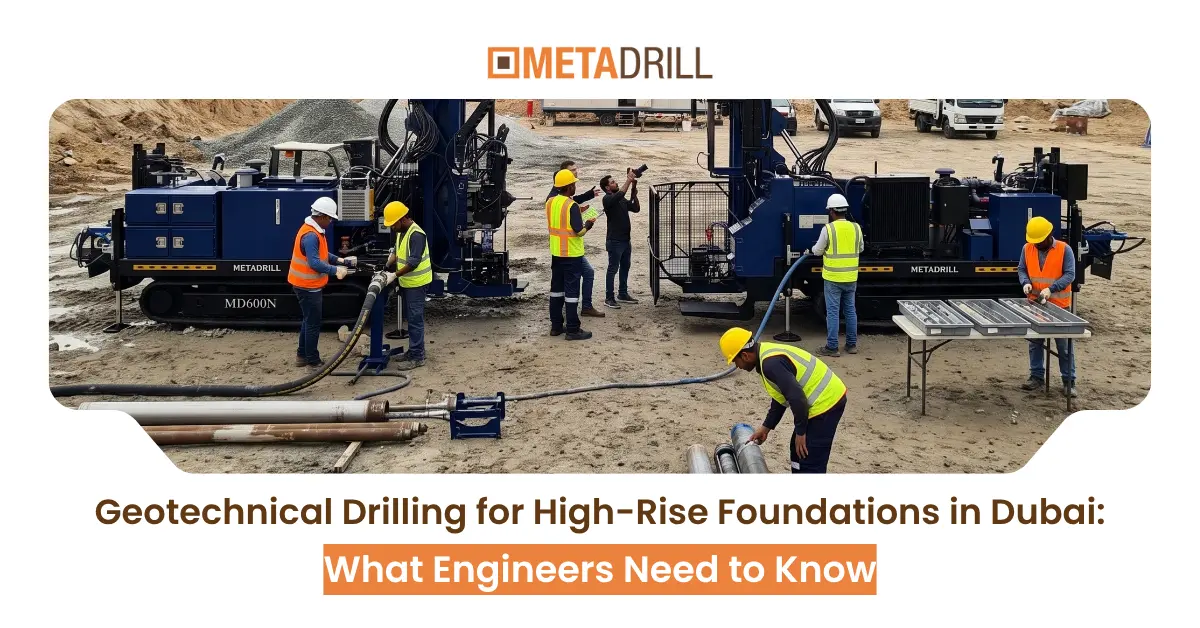
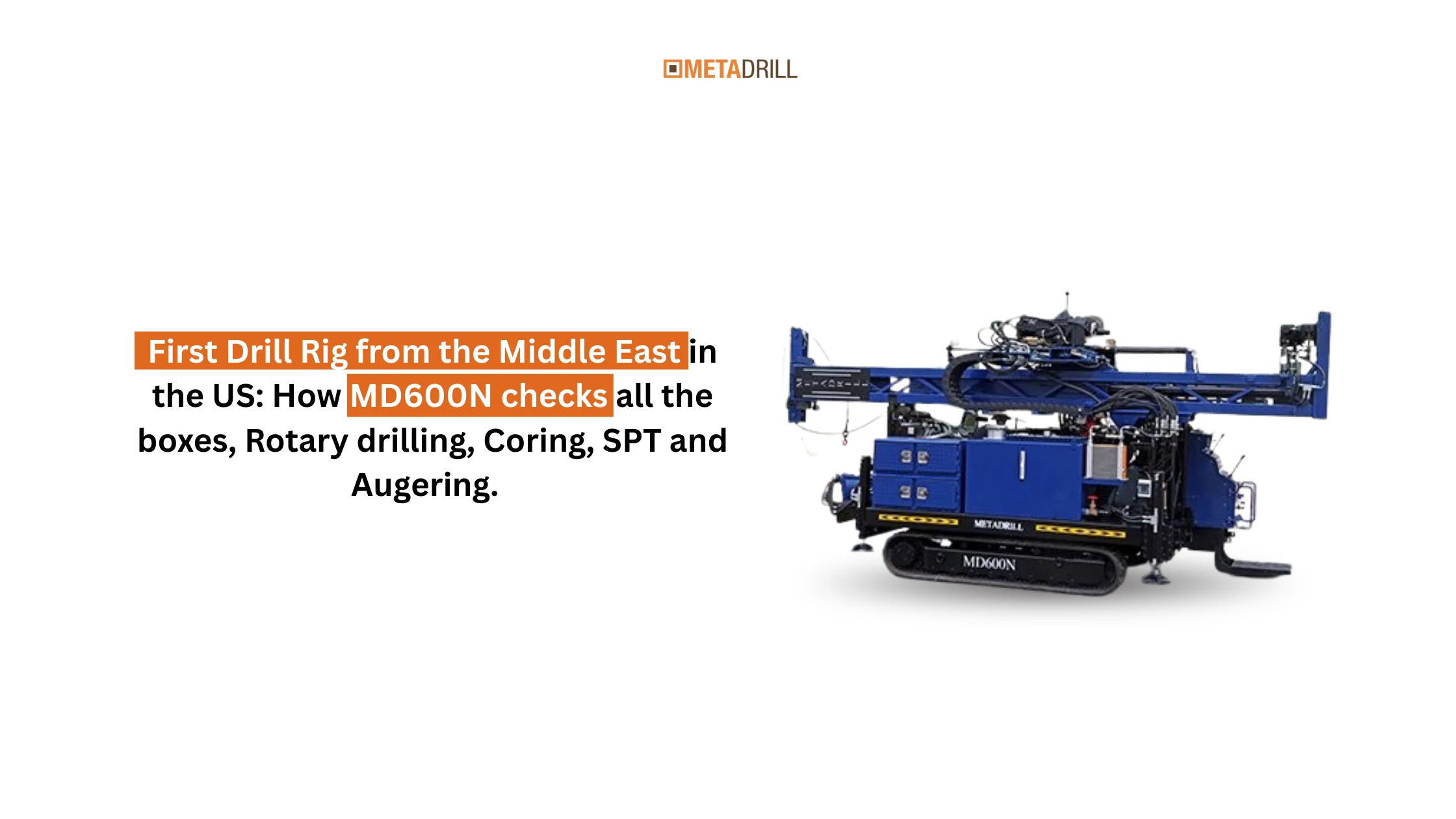
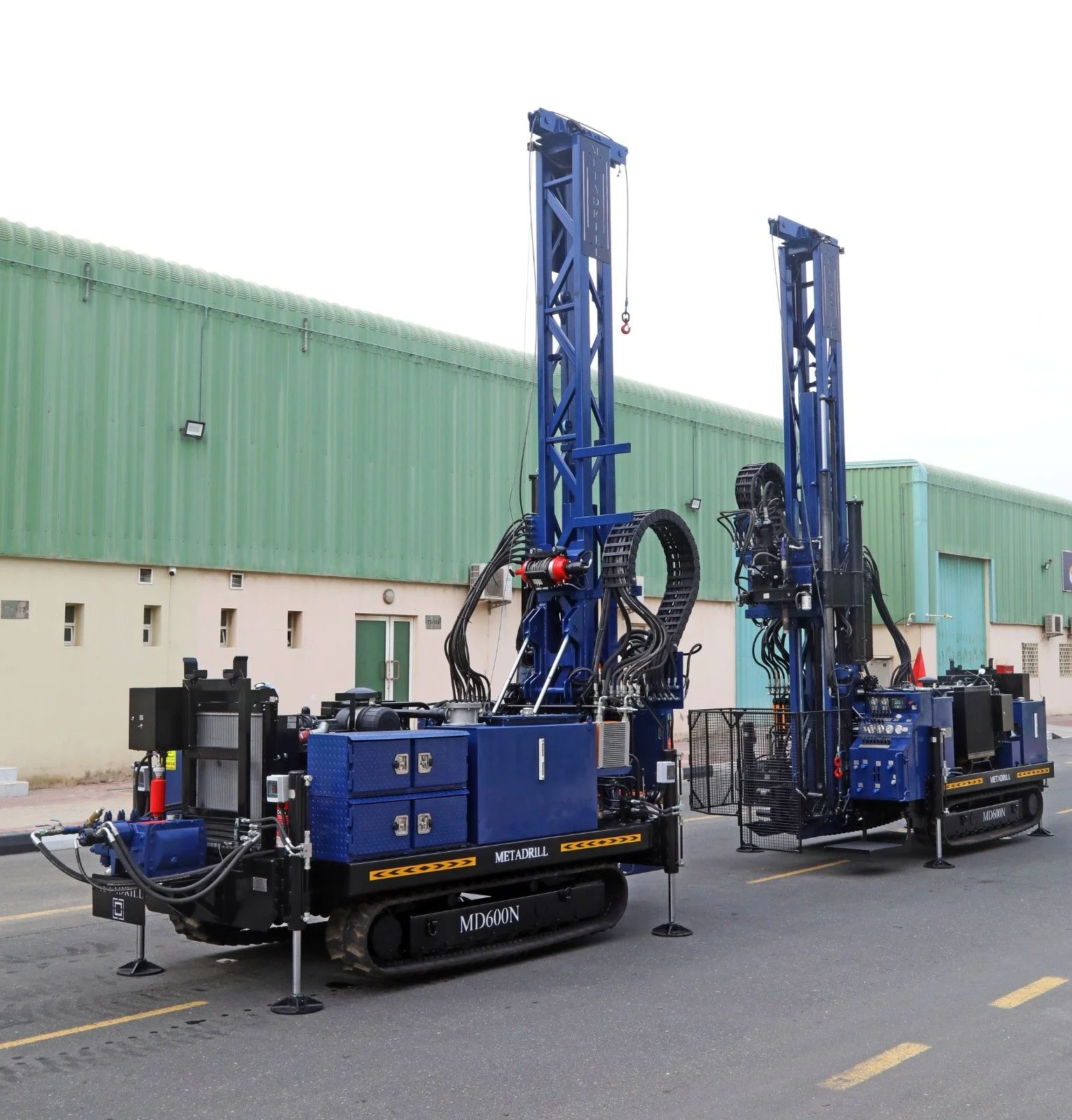
When teams compare geotechnical drilling rigs for sale, depth is only one line on the specification sheet. Torque, pullback, feed stroke, rod handling, SPT integration, transport dimensions and site access may be more important on a typical urban job. MetaDrill's UAE-made range includes compact and larger rigs for geotechnical and exploration work, with the MD600N positioned as a multipurpose geotechnical and exploration rig with optional automatic SPT capability and track or truck mounting. That kind of versatility can be useful for contractors moving between foundation investigations, deeper coring and regional projects.

What a good investigation looks like

A successful investigation is boring in the best possible way. The rig reaches the planned locations. Samples arrive labelled and intact. SPT records are clear. Core recovery is documented.

Groundwater observations are taken properly. The geologist can correlate the boreholes without guessing what happened in the field. That outcome depends on the whole team: driller, helpers, geologist, engineer and laboratory staff. Geotechnical drilling is the physical link between the design office and the ground itself. When that link is reliable, later engineering decisions become much easier to defend.

Use the investigation as a decision tool

The strongest project teams keep the investigation tied to design decisions. They ask what each test is meant to confirm and whether new field observations change the original assumptions. If conditions are more variable than expected, the programme can be adjusted while the rig is still mobilized. That is usually cheaper than discovering the gap during construction. In that sense, drilling is not simply data collection; it is an active risk-management process that should stay connected to the engineer making the final recommendations.

Closing

For site investigation teams, geotechnical drilling in Dubai is less about drilling quickly than drilling with purpose. Every metre should answer a question about the ground. UAE heat, coastal development and varied subsurface conditions make dependable equipment and disciplined field procedures especially important. If your team is reviewing geotechnical drilling equipment or planning a fleet upgrade, start with the investigation methods you actually perform and the sites you regularly face. MetaDrill's Sharjah base gives UAE contractors a local point of contact for rigs, tooling, spares and support, but whatever brand you choose, the standard should be the same: accurate data, safe operation and consistent field performance.

Drill Rig Maintenance in Extreme Heat: Keeping Your Rig Running in Dubai's Climate

A rig rarely fails at a convenient time. In Dubai, it often seems to choose the hottest afternoon of the week—when the hydraulic oil is already working hard, the crew is tired and the project manager wants one more borehole before demobilization.

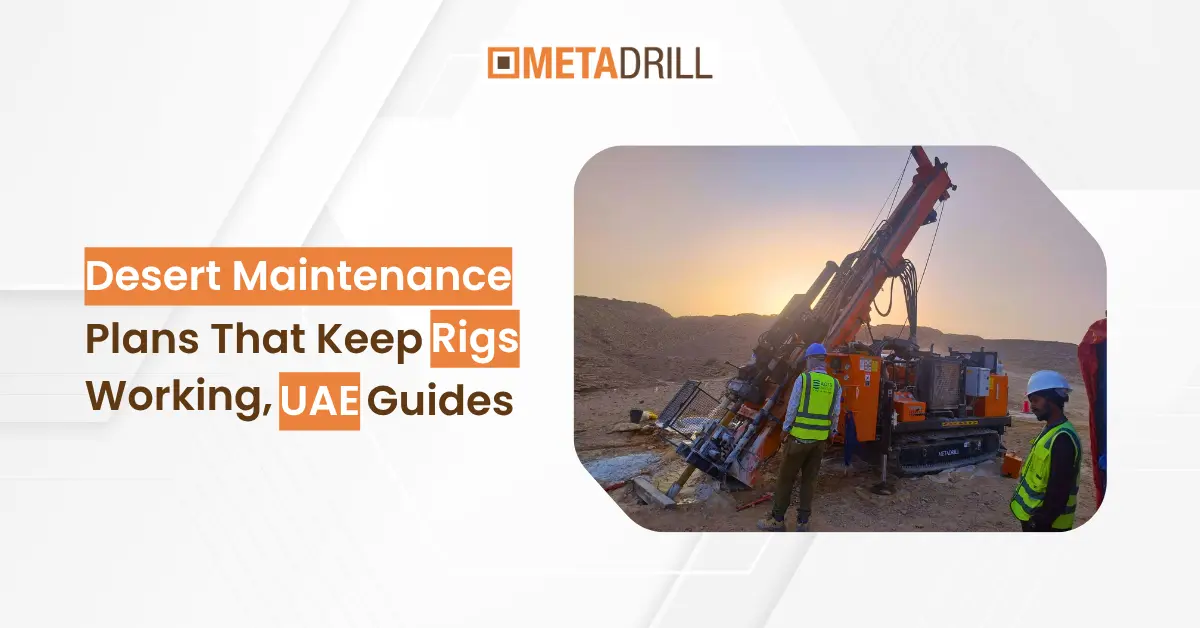
Extreme heat does not create every mechanical problem, but it makes weak maintenance show up faster. Cooling systems lose margin, seals harden, hoses age, dust blocks airflow and small leaks become larger under pressure. Good drill rig maintenance in Dubai’s climate is therefore less about reacting to breakdowns and more about protecting that margin every day.

The routine does not need to be complicated. It needs to be consistent.

Begin every shift with a machine you can actually inspect

The easiest rig to maintain is a clean one. Oil and dust packed around hoses, pumps and cylinders hide leaks and make temperature problems harder to spot. A quick wash or blow-down where appropriate allows operators to see changes before they become failures.

Daily checks should cover fluid levels, visible leaks, hose condition, guards, tracks, mast components, rotary-head area, emergency systems and the cooling pack. The operator should also notice anything that feels different: slower movements, unusual noise, changed pressure response or higher operating temperature.

MetaDrill emphasizes easy self-maintenance in its rig design. That matters in geotechnical drilling because the operator is often the first person who can detect a developing problem. A checklist is useful, but an operator who knows the normal behavior of the machine is even better.

Cooling system care is non-negotiable in summer

Radiators and oil coolers need airflow. Dubai dust and fine sand gradually create an insulating blanket on fins, especially if oily residue is present. A machine can appear fine in the morning and start running hot once ambient temperature climbs.

Cleaning frequency should be based on site conditions, not a calendar. A rig working on a dusty desert plot may need attention much more often than one operating on a paved urban site. Inspect fan condition, belts where fitted, coolant level and signs of contamination.

Do not respond to repeated overheating by simply adding fluid and carrying on. Rising temperature is information. Find the restriction, leak, fan issue or operating cause before expensive drilling rig equipment is damaged.

Hydraulics suffer quietly before they fail loudly

Hydraulic systems do most of the hard work on modern rigs. Heat reduces viscosity margin and can accelerate seal and hose degradation. Contaminated oil adds wear that may not be obvious until performance drops.

Operators should watch oil temperature, filter indicators and hose condition. Look for cracking near fittings, abrasion where hoses touch the frame and sweating that suggests a seal is beginning to fail. Keep replacement hoses and commonly used drill rig spare parts identified rather than waiting for a failure to discover the exact specification.

Good hose organization also matters. MetaDrill highlights branded hoses and identification numbers in its product approach, which can make maintenance and replacement easier for crews managing multiple machines.

Dust control protects more than the engine

Air filters receive most of the attention, but dust affects electrical connectors, sensors, moving joints and control surfaces as well. Fine sand can combine with grease to form an abrasive paste.

Use the correct cleaning method for filters—more aggressive is not always better—and replace elements at the right interval. Keep cabinets and connectors sealed, and inspect damaged boots or grommets before dust reaches sensitive components.

Maintenance tools should include what the crew needs for proper cleaning, inspection and torque checks, not a random toolbox collected over years. Organized tools save time and reduce the temptation to improvise.

Coastal rigs need a second maintenance routine

Dubai’s climate is not only heat and sand. Rigs working near Jebel Ali, Dubai Harbour, marinas or reclaimed coastal sites also face salt and humidity. Saline water left on fasteners, tracks and electrical components can create corrosion long after the project finishes.

After coastal work, wash down the machine with appropriate fresh water procedures, dry vulnerable areas and inspect protective coatings. Pay attention to hidden ledges where water sits. Lubricate according to the manufacturer’s recommendations after cleaning.

A fleet that rotates between desert and coastal sites should have two maintenance checklists. The machine sees different hazards, so the crew should respond differently.

Schedule preventive work around the UAE project calendar

A good maintenance plan uses quieter periods to complete deeper inspections instead of waiting for the next contract to expose problems. Track engine hours, drilling hours and component life. Review repeated failures across the fleet; patterns often reveal training or operating issues rather than bad luck.

MetaDrill says its systems can use power-unit monitoring and remote data to support preventive maintenance planning. Whether your rig has connected monitoring or a paper logbook, the principle is the same: maintenance should be triggered by evidence and operating conditions.

For contractors working across the GCC, service planning needs to consider location. Before a rig leaves the UAE for Saudi Arabia or Oman, pack critical spares and confirm who can provide technical support. A minor failure in a remote camp becomes a major logistics problem if the part is still in Sharjah.

Maintenance also protects safety and compliance

Worn guards, leaking hoses and malfunctioning emergency systems are not only productivity issues. They can stop the rig during a client audit or, worse, contribute to an incident. Project HSE rules, lifting requirements and equipment inspection procedures should be built into maintenance planning.

UAE requirements differ by project and authority, and major developers or ports may impose additional inspection documentation. Keep maintenance records, service certificates and relevant inspection evidence organized so the site team can produce them when requested.

If you are comparing geotechnical drilling rigs for sale, ask about service intervals, parts lists and maintenance access before buying. The true cost of a machine includes how easily your team can keep it compliant and productive.

The goal is predictable meters, not heroic repairs

The best maintenance team is not the one that can rebuild a failed component at midnight. It is the one that prevented the failure during Tuesday’s routine check.

For geotechnical drilling equipment in Dubai, focus on cooling, cleanliness, hydraulics, dust control, coastal wash-down and a disciplined spares plan. Train operators to report small changes instead of working around them. Keep records that show what was repaired and why.

MetaDrill manufactures rigs in the UAE and supports parts, service and training for regional users. Whether your fleet is new or well used, the maintenance objective stays the same: protect uptime when the temperature climbs and keep the rig earning instead of waiting for repairs.

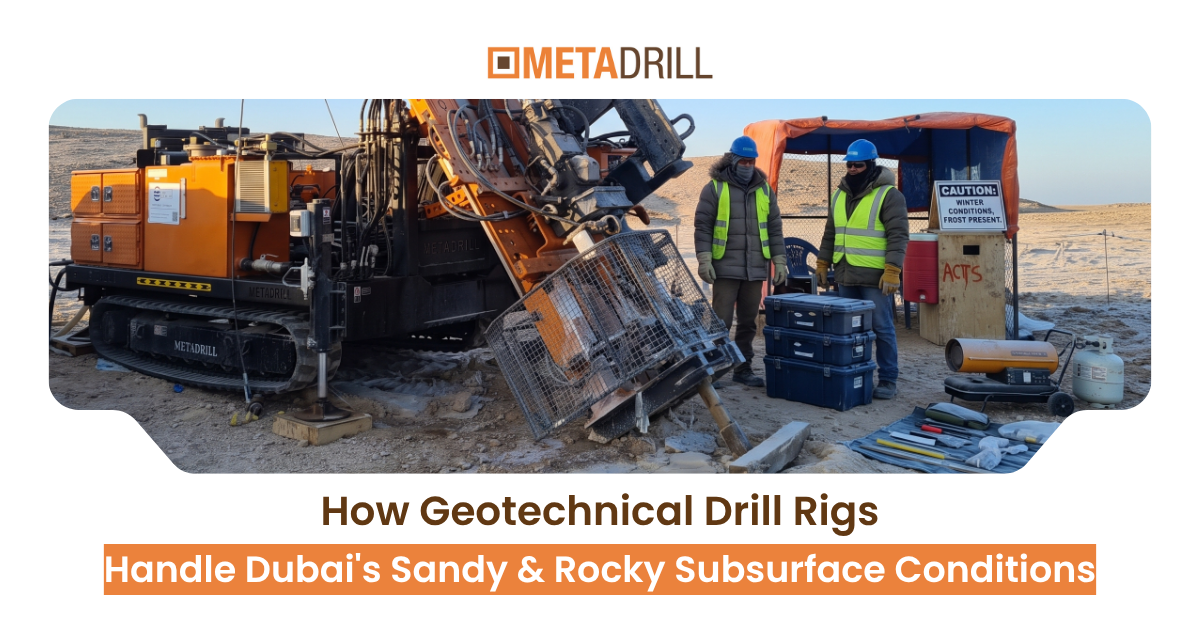
Inside MetaDrill's Rig Lineup — Built for Dubai's Desert Terrain

Dubai’s desert makes simple things difficult. Fine sand works into moving parts, summer heat pushes cooling systems hard, and an apparently flat site can hide soft patches that make moving heavy equipment awkward. A rig that is productive here has to be more than powerful; it has to be practical.

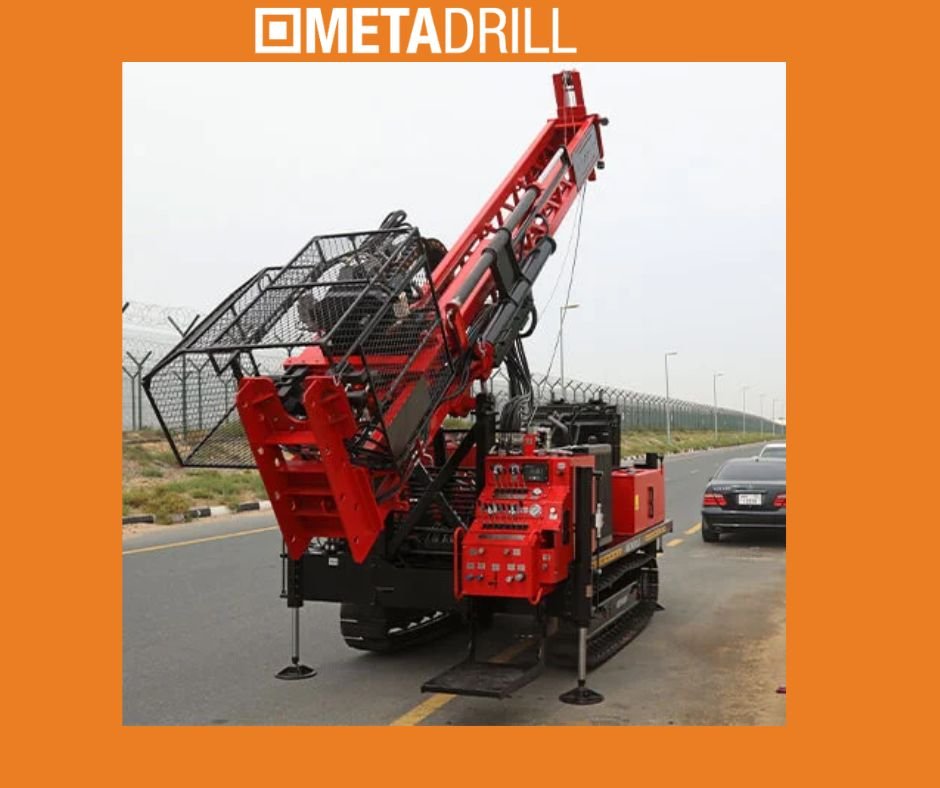
MetaDrill builds geotechnical drilling equipment in Sharjah, with a lineup that currently includes the MD40, MD75N, MD150N, MD600N and MD1000N. The range gives contractors different options for compact site investigation, routine geotechnical drilling, deeper coring and surface exploration.

Rather than treating the models as a ladder where 'bigger is better,' it makes more sense to look at the work each size can support. Desert terrain, urban access, coastal sites and GCC mobilization all reward different strengths.

Why desert terrain changes rig design priorities

On a prepared city plot, the rig may only move a few metres between boreholes. On a desert infrastructure project, it can travel repeatedly over loose sand and uneven ground. Stability, crawler traction, ground clearance and balance become daily productivity issues.

Heat is the other constant. Hydraulic oil, engines and cooling packs operate under higher ambient temperatures for long periods. Dust loads filters quickly. Service points that are easy to reach encourage crews to carry out the cleaning and inspections needed to keep the rig healthy.

That is the environment in which a geotechnical drilling rig for desert terrain should be judged. Published power matters, but so does how quickly the machine can be cleaned, checked and put back to work.

MD40: where compactness is the advantage

The MD40 sits at the compact end of MetaDrill’s range. For tight-access work, smaller rigs can be valuable because mobilization and setup often consume a large percentage of the working day.

Think of villa investigations, restricted urban plots, utility corridors or sites where a large crawler would create more access problems than drilling benefits. A compact machine can also be attractive as a second fleet unit for shallow geotechnical work while larger rigs remain on deep programs.

Buyers searching geotechnical drilling rigs for sale sometimes over-specify because they want one machine to do everything. The MD40 argument is the opposite: if a large share of your work is compact, a purpose-sized rig can earn its keep by being easier to move and deploy.

MD75N and MD150N: the middle ground for everyday site investigation

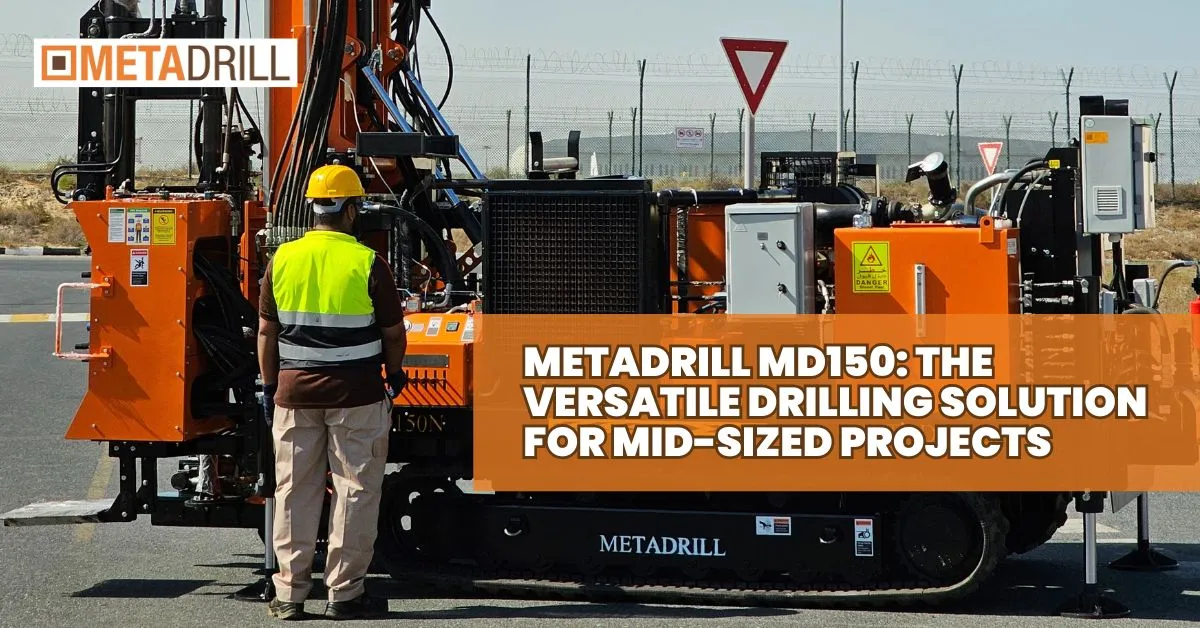
The middle of a rig range is often where fleet utilization is highest. MD75N and MD150N give contractors options between the compact MD40 and the deeper-capacity MD600N/MD1000N platforms.

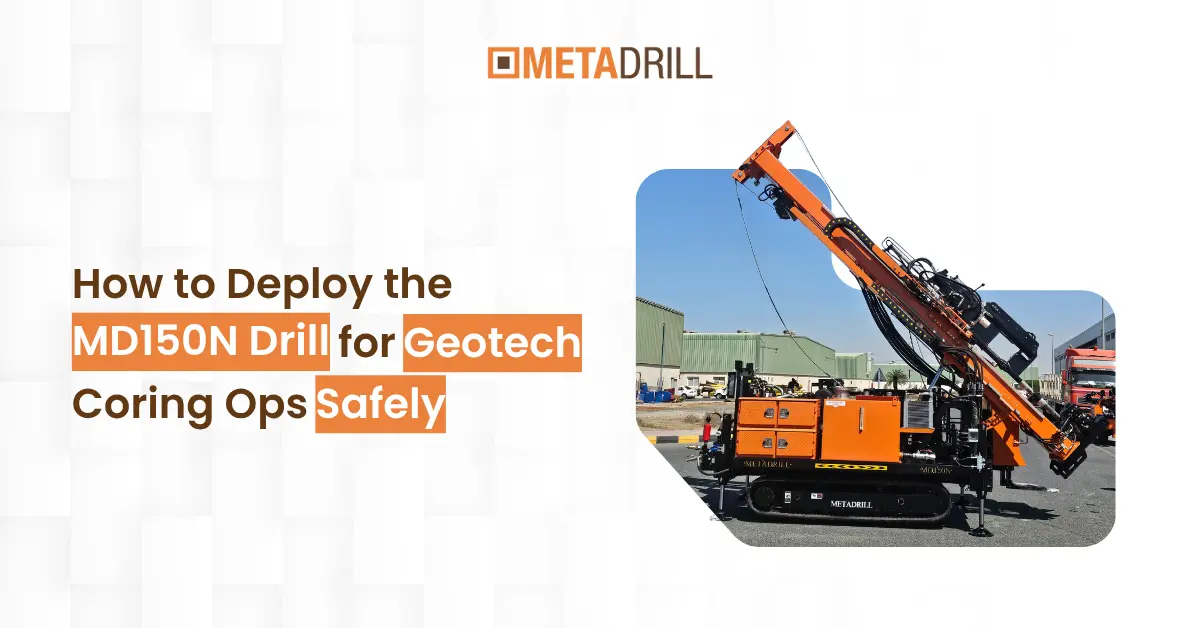
For UAE contractors, that middle ground can suit routine geotechnical drilling where mobility, SPT capability, sampling and moderate coring need to coexist. The exact model choice should be based on borehole depth, expected formations, tooling and the weight the company is comfortable transporting between sites.

These rigs may also make sense for contractors working across Dubai, Sharjah and Abu Dhabi who need one machine to move regularly without carrying deep-exploration capacity on every project.

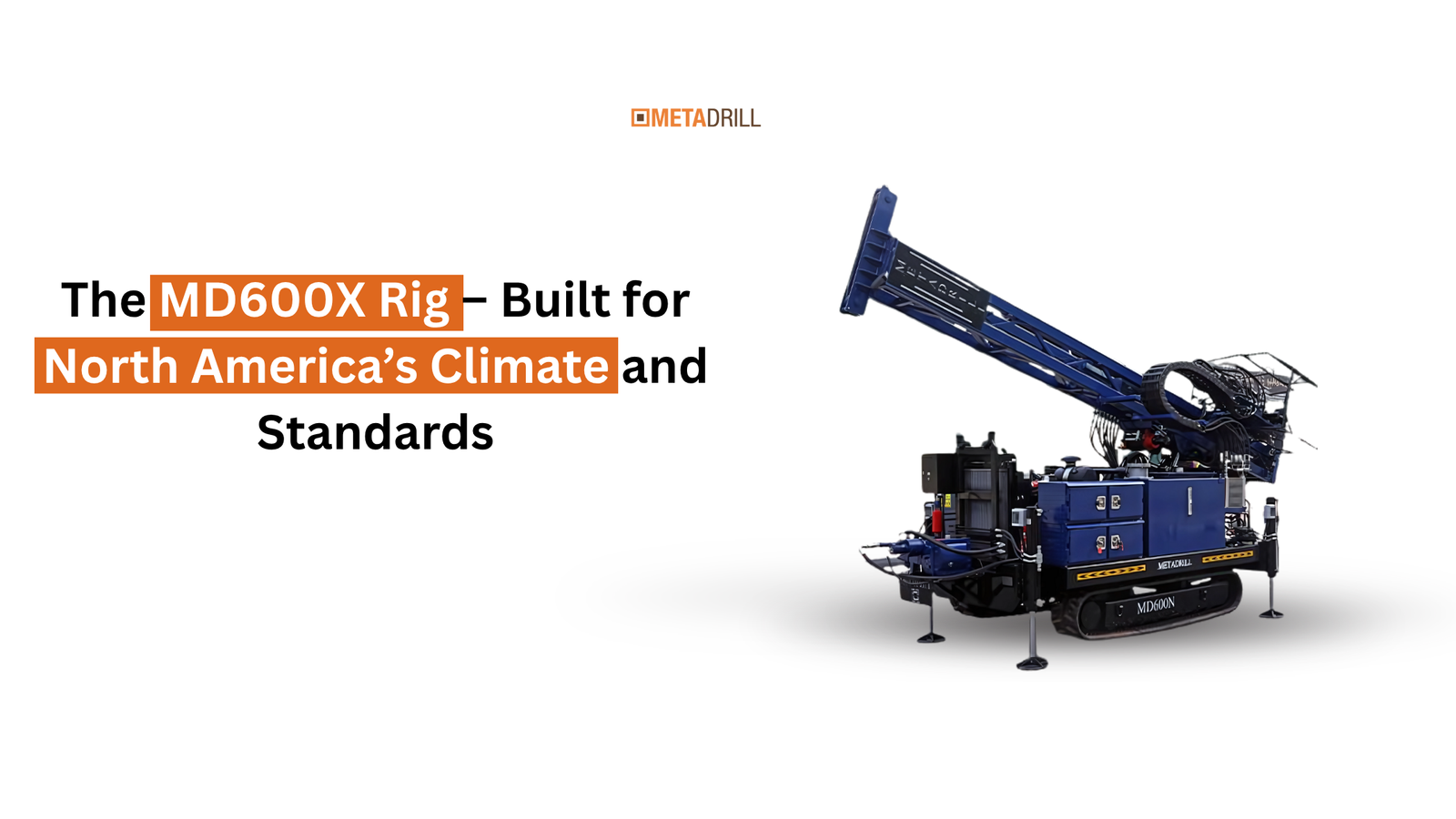
MD600N: a step into deeper, multipurpose work

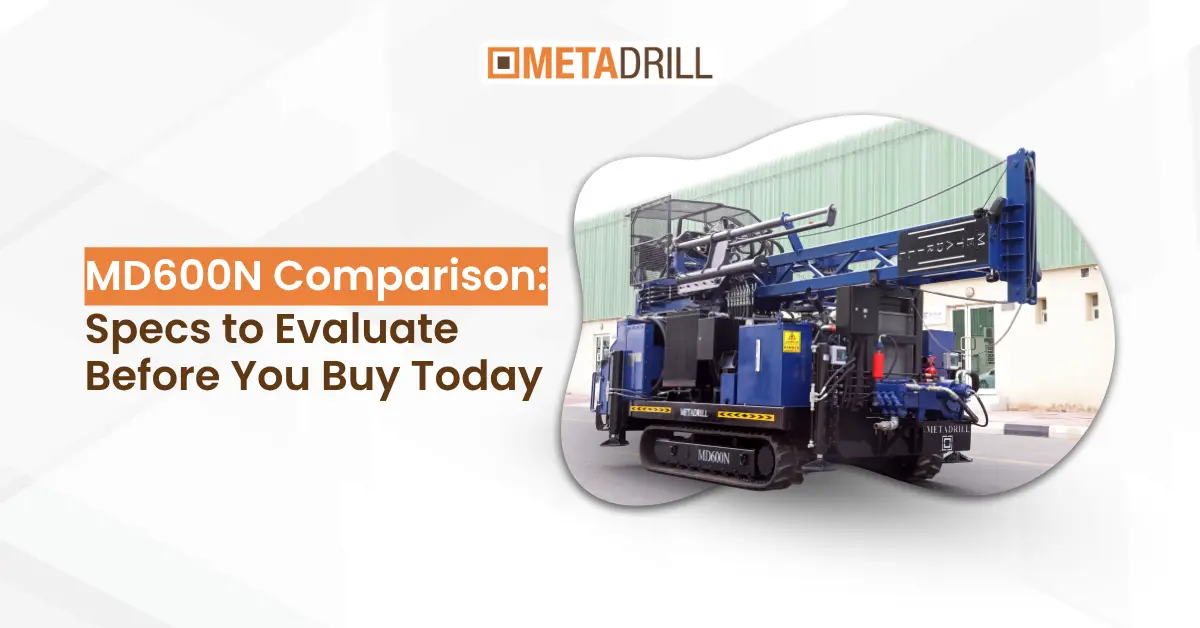
MetaDrill’s current brochure lists the MD600N as a geotechnical and water-well rig for surface exploration. It is rated for PQ to 250 m, HQ to 400 m and NQ to 600 m under suitable conditions, with 3 m rod handling and an optional automatic SPT hammer.

That combination explains why buyers looking for an MD600N for sale may be considering both geotechnical and exploration drilling. It has more depth and pullback capability than a compact site-investigation rig while retaining the ability to support SPT-based geotechnical programs.

The practical question is utilization. If most holes stop at 20 or 30 m, the MD600N may be more machine than you need. If the business regularly moves into deep core work, water wells or exploration, that additional envelope can become commercially useful.

MD1000N: when deep coring becomes the job

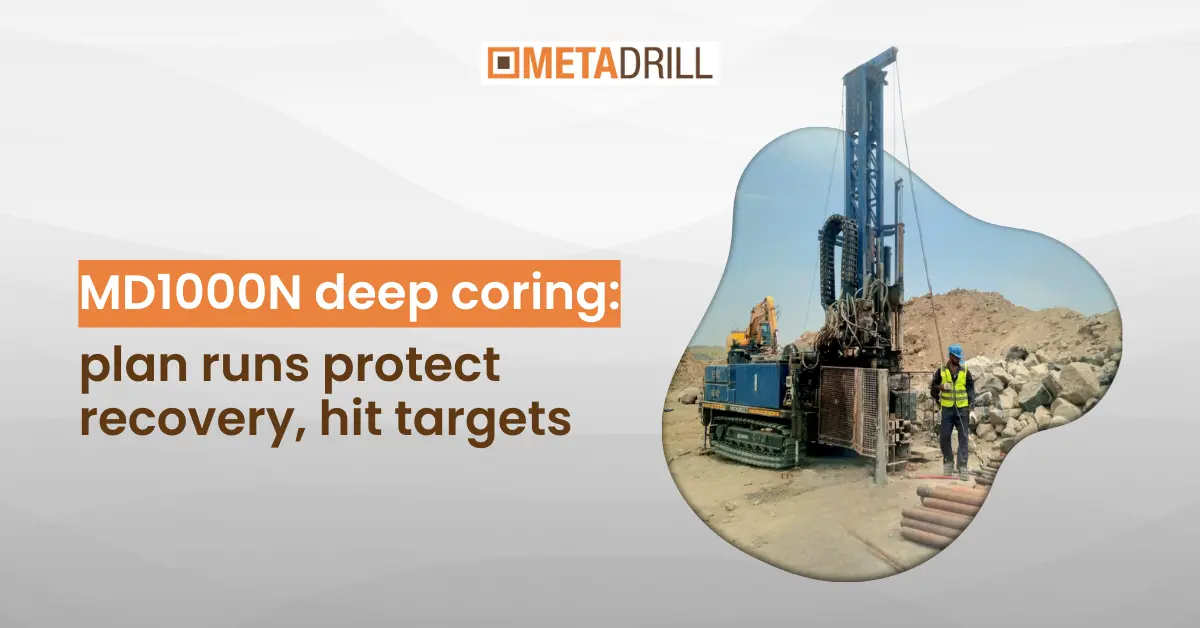
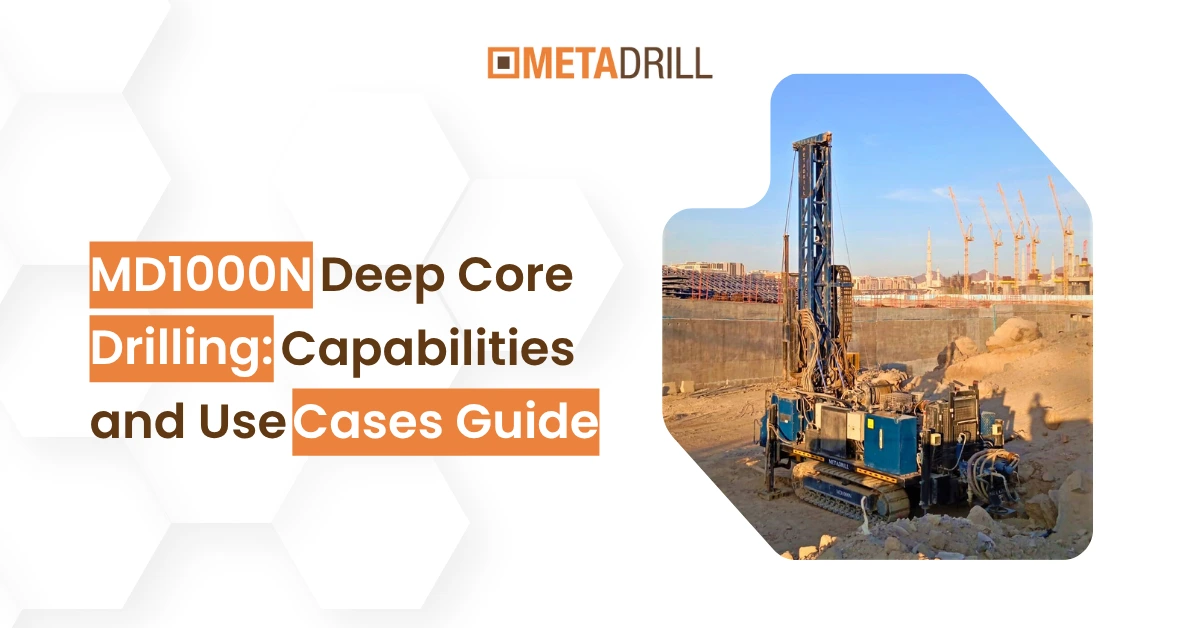
The MD1000N is the heavier deep-capacity option in the current lineup. MetaDrill’s brochure rates it to PQ 400 m, HQ 600 m and NQ 1,000 m under suitable conditions, with a 256 HP prime mover and 12,000 kgf pull-up capacity.

That puts the machine into a different operating category from compact urban rigs. Long exploration holes, deep geotechnical coring and water-well programs place more emphasis on stable feed, rod handling, pullback and the ability to keep production moving as the string becomes heavier.

Exploration drill rigs also spend longer on each setup, so maintenance access and support become crucial. A deep rig that stops for a small unavailable part can strand an expensive crew and support spread.

What about coastal and marine work?

A desert-focused fleet still needs to think about Dubai’s coast. Reclaimed developments, ports and waterfront infrastructure can involve high groundwater, saline exposure and soft access conditions. Crawler stability and a controlled drilling system are important, but maintenance changes too.

After coastal work, rigs should be cleaned carefully to reduce salt-related corrosion around fasteners, electrical connectors and hidden surfaces. Pumps, casing and borehole-support equipment should be configured for unstable saturated materials where needed.

The useful point is that one UAE fleet can see both extremes in the same month: dry desert dust inland and saline moisture at the coast. Equipment design and maintenance routines need to cope with both.

Buying for the GCC, not only Dubai

MetaDrill’s website highlights projects and users in Saudi Arabia as well as the UAE. That reflects the way regional contractors operate. A rig bought in Sharjah may end up working on a Saudi infrastructure program, an Omani investigation or a remote exploration site.

When comparing geotechnical drilling rigs for sale, GCC buyers should look at transport, parts support, operator training and remote troubleshooting. MetaDrill states that its rigs can incorporate GPS, power-unit monitoring and CCTV, and that it supports customers through spare-parts availability and technical guidance.

The best model in the lineup is therefore not a universal answer. The MD40 may be the productivity choice for compact access, while MD600N or MD1000N may suit deeper exploration drill rigs requirements. Match the machine to the work, then make sure the service system can follow it wherever the next GCC contract takes you.

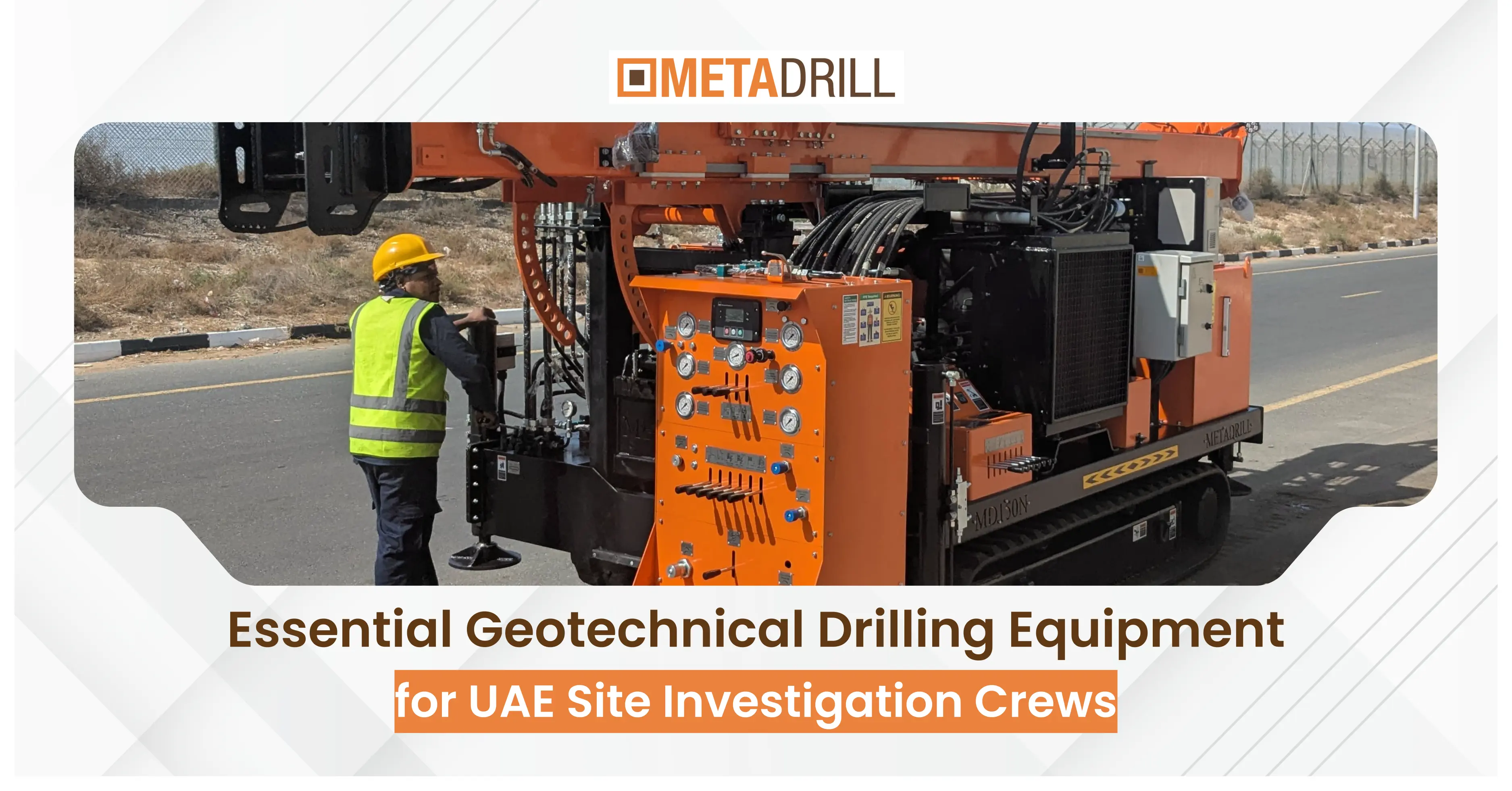
Essential Geotechnical Drilling Equipment for UAE Site Investigation Crews

A drilling crew can lose half a shift because of one missing crossover. Anyone who has worked on site knows the feeling: the rig is ready, the borehole location is cleared, the consultant is waiting—and a small tool that nobody checked is still in the yard.

That is why geotechnical drilling equipment in the UAE should be planned as a complete field system, not as a rig plus whatever fits on the support truck. Heat, dust, long travel between sites and coastal conditions make weak preparation expensive. The core equipment needs to drill and sample accurately, while the support gear needs to keep the crew safe and productive when conditions change.

The following is not meant to be a warehouse inventory. It is the practical equipment stack I would expect a UAE site investigation crew to think through before mobilization.

The rig is the center of the spread—but not the whole spread

The geotechnical drill rig has to match the drilling methods, expected depths and access constraints. Compact equipment may be better for villas, urban plots and restricted basement sites. Larger machines are more appropriate when deep coring, heavier casing or longer rod strings dominate the program.

MetaDrill’s UAE lineup currently includes the MD40, MD75N, MD150N, MD600N and MD1000N. Buyers looking at geotechnical drilling rigs for sale should select around actual hole profiles rather than simply choosing the highest capacity available.

Once the rig is chosen, the rest of the drilling rig equipment should be matched to it. Pumps, rods, casing and tooling that are poorly sized for the machine create bottlenecks even when the rig itself has more than enough power.

SPT equipment deserves proper attention

For many UAE investigations, SPT remains a routine part of the borehole program. The system includes the hammer, rods, sampler and the procedures used to prepare the hole and record blows. Automatic SPT systems can reduce repetitive manual work and improve consistency, but calibration and maintenance still matter.

MetaDrill lists an automatic SPT hammer as an optional feature on its MD600N and MD1000N. Whatever system is used, crews should keep the equipment clean, inspect wear points and maintain calibration records in line with the project’s specified standard.

A bent rod, damaged sampler or poorly maintained hammer can undermine the value of a test that looks perfectly normal on a field sheet. That is why the small items around the rig deserve the same discipline as the machine itself.

Rods, casing and core tooling should be organized like critical assets

Drilling rig tools take a beating. Rod threads, casing shoes, core barrels, bits and adapters move through abrasive ground, water and drilling fluids all day. When they are thrown into a truck without inspection or identification, small damage becomes tomorrow’s downtime.

A strong crew separates serviceable and suspect tooling, protects threads, records wear and keeps the common crossovers easy to find. For exploration or rock-coring work, core barrels, reaming shells and bit selection should be planned around the formation rather than carried as a random mix.

On coastal projects, rinse salt-contaminated drilling rig tools and equipment before storage. In desert work, protect clean threads from blowing sand. These are simple habits, but they extend tooling life noticeably.

Pumps, water management and borehole support equipment

Water is part of many drilling methods, but water management is often treated as an afterthought. The pump needs enough capacity for the selected technique, hoses need to be rated and protected, and the site needs a plan for supply, recirculation and containment.

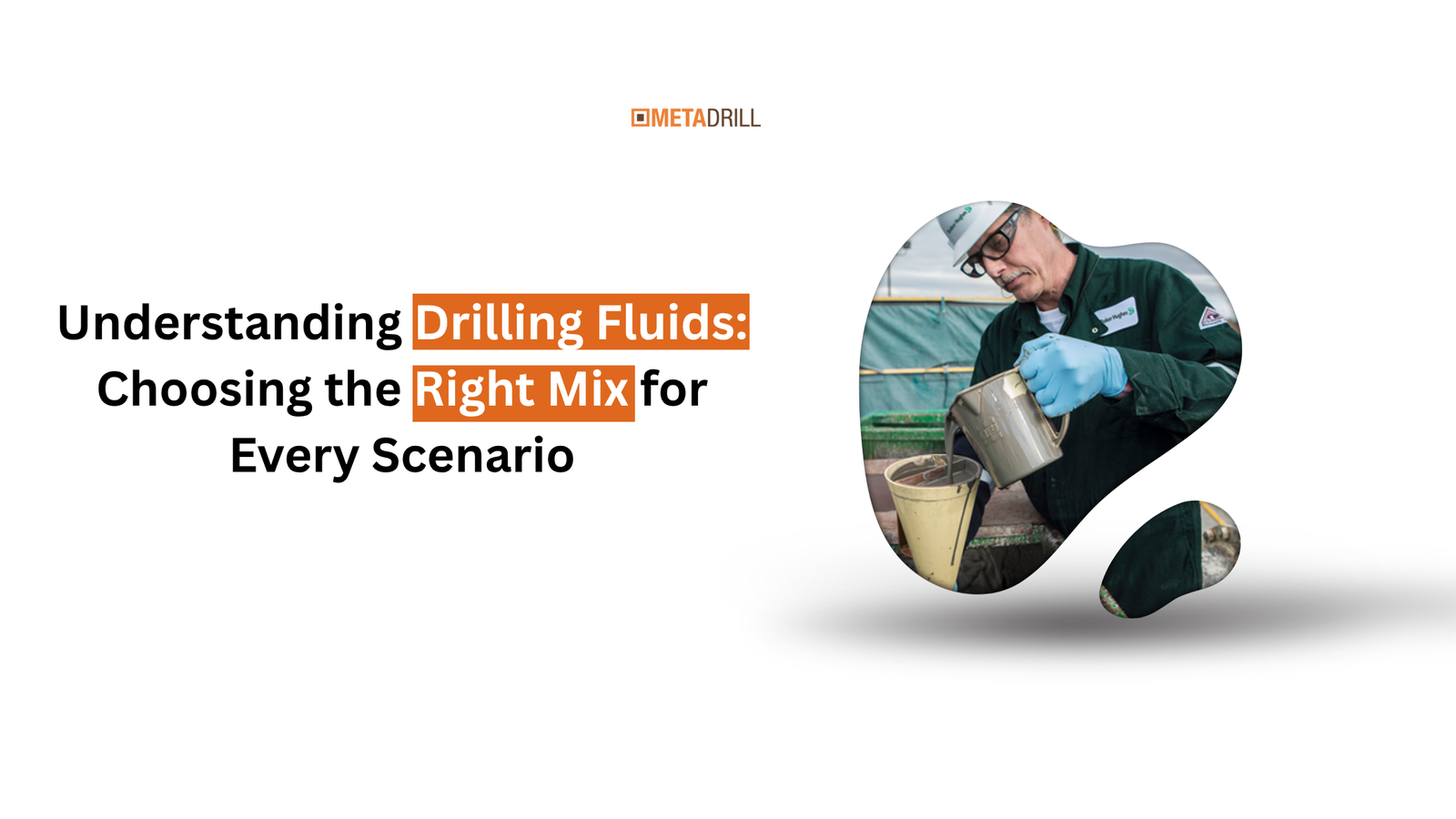
On a remote desert site, the challenge may be getting enough clean water to the rig. On a coastal site, the concern may be containing returns and preventing saline or contaminated water from damaging equipment. If drilling fluids are used, mixing and dosing equipment should be included in the mobilization plan.

For deeper work, pump performance can limit progress long before the rotary head does. That is one reason buyers should look at the complete drilling package rather than comparing rig horsepower alone.

Heat-ready support gear belongs on the equipment list

UAE summer conditions affect both the machine and the crew. Shade, drinking water, heat-stress monitoring, fire extinguishers and appropriate PPE are not accessories. They are part of the operating system.

For the rig, carry the filters, fluids, hoses and common service parts that are most likely to be needed during the program. A clean compressed-air source, pressure-washing equipment and basic diagnostic tools can save hours on dusty sites. Maintenance tools should be organized so operators can complete daily checks without improvising.

Client and authority requirements vary, so HSE equipment should be reviewed against the project method statement, local rules and site induction requirements. A port project in Jebel Ali may expect a different control set from an inland utility investigation.

Do not forget field logging and sample handling

The rig creates access to the ground; the investigation is only useful if the samples and records remain traceable. Crews need sample bags, jars, core boxes, labels, waterproof markers, depth blocks and a disciplined handover process.

Photos should be consistent, and borehole records should capture changes in recovery, groundwater, tooling and drilling behavior. Digital tools can help, but a digital system is only as good as the information entered into it.

This is where supervisors earn their keep. They connect drilling observations with what the engineer sees in the sample. When that loop works, the drilling rig equipment becomes part of a reliable data-production process rather than just a hole-making machine.

You can also check: Marine & Wetland Site Investigation: Drilling Techniques for Coastal UAE Projects

Build a standard UAE mobilization kit

A useful way to reduce missed items is to create a standard mobilization kit for each type of work: urban geotechnical, desert infrastructure, coastal investigation and deep coring. Each kit should have a tool list, consumables list, critical spares and HSE requirements.

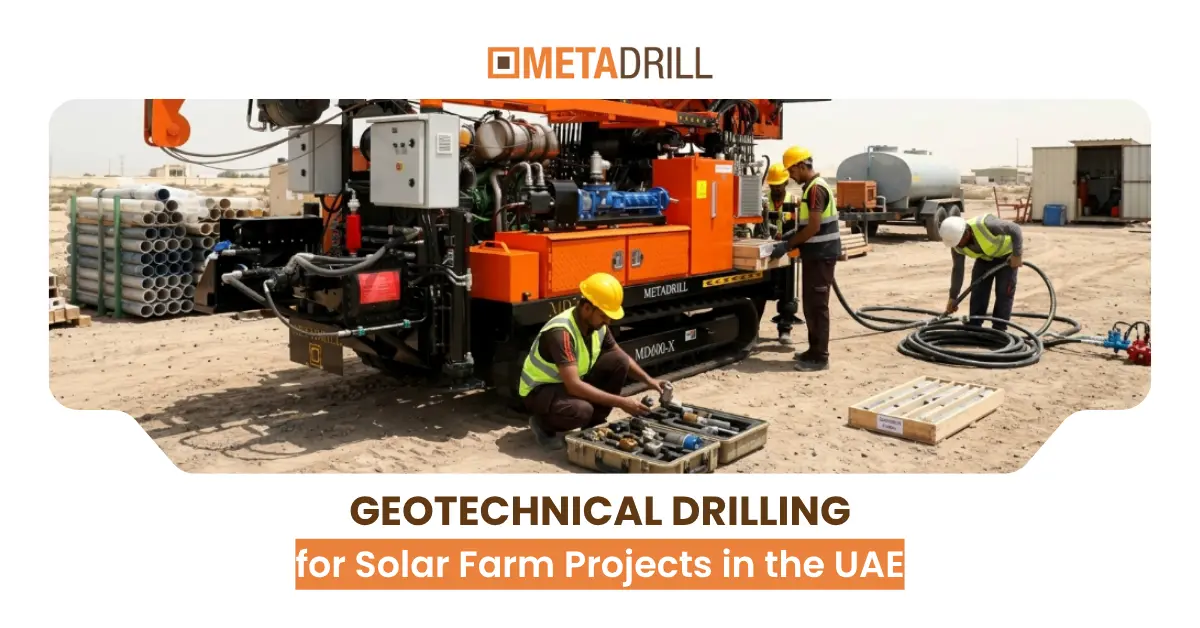
For GCC contractors, standardization also makes cross-border mobilization easier. Saudi, Oman or Qatar projects may have different approvals and site rules, but the core equipment stack can remain consistent while the compliance pack changes.

The best geotechnical drilling equipment UAE crews can carry is equipment they know, inspect and maintain. MetaDrill’s rigs, tools and spare-parts support are designed around that day-to-day productivity. Before the next mobilization, do not only ask whether the rig is ready. Ask whether the entire spread is ready to finish the borehole without coming back to the yard.

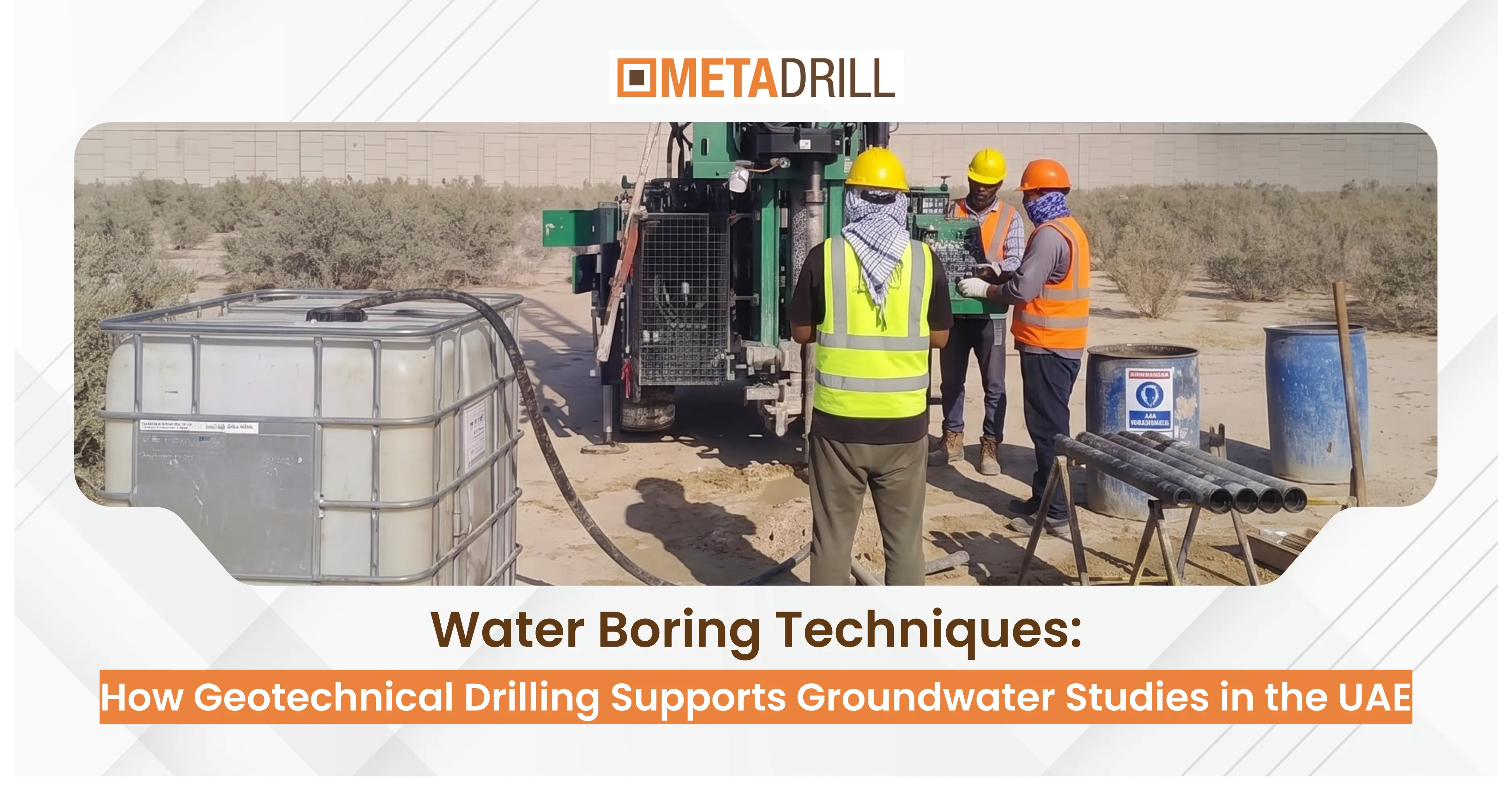
Water Boring Techniques: How Geotechnical Drilling Supports Groundwater Studies in the UAE

Groundwater is easy to underestimate in the UAE because the landscape looks dry. Then a contractor opens a deep excavation near the coast and water appears almost immediately. Or an inland infrastructure project encounters a water-bearing layer that changes dewatering plans, foundation assumptions and construction sequencing.

Groundwater studies in the UAE are therefore not only about finding water. They help engineers understand where groundwater sits, how it moves, how levels change over time and what its chemistry may mean for construction or environmental decisions. Geotechnical drilling provides the physical access needed to collect much of that information.

The drilling technique matters. A poorly constructed monitoring bore can create misleading readings, connect separate aquifers or clog before the study is complete. The objective should always guide the hole.

Start with the question the groundwater study needs to answer

A groundwater investigation for a basement excavation is different from a regional hydrogeological study. One may focus on shallow water level and expected inflow; another may need deeper stratigraphic information, aquifer testing or water-quality samples.

Before geotechnical drilling starts, the team should define target depth, expected geology, monitoring period and the type of data required. That determines borehole diameter, drilling method, casing, screen interval and whether temporary observations or permanent monitoring wells are needed.

This planning is especially important in the UAE, where coastal aquifers can be saline and inland groundwater conditions may vary significantly with geology and development history.

Common boring approaches for groundwater work

Rotary drilling is widely used when the investigation needs to advance efficiently through mixed formations. Depending on the ground, water, air or drilling fluid may be used to remove cuttings and stabilize the hole. In loose formations, casing may need to advance with the borehole to prevent collapse.

For shallow work, auger-based methods can sometimes provide a relatively clean approach, particularly where groundwater is not too deep. In harder rock, core drilling may be required to understand fractures and identify water-bearing zones.

The right geotechnical drilling equipment is the system that produces the information the hydrogeologist needs without unnecessarily disturbing the formation. Speed matters, but not at the expense of a usable monitoring point.

Monitoring wells need careful construction

Once the target interval is reached, a groundwater monitoring installation typically relies on screen and casing placed at the required depth, with suitable filter material and seals used to isolate the monitored zone. The exact design should follow the project specification and the hydrogeologist’s requirements.

Development after installation is important because drilling can introduce fines into the surrounding formation. A poorly developed well may yield cloudy samples or respond slowly to changing groundwater levels.

Field teams should record installation depths, materials, screen interval, groundwater observations and any unexpected loss or inflow during drilling. Those notes can be as valuable as the final water-level reading when the data is interpreted later.

Coastal UAE groundwater brings salinity and corrosion into the picture

Dubai and Abu Dhabi coastal projects often deal with shallow saline groundwater. That affects drilling equipment, sampling materials and the interpretation of water chemistry. It can also influence foundation durability and dewatering strategy, which is why dependable groundwater data matters early in design.

Rigs working near the coast should be cleaned after saline exposure, and monitoring-well materials should be selected for the intended chemistry and study duration. If water samples are required, the team must avoid introducing contaminants through dirty hoses, lubricants or unsuitable containers.

Marine and reclaimed projects can also have variable fill over natural deposits. A groundwater reading from one layer should not automatically be assumed to represent the entire site. Proper sealing and screen placement are critical.

Desert sites create a different set of problems

Inland groundwater studies may involve long distances between boreholes, limited water supply for drilling and extreme heat. Site logistics become part of the technical plan. A rig that needs constant external support can lose productivity when the nearest service point is hours away.

Cooling systems, filters and hydraulic components need close attention during summer. Crews also need heat-stress controls and safe working arrangements in line with UAE requirements and client HSE rules.

For deep programs, machine capacity becomes more important. MetaDrill’s brochure lists the MD1000N rig as a geotechnical and water-well platform for surface exploration, with an NQ depth rating up to 1,000 m under suitable conditions. A buyer searching for an MD1000N rig for sale should still verify the actual groundwater program, rod size, pump requirements and formation before assuming that maximum depth equals ideal operating depth.

Pumping tests and water quality need good boreholes first

A pumping test can only be as reliable as the well used to conduct it. If the screen is placed poorly, the bore is not developed or separate water-bearing zones are connected, the drawdown response may be difficult to interpret.

The same is true for water-quality sampling. Purging, stabilization, sample handling and field measurements should follow the project’s defined procedure. The drilling contractor may not be responsible for laboratory interpretation, but the way the borehole is drilled and completed directly affects sample quality.

That is why groundwater work sits between geotechnical drilling and hydrogeology. The rig provides access, while the investigation design turns that access into defensible data.

You can also check: What Sets a Trusted Geotechnical Drilling Company in Dubai Apart

Regulatory and GCC context

Groundwater abstraction, dewatering, discharge and environmental monitoring can be regulated differently depending on the emirate, authority and project location. Contractors should check the applicable municipality, environmental authority, developer, free-zone or client requirements before drilling, pumping or discharging water. The same applies to projects elsewhere in the GCC; permits and environmental controls are not interchangeable between countries.

For equipment buyers, regional support also matters. A groundwater rig may travel from a Dubai project to Saudi Arabia or Oman, where the cost of a failed pump or unavailable seal can exceed the saving from a cheaper machine. Geotechnical drilling rigs for sale should therefore be evaluated on serviceability and parts availability as well as depth.

MetaDrill manufactures its rigs in Sharjah and supports geotechnical, exploration and water-well applications. For groundwater studies UAE teams should begin with the study objective, then select the rig and tooling around the data required. A borehole is only useful when it tells the right story about the water below it.

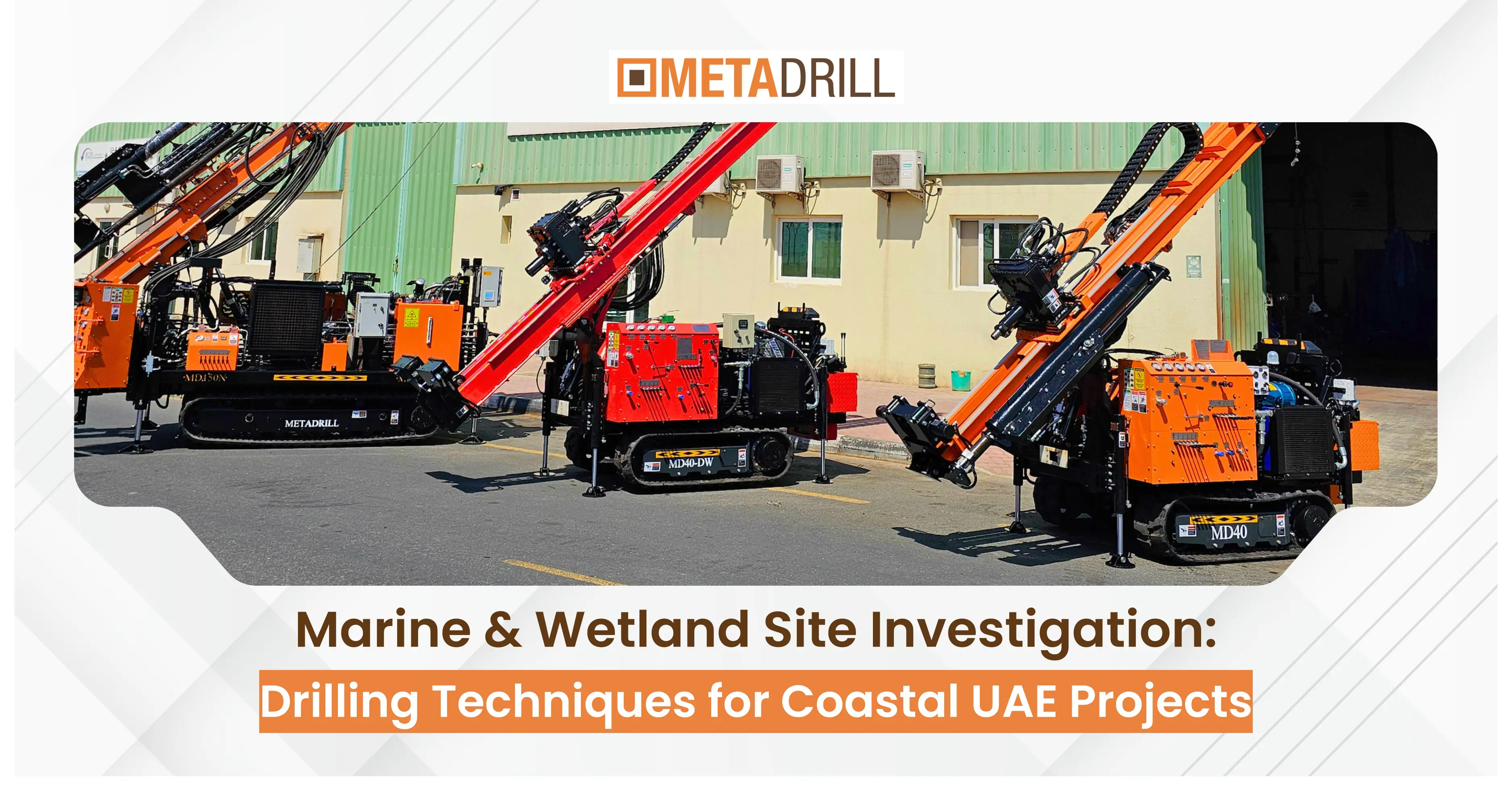
Marine & Wetland Site Investigation: Drilling Techniques for Coastal UAE Projects

Coastal ground can be deceptive. A site may sit only a few hundred metres from a completed waterfront development, yet the subsurface profile beneath it can change from loose reclamation fill to carbonate sand, soft layers, cemented horizons and shallow groundwater within a short distance.

That variability is why marine and wetland site investigation in the UAE deserves its own drilling strategy. The objective is not simply to reach a target depth. The team has to preserve borehole stability, recover representative samples and work safely around water, soft access conditions and saline exposure. The geotechnical drilling equipment selected for coastal UAE work needs to support that process rather than fight it.

From Dubai’s ports and artificial islands to Abu Dhabi’s waterfront infrastructure, coastal investigations reward careful planning. The rigs, casing, fluids, platforms and sampling systems all have to work as one spread.

Why coastal UAE ground is different

Many UAE waterfront projects are built on or near reclaimed land. Reclamation can create highly variable fill, while natural coastal deposits may include loose sands, silts, shells and weak carbonate materials. Groundwater is often shallow, and salinity can influence both field operations and long-term equipment care.

For geotechnical drilling, the immediate challenge is keeping the borehole open long enough to obtain useful data. In loose saturated sand, an unsupported hole may collapse quickly. That affects sampling depth, SPT quality and the ability to advance casing cleanly.

Site investigation services therefore need a method selected around the expected ground profile. A standard dry-land approach may work for the first few metres and then become inefficient once groundwater or unstable material is encountered.

Casing and drilling fluids are often the quiet heroes

On unstable coastal ground, casing is not an inconvenience; it is part of the investigation system. Advancing casing as the borehole progresses can isolate loose zones and reduce collapse. Depending on the formation and investigation objective, rotary wash methods or carefully selected drilling fluids may also help carry cuttings and support the hole.

The choice of fluid needs to respect sample quality and environmental requirements. The team should know what the consultant intends to test in the laboratory before selecting additives. Over-treatment can alter the material being investigated, while under-supporting the hole may lead to repeated collapse.

This is a good example of why geotechnical drilling equipment should be considered as a package. Pump capacity, casing tools, rods and the rig’s feed control all influence whether the method works smoothly.

SPT and sampling need extra discipline in saturated material

SPT is common in site investigation, but the test is only useful when the borehole is properly prepared and the procedure follows the applicable project standard. In loose, saturated sands, poor hole cleaning or heave can distort results. Experienced crews monitor the bottom condition and avoid treating the SPT as a simple production task.

Undisturbed sampling can be even more sensitive. Soft marine deposits may require suitable thin-wall or specialized samplers, careful handling and fast transfer to protect moisture condition. Rock or cemented layers call for a different approach again.

Good site investigation services should be able to explain how they will switch methods when the profile changes. Coastal geology rarely rewards a rigid plan.

Rig selection depends on the working platform

A crawler-mounted rig can be ideal on prepared coastal fill, but wetlands, soft ground or barge work introduce new constraints. Ground bearing pressure, platform stability, lifting points, access routes and tidal conditions can all influence the machine choice.

For short programs, drill rig rental or drilling equipment rental may make more sense than mobilizing a large owned rig from another emirate. The rental decision should still be technical: the machine needs the right torque, feed, mast, pump and tooling for the expected ground.

When reviewing geotechnical drilling rigs for sale for a fleet that regularly works on marine projects, I would give extra weight to corrosion-resistant details, easy wash-down, protected electrics, hose organization and parts support. Salt has a habit of finding every neglected surface.

Heat and salt are a difficult combination

Coastal UAE drilling is not cooler simply because the sea is nearby. Summer heat remains severe, and high humidity can make working conditions harder for crews. Hydraulic cooling, engine airflow and scheduled breaks need to be planned together.

Salt exposure adds long-term maintenance risk. At the end of a shift, cleaning should focus on joints, fasteners, electrical connectors, track assemblies and areas where saline water can sit. Protective coatings help, but they do not replace housekeeping.

The practical rule is simple: inspect more often than you would on a dry inland project. A small corrosion point caught early is cheap. A seized connection discovered during mobilization is not.

Environmental and local project controls cannot be an afterthought

Marine and wetland work often sits inside sensitive or tightly controlled zones. Port operators, free-zone authorities, developers and local government entities may each impose access, HSE, spill-control, waste and working-hour requirements. The exact rules depend on the project, so the drilling method statement should be checked against the relevant authority and client documentation before work begins.

Fluid containment, fuel handling and disposal of drilling returns deserve special attention near water. The fact that a product is commonly used in drilling does not automatically make unrestricted discharge acceptable. Contractors should plan containment and disposal routes before the first borehole.

For GCC projects outside the UAE, the same mindset applies: local environmental approvals and client specifications should lead the method. Do not assume a Dubai procedure can be copied unchanged into Oman, Qatar or Saudi Arabia.

You can also check: New vs Used Geotechnical Drill Rigs for Sale in Dubai: A Buyer's Guide

Building a coastal-capable equipment strategy

Teams that regularly work near the coast benefit from standardizing a coastal kit: casing systems, pumps, spill-control equipment, wash-down gear, corrosion-protection materials, sampling consumables and a defined inspection routine. That reduces the number of decisions made under pressure on site.

MetaDrill manufactures geotechnical drilling equipment in Sharjah and offers a range from compact rigs to deeper-capacity MD600N and MD1000N platforms, along with tools, parts and support. For a coastal fleet, the best model depends on borehole depth, access, sampling method and whether the same machine will also work on inland or exploration programs.

Marine site investigation is rarely won by brute force. It is won by control: stable holes, clean samples, disciplined maintenance and a rig package that suits the platform. For coastal UAE projects, that combination is what turns difficult ground into reliable engineering information.

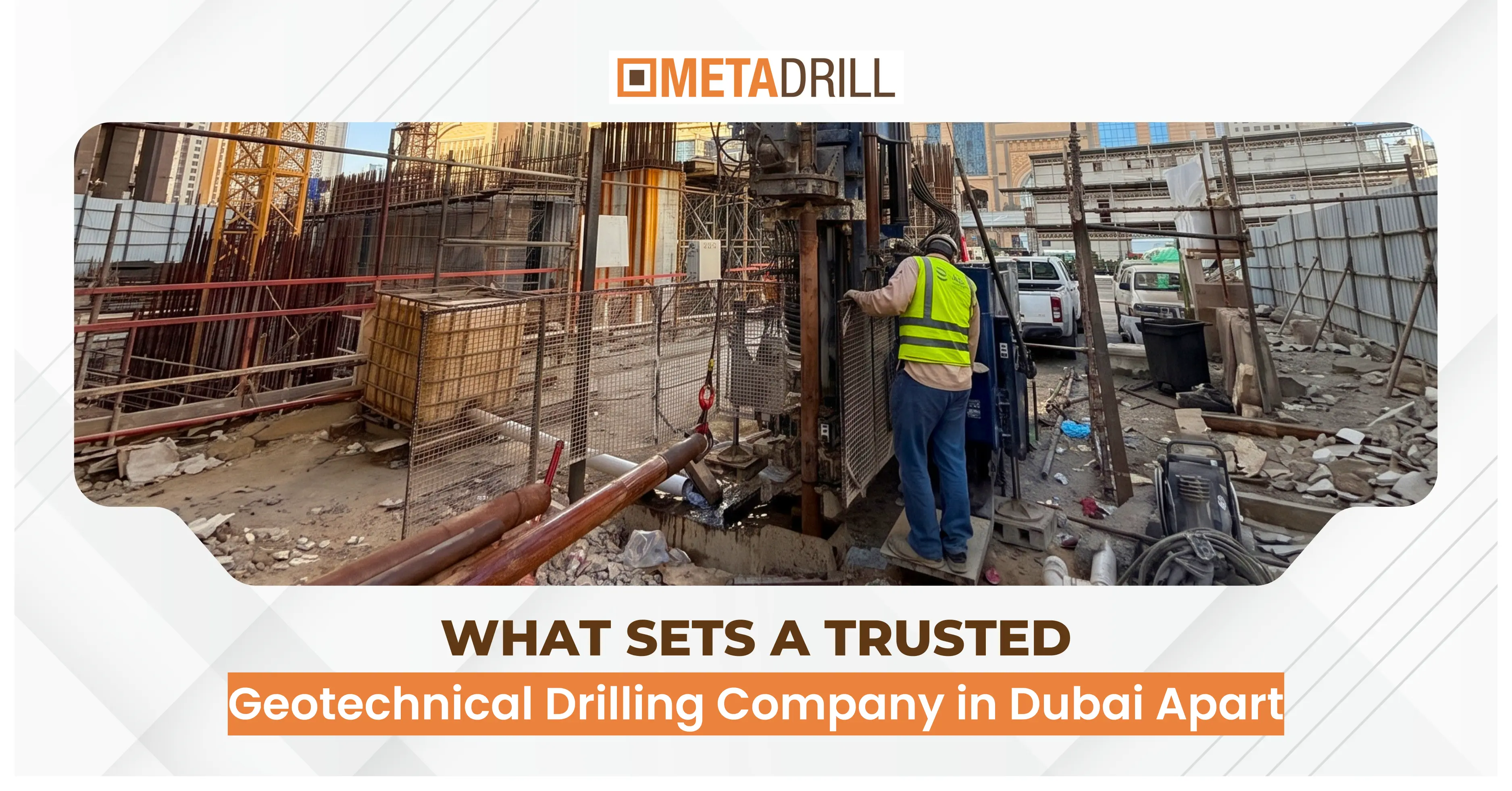
What Sets a Trusted Geotechnical Drilling Company in Dubai Apart

A site investigation can look routine right up until the first borehole refuses to behave. Loose fill collapses, groundwater rises, access changes, or the consultant asks for a different sampling method after seeing the first recovery. That is the moment when the difference between a drilling supplier and a dependable drilling partner becomes obvious.

A trusted geotechnical drilling company in Dubai is not defined by how many rigs are parked in its yard. The stronger test is how the team responds when field conditions stop matching the plan. Can they protect sample quality? Can they adapt the method without compromising safety? Can they explain delays clearly and keep the consultant informed? And do they have the geotechnical drilling equipment and technical support to recover productivity quickly?

For UAE projects, those questions matter because drilling teams work across extreme heat, desert sites, coastal developments, live construction zones and tightly controlled infrastructure locations. Reliability is a system, not a slogan.

Good companies plan the borehole before starting the engine

The best drilling teams begin with the investigation objective. They review the expected geology, borehole depths, test schedule, access constraints, groundwater risk and required samples before mobilization. That sounds basic, but it is often where project performance is won or lost.

If the work is in dense urban Dubai, mobilization may depend on restricted access, traffic windows and small working pads. On a desert project, the concern may be crawler stability, water supply and long travel between boreholes. Coastal investigation brings different questions around casing, groundwater, saline exposure and working-platform stability.

A capable contractor does not arrive with one method and force it onto every hole. Geotechnical drilling should be adjusted to the ground and the data the engineer needs.

Equipment condition tells you a lot about the company

Look at the rigs. Not the paint—the maintenance culture. Clean hose routing, intact guards, clear identification, organized tooling and documented inspections usually indicate a company that takes uptime and safety seriously.

Modern geotechnical drilling equipment can also improve consistency. Automatic SPT systems, digital monitoring, CCTV and better control layouts can reduce repetitive work and help supervisors see what is happening on site. MetaDrill, for example, manufactures rigs in Sharjah and promotes operator-friendly maintenance, remote monitoring and parts support as part of its design philosophy.

Ownership is not the only route. Some contractors use drill rig rental or drilling equipment rental to add capacity for a short program. That can work well, but rented equipment should be inspected to the same standard as owned machinery. A rented rig that arrives with maintenance problems is still your schedule problem once it is on site.

A trusted driller protects data quality, not just production

Meters drilled are easy to count. Useful samples are harder to earn. A geotechnical company should understand why the consultant needs the sample, how disturbance affects interpretation and when a change in technique is necessary.

For SPT, that means attention to the test sequence, equipment condition and applicable project standard. For rock coring, it means protecting recovery and documenting changes in formation. For groundwater observations, it means avoiding shortcuts that make later readings unreliable.

This is where experienced drillers stand out. They know when faster penetration is actually making the investigation worse. A crew that can drill ten extra meters but damages recovery may create re-drilling, laboratory uncertainty and design questions that cost the project much more than the time saved.

Dubai heat is a management issue as much as a machine issue

High summer temperatures affect people and equipment at the same time. A serious contractor plans work-rest cycles, hydration, shade and heat-stress controls in line with applicable UAE requirements and client HSE procedures. The company also adjusts maintenance because hydraulic temperature, filters, cooling systems and hoses need closer attention in dusty, hot conditions.

Watch how a team behaves at 2 p.m., not only during a morning site visit. Are daily inspections still being completed? Is the machine kept clean enough for leaks to be visible? Are crews rushing rod handling because everyone is overheated? Those observations tell you far more about safety culture than a framed certificate in the office.

Local rules and project requirements can vary between Dubai Municipality areas, free zones, ports and major developers, so a trusted company should be comfortable working within different permit, access and HSE systems.

Coastal capability should be proven, not assumed

Dubai’s growth along the coast has created a steady need for investigations on reclaimed land, waterfront developments and port-related sites. These jobs can involve soft fills, shallow groundwater and saline conditions that are less forgiving than a dry inland plot.

A contractor claiming marine capability should be able to explain how it manages borehole stability, casing, flushing, sample recovery and equipment cleaning after salt exposure. If work is from a barge or temporary marine platform, lifting plans, anchoring, access and emergency procedures become part of the drilling operation.

The right geotechnical drilling company Dubai consultants can rely on should be comfortable discussing these issues before mobilization. If every answer is 'we will see on site,' that is a warning sign.

Commercial transparency matters in the GCC buying context

Technical competence is only half the relationship. Procurement teams need clear scope boundaries, equipment rates, standby rules, consumable assumptions and a process for variations. This is especially important when a Dubai contractor is working across the GCC, where logistics and mobilization costs can change quickly.

If the company also sells geotechnical drilling rigs for sale or supplies rental equipment, ask how commercial recommendations are separated from technical needs. A trustworthy supplier should be willing to say when a smaller rig, a rental unit or a different method is the better choice.

I would also ask about response time for spare parts, backup equipment and technical support. On a multi-rig investigation, a company with a credible contingency plan is worth more than a low day rate with no backup.

You can also check: How to Choose the Right Geotechnical Drilling Rig for Projects in the UAE

The signs I would look for before awarding work

You do not need a 40-point checklist. Look for a few hard signals: competent supervisors, well-maintained equipment, method statements that reflect the actual site, clear HSE practice, traceable field records, realistic scheduling and straightforward communication when conditions change.

Then speak to the people who will actually run the work. A polished proposal is useful, but the driller and site supervisor will determine whether the boreholes produce defensible data on time.

A trusted geotechnical drilling company in Dubai earns confidence through repeatable field performance. MetaDrill’s role in that ecosystem is primarily as a UAE manufacturer and equipment partner, supplying rigs, tools, parts and support to drilling teams. Whether you own, purchase or use drilling equipment rental, the principle is the same: good people need dependable equipment, and dependable equipment needs disciplined people.

New vs Used Geotechnical Drill Rigs for Sale in Dubai: A Buyer's Guide

A used drill rig can look like a bargain in the yard. Fresh paint, a clean control panel and a price that leaves room in the budget are hard to ignore. Six weeks later, though, the real condition of the machine may start to show: tired hoses, heat-stressed seals, worn rod-handling components or a cooling system that struggles through a Dubai afternoon.

That does not mean used equipment is a bad purchase. Far from it. For the right contractor, a well-documented used rig can be a smart way to add capacity quickly. The problem is that buyers often compare the purchase price while ignoring the risk profile behind it.

If you are reviewing geotechnical drill rigs for sale in Dubai, the new-versus-used decision should be based on utilization, site conditions, maintenance history and the value of predictable uptime. In the UAE, where heat, dust and project schedules are unforgiving, those factors can turn a cheap machine into an expensive one surprisingly fast.

When a new rig usually makes more sense

New geotechnical drilling equipment is easiest to justify when the rig will be a core production asset. If your crew expects to run it most days of the month, downtime has an obvious revenue cost. Warranty coverage, known service intervals and a clean maintenance baseline reduce uncertainty during the years when the machine is working hardest.

New equipment also gives buyers more control over configuration. A contractor focused on compact urban investigations may prioritize a smaller footprint and easy mobilization; teams doing deeper geotechnical drilling may need stronger pullback, longer rod handling or an automatic SPT option. Buying new allows those choices to be made before the machine reaches site instead of retrofitting later.

For companies comparing a compact MD40 drill rig or another MetaDrill rig for sale, the benefit is not simply that the machine is new. It is that the configuration, training and support can be aligned with the crew from day one.

Where used equipment can be the better commercial move

Used rigs make sense when utilization is uncertain, the project duration is short, or the buyer has a strong internal workshop capable of managing repairs. A contractor that needs a second machine for seasonal demand may not want to tie up the same capital required for a new purchase.

There is also a practical advantage when a used rig is already located in the GCC. Mobilization may be faster, and the buyer can inspect the actual machine before committing. For a smaller company entering geotechnical drilling, that can be attractive.

The key phrase is 'actual machine.' A used-rig purchase should be treated like an engineering inspection, not a marketplace transaction. Hours alone do not tell the story. Two rigs with identical meter readings can have very different histories depending on operator habits, formations drilled, heat exposure and maintenance discipline.

Dubai climate makes inspection more important

Extreme summer temperatures accelerate the consequences of weak maintenance. Hydraulic hoses harden, seals age, batteries suffer, and cooling systems that have not been cleaned properly lose effectiveness. Fine airborne sand can also increase wear where filtration and daily housekeeping have been neglected.

When inspecting used geotechnical drilling rigs for sale, start the machine from cold if possible. Watch oil temperature, listen to the hydraulic system under load and check for leaks after the machine is warm. Inspect radiator and cooler condition, hose date codes, cylinder rods, mast wear points, rotary-head play and track components. Ask for oil-analysis records if the seller has them.

On a UAE machine, I would also look closely at evidence of improvised repairs. A neat temporary fix is still a temporary fix. If wiring, hose routing or guards have been modified repeatedly, the rig may carry hidden downtime into your next project.

Coastal history deserves its own questions

A rig that has spent years on marine or waterfront projects may have seen more salt exposure than a machine used inland. Saline mist, wet decks and reclaimed-ground operations can accelerate corrosion, especially around fasteners, electrical connections and areas that crews do not wash regularly.

Ask where the machine has worked. If it supported projects around ports, marinas or coastal reclamation, inspect for corrosion beneath panels and around hose fittings rather than judging only visible paintwork. A well-maintained coastal rig can still be an excellent purchase, but its cleaning history matters.

This is also relevant to future work. If your own project pipeline includes Jebel Ali, Dubai Harbour, Abu Dhabi waterfront developments or other coastal sites, make sure the machine can be cleaned and serviced easily after exposure to saline conditions.

Check documentation, compliance and support before price

A used rig should come with more than an invoice. Buyers need maintenance records, parts history, manuals, safety documentation and clear identification of any modifications. Depending on where the rig will operate, client HSE systems, municipality or free-zone requirements, port access procedures and consultant specifications may all influence acceptance on site.

For GCC operations, parts availability is equally important. A low purchase price loses its appeal if a critical component must wait weeks for overseas shipping. MetaDrill states that its Sharjah operation supports customers with spare parts, training and technical assistance through its regional network. Whether you buy new or used, confirm who can actually support the specific machine and configuration you are considering.

If the rig is being sold by a third party, ask whether the manufacturer will still support it. That answer should affect the price you are willing to pay.

Compare total cost, not sticker price

A simple ownership model is useful. Take the purchase price, then add estimated refurbishment, first-year preventive maintenance, likely wear parts, transport, inspection, operator training and an allowance for downtime. Do the same for the new rig, including finance cost where relevant. Suddenly the comparison becomes much clearer.

For example, a used rig that saves AED 180,000 upfront but requires AED 70,000 of immediate work and loses ten production days during the first year may not be cheaper at all. On the other hand, a carefully maintained unit with verified history and local parts support could deliver excellent value.

The right answer depends on your business. If the rig will carry high-value contracts and missed shifts are costly, new is often easier to defend. If it is a backup machine or your team has strong refurbishment capability, used can be perfectly rational.

A buyer’s final test

Before choosing between new and used geotechnical drill rigs for sale Dubai buyers should inspect, calculate and challenge assumptions. Ask what the machine has drilled, how it was maintained in summer, whether it has worked in coastal conditions, what support is available and how quickly it can be put into productive service.

Do not buy a used rig because it looks cheap, and do not buy a new rig simply because new feels safer. Buy the option that gives your operation the lowest realistic cost per productive drilling day.

If you are considering a new MetaDrill rig for sale or comparing it with an existing used machine, a technical discussion before purchase can help. Share your typical depths, formations and utilization target, then compare the machines on what they will actually do on UAE sites—not just what they cost in the yard.

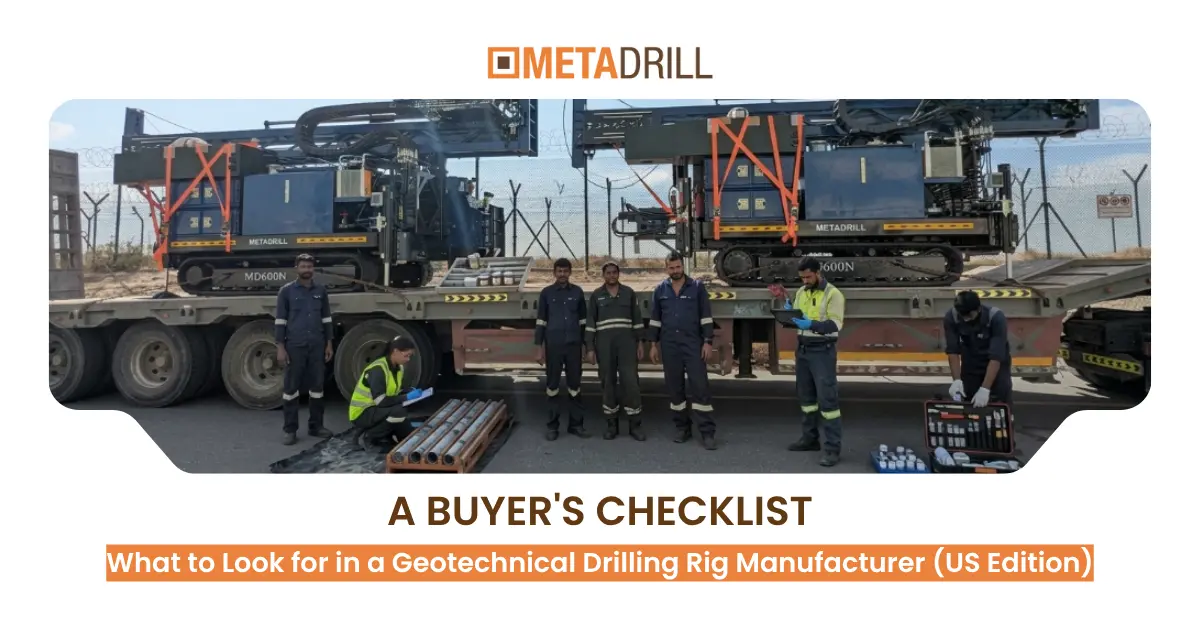
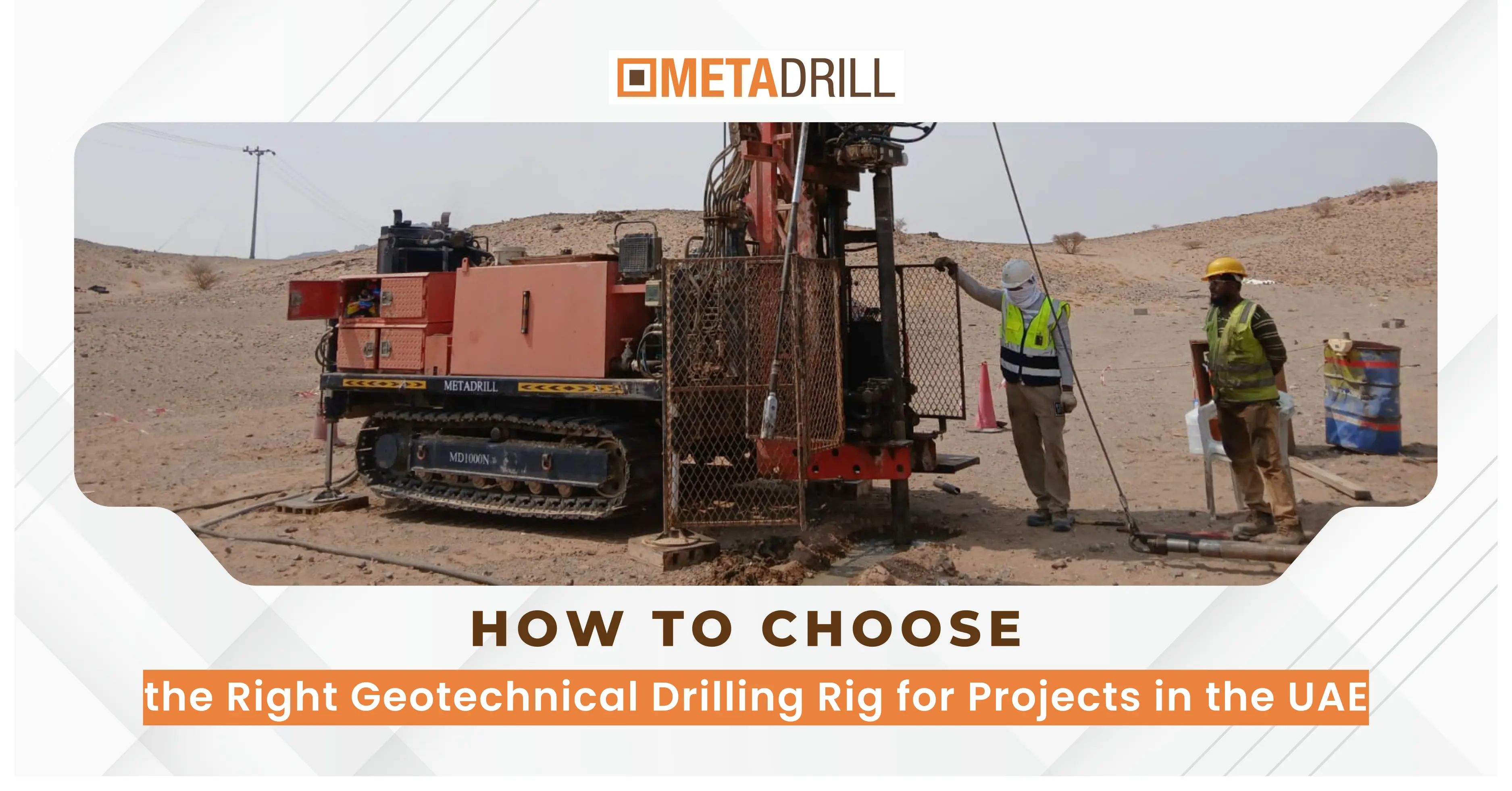
How to Choose the Right Geotechnical Drilling Rig for Projects in the UAE

A rig can look perfect on a specification sheet and still be the wrong machine for the job. That becomes obvious very quickly on a UAE site. A crawler that feels comfortable on a prepared plot in Sharjah may behave very differently on loose desert sand outside Al Ain, reclaimed ground near Dubai’s coast, or a congested foundation site where the crew has only a narrow access gate and a few hours to mobilize.

For contractors and site investigation teams, choosing a geotechnical drilling rig in the UAE is therefore less about buying the biggest machine and more about matching the rig to the work you actually do. Depth matters, of course. So do torque, feed control, rod handling and sampling capability. But in this market, heat management, mobility, maintenance access, spare-parts support and the ability to move between geotechnical drilling and exploration drilling can have just as much influence on lifetime productivity.

A good purchase should make the driller’s day easier, not create a new list of problems for the workshop. Here is how I would evaluate the decision before signing a purchase order.

Start with the ground, not the brochure

UAE geology can change sharply from one project to another. Inland sites may involve loose to dense sands, cemented horizons and variable rock, while coastal and reclaimed projects can introduce shallow groundwater, saturated material and stability challenges. In the Northern Emirates, harder formations can put a completely different load on the rotary head and tooling.

That is why the first question should be practical: what formations do your crews encounter most often? If most work is shallow site investigation with SPT and sampling, your ideal geotechnical drilling equipment will not be the same as a fleet built around long wireline core programs. If the company also bids for exploration drilling, you may want a platform that can handle a broader tooling range and deeper coring without becoming unnecessarily heavy for everyday urban work.

This is also where project records help. Look back at the last 20 or 30 boreholes your team drilled. How deep were they? Where did productivity drop? Which formations caused stuck tooling or repeated rod handling? That history tells you far more than a generic 'maximum depth' number.

Treat Dubai heat and desert dust as design inputs

A machine that spends July and August outdoors in the Emirates works in a harsh thermal environment. High ambient temperatures increase the burden on engines, hydraulic oil, seals and cooling systems. Fine dust adds another layer of stress by loading filters and finding its way into components if inspection routines are weak.

When you compare geotechnical drilling rigs for sale, ask how the cooling package is sized, how easily operators can clean heat exchangers, where filters are located, and whether daily checks can be done without dismantling half the machine. Easy maintenance sounds like a small benefit until a crew is losing two productive hours in 46°C heat because a routine service point is difficult to reach.

For desert terrain, mobility matters too. Crawler stability, ground clearance, machine balance and practical transport dimensions should be reviewed against the sites you actually visit. The best rig is the one that reaches the borehole location safely and starts work without a complicated recovery operation.

Coastal and marine projects change the calculation

Dubai and Abu Dhabi continue to develop waterfront, port and marine infrastructure. On these projects, contractors may be dealing with reclaimed fills, saline environments, high groundwater and limited working platforms. The drilling method, casing strategy and flushing system become important, but the rig itself also needs stable feed control and a layout that crews can operate safely in wet, corrosive conditions.

If marine and coastal work is part of your pipeline, do not buy solely for dry-land projects. Ask whether the rig can be configured for the sampling, coring and support equipment your consultants normally specify. Consider hose routing, exposed components and cleaning requirements after saline exposure. A few extra minutes spent planning wash-down and corrosion prevention can protect a much larger capital investment.

Local authority, port operator and client requirements also vary. Depending on the site, mobilization, access, environmental controls, HSE documentation and testing procedures may need to satisfy Dubai Municipality, Abu Dhabi DMT, free-zone or port requirements as well as project specifications. The rig should fit the work method, not force the method to fit the rig.

Match the rig to the drilling method

Geotechnical drilling is not one technique. A contractor may need SPT, disturbed and undisturbed sampling, rotary wash boring, core drilling or water-well capability. Exploration drill rigs may also need longer rod handling, stronger pullback and a rotary head suited to continuous coring.

MetaDrill’s current range spans the MD40, MD75N, MD150N, MD600N and MD1000N. The company’s brochure positions the MD600N and MD1000N as geotechnical and water-well rigs for surface exploration. The MD600N is rated for deeper wireline work up to 600 m with NQ rods, while the MD1000N extends that envelope to 1,000 m NQ, subject to formation, tooling and operating conditions. Those figures are useful, but they should not be treated as the only buying criteria.

If you are specifically searching for an MD600N for sale, look at your expected hole profile, rod size, transport plan, crew competence and percentage of deep work. A machine with unused capacity can be just as inefficient commercially as a machine that is constantly working at its limit.

Think like a GCC fleet manager, not a one-project buyer

UAE contractors increasingly work across Saudi Arabia, Oman, Qatar and other GCC markets. That changes the buying conversation. A rig purchased for one Dubai contract may later be sent to a remote Saudi project where spare-parts delays cost far more than the price difference between two machines.

Before comparing purchase prices, calculate the cost of ownership. Include consumables, preventive maintenance, expected component life, transport, training, service response and parts availability. MetaDrill is based in Sharjah and states that it supports customers with training, technical guidance, distributor-based parts availability, remote monitoring and CCTV systems. For a regional buyer, that local support structure can be commercially relevant because uptime is what ultimately pays for the rig.

Procurement teams should also ask who will support the machine after commissioning. Will operators receive training? Are service manuals clear? Can common maintenance be handled in-house? Is technical help available when the rig is outside the UAE? Those questions deserve the same attention as torque and horsepower.

Use a simple decision test before you buy

I like to reduce the final decision to four checks. First, can the rig complete at least 80 to 90 percent of your expected work without awkward compromises? Second, can your crew transport, set up and maintain it efficiently? Third, is the local support strong enough to protect uptime? Fourth, does the machine still make sense if your business expands into deeper geotechnical drilling or exploration drilling over the next three to five years?

If two rigs appear similar, ask for a demonstration or test them against a representative drilling cycle. Measure setup time, rod handling, penetration, fuel use, sample quality and operator fatigue. Real field data has a way of cutting through sales language very quickly.

Choosing the right geotechnical drilling rig UAE contractors can depend on is ultimately a balance of capability and practicality. Buy for the ground you drill, the climate you operate in, and the support network you will rely on when the schedule gets tight. MetaDrill’s UAE-made lineup gives regional teams several configurations to evaluate; the sensible next step is to match a model to your borehole program rather than starting with price alone.

Why Compact Drill Rigs Are Ideal for Limited Access Job Sites

Construction projects rarely offer unlimited working space. Contractors often face narrow streets, existing buildings, underground utilities, steep terrain, and restricted work zones. These conditions create significant challenges during ground investigation. Equipment selection becomes one of the most important decisions before drilling begins.

Compact drill rigs solve many of these challenges. Their smaller footprint, efficient design, and excellent mobility allow contractors to complete geotechnical investigations without sacrificing drilling performance. Instead of relying on oversized equipment that requires additional site preparation, many companies choose compact solutions to improve productivity while reducing project delays.

Demand for compact drill rig solutions continues to grow across the UAE. Rapid urban development, transportation projects, utility upgrades, and commercial construction all require drilling equipment that fits into confined locations while delivering accurate soil investigation results.

This article explains why compact drill rigs perform so well on limited access job sites and how contractors benefit from choosing the right equipment.

Limited Access Sites Present Unique Challenges

Every project begins with different site conditions. Urban developments often provide very little room for equipment movement. Existing roads, nearby structures, boundary walls, pedestrian pathways, and underground infrastructure reduce available working space.

Several common challenges include:

·         Narrow access roads

·         Restricted entry gates

·         Low overhead clearance

·         Existing utility services

·         Dense commercial developments

·         Residential neighborhoods

·         Uneven terrain

·         Active construction zones

Large drilling equipment often requires additional planning before mobilization. Site preparation takes longer, transportation becomes more complicated, and setup requires additional space.

Compact drilling equipment removes many of these obstacles.

Smaller Equipment Improves Site Accessibility

Access determines whether drilling begins on schedule.

Many investigation sites only provide limited room for machinery movement. Contractors working inside factories, schools, hospitals, airports, bridges, and urban developments often deal with confined work areas.

Compact rigs enter locations where larger equipment simply does not fit.

This flexibility allows drilling operations to begin sooner. Crews spend less time modifying site access and more time completing investigations.

Projects with multiple borehole locations also benefit because equipment moves quickly between drilling positions.

Faster Mobilization Saves Valuable Time

Project schedules often depend on early ground investigation.

Delayed drilling delays laboratory testing, engineering reports, foundation design, and construction activities.

Compact equipment reduces mobilization time through:

·         Easier transportation

·         Faster unloading

·         Simple positioning

·         Reduced setup requirements

·         Better maneuverability

Contractors working across several locations during one project gain additional efficiency because the equipment relocates quickly without extensive planning.

Time savings become significant across long-term infrastructure projects.

Compact Size Does Not Mean Lower Performance

Many contractors assume larger rigs automatically deliver better drilling performance.

Modern engineering proves otherwise.

Today’s compact drilling systems combine efficient hydraulic performance, optimized weight distribution, and advanced drilling technology into smaller machines.

Depending on project requirements, compact rigs support:

·         Rotary drilling

·         Core drilling

·         Auger drilling

·         Standard Penetration Testing (SPT)

·         Soil sampling

·         Environmental investigations

These capabilities allow contractors to complete various ground investigations using one machine instead of maintaining several specialized units.

Better Mobility Across Different Project Types

Construction projects rarely remain in one location.

Contractors frequently move equipment between commercial developments, highways, industrial facilities, renewable energy projects, and infrastructure upgrades.

Compact rigs simplify transportation because they require less space during loading and unloading.

Improved mobility benefits projects involving:

·         Building foundations

·         Road improvements

·         Railway developments

·         Utility installations

·         Bridge construction

·         Environmental investigations

·         Geological surveys

Reduced transportation complexity lowers operating expenses throughout the project.

Urban Construction Benefits from Compact Equipment

Urban construction continues expanding throughout Dubai, Abu Dhabi, Sharjah, and other Emirates.

Available working space becomes smaller as cities become denser.

Many drilling projects occur beside active roads, occupied buildings, shopping centers, and transportation corridors.

Equipment with a smaller operating footprint minimizes disruption while allowing contractors to complete investigations safely.

Traffic management also becomes easier because compact rigs occupy less working space.

Reduced Ground Disturbance

Ground disturbance creates additional project costs.

Heavy machinery often requires larger working platforms, additional stabilization, and more extensive restoration after drilling finishes.

Compact rigs place lower loads on prepared surfaces.

This advantage helps protect:

·         Existing pavements

·         Landscaped areas

·         Concrete surfaces

·         Utility corridors

·         Finished developments

Property owners appreciate equipment that minimizes unnecessary site damage.

Easier Operation on Challenging Terrain

Many UAE projects involve uneven ground, desert environments, embankments, and restricted slopes.

Compact equipment often provides improved balance during positioning.

Operators gain better control while moving across irregular terrain.

Careful equipment design also improves stability during drilling operations.

This combination supports safer daily operations while maintaining drilling accuracy.

Lower Transportation Costs

Transportation represents an important operating expense.

Large drilling equipment often requires specialized trailers, route planning, permits, and escort vehicles.

Compact rigs simplify logistics.

Smaller transport vehicles reduce mobilization expenses while allowing contractors to respond more quickly to changing project schedules.

Companies managing multiple projects simultaneously benefit from improved equipment availability.

Maintenance Becomes More Efficient

Routine maintenance protects equipment performance.

Compact rigs often provide organized component layouts that simplify inspections.

Daily maintenance tasks include:

·         Hydraulic oil inspection

·         Engine checks

·         Greasing moving components

·         Filter inspection

·         Cooling system inspection

·         Hose examination

Easy access encourages regular maintenance.

Well-maintained equipment experiences fewer unexpected breakdowns and longer operating life.

Many contractors pair compact rigs with high-quality drilling rig equipment and scheduled servicing to maintain consistent field performance.

Improved Operator Productivity

Operator comfort directly affects project efficiency.

Modern compact rigs feature controls designed for simple operation.

Clear instrument panels, responsive hydraulic controls, and good visibility help operators maintain drilling accuracy throughout the working day.

Reduced operator fatigue also improves consistency across multiple boreholes.

Efficient operation contributes to improved project schedules without sacrificing investigation quality.

Suitable for Multiple Industries

Compact drilling equipment supports many industries throughout the UAE.

Applications include:

·         Commercial construction

·         Residential developments

·         Infrastructure projects

·         Renewable energy installations

·         Utility corridors

·         Environmental studies

·         Geotechnical investigations

·         Transportation projects

This versatility improves equipment utilization throughout the year.

Instead of purchasing separate machines for different applications, contractors complete a wide range of projects using one efficient drilling solution.

Equipment Selection Still Matters

Not every compact rig performs equally.

Before purchasing equipment, contractors should compare:

·         Drilling depth

·         Torque output

·         Feed force

·         Hydraulic capacity

·         Mast travel

·         Rotation speed

·         Transport dimensions

·         Maintenance accessibility

·         Spare parts availability

·         Technical support

Comparing these specifications provides a clearer picture of long-term operating value.

Many contractors also review available geotechnical drilling rigs for sale before making a purchasing decision to compare features across different equipment models.

Why Contractors Continue Choosing Compact Drill Rigs

Construction companies aim to complete projects efficiently while controlling operating costs.

Compact equipment supports those goals through improved mobility, faster setup, lower transportation expenses, and dependable drilling performance.

Growing infrastructure investment across the UAE increases demand for flexible equipment capable of working across different project environments.

Compact rigs help contractors respond quickly to changing project requirements without compromising drilling quality.

Equipment designed for confined work areas often delivers better daily productivity than oversized alternatives.

Frequently Asked Questions

What is a compact drill rig?

Compact drill rigs are drilling machines designed for projects with limited working space. They combine mobility, drilling performance, and efficient operation within a smaller footprint.

Where are compact drill rigs commonly used?

They are widely used on urban construction sites, infrastructure projects, environmental investigations, utility installations, transportation developments, and geotechnical site investigations.

Do compact rigs provide enough drilling capacity?

Modern compact rigs support several drilling methods while delivering excellent drilling performance for many geotechnical and environmental applications.

Why are compact rigs suitable for UAE projects?

Many UAE developments involve congested urban locations and restricted access areas. Compact equipment improves mobility while reducing transportation and setup time.

What should contractors evaluate before purchasing a compact drill rig?

Important considerations include drilling depth, hydraulic performance, torque, mobility, maintenance requirements, spare parts availability, technical support, and compatibility with required drilling methods.

Final Thoughts

Limited access job sites demand equipment that combines mobility, efficiency, and dependable drilling performance. Compact drill rigs address these requirements by reducing transportation challenges, simplifying site access, and supporting accurate geotechnical investigations across a wide range of construction projects.

Selecting equipment based on project requirements instead of machine size helps contractors improve productivity while controlling operating costs. High-quality compact drilling solutions also support faster mobilization, safer operation, and consistent field performance throughout the project lifecycle.

MetaDrill continues developing modern compact drilling solutions designed for contractors working across the UAE. Equipment engineered for confined spaces, challenging ground conditions, and demanding project schedules helps construction teams complete investigations with greater efficiency and confidence.

What Makes a Geotechnical Drilling Company Reliable for Contractors

Selecting the right drilling partner influences every stage of a construction project. Before excavation begins, engineers require accurate subsurface information to design safe foundations and plan construction activities. When drilling operations fall behind schedule or produce poor-quality data, contractors face delays, additional costs, and unnecessary project risks.

Every construction project has unique requirements. Some sites involve restricted access, while others include hard rock, loose sand, or mixed geological formations. Because of these differences, contractors need a drilling partner with the right experience, equipment, and technical knowledge.

Many companies offer drilling services, although their capabilities often differ significantly. Equipment quality, operator experience, maintenance standards, safety procedures, and project management all contribute to successful site investigations.

This guide explains the characteristics contractors should evaluate when selecting a geotechnical drilling company for projects across the UAE.

Experience Across Different Project Types

Experience helps drilling teams respond to changing site conditions without disrupting project schedules.

Projects across the UAE include:

·         High-rise developments

·         Residential communities

·         Highways

·         Bridges

·         Airports

·         Ports

·         Renewable energy facilities

·         Industrial plants

·         Utility corridors

Each project presents different drilling challenges.

Experienced drilling teams understand how changing soil conditions affect drilling methods, sample collection, equipment selection, and overall productivity.

Their knowledge also helps identify potential issues before they affect the project timeline.

Modern Equipment Supports Better Results

Equipment plays a major role in investigation quality.

Older machines often experience more mechanical failures and require additional maintenance. Modern drilling systems improve operational efficiency through stronger hydraulic systems, dependable drilling performance, and simplified maintenance.

Professional drilling companies invest in modern geotechnical drilling equipment because equipment reliability directly affects project performance.

Modern rigs support:

·         Rotary drilling

·         Core drilling

·         Auger drilling

·         Soil sampling

·         Standard Penetration Testing

Versatile equipment allows contractors to complete different investigation requirements using one dependable drilling platform.

Accurate Soil Sampling Builds Better Engineering Reports

Drilling creates the opportunity to collect representative soil and rock samples.

Poor sampling practices reduce the accuracy of laboratory testing and engineering recommendations.

Reliable drilling companies follow established procedures throughout every stage of sample collection.

These procedures include:

·         Maintaining borehole stability

·         Recording drilling depth

·         Protecting sample integrity

·         Labeling samples correctly

·         Transporting samples carefully

Accurate samples provide engineers with dependable information for foundation design and construction planning.

Skilled Operators Improve Daily Productivity

Equipment performs best when experienced operators manage drilling activities.

Professional operators understand:

·         Ground conditions

·         Drilling methods

·         Tool selection

·         Hydraulic system operation

·         Sample recovery

·         Equipment maintenance

Their experience improves drilling accuracy while reducing unnecessary equipment wear.

Operators also communicate effectively with engineers and project managers throughout the investigation.

This coordination helps maintain project schedules.

Safety Standards Protect Every Project

Construction sites demand strict safety procedures.

Reliable drilling companies establish safety practices before drilling begins.

These practices include:

·         Equipment inspections

·         Daily toolbox meetings

·         Hazard identification

·         Personal protective equipment

·         Safe equipment positioning

·         Emergency response planning

Consistent safety procedures protect workers while reducing project interruptions caused by workplace incidents.

Many contractors evaluate safety records before selecting drilling partners.

Preventive Maintenance Keeps Equipment Working

Reliable drilling companies maintain equipment throughout the year instead of waiting for failures.

Preventive maintenance programs typically include:

·         Daily inspections

·         Hydraulic system checks

·         Engine servicing

·         Filter replacement

·         Lubrication schedules

·         Component inspection

Routine servicing helps reduce unexpected downtime during active projects.

Well-maintained equipment also produces more consistent drilling performance.

Strong Project Planning Improves Efficiency

Successful drilling begins long before equipment arrives on site.

Professional project planning includes:

·         Reviewing project drawings

·         Understanding investigation objectives

·         Scheduling equipment

·         Confirming access routes

·         Preparing drilling tools

·         Organizing field documentation

Good planning reduces delays during mobilisation.

Site teams begin productive work sooner because required resources arrive prepared.

Communication Builds Contractor Confidence

Construction projects involve several stakeholders.

These often include:

·         Contractors

·         Consultants

·         Geotechnical engineers

·         Laboratory personnel

·         Project managers

·         Site supervisors

Reliable drilling companies maintain clear communication throughout every stage of the investigation.

Field updates, drilling records, daily progress reports, and sample documentation help everyone remain informed.

Effective communication also allows project teams to respond quickly when site conditions change.

Equipment Availability Supports Tight Schedules

Construction schedules leave little room for equipment delays.

Reliable companies maintain equipment availability through careful fleet management.

Backup planning also helps when unexpected maintenance becomes necessary.

Contractors benefit because investigations continue with minimal interruption.

Many leading geotechnical drilling companies also maintain organized maintenance records that improve equipment readiness before mobilisation.

Technical Knowledge Improves Investigation Quality

Every site presents different geological conditions.

Reliable drilling teams understand how drilling methods influence:

·         Sample quality

·         Borehole stability

·         Penetration rates

·         Groundwater control

·         Investigation accuracy

Technical knowledge allows crews to adjust drilling procedures according to field conditions instead of following identical methods on every project.

This flexibility improves overall investigation quality.

Quality Control Supports Accurate Results

Reliable drilling companies establish quality control procedures throughout field operations.

These procedures often include:

·         Equipment calibration

·         Borehole verification

·         Sample inspection

·         Documentation reviews

·         Daily operational checks

Quality control reduces errors while improving confidence in investigation data.

Engineers depend on this information when making foundation recommendations.

Local Knowledge Provides Practical Advantages

Ground conditions vary throughout the UAE.

Projects near coastal areas often encounter different soil characteristics than developments located inland.

Reliable drilling companies understand regional geological conditions and prepare equipment accordingly.

Local experience helps crews anticipate potential challenges involving groundwater, loose sand, limestone formations, and mixed soil profiles.

Better preparation supports smoother field operations.

After-Sales Support Reflects Professional Standards

Reliable service extends beyond project completion.

Professional companies continue supporting contractors through:

·         Technical guidance

·         Equipment recommendations

·         Maintenance advice

·         Spare parts assistance

·         Operator training

Long-term relationships create additional value for contractors managing multiple projects throughout the year.

Investment in Technology Improves Performance

Modern drilling operations increasingly benefit from advanced technology.

Many companies now incorporate:

·         Digital drilling records

·         GPS positioning

·         Hydraulic monitoring

·         Electronic reporting

·         Equipment diagnostics

Technology improves documentation accuracy while supporting better project management.

Contractors receive more consistent reporting throughout the investigation.

Reputation Earns Long-Term Partnerships

Reliable companies build their reputation through consistent performance rather than advertising alone.

Contractors often evaluate:

·         Previous projects

·         Client references

·         Equipment condition

·         Technical capability

·         Project delivery history

Consistent project performance builds confidence across future developments.

Many long-term partnerships begin because contractors experience dependable service during earlier projects.

Questions Contractors Should Ask Before Choosing a Drilling Company

Selecting a drilling partner becomes easier when contractors ask detailed questions before awarding a project.

Important questions include:

·         What drilling methods do you provide?

·         What equipment will be assigned?

·         How frequently is equipment maintained?

·         What safety procedures do you follow?

·         How do you manage sample quality?

·         What experience do your operators have?

·         How quickly do you respond to technical issues?

·         What reporting do you provide during field operations?

These discussions help contractors compare capabilities before project mobilisation.

Frequently Asked Questions

Why is choosing the right geotechnical drilling company important?

The right drilling company provides accurate investigation data, maintains project schedules, improves drilling quality, and reduces construction risks before foundation work begins.

What services does a geotechnical drilling company provide?

Services commonly include soil investigation, borehole drilling, rock coring, soil sampling, groundwater monitoring, Standard Penetration Testing, and other site investigation activities.

How does equipment quality affect drilling projects?

Modern equipment improves drilling accuracy, reduces downtime, increases productivity, and produces more consistent investigation results.

Why does operator experience matter?

Experienced operators understand changing ground conditions, select appropriate drilling methods, maintain equipment properly, and improve sample quality throughout the investigation.

What should contractors evaluate before selecting a drilling company?

Contractors should review experience, equipment quality, maintenance standards, safety procedures, technical capability, communication practices, and project history before making a decision.

Final Thoughts

Every successful construction project begins with dependable ground investigation. Choosing the right geotechnical drilling company helps contractors obtain accurate subsurface information, maintain project schedules, and reduce unnecessary construction risks. Equipment quality, experienced operators, preventive maintenance, strong communication, and consistent safety practices all contribute to dependable project delivery.

Professional drilling partners also support long-term project success through accurate soil sampling, modern drilling equipment, and efficient field operations. Contractors who evaluate these factors before selecting a drilling company place their projects in a stronger position from the first borehole through final engineering design.

MetaDrill supports contractors across the UAE with advanced drilling solutions designed for demanding geotechnical investigations. Modern drilling systems, experienced technical support, and application-focused engineering help project teams complete accurate site investigations with greater efficiency and confidence.

Understanding the Role of Geotechnical Drilling in Soil Analysis

Every successful construction project starts below ground. Buildings, bridges, highways, industrial facilities, and renewable energy developments all depend on accurate information about the soil beneath the site. Without proper investigation, engineers work with incomplete information, which increases project risks and construction costs.

Geotechnical drilling provides the data engineers need before foundation design begins. Boreholes, soil samples, and in-situ testing reveal how the ground will respond under structural loads. This information supports safe design decisions, efficient construction planning, and long-term structural performance.

Construction activity across the UAE continues to expand through residential developments, transportation networks, ports, airports, commercial towers, and industrial projects. Every one of these developments requires dependable soil investigation before excavation starts.

This guide explains the role of geotechnical drilling in soil analysis, why accurate ground investigation matters, and how contractors benefit from using the right equipment and drilling methods.

Why Soil Analysis Matters Before Construction

Every construction site has unique ground conditions.

One location might contain dense sand, while another includes soft clay, weathered limestone, gravel, or mixed formations. These differences affect foundation design, excavation methods, groundwater management, and overall project planning.

Accurate soil analysis helps engineers determine:

·         Soil strength

·         Load-bearing capacity

·         Groundwater conditions

·         Settlement potential

·         Soil classification

·         Rock depth

·         Foundation recommendations

Without this information, construction teams face unnecessary uncertainty during later project stages.

Early investigation reduces technical risks and improves project planning from the beginning.

How Geotechnical Drilling Supports Soil Analysis

Soil analysis begins with collecting representative samples from different depths.

Drilling equipment creates boreholes that allow engineers and geologists to study underground conditions without extensive excavation.

Each borehole provides valuable information about the site’s geological profile.

Field teams record:

·         Soil layers

·         Rock formations

·         Groundwater levels

·         Sample depth

·         Borehole conditions

·         Field observations

Laboratories then analyze collected samples to determine engineering properties that support foundation design.

Accurate drilling leads to accurate data. Accurate data leads to better engineering decisions.

Boreholes Reveal the Complete Soil Profile

Surface observations only provide limited information.

Subsurface conditions often change significantly within a few meters.

Boreholes identify changes in:

·         Soil composition

·         Density

·         Moisture content

·         Rock depth

·         Groundwater conditions

·         Weak soil zones

These findings help engineers understand how the ground behaves under future structural loads.

Projects involving high-rise buildings or heavy infrastructure often require several boreholes across the construction site to develop a complete geotechnical model.

Soil Sampling Improves Engineering Accuracy

Collecting representative soil samples remains one of the primary objectives of geotechnical drilling.

Sampling methods depend on project requirements and ground conditions.

Common sample types include:

·         Disturbed samples

·         Undisturbed samples

·         Rock core samples

·         Split spoon samples

Each sample provides different engineering information.

Laboratory testing evaluates properties such as:

·         Grain size distribution

·         Moisture content

·         Plasticity

·         Shear strength

·         Compressibility

·         Density

These results influence foundation selection and structural design.

Poor sampling practices often produce misleading laboratory results.

Therefore, proper drilling procedures remain essential throughout the investigation.

Standard Penetration Testing Supports Soil Evaluation

Many geotechnical investigations include Standard Penetration Testing, commonly known as SPT.

During this procedure, technicians drive a split spoon sampler into the soil using controlled hammer energy.

The number of blows required for penetration indicates soil resistance.

Engineers use SPT data to estimate:

·         Soil density

·         Relative strength

·         Bearing capacity

·         Settlement behavior

SPT remains one of the most widely accepted field tests because it provides valuable information during drilling without requiring extensive additional equipment.

Groundwater Conditions Influence Construction

Groundwater plays an important role in foundation design.

High groundwater levels affect excavation stability, dewatering requirements, concrete placement, and long-term structural performance.

Geotechnical drilling identifies:

·         Groundwater depth

·         Seasonal water variation

·         Water inflow

·         Aquifer conditions

Engineers use this information when designing basements, retaining structures, and deep foundations.

Across many UAE projects, groundwater monitoring forms an important part of the site investigation process.

Different Soil Types Require Different Drilling Methods

No single drilling method suits every project.

Ground conditions determine the most appropriate approach.

Common drilling methods include:

Rotary Drilling

Rotary drilling performs efficiently across many soil and rock conditions.

This method supports deep boreholes while maintaining consistent productivity.

Auger Drilling

Auger drilling works well in soft and medium-density soils.

Projects involving environmental investigations and shallow foundation studies frequently use this method.

Core Drilling

Core drilling produces continuous rock samples for geological evaluation.

Engineers rely on core recovery when projects involve hard rock formations.

Selecting the appropriate drilling technique improves sample quality and overall investigation accuracy.

Equipment Quality Affects Soil Investigation Results

Every component of the drilling system contributes to investigation quality.

Modern geotechnical drilling equipment improves drilling accuracy through stable hydraulic performance, controlled feed pressure, and dependable rotation systems.

High-quality equipment helps operators maintain:

·         Straight boreholes

·         Consistent drilling depth

·         Better sample recovery

·         Accurate drilling records

Reliable equipment also reduces interruptions caused by mechanical failures.

Contractors completing multiple investigations benefit from equipment designed for continuous field operation.

Operator Experience Makes a Difference

Drilling equipment alone does not guarantee accurate results.

Experienced operators understand:

·         Ground conditions

·         Tool selection

·         Drilling techniques

·         Sampling procedures

·         Borehole stability

·         Equipment adjustments

Their knowledge helps preserve sample quality throughout the investigation.

Careful drilling practices reduce sample disturbance and improve laboratory accuracy.

Operator training also improves workplace safety and equipment performance.

Soil Analysis Supports Better Foundation Design

Foundation engineers rely on geotechnical reports before selecting foundation systems.

Investigation data influences decisions involving:

·         Shallow foundations

·         Raft foundations

·         Pile foundations

·         Ground improvement

·         Excavation methods

Choosing the correct foundation reduces future structural movement while improving long-term stability.

Projects completed without sufficient soil investigation often require costly design modifications later.

Geotechnical Drilling Supports Many Industries

Soil investigation extends beyond commercial construction.

Many industries depend on accurate geotechnical information.

These include:

·         Residential developments

·         Transportation infrastructure

·         Industrial facilities

·         Airports

·         Ports

·         Renewable energy projects

·         Oil and gas facilities

·         Water infrastructure

Each project benefits from detailed knowledge of subsurface conditions before construction begins.

Selecting the Right Equipment for Soil Investigation

Contractors should evaluate equipment according to project requirements rather than machine size.

Important considerations include:

·         Drilling depth

·         Hydraulic capacity

·         Torque output

·         Sampling compatibility

·         Mobility

·         Maintenance accessibility

·         Technical support

Many contractors comparing geotechnical drill rigs also evaluate future project requirements before making equipment investments.

Flexible equipment often supports multiple drilling applications throughout its operating life.

Common Challenges During Soil Investigation

Ground investigation rarely follows identical conditions from one site to another.

Field teams regularly encounter:

·         Mixed soil formations

·         Hard rock layers

·         Loose sand

·         Groundwater inflow

·         Limited site access

·         Extreme temperatures

Proper planning, suitable equipment, and experienced crews help overcome these challenges while maintaining investigation quality.

Routine equipment inspections also reduce the possibility of unexpected delays.

Why Early Investigation Saves Time and Money

Construction schedules depend on accurate planning.

Early soil investigation helps project teams:

·         Reduce design uncertainty

·         Improve construction planning

·         Minimize change orders

·         Select suitable foundations

·         Control project costs

·         Improve safety

Investing in quality ground investigation often prevents significantly higher expenses during construction.

Accurate information at the beginning of the project creates smoother progress throughout every construction phase.

Frequently Asked Questions

What is geotechnical drilling?

Geotechnical drilling involves creating boreholes to collect soil and rock samples for engineering analysis. Engineers use this information to evaluate subsurface conditions before construction.

Why is soil analysis important?

Soil analysis determines ground strength, bearing capacity, groundwater conditions, and other engineering properties required for safe foundation design.

Which projects require geotechnical drilling?

Commercial buildings, residential developments, bridges, highways, airports, ports, industrial facilities, renewable energy projects, and infrastructure developments all benefit from geotechnical investigation.

How does geotechnical drilling improve construction planning?

Accurate soil data helps engineers design suitable foundations, estimate excavation requirements, manage groundwater, and reduce construction risks before work begins.

What equipment is commonly used during geotechnical investigations?

Modern drilling operations often use geotechnical drill rig systems equipped for rotary drilling, auger drilling, core drilling, and soil sampling, depending on project requirements.

Final Thoughts

Understanding underground conditions forms the foundation of every successful construction project. Geotechnical drilling provides engineers with accurate information about soil layers, groundwater conditions, rock formations, and bearing capacity before construction begins. These findings support safer designs, better planning, and improved project efficiency.

Choosing suitable drilling methods, experienced operators, and high-quality equipment improves the accuracy of every investigation. Reliable data also helps contractors reduce project risks while delivering stronger long-term results.

MetaDrill supports contractors across the UAE with advanced geotechnical drilling solutions designed for demanding site investigations. Modern drilling systems, dependable performance, and application-focused engineering help construction teams complete accurate soil analysis across projects of every size.

How Drilling Rig Tools Improve Efficiency in Field Operations

Every successful drilling project depends on more than the drilling rig itself. Field performance relies on the quality, condition, and compatibility of the tools attached to the rig. Even the most advanced drilling machine struggles to deliver consistent results when operators use worn or unsuitable tooling.

Construction, infrastructure, mining, and geotechnical projects across the UAE demand accurate drilling, efficient workflows, and dependable equipment. Project schedules remain tight, and every hour of downtime affects productivity, labour costs, and client expectations. Because of this, selecting the right drilling rig tools becomes an important part of every drilling operation.

Well-designed tooling improves penetration rates, protects drilling equipment, delivers better sample quality, and supports safer working conditions. Contractors who invest in quality tooling often complete projects faster while reducing maintenance requirements.

This guide explains how drilling rig tools improve efficiency in field operations and why every contractor should evaluate tooling with the same attention given to the drilling rig.

Field Efficiency Begins with the Right Tools

Every drilling application requires specific tools designed for the ground conditions and drilling method.

Selecting unsuitable equipment creates unnecessary delays. Operators spend more time replacing worn components, correcting drilling problems, and maintaining equipment instead of completing productive work.

Efficient field operations depend on tools that match:

·         Soil conditions

·         Rock formations

·         Borehole depth

·         Drilling method

·         Project objectives

·         Rig capacity

Careful planning before mobilisation reduces interruptions throughout the project.

Quality Drill Bits Improve Penetration Rates

The drill bit performs the first contact with the ground.

Its condition directly affects drilling speed, borehole quality, and equipment wear.

Different formations require different bit designs. Soft soils demand different cutting characteristics than fractured limestone or dense rock.

Choosing the correct bit helps operators:

·         Drill faster

·         Reduce vibration

·         Improve borehole stability

·         Lower fuel consumption

·         Reduce stress on hydraulic systems

Replacing worn bits before performance declines also prevents unnecessary strain on the entire drilling system.

Drill Rods Transfer Power Efficiently

Drill rods transfer rotation and feed force from the rig to the cutting tool.

Poor-quality rods often bend, wear unevenly, or develop damaged threads. These problems reduce drilling accuracy and increase maintenance costs.

High-quality rods provide:

·         Better alignment

·         Consistent power transfer

·         Longer service life

·         Improved drilling accuracy

·         Reduced connection failures

Routine inspection allows operators to identify damaged rods before they create larger equipment problems.

Tool Compatibility Improves Productivity

Every component should work together as one complete system.

Mixing incompatible tooling often creates alignment issues, poor drilling performance, and unnecessary wear.

Before beginning any project, contractors should verify compatibility between:

·         Drill rods

·         Couplings

·         Adapters

·         Drill bits

·         Rotary heads

·         Hydraulic systems

Proper compatibility allows drilling rig tools and equipment to operate efficiently while reducing mechanical stress throughout the drilling process.

Quality Core Barrels Improve Sample Recovery

Geotechnical investigations depend on accurate core samples.

Poor sample recovery affects engineering analysis and project decisions.

Well-manufactured core barrels help maintain sample integrity throughout drilling operations.

Improved recovery provides engineers with better geological information for foundation design, slope stability studies, and infrastructure planning.

Accurate sampling also reduces the need for repeat drilling.

Proper Tool Maintenance Prevents Downtime

Maintenance begins before equipment reaches the job site.

Daily inspections help operators identify worn components before failure occurs.

Routine maintenance includes:

·         Cleaning tools after use

·         Inspecting threaded connections

·         Checking cutting surfaces

·         Removing corrosion

·         Applying proper lubrication

·         Storing equipment correctly

Simple maintenance routines extend tool life and improve daily productivity.

Projects experience fewer unexpected delays when crews inspect equipment consistently.

Faster Tool Changes Increase Productive Hours

Field operations often require multiple drilling methods during one project.

Quick tool replacement reduces idle time between drilling activities.

Modern connection systems simplify changing:

·         Drill bits

·         Augers

·         Core barrels

·         Rod assemblies

·         Sampling equipment

Efficient changeovers allow operators to continue drilling with minimal interruption.

Across large projects, these time savings become significant.

Tool Quality Protects the Drilling Rig

Tooling quality affects more than drilling performance.

Poor tools increase vibration throughout the drilling system.

Excess vibration places additional loads on:

·         Hydraulic motors

·         Rotary heads

·         Bearings

·         Feed systems

·         Mast components

Quality tooling reduces unnecessary mechanical stress and supports longer equipment life.

Contractors who protect their rigs often experience lower repair costs over time.

Better Tools Support Safer Operations

Safety remains an important consideration on every drilling project.

Damaged or worn tooling increases the possibility of equipment failure.

Regular inspection helps identify:

·         Cracked adapters

·         Damaged threads

·         Bent rods

·         Worn cutting surfaces

·         Loose connections

Replacing damaged components before mobilisation creates a safer working environment for operators and site personnel.

Field Efficiency Depends on Operator Knowledge

Even high-quality tools require proper handling.

Operators should understand:

·         Tool selection

·         Ground conditions

·         Installation procedures

·         Torque requirements

·         Inspection methods

·         Replacement intervals

Training improves consistency across every drilling project.

Experienced crews also recognise early signs of wear before problems affect productivity.

Choosing the Right Supplier Matters

Equipment suppliers continue supporting contractors long after delivery.

Before purchasing tooling, contractors should evaluate:

·         Product quality

·         Material standards

·         Technical assistance

·         Spare parts availability

·         Delivery times

·         Product documentation

Strong supplier support reduces operational interruptions and improves long-term equipment performance.

Many contractors working with geotechnical drilling equipment also prefer suppliers offering complete tooling solutions instead of individual components.

Tool Selection for Different Ground Conditions

Ground conditions across the UAE vary considerably.

Projects often involve loose sand, dense gravel, weathered limestone, hard rock, or mixed formations.

Each condition requires appropriate tooling.

For example:

·         Augers perform efficiently in soft soils.

·         Core barrels improve rock sampling.

·         Diamond bits support hard formations.

·         Sampling tools improve soil investigation accuracy.

Matching tools to ground conditions increases drilling efficiency while protecting equipment.

Spare Tool Management Improves Productivity

Unexpected tool damage should never stop field operations.

Contractors benefit from maintaining organised inventories of frequently used components.

Essential spare items include:

·         Drill bits

·         Adapters

·         Couplings

·         Rod sections

·         Cutting teeth

·         Thread protectors

Prepared crews respond quickly to equipment wear without waiting for replacement deliveries.

This planning reduces costly project delays.

Investing in Quality Delivers Long-Term Value

Lower purchase prices often appear attractive during procurement.

Long-term operating costs tell a different story.

Higher-quality tooling generally provides:

·         Longer service life

·         Lower replacement frequency

·         Better drilling accuracy

·         Reduced maintenance

·         Improved productivity

·         Lower operating costs

Many contractors evaluate lifecycle value instead of purchase price alone.

This approach supports stronger financial performance across multiple projects.

Frequently Asked Questions

Why are drilling rig tools important?

Drilling rig tools directly influence drilling speed, sample quality, equipment wear, and overall project productivity.

How often should drilling tools be inspected?

Operators should inspect tooling before mobilisation, during daily maintenance, and after completing each drilling project.

What happens when incompatible tools are used?

Incompatible components reduce drilling efficiency, increase mechanical wear, and create unnecessary maintenance costs.

How do quality tools reduce downtime?

Quality tools experience less wear, require fewer replacements, and improve drilling consistency throughout field operations.

Which industries benefit from professional drilling rig tools?

Construction, geotechnical investigation, infrastructure development, mining, environmental studies, utility projects, and exploration drilling all depend on professional drilling tools for efficient field operations.

Final Thoughts

Efficient drilling operations depend on more than the drilling rig. Every drill bit, rod, adapter, coupling, and sampling tool contributes to overall project performance. Careful tool selection improves drilling accuracy, reduces maintenance, protects equipment, and supports consistent productivity throughout the project.

Contractors who invest in quality drilling rig tools also reduce downtime, improve operational efficiency, and lower long-term ownership costs. Combined with regular maintenance and proper operator training, professional tooling helps every drilling project progress with greater confidence.

MetaDrill supplies advanced drilling solutions designed for demanding geotechnical applications across the UAE. From complete drilling systems to high-quality tooling, every solution supports contractors seeking efficient, accurate, and productive field operations.

How Modern Drill Rig Equipment Reduces Downtime on Site

Downtime remains one of the biggest challenges on every drilling project. Every hour a drill rig sits idle affects productivity, increases operating costs, delays project schedules, and places additional pressure on contractors. Whether the project involves geotechnical investigations, infrastructure development, environmental studies, or foundation work, equipment availability directly influences overall performance.

Many equipment failures do not happen without warning. Small maintenance issues, worn components, poor equipment selection, and incompatible tooling often develop over time before leading to unexpected breakdowns. Contractors who invest in modern drilling rig equipment reduce these risks through improved engineering, simplified maintenance, and dependable operating systems.

Construction activity continues to grow across the UAE. Projects demand faster execution while maintaining strict quality and safety standards. Therefore, contractors require equipment designed for continuous operation under demanding site conditions.

This guide explains how modern drill rig equipment reduces downtime, improves field productivity, and supports long-term operational efficiency.

Why Downtime Affects Every Stage of a Project

Equipment downtime extends beyond repair costs.

When drilling operations stop, several project activities slow down at the same time.

These include:

·         Soil investigation

·         Laboratory testing

·         Engineering analysis

·         Foundation design

·         Construction scheduling

·         Client approvals

Delays during ground investigation often affect every following construction phase.

Reducing equipment downtime helps contractors maintain project momentum while improving resource planning.

Modern Equipment Delivers Better Reliability

Older equipment often requires frequent adjustments and repairs.

Modern drilling systems include improved engineering, stronger structural components, and advanced hydraulic technology designed for continuous field operation.

These improvements help reduce failures involving:

·         Hydraulic systems

·         Feed mechanisms

·         Rotary heads

·         Mast assemblies

·         Control systems

·         Power transmission components

Reliable equipment allows operators to complete more productive drilling hours each day.

Hydraulic Systems Play a Major Role

Hydraulic performance determines how efficiently many drilling functions operate.

Modern hydraulic systems provide consistent pressure, smoother control, and improved cooling performance.

High-quality hydraulic systems help reduce:

·         Overheating

·         Pressure loss

·         Hose failures

·         Pump wear

·         Flow instability

These improvements protect critical components while maintaining steady drilling performance throughout long working days.

Given the UAE’s high temperatures, efficient hydraulic cooling becomes even more important during continuous operation.

Better Cooling Systems Improve Equipment Performance

Heat affects engines, hydraulic oil, electrical systems, and moving components.

Modern drill rigs include cooling systems designed to maintain stable operating temperatures under demanding field conditions.

Efficient cooling provides several advantages:

·         Longer component life

·         Stable hydraulic performance

·         Reduced engine stress

·         Lower maintenance frequency

·         Improved daily productivity

Regular inspection of cooling systems also helps prevent unexpected equipment failures.

Simplified Maintenance Reduces Service Time

Maintenance becomes easier when equipment designers consider technician accessibility.

Modern equipment places routine inspection points where operators reach them quickly.

Daily maintenance normally includes:

·         Engine oil inspection

·         Hydraulic oil checks

·         Greasing moving parts

·         Filter inspection

·         Coolant level verification

·         Hose inspection

Easy maintenance encourages routine servicing.

Regular inspections identify developing problems before they interrupt field operations.

Advanced Monitoring Systems Detect Problems Earlier

Modern drilling equipment often includes monitoring systems that provide operators with real-time equipment information.

These systems monitor:

·         Hydraulic pressure

·         Engine temperature

·         Oil levels

·         Operating hours

·         Warning indicators

·         System performance

Early detection allows maintenance teams to correct small issues before they become major repairs.

Preventive action helps reduce unexpected downtime while protecting valuable equipment.

Quality Components Extend Equipment Life

Every drilling system depends on the quality of its individual components.

High-quality bearings, seals, pumps, valves, hoses, and structural parts perform more consistently under demanding conditions.

Better component quality helps reduce:

·         Premature wear

·         Oil leakage

·         Mechanical vibration

·         Component failure

·         Service interruptions

Many contractors evaluate equipment quality by examining the durability of these essential systems rather than appearance alone.

Compatible Tooling Protects the Entire System

Equipment performance depends on compatible tooling.

Poorly matched tools create additional stress throughout the drilling system.

Operators should verify compatibility between:

·         Drill rods

·         Couplings

·         Adapters

·         Drill bits

·         Rotary heads

·         Sampling equipment

Proper compatibility improves drilling accuracy while protecting both tooling and equipment.

Many contractors pair quality drilling rig tools and equipment with routine inspections to maximize operational efficiency.

Faster Setup Improves Productive Working Hours

Modern rigs focus on operational efficiency from the moment equipment reaches the site.

Improved design supports:

·         Faster positioning

·         Easier leveling

·         Efficient mast setup

·         Simplified control operation

Reduced setup time allows crews to begin drilling earlier each day.

Across multiple projects, these time savings significantly improve annual productivity.

Modular Designs Simplify Repairs

Modern equipment often uses modular component layouts.

This approach allows technicians to replace individual components without dismantling larger systems.

Benefits include:

·         Faster repairs

·         Lower labour requirements

·         Reduced equipment downtime

·         Easier diagnostics

·         Improved service efficiency

Contractors benefit because equipment returns to operation more quickly.

Routine Preventive Maintenance Prevents Costly Failures

Preventive maintenance remains one of the most effective methods for reducing downtime.

Successful maintenance programs include:

·         Daily inspections

·         Weekly servicing

·         Monthly system checks

·         Scheduled oil changes

·         Filter replacement

·         Hydraulic inspections

Maintenance records also help identify recurring issues before they affect future projects.

Consistent servicing extends equipment life while improving operating reliability.

Spare Parts Availability Supports Continuous Operations

Even well-maintained equipment eventually requires replacement components.

Contractors should evaluate supplier support before purchasing equipment.

Important considerations include:

·         Local spare parts inventory

·         Technical support

·         Delivery time

·         Service documentation

·         Maintenance training

Fast access to replacement parts helps projects continue with minimal interruption.

Many experienced contractors consider after-sales support as important as the initial equipment purchase.

Operator Training Improves Equipment Performance

Equipment performs best when operators understand proper operating procedures.

Training helps crews:

·         Identify warning signs

·         Perform daily inspections

·         Select appropriate drilling methods

·         Use controls efficiently

·         Reduce unnecessary equipment stress

Well-trained operators often prevent mechanical problems through proper operating practices.

Their knowledge contributes directly to reduced downtime.

Modern Equipment Supports Multiple Applications

Versatile equipment improves equipment utilization throughout the year.

Modern drilling systems often support:

·         Rotary drilling

·         Core drilling

·         Auger drilling

·         Soil sampling

·         Standard Penetration Testing

This flexibility allows contractors to complete different project types without investing in separate machines.

Higher utilization improves overall equipment value.

Choosing Equipment with Long-Term Performance in Mind

Purchase price should never become the only decision factor.

Contractors should compare:

·         Reliability

·         Service accessibility

·         Hydraulic performance

·         Cooling systems

·         Spare parts support

·         Technical assistance

·         Maintenance requirements

Many companies evaluating geotechnical drilling equipment also review expected operating costs over several years instead of focusing only on the initial investment.

This approach often produces better financial results throughout the equipment lifecycle.

Modern Engineering Supports Better Project Performance

Construction projects demand accuracy, consistency, and dependable equipment.

Modern drilling technology helps contractors maintain drilling schedules despite demanding working conditions.

Improved engineering reduces mechanical failures while supporting:

·         Better drilling accuracy

·         Lower maintenance requirements

·         Improved equipment availability

·         Consistent field performance

·         Greater operational efficiency

Reliable equipment contributes directly to successful project delivery.

Frequently Asked Questions

What causes downtime during drilling operations?

Common causes include poor maintenance, hydraulic failures, worn components, incompatible tooling, operator error, delayed spare parts, and unsuitable equipment selection.

How does modern drill rig equipment reduce downtime?

Modern equipment improves reliability through advanced hydraulic systems, better cooling, simplified maintenance, stronger components, and integrated monitoring systems.

Why is preventive maintenance important?

Preventive maintenance identifies developing issues before equipment failure occurs. Regular servicing also extends equipment life and improves daily productivity.

How important are spare parts?

Fast access to replacement components helps contractors complete repairs quickly while minimizing project delays.

Why should contractors invest in modern drilling equipment?

Modern equipment provides better operational efficiency, lower maintenance requirements, improved safety, and greater reliability across demanding drilling applications.

Final Thoughts

Downtime affects productivity, operating costs, and project schedules across every drilling operation. Modern drill rig equipment addresses these challenges through improved engineering, dependable hydraulic systems, efficient cooling, simplified maintenance, and durable components designed for continuous field performance.

Contractors who invest in modern equipment also benefit from reduced maintenance interruptions, improved drilling accuracy, and stronger long-term operating value. Combined with preventive maintenance, operator training, and quality tooling, modern drilling systems help projects progress efficiently from mobilization through completion.

MetaDrill develops advanced drilling solutions for contractors working across the UAE. Every drilling system is engineered to support dependable field performance, efficient maintenance, and productive operation across geotechnical, infrastructure, and site investigation projects.

What Every Contractor Should Know Before Buying a Geotech Drill Rig for Sale

Buying a geotechnical drill rig is one of the biggest equipment decisions a contractor makes. Every project depends on accurate ground investigation, efficient drilling, and consistent equipment performance. Poor equipment selection often leads to delays, higher operating costs, frequent maintenance, and lower productivity.

Every contractor faces different project requirements. Some projects involve confined urban locations, while others require drilling across rocky ground or remote desert sites. Equipment selection should match those conditions instead of relying only on price or brand recognition.

UAE construction projects continue to expand across transportation, commercial development, utilities, renewable energy, and infrastructure. Therefore, contractors need equipment that delivers consistent performance under demanding site conditions.

This guide explains the most important factors every contractor should evaluate before investing in a geotech drill rig for sale. Better planning helps reduce operating costs and improves long-term project performance.

Define Your Project Requirements First

Every drilling project starts with different ground conditions and technical requirements. Equipment should support those requirements without creating unnecessary operating expenses.

Begin by answering several important questions.

·         What drilling depth does the project require?

·         Which drilling methods will you use?

·         What soil and rock conditions exist on site?

·         How frequently will the rig operate each month?

·         Will the rig move between multiple job sites?

·         Does the project involve restricted access areas?

Clear answers help narrow equipment options before comparing specifications.

Contractors working on transportation projects often require larger geotechnical drill rigs capable of handling deeper investigations. Urban construction companies frequently prefer compact solutions because they improve mobility and simplify transportation between locations.

Evaluate Drilling Capacity Instead of Marketing Claims

Equipment brochures often highlight impressive numbers. Contractors should compare real operating performance instead of promotional statements.

Important performance specifications include:

·         Maximum drilling depth

·         Torque output

·         Feed force

·         Pullback capacity

·         Rotation speed

·         Hydraulic system performance

·         Mast travel

·         Rod handling capability

These specifications directly influence drilling productivity.

Higher torque improves drilling through dense formations. Strong hydraulic systems maintain smooth operation during continuous drilling. Balanced feed pressure supports better penetration while protecting drilling components.

Comparing technical specifications provides better insight than comparing machine size alone.

Match the Rig to Local Ground Conditions

Ground conditions across the UAE vary from compact sand to weathered rock and limestone formations. Equipment should perform efficiently across those conditions.

Projects involving mixed formations require flexible drilling systems capable of supporting several drilling techniques.

Many contractors perform:

·         Rotary drilling

·         Core drilling

·         Auger drilling

·         Standard Penetration Testing (SPT)

Equipment supporting multiple applications increases utilization throughout the year.

Many modern geotechnical drilling equipment solutions offer interchangeable tooling systems, allowing contractors to complete different project types without investing in several machines.

Consider Mobility Between Job Sites

Transportation efficiency directly affects project schedules.

Heavy rigs often require additional transportation planning, permits, and larger support vehicles.

Compact equipment simplifies:

·         Site mobilization

·         Urban transportation

·         Remote access

·         Setup time

·         Daily relocation

Many UAE projects involve active construction zones with limited working space. Equipment with a smaller footprint allows crews to begin drilling sooner while reducing site preparation requirements.

Choosing equipment based on mobility often improves productivity across multiple projects.

Review Hydraulic System Quality

Hydraulic systems perform most drilling functions.

Poor hydraulic performance reduces drilling efficiency and increases maintenance requirements.

Contractors should examine:

·         Pump quality

·         Cooling capacity

·         Hose routing

·         Hydraulic filtration

·         Oil accessibility

·         Service intervals

High ambient temperatures throughout the UAE place additional stress on hydraulic systems.

Proper cooling protects components during extended operating hours. Easy maintenance access also reduces service time and supports routine inspections.

Operator Comfort Supports Daily Productivity

Equipment performance depends on the operator as much as the machine.

Poor visibility, uncomfortable controls, and complicated operating systems slow daily production.

Look for features such as:

·         Ergonomic controls

·         Clear instrument displays

·         Good mast visibility

·         Emergency stop systems

·         Simple control layouts

·         Comfortable operating position

Operators work more efficiently when equipment responds consistently throughout the day.

Reduced fatigue often improves drilling accuracy while lowering operating mistakes.

Examine Service Accessibility

Routine maintenance should never require unnecessary downtime.

Contractors should inspect maintenance access before purchasing equipment.

Daily inspection points should remain easy to reach.

These include:

·         Engine compartment

·         Hydraulic filters

·         Grease points

·         Fuel system

·         Coolant reservoir

·         Electrical components

Simple maintenance procedures encourage regular inspections.

Regular servicing extends equipment life while reducing unexpected failures.

Availability of Spare Parts Matters

Equipment value extends beyond the initial purchase.

Replacement parts availability influences long-term operating costs.

Before purchasing, ask suppliers about:

·         Local inventory

·         Average delivery times

·         Technical documentation

·         Service technicians

·         Warranty support

·         Preventive maintenance programs

Projects cannot wait several weeks for basic replacement components.

Many experienced contractors evaluate after-sales support before comparing purchase prices.

Reliable parts supply reduces project interruptions and protects equipment investment.

Compare Total Ownership Costs

Purchase price represents only one portion of ownership expenses.

Contractors should calculate:

·         Fuel consumption

·         Preventive maintenance

·         Replacement parts

·         Operator training

·         Transportation

·         Service intervals

·         Equipment lifespan

·         Resale value

Lower purchase prices sometimes lead to higher operating expenses over several years.

Comparing ownership costs provides a more accurate financial picture.

Evaluate Safety Features

Safety remains a priority on every drilling project.

Modern rigs include systems that improve operator protection and simplify site operations.

Important safety features include:

·         Emergency stop controls

·         Load monitoring

·         Guarding around moving components

·         Stable mast design

·         Clear warning indicators

·         Safe maintenance access

Construction companies increasingly require equipment meeting recognized safety standards before approving site operations.

Selecting equipment with strong safety features supports compliance while protecting operators.

Verify Manufacturer Support

Equipment manufacturers continue supporting contractors long after delivery.

Before making a purchase, discuss:

·         Technical assistance

·         Equipment commissioning

·         Operator training

·         Maintenance schedules

·         Troubleshooting support

·         Spare parts availability

Experienced drill rig manufacturers often provide structured support programs that improve equipment performance throughout its operating life.

Strong technical support reduces learning time and improves productivity from the first project.

Future Expansion Should Influence Your Decision

Many contractors purchase equipment for today’s projects without considering future opportunities.

Construction activity across the UAE continues expanding across transportation, renewable energy, utilities, industrial developments, and commercial construction.

Selecting equipment with broader drilling capabilities creates opportunities to compete for larger projects later.

Flexible equipment also supports changing client requirements without immediate replacement.

Why Equipment Quality Directly Affects Project Success

Every drilling operation depends on equipment consistency.

Stable drilling performance produces accurate boreholes, cleaner samples, and smoother project execution.

Lower equipment quality often results in:

·         Frequent maintenance

·         Lower drilling accuracy

·         Longer project schedules

·         Higher operating costs

·         Increased equipment wear

Quality equipment helps contractors maintain project schedules while improving operational efficiency.

Investing in durable equipment supports stronger long-term business performance.

Frequently Asked Questions

What should contractors check before buying a geotech drill rig for sale?

Review drilling depth, torque, hydraulic performance, mobility, maintenance access, spare parts availability, safety systems, and after-sales support before making a purchase.

Why is drilling capacity important?

Drilling capacity determines whether the rig matches current and future project requirements. Proper capacity improves productivity and reduces unnecessary equipment limitations.

Do compact rigs work well on UAE construction projects?

Yes. Compact equipment performs well on projects with limited access, urban construction sites, and locations requiring frequent transportation between job sites.

How important is after-sales support?

After-sales support plays a significant role in equipment ownership. Fast technical assistance and spare parts availability reduce downtime and help contractors keep projects on schedule.

Should contractors consider used geotechnical drill rigs for sale?

Used equipment suits some budgets, although buyers should inspect maintenance history, hydraulic condition, structural components, engine performance, and service records before making a decision.

Final Thoughts

Selecting the right geotech drill rig for sale requires careful planning instead of quick purchasing decisions. Every contractor should compare technical specifications, maintenance requirements, mobility, operating costs, safety features, and manufacturer support before investing.

High-quality equipment supports accurate investigations, smoother site operations, and better long-term value. Careful evaluation also reduces ownership costs while improving productivity across future projects.

MetaDrill continues supporting contractors with advanced drilling solutions designed for demanding geotechnical applications across the UAE. From compact drilling systems to high-performance rigs, selecting equipment aligned with project requirements helps contractors complete every investigation with greater efficiency and confidence.

Step-by-Step Guide to Evaluating Drill Rigs for Sale in Any Market

Purchasing a drilling rig is a significant investment that directly influences project efficiency, operational costs, and long-term profitability. Whether you are expanding your fleet, replacing aging equipment, or entering the geotechnical drilling industry for the first time, selecting the right machine requires more than simply comparing prices. With numerous Drill Rigs for Sale available across local and international markets, buyers must evaluate technical specifications, build quality, maintenance requirements, and manufacturer support before making a final decision.

In the UAE, construction, infrastructure, renewable energy, mining, and environmental projects continue to drive demand for reliable Geotechnical Drilling Equipment. Every project presents unique drilling challenges, from dense urban developments in Dubai to large-scale infrastructure works in Abu Dhabi and remote exploration sites across the region. Choosing equipment that aligns with these varying conditions can improve productivity, reduce downtime, and deliver more accurate drilling results.

Many buyers focus primarily on upfront costs, only to discover later that maintenance expenses, limited spare parts availability, or inadequate drilling performance significantly increase the total cost of ownership. A structured evaluation process helps contractors identify equipment that offers the best long-term value while supporting operational efficiency.

This guide outlines a practical, step-by-step framework for evaluating Drill Rigs for Sale in any market. Whether you are considering a new or used machine, these insights will help you make an informed investment that supports both current and future project requirements.


Why a Structured Evaluation Process Matters

Every drilling project demands reliable equipment capable of performing consistently under different geological conditions. Selecting a rig without fully assessing its technical capabilities can result in lower productivity, higher repair costs, and unexpected project delays.

A structured evaluation allows buyers to:

  • Match equipment with project requirements.
  • Compare manufacturers objectively.
  • Estimate long-term operating costs.
  • Reduce equipment downtime.
  • Improve drilling accuracy.
  • Increase return on investment.

Instead of focusing solely on purchase price, successful contractors evaluate the complete lifecycle value of the equipment before making a purchasing decision.


Step 1: Clearly Define Your Project Requirements

The first and most important step is understanding exactly how the drilling rig will be used. Different applications require different machine configurations, drilling methods, and performance capabilities.

Before comparing available models, ask the following questions:

  • What type of projects will the rig primarily support?
  • What drilling depths are typically required?
  • Which soil or rock conditions will be encountered?
  • Will the equipment operate in urban environments or remote locations?
  • How frequently will the rig be transported between job sites?

These considerations help narrow your options and prevent investing in equipment that is either underpowered or unnecessarily oversized.

Common Applications

Geotechnical Site Investigations

These projects require precision drilling to collect soil and rock samples for engineering analysis. Buyers often prioritize reliable Geotechnical Drill Rig for Sale options that provide accurate borehole positioning, consistent penetration rates, and efficient sample recovery.

Infrastructure Development

Roads, bridges, tunnels, airports, and commercial buildings require rigs capable of working across varying soil conditions while maintaining productivity throughout extended drilling programs.

Mineral Exploration

Projects involving Exploration Drilling often require deeper drilling capacities, robust hydraulic systems, and advanced mast configurations designed for demanding geological environments.

Water Well Construction

Selecting suitable Water Well Drilling Equipment depends on drilling depth, groundwater conditions, casing requirements, and overall drilling efficiency.

Environmental Investigations

Environmental assessments frequently require compact, low-impact drilling solutions that minimize site disturbance while collecting reliable subsurface data.

Clearly identifying your intended application allows you to compare equipment based on relevant performance criteria rather than marketing specifications alone.


Step 2: Understand the Different Types of Drill Rigs

Not all drilling rigs are designed for the same purpose. Understanding the major equipment categories helps buyers select machinery that best supports their operational requirements.

Geotechnical Drill Rigs

Designed specifically for soil investigations, foundation testing, and engineering projects, geotechnical rigs emphasize drilling precision, sample quality, and operational flexibility.

Modern Geotechnical Drilling Equipment often supports multiple drilling methods, allowing contractors to perform a wider variety of site investigations using a single machine.

Typical applications include:

  • Foundation investigations
  • Soil sampling
  • Rock coring
  • Environmental testing
  • Infrastructure projects


Compact Drill Rigs

Urban construction increasingly demands equipment capable of operating within confined spaces. Compact Drill Rigs offer excellent maneuverability without sacrificing drilling performance.

Advantages include:

  • Easy transportation
  • Lower ground pressure
  • Faster site setup
  • Access to restricted locations
  • Reduced operating costs

Compact models are particularly valuable for projects inside industrial facilities, residential developments, and city infrastructure upgrades.


Exploration Drill Rigs

Exploration Drill Rigs are engineered for deeper drilling operations used in mining and resource exploration. These machines generally feature:

  • Higher torque output
  • Greater pullback capacity
  • Heavy-duty hydraulic systems
  • Enhanced structural strength
  • Larger drilling depths

Although they represent a larger investment, exploration rigs deliver exceptional performance in challenging geological formations.


Water Well Drilling Rigs

Machines designed for groundwater development focus on deeper boreholes, larger diameters, and efficient casing installation.

Buyers evaluating Water Well Drilling Equipment should carefully assess:

  • Maximum drilling depth
  • Air compressor compatibility
  • Rotary drilling performance
  • Mud pump options
  • Transport requirements


Multi-Purpose Drill Rigs

Some manufacturers now produce rigs capable of performing several drilling methods using interchangeable tooling.

These versatile systems can support:

  • Geotechnical investigations
  • Core drilling
  • Rotary drilling
  • Auger drilling
  • SPT testing

For contractors managing diverse project portfolios, multi-purpose equipment often delivers greater long-term value.


Step 3: Evaluate Drilling Performance Specifications

Once you've identified the appropriate equipment category, the next step is examining drilling performance.

Technical specifications directly influence project productivity and determine whether a machine can consistently meet operational requirements.

Maximum Drilling Depth

Always compare the machine's maximum drilling depth with the requirements of your typical projects.

Purchasing equipment that only meets current requirements may limit future business opportunities.

Many contractors choose rigs with additional drilling capacity to accommodate larger projects as their business grows.


Torque Output

Torque determines how effectively the drill head rotates through difficult formations.

Higher torque generally improves performance when drilling through:

  • Dense clay
  • Gravel
  • Limestone
  • Hard rock
  • Mixed formations

Machines with insufficient torque often experience slower drilling rates and increased wear on drilling tools.


Feed Force and Pullback Capacity

Feed force controls downward drilling pressure, while pullback capacity allows safe retrieval of drilling tools and casing.

Adequate pullback becomes especially important during:

  • Deep drilling
  • Core recovery
  • Casing extraction
  • Challenging soil conditions


Drilling Speed

Higher drilling speed improves overall project productivity but should always be evaluated alongside drilling accuracy and equipment reliability.

An efficient rig balances:

  • Consistent penetration rates
  • Stable operation
  • Minimal vibration
  • Reduced tool wear


Mast Design

The mast influences both operational safety and drilling efficiency.

Look for:

  • Smooth hydraulic movement
  • High structural rigidity
  • Adjustable mast angles
  • Easy maintenance access
  • Strong locking mechanisms

A well-designed mast contributes significantly to accurate borehole alignment and safer operations.


Step 4: Assess Hydraulic System Performance

Hydraulic systems power nearly every major function of a drilling rig.

A poorly designed hydraulic system can reduce drilling speed, increase maintenance costs, and shorten equipment lifespan.

Hydraulic Pump Quality

High-quality pumps deliver consistent oil flow while minimizing energy losses.

Reliable hydraulic systems provide:

  • Faster drilling cycles
  • Better drilling control
  • Reduced fuel consumption
  • Lower maintenance requirements


Hose and Fitting Durability

Hydraulic hose failures remain one of the most common causes of unexpected equipment downtime.

Inspect:

  • Hose routing
  • Protective shielding
  • Connection quality
  • Ease of replacement

Well-protected hydraulic lines improve equipment reliability under demanding site conditions.


Cooling System Efficiency

The UAE's high ambient temperatures place additional stress on hydraulic systems.

Efficient cooling prevents:

  • Oil overheating
  • Pressure loss
  • Seal damage
  • Reduced hydraulic performance

Machines designed specifically for hot climates often provide better long-term reliability.


Hydraulic Maintenance Access

Routine servicing should be straightforward.

Easy access to filters, pumps, reservoirs, and service points reduces maintenance time and improves equipment availability.


Step 5: Examine Engine Performance and Fuel Efficiency

The engine serves as the heart of any drilling rig, making its performance critical to productivity and operating costs.

A reliable engine should provide sufficient power while maintaining fuel efficiency across varying drilling conditions.

Engine Reliability

Choose equipment powered by well-established engine manufacturers known for global service networks and readily available spare parts.

Reliable engines reduce the likelihood of unexpected failures and help contractors maintain project schedules.


Fuel Consumption

Fuel represents one of the largest operating expenses throughout a drilling rig's lifecycle.

Modern engines incorporate technologies that improve combustion efficiency while reducing emissions and operating costs.

Even small improvements in fuel efficiency can generate significant savings over years of operation.


Power Output

Ensure engine power aligns with the hydraulic demands of the drilling system.

An underpowered engine may struggle under heavy drilling loads, while an oversized engine can increase fuel consumption without delivering proportional productivity gains.


Compliance with Environmental Standards

Many infrastructure projects increasingly require equipment that complies with modern emission regulations.

Selecting environmentally efficient machinery may improve eligibility for government-funded projects while supporting corporate sustainability initiatives.

Step 6: Inspect Build Quality and Structural Durability

A drilling rig is expected to operate under demanding conditions, including continuous vibration, high loads, abrasive ground formations, and extreme temperatures. While technical specifications are important, the machine's structural quality often determines how well it performs over many years of service.

When comparing Drill Rigs for Sale, look beyond the exterior finish and evaluate the engineering behind the machine.

Frame Construction

The frame serves as the foundation of the drilling rig. A well-engineered chassis provides stability during drilling while reducing stress on major components.

Look for:

  • High-strength structural steel
  • Reinforced load-bearing sections
  • Precision welding
  • Corrosion-resistant coatings
  • Well-balanced weight distribution

A rigid frame minimizes vibration, improves drilling accuracy, and extends component life.


Weld Quality

Poor welding can become a major source of structural failure after years of operation.

Inspect welds for:

  • Uniform appearance
  • Complete penetration
  • Smooth finishing
  • No visible cracks
  • Consistent reinforcement

High-quality welding reflects careful manufacturing standards and contributes to overall machine reliability.


Corrosion Protection

In the UAE, drilling equipment may operate in coastal environments where humidity and salt exposure accelerate corrosion.

Quality manufacturers protect structural components using:

  • Industrial-grade paint systems
  • Powder-coated finishes
  • Galvanized components
  • Rust-resistant hardware
  • Protective hydraulic line coatings

Proper corrosion protection helps preserve both appearance and structural integrity over the equipment's lifespan.


Stability During Operation

Machine stability directly affects drilling accuracy and operator safety.

Evaluate:

  • Outrigger design
  • Ground contact stability
  • Mast rigidity
  • Weight balance
  • Vibration control

A stable platform produces straighter boreholes while reducing stress on the mast and rotary head.


Step 7: Evaluate Automation and Smart Technology

Modern drilling equipment is becoming increasingly intelligent. Today's Geotechnical Drilling Equipment often incorporates automation features that improve productivity, enhance safety, and simplify equipment management.

While automation may increase the initial purchase price, it frequently reduces operating costs over the long term.

Digital Monitoring Systems

Advanced control systems provide operators with real-time information such as:

  • Hydraulic pressure
  • Engine performance
  • Fuel consumption
  • Drilling depth
  • Rotary speed
  • Maintenance alerts

These systems allow operators to identify issues before they develop into expensive repairs.


Automatic Drilling Functions

Many modern rigs now include automated functions that improve drilling consistency.

Examples include:

  • Automatic feed control
  • Auto rod handling
  • Depth control
  • Rotary speed adjustment
  • Automatic shutdown protection

Automation reduces operator fatigue while maintaining consistent drilling quality throughout the project.


Remote Diagnostics

Some leading Drill Rig Manufacturers now offer remote diagnostic capabilities.

This technology enables technical support teams to:

  • Identify machine faults
  • Monitor performance
  • Recommend maintenance
  • Reduce troubleshooting time
  • Improve equipment uptime

Remote support can be particularly valuable for projects in remote locations where on-site technical assistance may not be immediately available.


Safety Technologies

Safety remains one of the most valuable investments in modern drilling equipment.

Look for features such as:

  • Emergency stop systems
  • Overload protection
  • Mast interlocks
  • Operator warning alarms
  • Stability monitoring
  • Automatic pressure relief systems

These technologies help protect operators while reducing the likelihood of costly equipment damage.


Step 8: Review Maintenance and Serviceability

No drilling rig is maintenance-free. However, well-designed equipment simplifies routine servicing and minimizes downtime.

Before purchasing any Geotechnical Drill Rig for Sale, evaluate how easily the machine can be maintained throughout its lifecycle.

Accessibility of Service Points

Routine inspections should not require excessive disassembly.

Check whether technicians can easily access:

  • Hydraulic filters
  • Engine components
  • Fuel filters
  • Grease points
  • Electrical systems
  • Cooling units

Easy maintenance access reduces service time and lowers labor costs.


Spare Parts Availability

Even the most reliable equipment will eventually require replacement parts.

Ask suppliers:

  • Are spare parts stocked locally?
  • What is the average delivery time?
  • Which components are commonly replaced?
  • Are genuine parts readily available?

Reliable parts availability significantly reduces unexpected project delays.


Scheduled Maintenance Requirements

Compare maintenance intervals between different models.

Machines requiring fewer service interruptions often provide:

  • Higher equipment availability
  • Lower maintenance costs
  • Better project scheduling
  • Increased annual productivity

Always review the manufacturer's recommended maintenance schedule before purchasing.


Technical Documentation

Comprehensive documentation improves maintenance quality and troubleshooting efficiency.

Look for:

  • Detailed service manuals
  • Parts catalogs
  • Hydraulic diagrams
  • Electrical schematics
  • Operator training materials

Well-documented equipment is generally easier to maintain throughout its operational life.


Step 9: Compare Drill Rig Manufacturers

Choosing the right manufacturer is just as important as selecting the right machine.

A reputable manufacturer provides not only quality equipment but also engineering expertise, technical support, and long-term service.

Industry Experience

Manufacturers with extensive industry experience often demonstrate stronger engineering capabilities and a deeper understanding of customer requirements.

Evaluate:

  • Years in operation
  • Completed projects
  • Regional experience
  • Equipment specialization
  • Industry reputation

Experience often translates into better product reliability and continuous equipment improvements.


Engineering Innovation

Leading Drill Rig Manufacturers invest continuously in research and development.

Modern innovations may include:

  • Improved hydraulic efficiency
  • Lightweight structural designs
  • Lower fuel consumption
  • Enhanced operator comfort
  • Advanced automation
  • Digital diagnostics

Innovative engineering helps contractors remain competitive while reducing operating costs.


Product Range

A manufacturer offering a diverse equipment portfolio is often better positioned to support future business growth.

Look for suppliers that provide:

  • Compact Drill Rigs
  • Geotechnical rigs
  • Exploration Drill Rigs
  • Water Well Drilling Equipment
  • Custom drilling solutions

Working with a single supplier can simplify fleet management, operator training, and spare parts procurement.


Customer Support

Excellent after-sales support often distinguishes reliable manufacturers from average suppliers.

Evaluate:

  • Technical assistance
  • Operator training
  • Warranty coverage
  • Spare parts inventory
  • Field service availability

Strong customer support reduces operational risks while improving equipment performance throughout its service life.


Step 10: Calculate the Total Cost of Ownership (TCO)

One of the most common purchasing mistakes is evaluating equipment solely on its purchase price.

The initial investment represents only a portion of the total expense incurred throughout the machine's operational life.

A comprehensive Total Cost of Ownership (TCO) analysis provides a more accurate basis for comparison.

Purchase Price

While purchase price remains important, it should never be the sole decision-making factor.

A lower-priced rig may result in significantly higher maintenance and operating costs over time.


Fuel Costs

Fuel consumption accumulates over thousands of operating hours.

Fuel-efficient equipment can generate substantial long-term savings, particularly for contractors managing multiple drilling projects each year.


Maintenance Expenses

Routine servicing includes:

  • Oil changes
  • Hydraulic filters
  • Engine maintenance
  • Wear parts
  • Lubrication
  • Preventive inspections

Machines with simplified maintenance requirements generally offer lower lifetime operating costs.


Downtime Costs

Equipment downtime often represents the largest hidden expense.

Unexpected failures can lead to:

  • Project delays
  • Idle labor
  • Equipment rental costs
  • Missed deadlines
  • Contract penalties

Reliable equipment minimizes these risks and supports consistent project delivery.


Resale Value

Well-maintained drilling rigs from respected manufacturers typically retain stronger resale value.

Factors influencing resale include:

  • Manufacturer reputation
  • Service history
  • Operating hours
  • Equipment condition
  • Spare parts availability
  • Market demand

Considering resale value during the initial purchase decision can significantly improve long-term investment returns.


Operator Productivity

Modern Drilling Rig Equipment with ergonomic controls, efficient hydraulics, and intelligent automation enables operators to complete more work within the same timeframe.

Higher productivity often offsets higher purchase costs by increasing project output and reducing labor expenses.


Should You Buy or Rent?

Not every contractor requires immediate ownership. For short-term projects, seasonal workloads, or specialized drilling applications, Drill Rig Rental may offer a more cost-effective solution.

Renting can help businesses:

  • Preserve capital
  • Test equipment before purchase
  • Meet temporary project demands
  • Reduce maintenance responsibilities
  • Access specialized rigs without long-term commitments

However, contractors with consistent drilling schedules often find that purchasing equipment provides better value over the long term through lower operating costs and greater availability.


Making a Smarter Investment Decision

Evaluating drilling equipment involves much more than reviewing brochures or comparing specifications. Contractors who focus on structural quality, advanced technology, maintenance requirements, manufacturer support, and total lifecycle costs are better positioned to invest in equipment that delivers dependable performance for years to come.

By following this structured evaluation process, buyers can reduce uncertainty, improve operational efficiency, and select a drilling rig that aligns with both current project requirements and future business growth.

Step 11: Evaluate Operator Comfort and Safety

While drilling performance and technical specifications often receive the most attention, operator comfort and safety are equally important. A drilling rig that is comfortable to operate helps reduce fatigue, improves concentration, and supports consistent productivity throughout long working hours.

Modern Drilling Rig Equipment is increasingly designed with ergonomics in mind, allowing operators to work more efficiently while minimizing physical strain.

Ergonomic Control Layout

Controls should be positioned logically and within easy reach to allow smooth operation without unnecessary movement.

Consider features such as:

  • Clearly labelled controls
  • Adjustable operating positions
  • Responsive joysticks
  • Easy-to-read digital displays
  • Intuitive control panels

These design elements help shorten training time and reduce the risk of operator error.


Visibility Around the Rig

Clear visibility enhances both safety and drilling accuracy.

Operators should have an unobstructed view of:

  • The drilling area
  • Mast movement
  • Hydraulic components
  • Ground conditions
  • Supporting personnel

Good visibility improves communication on site and reduces the likelihood of accidents.


Noise and Vibration Reduction

Continuous exposure to excessive noise and vibration can negatively affect operator wellbeing and productivity.

Modern drilling rigs often include:

  • Improved insulation
  • Anti-vibration mounts
  • Quieter hydraulic systems
  • Low-noise engine technology

These features contribute to a more comfortable working environment, particularly on projects involving extended drilling hours.


Built-In Safety Features

A reliable drilling rig should include comprehensive safety systems that protect both operators and nearby workers.

Important features include:

  • Emergency stop buttons
  • Hydraulic overload protection
  • Automatic mast locking
  • Guarding around moving components
  • Slip-resistant access steps
  • Safety alarms and warning indicators

Prioritizing safety not only protects personnel but also helps contractors comply with workplace health and safety requirements.


Step 12: Assess After-Sales Service and Technical Support

Purchasing a drilling rig marks the beginning of a long-term relationship with the equipment supplier. Strong after-sales support helps maintain machine performance and minimizes disruptions throughout its operational life.

Before selecting any Geotechnical Drill Rig for Sale, evaluate the supplier's service capabilities as carefully as the equipment itself.

Technical Assistance

Reliable suppliers provide ongoing technical support to help customers resolve operational or maintenance issues quickly.

Ask whether the supplier offers:

  • Telephone support
  • Remote diagnostics
  • On-site service
  • Troubleshooting assistance
  • Preventive maintenance advice

Prompt technical assistance can significantly reduce equipment downtime.


Spare Parts Availability

Access to genuine spare parts is essential for maintaining equipment reliability.

When evaluating suppliers, consider:

  • Local parts inventory
  • Delivery lead times
  • Availability of wear components
  • Genuine replacement parts
  • Long-term parts support

Contractors operating in the UAE benefit from suppliers that maintain regional inventories, reducing delays when replacement components are required.


Operator Training

Modern drilling equipment often incorporates advanced control systems and automation features. Proper operator training ensures these technologies are used effectively.

Training may include:

  • Safe operating procedures
  • Daily inspections
  • Preventive maintenance
  • Troubleshooting techniques
  • Equipment optimisation

Well-trained operators help maximize equipment lifespan while improving drilling efficiency.


Warranty Coverage

Warranty terms vary between manufacturers and should be reviewed carefully before purchase.

Compare:

  • Warranty duration
  • Covered components
  • Service response times
  • Exclusions
  • Extended warranty options

A comprehensive warranty demonstrates the manufacturer's confidence in product quality.


Step 13: Compare New vs. Used Drill Rigs

One of the most common purchasing decisions involves choosing between new and used equipment. Both options offer advantages depending on project requirements, budget, and operational priorities.

Advantages of Buying a New Drill Rig

A new drilling rig provides access to the latest engineering innovations and manufacturer support.

Benefits include:

  • Full manufacturer warranty
  • Latest safety technology
  • Improved fuel efficiency
  • Advanced automation features
  • Lower maintenance requirements
  • Longer expected service life

For contractors planning long-term operations or expanding their fleet, investing in new equipment often delivers greater value over time.


Advantages of Buying a Used Drill Rig

A used drilling rig can be a practical solution for businesses seeking to reduce upfront costs.

Potential advantages include:

  • Lower purchase price
  • Faster return on investment
  • Immediate availability
  • Reduced depreciation
  • Suitable for occasional use

However, used equipment should always undergo a thorough inspection before purchase.


Inspection Checklist for Used Equipment

When evaluating a used rig, inspect:

  • Engine operating hours
  • Hydraulic system condition
  • Structural frame integrity
  • Weld quality
  • Mast alignment
  • Rotary head wear
  • Hydraulic leaks
  • Service history
  • Replacement parts records
  • General maintenance condition

A detailed inspection helps identify hidden issues that could increase future maintenance costs.


When New Equipment Is the Better Choice

New equipment is generally recommended when:

  • Projects require maximum reliability.
  • Equipment utilisation will be high.
  • Advanced automation is beneficial.
  • Long-term ownership is planned.
  • Downtime must be minimised.


When Used Equipment May Be Appropriate

Used rigs can be suitable when:

  • Budget limitations exist.
  • Equipment usage is seasonal.
  • Backup machines are required.
  • Smaller contractors are expanding gradually.

Regardless of the decision, evaluating lifecycle costs remains more important than comparing purchase prices alone.


Step 14: Request a Live Demonstration Before Purchasing

Whenever possible, request a practical demonstration before making a purchasing decision.

Observing the machine in operation provides valuable insights that specifications alone cannot reveal.

During the demonstration, evaluate:

  • Engine responsiveness
  • Hydraulic smoothness
  • Mast stability
  • Rotary performance
  • Noise levels
  • Operator visibility
  • Ease of control
  • Drilling speed
  • Safety systems
  • Overall machine stability

A live demonstration also provides an opportunity to ask technical questions and compare different models under similar operating conditions.


Step 15: Essential Questions to Ask Before Buying

Before finalising your purchase, ask suppliers the following questions:

  • What applications is this rig specifically designed for?
  • What drilling depth can it achieve under normal site conditions?
  • Are spare parts available within the UAE?
  • What warranty is included?
  • What operator training is provided?
  • How frequently does routine maintenance need to be performed?
  • What is the estimated fuel consumption?
  • Which optional accessories are available?
  • Can the rig be upgraded in the future?
  • What financing or leasing options are offered?
  • What technical support is available after delivery?
  • Can existing customers provide references?

Clear answers to these questions will help you compare suppliers objectively and make a confident purchasing decision.


Common Mistakes Buyers Should Avoid

Even experienced contractors occasionally make purchasing decisions based on short-term considerations rather than long-term value.

Some of the most common mistakes include:

  • Choosing equipment based only on price.
  • Purchasing a rig that exceeds actual project requirements.
  • Ignoring maintenance and servicing costs.
  • Overlooking spare parts availability.
  • Failing to inspect used equipment thoroughly.
  • Comparing specifications without considering manufacturer support.
  • Skipping practical demonstrations.
  • Underestimating operator training requirements.

Avoiding these mistakes helps reduce unexpected expenses while improving operational performance.


Why Partner with MetaDrill for Your Drilling Equipment Needs?

Selecting the right drilling equipment requires more than comparing technical specifications—it requires expert guidance, dependable support, and equipment designed for long-term performance. At MetaDrill, we understand the challenges contractors face across the UAE's construction, infrastructure, geotechnical, and exploration sectors.

Our range of Geotechnical Drilling Equipment is engineered to deliver reliable performance across diverse ground conditions while helping businesses improve productivity and reduce operational costs. Whether you are looking for Compact Drill Rigs for restricted-access projects, advanced Exploration Drill Rigs, or a dependable Geotechnical Drill Rig for Sale, our team provides practical recommendations based on your project requirements rather than a one-size-fits-all approach.

Beyond supplying equipment, we focus on building long-term partnerships through technical consultation, responsive after-sales support, operator guidance, and dependable access to spare parts. This commitment helps contractors maximise equipment uptime and achieve better returns on their investment throughout the rig's operational life.


Conclusion

Investing in a drilling rig is a strategic decision that can influence project success for many years. While comparing Drill Rigs for Sale, it is essential to evaluate far more than the purchase price. Factors such as structural durability, drilling performance, hydraulic efficiency, maintenance requirements, manufacturer reputation, after-sales support, and total cost of ownership all contribute to long-term value.

By following a structured evaluation process, contractors can confidently identify equipment that aligns with their operational goals, supports efficient field performance, and adapts to future business growth. Whether purchasing a new or used rig, taking the time to assess every aspect of the equipment helps reduce operational risks and ensures a more reliable return on investment.

Partnering with an experienced supplier further strengthens that investment by providing ongoing technical expertise and dependable support throughout the equipment's lifecycle.


Frequently Asked Questions (FAQs)

1. What should I evaluate first when comparing drill rigs for sale?

Start by identifying your project requirements, including drilling depth, ground conditions, site accessibility, and drilling methods. Matching equipment to your specific applications is the first step toward selecting the right rig.


2. Is buying a new drill rig better than purchasing a used one?

New rigs typically offer improved technology, warranty protection, and lower maintenance requirements, while used rigs can reduce upfront costs. The best choice depends on your budget, workload, and long-term operational plans.


3. Why is total cost of ownership more important than purchase price?

The purchase price represents only part of the investment. Fuel consumption, maintenance, spare parts, downtime, and resale value all influence the overall cost of owning and operating a drilling rig.


4. How important is after-sales support when buying drilling equipment?

Reliable after-sales support helps minimise downtime by providing technical assistance, spare parts, maintenance guidance, and operator training throughout the equipment's service life.


5. Are compact drill rigs suitable for large construction projects?

Compact Drill Rigs are ideal for projects with limited site access, urban developments, and confined work areas. While they may not replace heavy-duty rigs for every application, they offer excellent versatility for many geotechnical investigations.


6. What industries commonly use geotechnical drilling equipment?

Geotechnical Drilling Equipment is widely used in construction, transportation infrastructure, mining, renewable energy, environmental consulting, water resource development, and civil engineering projects.


7. How often should drilling rigs be serviced?

Maintenance intervals vary depending on the manufacturer and operating conditions. Following the recommended preventive maintenance schedule helps maximise equipment reliability and extend service life.


8. How can I choose a reliable drilling equipment supplier?

Look for suppliers with proven industry experience, quality engineering, responsive technical support, readily available spare parts, operator training, and a strong reputation for long-term customer services.

Geotechnical Drill Rigs for Sale: New vs Used, A Clear Decision Framework

For most UAE geotechnical buyers, the real question is not simply new drill rigs UAE versus used drill rigs UAE. It is whether the machine will deliver the required sampling methods, mobility, uptime, and compliance profile at a total cost the business can defend over three to five years. OEM data shows that truck-mounted rigs are built for fast relocation and urban or corridor work, crawler rigs are built for difficult access and broader multi-method drilling, and compact rigs remain valuable where restricted access is the deciding constraint. Marketplace data also shows a wide spread in used pricing: older compact rigs can sit around the low tens of thousands of euros, while late-model geotechnical or sonic rigs can move into the hundreds of thousands of dollars.

The practical decision rule is straightforward. Buy new when downtime is expensive, warranty is essential, project scopes are demanding, and you need supplier-backed commissioning, training, and parts support. Buy used when you have strong technical staff, can verify maintenance history, can inspect the hydraulic and structural condition properly, and the savings are large enough to justify the added risk. In the UAE, that decision must also account for site-investigation requirements, workplace safety obligations, heat-stress controls, and waste-management responsibilities that can turn a cheap machine into an expensive operational problem if the support package is weak. 

Why this decision is harder in the UAE market

UAE buyers usually care about the same five commercial outcomes: lower capital cost, reliable uptime, defensible warranty coverage, acceptable resale value, and compliance with local project and safety requirements. The challenge is that OEM websites usually publish detailed capability data but not public list prices, so procurement teams often have to triangulate between dealer quotes, specialist marketplaces, and local financing options before they can compare new and used offers on equal terms. That is especially true for geotechnical rigs, where one machine may be configured for augering, SPT, mud rotary, coring, CPT, and direct push, while another looks similar but is materially less versatile

That makes specification discipline essential. A truck-mounted rig that shines on highway, utility, and urban programs may be the wrong answer for a soft-sand or restricted-access plot. A compact crawleray be ideal for Dubai infill and tight working envelopes, but too slow for a contractor moving across multiple UAE sites in one week. Buying the wrong mobility format typically costs more than paying a premium for the right machine. 

For MetaDrill UAE, this is where advisory selling matters. Instead of leading with “for sale,” the better conversion path is a specification-first conversatioaround project mix, target bore depth, expected formation, daily mobilization pattern, and service support. 

Rig types and the technical specs that actually drive the decision

The first filter should be rig type. Truck-mounted rigs are strong when you need fast inter-emirate mobilization and frequent site changes. Comacchio’s truck-mounted GEO line is designed for geotechnical and environmental investigation and spans pull-up classes from 2.5 to 15 tons, while Geoprobe’s 3100GT is specifically positioned as a truck-based geotechnical platform that can switch among augering, mud rotary, SPT, Shelby tubes, hard-rock coring, CPT, and even direct push.

Crawler and skid-based rigs tend to win where terrain, stability, or multi-method drilling matter more than highway speed. Comacchio’s GEO 405 is a mid-size crawler that can be configured for wireline coring, rotary, rotary-percussion, hollow-stem augering, mud rotary, SPT, dynamic sampling, and even sonic drilling. At the heavier end, the GEO 900 is aimed at deep geotechnical work and supports deep wireline coring, sonic, mud rotary, DTH, and RC-style work. Dando’s multipurpose rigs also show why skid or non-truck packages still matter: the company offers several models in truck, trailer, crawler, and skid mounting formats, giving contractors flexibility if they want to mount the drilling package on their own carrier strategy. 

Trailer-mounted rigs are relevant when towability and lower acquisition cost matter more than production rate. Dando’s Duke cable-percussion rig is offered in both trailer and track versions for site investigation and shallow water-well or prospecting work, which makes this format attractive for lighter campaigns or firms that want a simpler towing and storage model. 

Portable or ultra-compact rigs are still strategic in dense urban environments. Dando’s Terrier is crawler-mounted, but functionally it represents the portable end of the market: it is designed for restricted-access work, can fit through a standard doorway, can be transported by van, trailer, or pickup, and supports disturbed and undisturbed sampling, SPT, U4, dynamic probing, hollow-stem augering, rotary core drilling, and DTH hammer work depending on mast configuration. 

The second filter is technical specification. Torque, rod or casing size, feed stroke, retract or pullback force, and powertrain architecture determine whether the rig will merely drill holes or deliver profitable production. On the higher side of compact truck geotech, the Geoprobe 3100GT offers a 4-speed rotary head at 4,000 ft-lb, with an optional GR6.5 rotary drive at 6,800 ft-lb, plus breakout torque of 6,000 ft-lb and casing compatibility from 1.25 to 6 inches. Comacchio’s GEO-T 5 truck rig lists torque from 2,471 to 8,113 lb-ft, the GEO 405 crawler from 3,319 to 9,957 lb-ft, and the GEO 900 from 9,588 to 11,211 lb-ft. At the compact-access end, Dando’s Terrier offers low-range torque up to 1,652 ft-lb, 5,000 kgf pullback, and stroke sized around 1.5 m effective drill rods. 

Rig format

Best fit in UAE buying terms

Representative spec signals

Truck-mounted

Frequent moves, urban programs, corridor projects, faster mobilization

4x4 carriers, mid-to-high torque, multi-method geotech capability

Trailer-mounted

Lighter campaigns, lower entry cost, towable deployment

Simpler transport model, good for shallower or lighter site-investigation work

Crawler or skid

Rough ground, remote sites, stability, deeper or broader drilling scope

Higher retract force, wider tool compatibility, superior off-road access

Portable compact

Restricted access, infill sites, low disturbance, narrow entry points

Small footprint, lower torque, shorter rods, easier transport and storage

Source note: representative descriptions and specs are drawn from Comacchio GEO-T 5, GEO 405, GEO 900, Geoprobe 3100GT and 7822DT, and Dando Terrier materials. 

For SEO and buyer intent, this is the key educational message: when someone searches buy drill rig UAE, they are often shopping by price, but the profitable purchase is made by matching application to spec. 

New vs used cost and total cost of ownership

The biggest advantage of a new geotechnical drill rig for sale is not just warranty. It is predictability. New machines usually come with the current engine and emissions package, factory training, commissioning support, diagnostic tools, and a cleaner parts pipeline. That matters because hydraulic rigs are highly sensitive to contamination and missed service. Geoprobe notes that hydraulic fluid and filter service should occur after the first 200 hours and then every 500 hours or 12 months, and it repeatedly frames hydraulic cleanliness as critical to service life. 

The problem is capital cost. Recent market snapshots show how wide the spread can be. Used compact Comacchio GEO 205 units have recently appeared around €40,000 to about €101,333 depending on year and hours, while a 2023 Comacchio GEO 900 A was listed at £335,000 and MachineryTrader showed GEO 900 listings around roughly $395,105 to $441,201. Used sonic and other premium specialty rigs can move far higher: a 2017 Terrasonic TSI 150CC listing was shown at $500,000. Those numbers are not clean apples-to-apples MSRP comparisons, but they are exactly the sort of live market evidence buyers in the UAE use when building a procurement case. [12]

UAE financing options materially change the equation. Emirates NBD advertises business vehicle and equipment loans up to AED 10 million and construction-equipment loans for new and used assets, while ADCB advertises construction equipment financing up to AED 10 million, up to 90% of equipment cost, and terms up to 84 months. Emirates Islamic also highlights ijarah as a medium- to long-term financing structure for plant, machinery, and equipment. That means a buyer deciding between new and used should compare monthly cash impact plus expected downtime, not sticker price alone. 

Factor

New rig

Used rig

Upfront cost

Highest

Lower, sometimes dramatically

Early-life reliability

Usually strongest

Depends on hours, service history, and inspection quality

Warranty

OEM or dealer-backed

Often limited, short, or absent

Productivity confidence

Higher if spec is correct

Can be equal on late-model units, weaker on poorly maintained units

Financing

Strong bank and dealer support

Often available, but terms may vary by age and asset condition

Resale value

Better if brand and service records stay strong

Still viable, especially on recognized brands with active secondary markets

Hidden risk

Lower

Higher: hydraulic issues, structural wear, missing documentation, downtime

Source note: pricing and financing observations are based on live marketplace and UAE bank pages; resale-value logic is supported by the active secondary market visible across MachineryTrader, Truck1, Machineryline, Mascus, IronPlanet, and Machinio. 

A useful procurement shortcut is this: if one day of lost drilling revenue plus crew idle time is greater than one month of financing spread between a sound new offer and a marginal used one, the “cheap” used rig is usually not cheap. That is especially true for contractors without a strong in-house hydraulic and fabrication team.

How to inspect a used rig before you buy

Most used-rig failures do not start as catastrophic events. They start as contamination, leaks, wear, poor alignment, or neglected service. OEM and maintenance guidance repeatedly point to hydraulic contamination, dirty filters, fluid-level problems, hose and seal deterioration, and weak system response as early indicators of bigger failures. On drill rigs specifically, mast wear, breakout wear, clamp damage, cable and winch issues, track or undercarriage wear, and poor responsiveness under load deserve close attention before money changes hands.

A proper used-rig inspection should always include a cold start, a hot hydraulic test, and a live drilling or simulated function test. It should also include serial-number validation, service records, hour-meter credibility, and confirmation that the exact tooling package being sold is the tooling package delivered. If the machine has an automatic drop hammer, rod loader, or radio remote, those systems should be tested, not merely listed on paper. 

Inspection point

What to verify

Why it matters

Hydraulic system

Fluid condition, filter history, leaks, pressure stability, hose abrasion

The hydraulic circuit is the fastest way to turn a bargain into prolonged downtime

Rotary head and breakout

Torque consistency, clamp force, breakout function, noise and heat

Worn rotary or breakout components hurt productivity and can indicate deeper abuse

Mast and structure

Cracks, weld repairs, pin wear, mast alignment, feed smoothness

Structural issues are expensive and can create safety risk

Winches, cables, pulleys

Line condition, sheaves, pull consistency, hook wear

Tool handling failures create both downtime and injury exposure

Tracks, outriggers, transport base

Undercarriage wear, stabilizer leakage, chassis condition

Mobility and set-up stability directly affect safe operation

Engine and cooling

Cold start, smoke, overheating, service log, emissions package

Engine neglect often travels with broader maintenance neglect

Controls and safety systems

E-stops, guards, remote controls, displays, alarms

Safety defects can block site approval and increase liability

Tooling package

Rod size, casing compatibility, augers, mud pump, hammer, spare parts

The real purchase is the productive package, not only the carrier machine

Documentation

Owner history, manuals, inspection forms, maintenance records

Strong paperwork supports valuation, import confidence, and resale

Source note: inspection and failure items synthesize Geoprobe service guidance, rig inspection documents, and field checklists emphasizing leaks, mast defects, cable wear, emergency stops, and hydraulic responsiveness. 

This is also where MetaDrill UAE can differentiate. A strong offer is not just “used drill rigs UAE.” It is a documented pre-sale inspection, parts plan, service handover, and commissioning checklist. 

Warranty, service support, and UAE compliance

Service support deserves almost as much weight as price. Comacchio emphasizes a global pre- and after-sales network. Geoprobe states that it supports international customers through a distributor model and dedicated international sales and service support. In the UAE specifically, Soilmec Gulf and Soilmec Emirates promote workshops, spare-parts availability, and regional service response from Dubai and Fujairah. The broader lesson is simple: when comparing suppliers, ask where the nearest trained technician, parts stock, and commissioning capability actually sit—not where the sales office sits. 

Compliance is just as important. Dubai’s soil-investigation bylaw requires soil reports to be signed by a Dubai Municipality-registered geotechnical engineer, requires laboratories to be licensed, accredited, and approved by Dubai Municipality and EIAC, and sets requirements around borehole coordinates, site layout information, minimum borehole numbers, and minimum investigation depth logic based on Eurocode 7-style practice. At the labor level, MOHRE requires employers to maintain an occupational safety and health program appropriate to the operation, including controls for harmful dusts, gases, vapors, or fibers, and the summer midday-break rule prohibits most outdoor work from 12:30 p.m. to 3:00 p.m. from June 15 to September 15. Federal waste-management rules also govern hazardous and non-hazardous waste streams, which matters for oils, filters, and potentially contaminated drilling residues generated on site. 

For buyers, that means a “compliant rig” is not only a machine with guards and e-stops. It is a machine whose support package, documentation, tooling configuration, and site operating method fit the emirate, the client HSE plan, and the investigation scope. If your project team cannot answer those questions before purchase, keep the PO on hold. 

A simple decision framework for MetaDrill UAE buyers

The clearest way to choose between new drill rigs UAE and used drill rigs UAE is to sequence the decision from application to support. The framework below combines OEM capability logic, active market pricing, maintenance risk, financing availability, and UAE compliance realities into a single buying path. 

Rendered Mermaid diagram 1

A few illustrative outcomes make the framework practical. If you are a UAE contractor mobilizing often between infrastructure plots and need fast setup, highway movement, and broad geotechnical functionality, a truck-mounted rig with strong local support usually justifies the premium. If you are handling restricted-access plots, difficult terrain, or a mixed program that includes coring, SPT, and heavier rotary work, a crawler or skid package is often the better operational asset. If budget is tight and the job mix is lighter, a rigorously inspected used compact rig can absolutely be the right purchase—but only if service history, hydraulics, structure, and tooling package all check out. [

MD600N for Sale: Full Specifications, Depth Ratings, and Field Performance Review

The MD600N has established itself as a capable, versatile drilling platform suited to both geotechnical investigation and shallow to medium-depth exploration programs. For contractors evaluating the MD600N for sale, understanding its full specification sheet, depth ratings, and how it performs in real field conditions is essential to making a confident purchase decision. This review covers the machine's key technical parameters, its operational strengths, and the project types it is best suited for.

MD600N Overview

The MD600N is a track-mounted, hydraulic rotary drill rig designed for geotechnical and light exploration drilling applications. It is built to handle a wide range of investigation methods including rotary drilling, SPT testing, undisturbed sampling, and core drilling in softer rock formations. Its track-mounting system provides stable ground mobility across a range of site terrains.

The rig's compact profile relative to its depth capability makes it a popular choice for contractors who need to move between urban and regional sites without changing equipment. It can be transported on a standard flatbed trailer, reducing logistical complexity compared with heavier exploration platforms.

Full Specifications

The MD600N is powered by a diesel engine delivering sufficient hydraulic flow to drive both the rotation head and the feed system simultaneously. The rotation head delivers variable speed and torque output allowing the operator to adjust drilling parameters across a range of formation types without mechanical intervention. Maximum rotational speed is suited to rotary drilling in soft to medium soils, while the low-speed high-torque range covers stiffer soils and soft rock.

The mast assembly allows for standard drill rod lengths with extension capability to reach investigation depths appropriate for most geotechnical programs. Pull-back force is rated to handle rod recovery in moderately difficult ground conditions. The hydraulic feed system provides consistent weight on bit control a key parameter for maintaining sample quality during SPT testing and undisturbed sampling.

Dimensions and transport weight position the MD600N within the range that can be mobilised on a standard flat trailer without heavy haulage permits in most jurisdictions. Ground clearance and track width are adequate for normal site terrain including soft ground, grassed areas, and gravel surfaces.

Depth Ratings

The MD600N is rated for geotechnical investigation to depths appropriate for the majority of foundation and site characterisation programs. In soft to medium soils, standard investigation depths are well within the rig's capacity. Where the investigation extends into stiff clays, dense gravels, or weathered rock, the rig's torque output and pull-back force maintain drilling performance without the need for a larger platform.

For core drilling in soft to medium rock formations, the MD600N handles standard core barrel sizes with adequate hydraulic pressure for effective core recovery. Depth capacity in rock drilling is influenced by formation hardness and the drilling method used the rig is best suited to investigations where rock coring is required over limited depth intervals rather than as the primary drilling mode throughout a deep program.

Field Performance Review

In field deployment, the MD600N demonstrates consistent performance in the investigation types it is designed for. SPT programs in a range of soil profiles from soft fill through stiff residual soils to weathered rock are handled reliably. The hydraulic feed control provides stable blow count data without the variability that can affect mechanical systems. Operators report that the rig is straightforward to set up and that hydraulic controls are intuitive after minimal familiarisation.

Mobility on-site is a genuine strength. The track system allows the rig to traverse soft ground, slopes, and uneven surfaces that would be problematic for wheeled platforms. Moving between borehole positions on a typical geotechnical site is quick, reducing inter-borehole travel time and improving daily productivity.

In urban geotechnical applications, the MD600N's transport dimensions and site footprint are advantages. The rig can access most urban sites without specialist transport, and its working footprint is compact enough to position at borehole locations in constrained environments. Contractors using the MD600N for urban investigation programs report lower mobilisation costs compared with heavier alternatives.

Who the MD600N Is Best Suited For

The MD600N is best suited to contractors undertaking geotechnical investigation programs where investigation depths fall within the rig's rated range and site conditions are within its mobility parameters. It suits contractors who move between urban and regional sites and need a platform that is equally capable in both environments.

For contractors evaluating the MD600N as part of a fleet alongside a larger exploration drill rig, it fills the role of primary geotechnical rig for standard programs, freeing the larger machine for deeper or harder formation work. This configuration provides operational flexibility across a broad range of project types.

Purchasing Considerations

When considering the MD600N for sale, buyers should evaluate the full tooling inventory included with the rig, the warranty and service support available from the manufacturer, and the availability of spare parts in their operating region. MetaDrill's reputation as a geotechnical drilling equipment provider includes support for operators in the field an important consideration for contractors working in remote or regional areas.

The MD600N represents strong value for contractors whose project profile aligns with its design intent. Buyers who have evaluated the specification against their investigation requirements and confirmed the rig's suitability for their typical site conditions should find the MD600N a dependable, productive addition to their fleet.

How to Build a Reliable Drill Rig Tools Inventory for Any Project Type

A well-organised drill rig tools inventory is one of the most undervalued assets in a drilling operation. Delays caused by missing equipment, incorrect tooling, or worn-out components are avoidable yet they consistently affect project programmes and contractor margins. Building a reliable inventory is not a one-time task. It requires systematic planning, consistent maintenance, and an understanding of how tooling requirements vary across project types.

Why Tooling Inventory Management Matters

Drilling tools are consumables. Bits wear out, rods thread-gall, sampling tubes deform, and core barrels require regular maintenance. A contractor who does not actively manage their tooling inventory will eventually face the situation where a critical component is either missing or unserviceable on the day it is needed.

The cost of a drilling delay caused by unavailable tooling significantly exceeds the cost of maintaining a proper inventory. Site costs, crew standby rates, and programme impacts all accumulate rapidly when a rig sits idle waiting for a replacement bit or spare rod. Disciplined inventory management is fundamentally an economic decision.

Starting Point: Understand Your Project Types

The starting point for building a drill rig tools inventory is understanding the range of project types your operation expects to undertake. A contractor focused on geotechnical drilling in urban environments has different tooling needs than one focused on exploration drilling in regional resource areas.

Map your project types against the drilling methods they require. Geotechnical urban projects typically involve SPT, continuous sampling, and possibly rock coring in shallow bedrock. Exploration projects in variable geology may require multiple bit types, core barrels in different sizes, and down-the-hole hammer systems. Environmental investigations may have specific sampling requirements around contamination management.

Core Components of a Drilling Tools Inventory

A comprehensive drilling tools inventory for a geotechnical operation typically covers: drill rods in the sizes used by the rig platform, with an adequate quantity for maximum expected borehole depth; drill bits across the range of formation types likely to be encountered; sampling tubes split spoons and Shelby tubes in standard sizes; core barrels in the sizes required for the investigation methods specified; drive hammers and SPT equipment; casing in the sizes matched to the rig's rod system; and consumables including thread grease, cleaning supplies, and spare O-rings.

Drilling rig tools and equipment that are frequently used should be stocked at higher quantities than specialist items used only on specific project types. Reviewing past project records to identify which items have been consumed most frequently provides the best basis for stock level decisions.

Organising the Inventory

An inventory that cannot be found quickly is nearly as problematic as one that doesn't exist. Organise drill rig tools by category and keep them in consistent, labelled storage locations on the work vehicle or in the yard. Rods should be racked by size. Bits should be stored in protective containers that prevent damage to cutting edges. Sampling tubes should be kept clean and protected from corrosion.

A digital inventory log even a simple spreadsheet tracking stock levels, item condition, and dates of last use allows supervisors and managers to see the inventory status without physically checking the vehicle. This is particularly valuable for operations running multiple rigs across different sites simultaneously.

Maintenance Schedules for Tooling

Tooling maintenance is as important as tooling availability. Drill rods should be inspected for thread damage, straightness, and wall wear at regular intervals. Worn threads should be re-cut or the rod retired. Core barrels should be stripped and cleaned after each use, with inner tube and liner inspections before re-deployment.

SPT equipment particularly the drive hammer should be inspected against the applicable testing standard on a regular schedule. Hammer weight, condition of the drop guide, and anvil condition all affect test results. Non-compliant SPT equipment should be taken out of service immediately.

Managing Consumable Replenishment

Bits and sampling tubes are consumed during normal operations and must be replenished regularly. Establish minimum stock thresholds for critical consumables and trigger replenishment orders when stock falls below those thresholds. Waiting until the last bit is used before ordering creates the conditions for programme delays.

Lead times for specialist drilling tools can be significant, particularly for less common bit sizes or specialist core barrel systems. Identify the items in your inventory with the longest lead times and maintain higher buffer stocks for those items. Where possible, source from drill rig manufacturers or suppliers with local stockholding to reduce exposure to long international lead times.

Adapting the Inventory for Different Project Types

A static inventory designed for one project type will be inadequate when project requirements change. Build flexibility into the inventory by identifying which items are universal across project types and which are project-specific. Universal items standard rods, common bit sizes, SPT equipment form the permanent inventory base. Project-specific items can be sourced or rented as needed.

For specialist projects deep rock coring, environmental sampling with specific contamination controls, water well drilling assess the tooling requirements during the project planning phase and confirm availability well before mobilisation. Last-minute tooling sourcing under programme pressure is avoidable with early planning.

Drilling Rig Tools Every Site Supervisor Needs to Understand Before Mobilization

Site supervisors are responsible for what happens on their sites. When a drilling rig mobilises, that responsibility includes understanding the equipment well enough to ensure it is appropriate for the project, safe to operate, and producing the investigation data the project requires. You do not need to be a driller to supervise drilling effectively but you do need to understand drilling rig tools well enough to ask the right questions and recognise when something is wrong.

Why Supervisors Need Drilling Equipment Knowledge

Gaps in supervisor knowledge create real project risk. A supervisor who cannot recognise that the wrong sampling tool is being used, or that a rig is being operated at inappropriate parameters for the formation, cannot catch errors before they affect data quality. In ground investigation, poor-quality data can lead to incorrect design assumptions with costly or dangerous consequences downstream.

Beyond quality, drilling operations have significant safety implications. A supervisor who understands the rig and its tools is better placed to identify unsafe practices, enforce site rules, and intervene before incidents occur.

The Drill Rig Itself: What to Know

Before mobilisation, the site supervisor should confirm the geotechnical drill rig proposed for the project is appropriate for the site conditions and investigation requirements. Key parameters include the depth rating of the rig, the available torque output, the pull-back force, and the compatibility of the rig with the investigation methods specified.

The supervisor should also confirm that the rig has been serviced and inspected before mobilisation. Drilling rig equipment arriving on-site in poor mechanical condition creates both safety risks and programme risks. A pre-start inspection checklist completed by the drilling crew should be reviewed by the supervisor at the start of each shift.

Drill Rods and Casing

Drill rods transmit rotational force and feed from the rig to the bit at the bottom of the borehole. They come in various sizes and thread patterns the correct size must match both the rig head and the bit system being used. Mismatched or worn threads are a common cause of rod failures in the field. Supervisors should check that rods are visually inspected before use and that any damaged or heavily worn rods are removed from service.

Casing is used to maintain borehole stability in unstable formations. It is advanced ahead of or alongside the drill string to prevent hole collapse. The supervisor should understand when casing is required and ensure the drilling crew has adequate casing in the appropriate size for site conditions.

Drill Bits: Types and Applications

Drill bits are the cutting tools at the bottom of the drill string. Selecting the correct bit for the formation is critical to both drilling efficiency and sample quality. Drag bits and roller bits are used in soft to medium soils. Tricone bits handle harder soils and soft rock. PDC bits are used in medium to hard formations. Down-the-hole hammer bits are used in hard rock drilling.

A supervisor should be able to confirm that the bit being used is appropriate for the formation being drilled. Using a soft-formation bit in hard ground will cause rapid wear and poor penetration. Using a hard-formation bit in soft ground may cause sample disturbance. Drilling tools must match the material being drilled.

Sampling Tools

Sampling tools define the type and quality of soil sample recovered from each borehole. Split-spoon samplers are used for disturbed sampling and SPT testing. Thin-walled (Shelby tube) samplers are used for undisturbed sampling of cohesive soils. Core barrels are used for rock coring. The supervisor must confirm that the correct sampler is being used for each investigation requirement.

SPT equipment the split spoon, the drive hammer, and the anvil must comply with the testing standard specified in the investigation program. Hammer weight, drop height, rod condition, and borehole preparation all affect SPT results. A supervisor who understands these variables can detect when SPT procedures are being followed incorrectly.

Drilling Fluid Systems

Most rotary drilling operations use drilling fluid typically water or a water-bentonite mix to cool the bit, flush cuttings from the borehole, and support the borehole walls. The supervisor should understand the function of the fluid system, how it is monitored, and when it needs adjustment.

Loss of circulation where drilling fluid is lost into the formation rather than returning to the surface is a key operational indicator. It signals either a highly permeable formation or borehole instability, both of which affect investigation planning. A supervisor who recognises loss of circulation can prompt the crew to log it, adjust procedures, and notify the project engineer.

Pre-Mobilisation Checklist for Supervisors

A pre-mobilisation review should confirm: the rig is appropriate for site conditions and investigation requirements; all required drilling rig tools and equipment are on the rig or being delivered; the crew holds appropriate qualifications and site-specific inductions; permits and service locates are in place; safety plans are current and understood by all personnel; and first aid provisions meet site requirements.

Understanding drilling rig tools and equipment does not require years of drilling experience. It requires a structured approach to learning what the equipment does, why it matters, and what to look for when it is being used. That knowledge makes the site supervisor a genuine asset to the project not just an administrator.

How Exploration Drill Rigs Handle Extreme Formation Variability in the Field

Subsurface geology does not cooperate with neat classifications. On any given site, a driller may encounter soft fill, stiff clay, loose gravel, cemented cobbles, and fresh bedrock within a single borehole. Extreme formation variability is not the exception in geotechnical and resource exploration it is the norm. Exploration drill rigs built for field conditions must handle this variability reliably, safely, and without constant equipment changes that slow the program and inflate cost.

Why Formation Variability Is the Core Challenge

A rig that performs well in homogeneous conditions is not necessarily a rig that performs well in variable ground. The ability to transition from rotary drilling in soft soils to percussion or core drilling in harder formations without demobilising and remobilising different equipment is a genuine differentiator between exploration drill rigs.

Formation variability also affects drilling fluid management, bit selection, rod handling, and sample recovery. A driller working in variable ground must make multiple technical adjustments throughout the day, drawing on experience and the rig's built-in flexibility to maintain data quality and drilling progress.

Key Features That Enable Versatility

Modern exploration drill rigs designed for variable formations share several key features. Variable speed and torque control is fundamental it allows the operator to adjust drilling parameters in real time as formation hardness changes. High-torque output at low speeds for hard formations and higher rotational speeds for soft formations require a powertrain that offers genuine range across the control envelope.

Mast design and pull-back capacity also matter. In variable ground, the rig must be able to extract drill rods from formations that may have swelled, caved, or been cemented since drilling commenced. A rig with limited pull-back force may become unable to recover its own rod string in challenging ground, creating significant operational and financial risk.

The ability to accommodate multiple drilling methods rotary, rotary-percussion, wireline core drilling, down-the-hole hammer within the same mechanical platform is a hallmark of a well-engineered exploration rig. Drilling rig tools compatibility across methods allows the crew to adapt without changing equipment.

Tooling Selection for Variable Ground

The drilling tools used in variable formations must match the mechanical demands of each zone encountered. In soft to medium soils, auger flights, hollow stem augers, and standard core barrels are appropriate. As hardness increases, tricone roller bits, PDC bits, and down-the-hole hammer systems provide the penetration performance required.

Transitioning between tool types in the field requires both an adequate tool inventory and a crew trained in the changeover procedures. Drilling rig tools and equipment stored on-site should include the most likely variations required for the anticipated formation range identified during the desktop study phase.

Bit wear is accelerated in variable ground, particularly where abrasive formations alternate with softer zones that cause pressure surges. Maintaining a spare bit inventory is good field practice. Geotechnical drilling equipment used in variable ground should be inspected more frequently, with wear-affected components replaced before they affect data quality or create safety hazards.

Managing Borehole Stability in Variable Formations

Borehole stability is one of the most technically challenging aspects of geotechnical drilling in variable ground. A borehole that passes through alternating soft and hard formations is prone to caving in the soft zones and differential sticking in the hard zones. Proper drilling fluid selection and management is essential for maintaining borehole integrity through formation transitions.

Bentonite-based drilling muds are commonly used in geotechnical and exploration drilling to support borehole walls in unstable formations. The mud weight and viscosity must be adjusted as formation conditions change. In some cases, temporary casing may be required to maintain borehole stability through particularly problematic zones.

Data Quality Through Formation Transitions

Maintaining data quality through formation transitions is a real challenge. SPT test results, for example, can be affected by borehole instability caused by a formation change just above the test zone. Core recovery in transition zones between soft and hard rock is often poor if drilling parameters are not adjusted appropriately.

Experienced drillers recognise formation changes through changes in penetration rate, drilling torque, returns in the drilling fluid, and the character of cutting samples. Logging these observations accurately is as important as the formal sampling and testing data. The qualitative information collected during exploration drilling adds significant context to the quantitative test results.

Field Adaptability as a Rig Selection Criterion

When evaluating exploration drill rigs for purchase or rental, formation adaptability should be a primary selection criterion, not an afterthought. Ask the manufacturer or supplier to demonstrate how the rig handles transitions between drilling methods, what pull-back force is available, and what tooling compatibility the platform supports.

For projects in geologically complex areas mixed ground, weathered profiles, transition zones between rock types a rig that handles variability reliably will almost always deliver a better outcome than one that excels in a single formation type. The subsurface does not offer the driller the luxury of choosing which formations to encounter. The rig has to handle whatever is there.

How to Plan Your First Exploration Drilling Campaign From Start to Finish

Planning an exploration drilling campaign for the first time can feel overwhelming. There are equipment choices, regulatory requirements, safety considerations, and technical decisions that all need to come together before a single drill rod goes in the ground. This guide breaks the process down into clear, manageable stages — from initial desktop study to final data delivery — so you can approach your first campaign with confidence.

Stage 1: Define Your Investigation Objectives

Before any equipment is specified or any contractor is engaged, you need to define exactly what the investigation is trying to achieve. Are you characterising a soil profile for a foundation design? Assessing contamination extent? Exploring for mineral resources? The objectives determine everything downstream: required depths, sampling frequency, testing requirements, and the type of rig best suited to the work.

Write a clear brief that captures the investigation objectives, the site area and expected formation types, required investigation depths, any known site constraints, and the data outputs needed. This brief becomes the basis for all subsequent decisions.

Stage 2: Desktop Study and Site Review

A desktop study is the foundation of good investigation planning. Review available geological maps, previous investigation data, geotechnical reports, and borehole records for the area. Understanding likely formation types and depths before mobilisation allows you to specify the right equipment and anticipate technical challenges.

Site access should also be assessed at desktop stage. Identify access routes, gate widths, overhead obstructions, and any weight restrictions. This information feeds directly into equipment selection — a site with restricted access may require a compact drill rig rather than a full-size exploration drill rig.

Review the regulatory environment too. Permits, planning approvals, environmental management requirements, and heritage or ecological constraints should all be understood before field work begins. Many exploration drilling campaigns are delayed because regulatory requirements were not identified early enough.

Stage 3: Select the Right Equipment

Equipment selection should be driven by your investigation objectives and site conditions. Exploration drill rigs come in a range of sizes and configurations. Full-size rigs offer greater depth capacity and torque for hard rock or deep investigations. Compact rigs are better suited to restricted access, lightweight transport, and shallow to medium-depth programs.

Consider whether to purchase, rent, or contract the drilling. For a one-off campaign, drill rig rental is often the most practical option, particularly if the rig type required is specialist. Drilling equipment rental providers typically supply the rig with an experienced operator, which reduces the technical burden on the project team.

When evaluating rigs, confirm the depth rating against your deepest required borehole, the torque specification against your anticipated formation hardness, and the availability of required sampling tools and testing attachments. Drilling rig tools and equipment should be matched to the investigation method specified — an SPT program requires a different tool set than a continuous core recovery program.

Stage 4: Plan the Borehole Layout

The spatial layout of your boreholes should be designed to meet the investigation objectives with the minimum number of holes required. For foundation investigations, boreholes are typically located at proposed structure corners and centre points. For contamination investigations, a grid layout may be more appropriate. For resource exploration, geological targets drive the layout.

Borehole spacing, depth, and sampling intervals should all be specified in the investigation plan before field mobilisation. This allows the contractor to price the work accurately and plan their resources. A well-defined borehole schedule also makes it easier to manage the work on-site and track progress against program.

Stage 5: Safety Planning

Exploration drilling carries genuine risks that must be managed systematically. Before mobilisation, a site-specific safety plan should be developed covering hazard identification, risk controls, emergency procedures, and equipment inspection requirements. Buried services must be located and marked before any drilling commences.

Drilling rig tools and the rig itself should be inspected and confirmed serviceable before deployment. A pre-start checklist should be completed on each shift. If the campaign involves exploration drilling in remote areas, communication protocols and emergency response plans need particular attention.

Stage 6: Mobilise and Execute

With planning complete, mobilisation should be straightforward. Confirm logistics, confirm site access, and ensure the drilling crew has all required documentation — safety plans, permits, investigation schedules, and borehole specification sheets. Brief the crew on site-specific hazards and investigation requirements at the start of the first shift.

During drilling, maintain daily logs of drilling progress, formation descriptions, sampling and testing data, and any site observations. Good field records are the foundation of a useful investigation report and protect the project in the event of later disputes about ground conditions.

Stage 7: Data Management and Reporting

Geotechnical data has no value if it cannot be accessed, interpreted, and communicated effectively. Establish a data management system before the campaign begins. Samples should be properly labelled, logged, and dispatched to the laboratory promptly. Field data should be entered into a project database daily, not left to be compiled at the end of the campaign.

The final investigation report should clearly present borehole logs, laboratory test results, in-situ test data, and a geotechnical interpretation that addresses the original investigation objectives. A well-structured report from a well-planned exploration drilling campaign is a significant asset for any engineering project.

Why the Compact Driller Has Become Essential for Restricted-Access Projects

Restricted access has always been a defining constraint in geotechnical investigation. Whether the obstruction is a low ceiling, a narrow corridor, an active road, or proximity to sensitive structures, getting a rig into position can be as technically demanding as the drilling itself. Over the past decade, the compact driller has evolved from a specialist niche tool into an essential component of the modern ground investigation fleet.

Defining Restricted Access in Geotechnical Work

Restricted access covers a wide range of site conditions. It may mean low overhead clearance in a carpark or basement. It may mean a narrow access gate that standard rigs cannot pass through. It could mean weight restrictions on a bridge approach or floor loading limits inside an existing structure. In some cases, it means operating in close proximity to buried services, existing piles, or sensitive heritage structures where vibration must be strictly controlled.

Each of these conditions creates a different challenge, but they share a common requirement: the drilling equipment must fit and function within constraints that a standard geotechnical drill rig simply cannot accommodate. This is the problem the compact driller was designed to solve.

The Evolution of the Compact Driller

Early compact rigs were often compromises — lighter versions of standard machines that sacrificed depth capability and tooling versatility to achieve smaller dimensions. The compact driller available today is a fundamentally different proposition. Advances in hydraulic system design, lightweight composite materials, and modular component engineering have allowed manufacturers to build compact rigs that match full-size machines in many performance categories.

This evolution has been driven by demand. As geotechnical drilling companies took on more urban, industrial, and infrastructure-adjacent projects, the business case for purpose-built compact equipment became clear. The rigs that entered the market in response to that demand have progressively improved with each generation.

Practical Advantages on Restricted Sites

On a restricted-access project, the advantages of a compact driller are immediate and tangible. Mobilisation is faster compact rigs can often be transported on a small trailer and set up by a two-person crew without a crane or heavy lifting equipment. This reduces both cost and the time the site is disrupted.

Footprint is the other major practical advantage. A compact drill rig operating in a basement or corridor takes up significantly less space than a standard machine. This allows other trades to continue working in adjacent areas, reducing overall project program impacts. On urban sites where time and access are tightly managed, this matters enormously.

Noise and vibration are also reduced with most compact rigs, particularly those running on electric or hydraulic power systems. This is a significant advantage on sites near sensitive receivers hospitals, schools, occupied apartments where standard rotary drilling equipment would trigger noise complaints or regulatory intervention.

Where the Compact Driller Excels

Basement and sub-basement investigations are perhaps the most common application. Structural engineers routinely require geotechnical data from within existing basements before undertaking underpinning, basement extensions, or ground-level loading assessments. The compact driller makes this possible without the need to open the floor for conventional rig access.

Bridge approach investigations are another strong application. Many bridge structures have strict vehicle weight limits on approach roads and deck surfaces. Compact drilling equipment can operate within these constraints while still delivering the investigation data engineers need for foundation assessments and maintenance planning.

Indoor industrial sites factories, warehouses, processing plants present access conditions where geotechnical drilling equipment must navigate around machinery, racking systems, and process piping. A compact driller can work within these constraints, allowing environmental or foundation investigations to proceed without shutting down operations.

Geotechnical Data Quality From Compact Rigs

A common concern about compact equipment is whether it can produce the same quality of geotechnical data as a full-size rig. For most investigation types and depth ranges, the answer is yes. Modern compact rigs are capable of SPT testing, undisturbed sampling, vane shear testing, and installation of monitoring instrumentation with equivalent data quality to larger machines.

The key is selecting the right rig for the investigation requirements. A compact driller operating within its rated depth and formation parameters will produce reliable data. The engineer specifying the investigation program should confirm that the proposed rig meets the technical requirements of the investigation before mobilisation.

Why Contractors and Engineers Are Specifying Compact Equipment

The shift toward compact drilling on restricted-access projects is partly driven by capability, but also by commercial reality. Geotechnical drilling companies that invest in compact equipment can win contracts that would otherwise be inaccessible literally. Projects that previously required temporary demolition, complex shoring, or expensive crane-assisted rig placement can now be approached directly.

For engineers specifying investigation programs, compact drilling also reduces the risk of programme delays caused by access difficulties. Specifying equipment known to be suitable for site conditions from the outset prevents the situation where a rig arrives on-site and cannot be positioned at the required borehole locations.

The compact driller has become essential not because it replaces the full-size geotechnical drill rig, but because it extends what is operationally possible. In a construction and infrastructure environment that is increasingly dense, complex, and constrained, that extension of capability is genuinely valuable.

Compact Drill Rigs for Small Spaces: Setup Requirements, Limits, and Best Uses

Not every site gives you room to work. Basements, indoor slabs, narrow urban plots, and access-restricted locations demand equipment that fits within tight parameters without losing drilling capability. A compact drill rig for small spaces solves a real and persistent problem in ground investigation but choosing and deploying one correctly requires a clear understanding of setup requirements, operational limits, and the conditions where compact equipment genuinely excels.

What Defines a Compact Drill Rig?

Compact drill rigs are characterised by reduced physical dimensions, lower operating weight, and the ability to function in restricted access conditions. Most are designed to pass through standard doorways (typically 900mm to 1000mm wide), operate under low headroom conditions, and travel on lightweight transport without heavy haulage requirements.

Despite their size, a well-engineered compact drill rig for small spaces retains core drilling capability: rotary drilling, auger drilling, SPT capability, and in some cases core drilling in softer formations. The engineering challenge and the quality differentiator between manufacturers is achieving that capability within a compact envelope.

Setup Requirements for Restricted Sites

Before mobilising a compact rig, site preparation must still be taken seriously. Even lightweight rigs require a stable, level working platform. On indoor slabs, a structural assessment of the floor's load-bearing capacity is essential even compact equipment exerts concentrated point loads during drilling operations.

Power supply is another setup consideration. Many compact rigs operate on electric or hydraulic power, requiring access to a suitable electrical supply or a small generator. Confirming power availability during site planning prevents delays on the day of mobilisation.

Water supply for rotary drilling and flushing must also be considered. Small-space sites often require water to be transported in, managed carefully, and contained on-site to avoid contamination or flooding of existing structures. Drilling rig equipment for compact deployments typically includes small-volume water systems, but the driller must plan accordingly.

Operational Limits You Need to Know

Compact rigs are powerful within their design envelope, but they have genuine limits. Depth capacity is typically the most significant constraint. While modern compact units can reach 20 to 40 metres in soft to medium formations, they are generally not suited to deep investigations in hard rock without mast extensions or specialist configurations.

Torque output is also lower than full-size rigs. This affects performance in dense gravels, very stiff clays, and cemented soils. A compact drill rig for small spaces is best specified for sites where soil investigation depths are within its rated range and formation hardness is known in advance.

Rod handling in tight spaces presents another operational consideration. Standard drill rod lengths may be impractical under low headroom many compact rigs accommodate shorter rod sections specifically for this reason. Operators must be trained in the modified rod-handling procedures that apply in restricted environments.

Best Uses for Compact Drill Rigs

Compact drill rigs perform best in specific site conditions and investigation types. Urban geotechnical investigations are the most common application. Sites in city centres, near existing buildings, or within active industrial facilities all benefit from compact equipment that minimises disruption.

Indoor investigations basement slabs, factory floors, carpark decks are another strong use case. The drill rig for small spaces was largely developed to serve exactly this need. With the right rig, it is possible to drill a full investigation program from within an existing structure without demolition or significant structural alteration.

Environmental investigations, particularly contaminated land assessments, also suit compact rigs well. Smaller spoil volumes, contained working areas, and lower cross-contamination risk make compact equipment appropriate for sensitive or regulated sites.

When Not to Use a Compact Rig

Understanding the limits is as important as understanding the benefits. Compact rigs are not the right tool for deep rock coring, high-capacity SPT programs in very stiff formations, or large-volume bulk sampling. Where investigation requirements exceed the rated depth or torque of a compact rig, a full-size geotechnical drill rig will deliver better data and lower overall project risk.

The decision between compact and full-size equipment should always be driven by investigation requirements first, and access constraints second. If both a compact and a standard rig can physically access a site, the investigation specification should determine the choice not simply convenience.

Sourcing and Specifying the Right Compact Rig

When selecting a compact drill rig, buyers should evaluate depth rating against project requirements, available tooling options, power source compatibility, and manufacturer support. Many reputable drill rig manufacturers now offer compact models specifically engineered for restricted-access applications, with accessories and rod systems matched to low-headroom conditions.

For contractors looking at drill rigs for sale, compact models now represent a growing segment of the market reflecting genuine demand from urban and industrial investigation projects. Assessing the full tooling inventory available for a given platform is as important as the rig specification itself.

How Compact Drilling Is Reshaping Urban Geotechnical Investigations in 2026

Urban environments are growing denser. As cities expand vertically and push infrastructure deeper underground, the need for geotechnical investigation in tight spaces has never been greater. Traditional large-format rigs were once the default. Today, compact drilling is redefining what is possible in restricted urban settings and 2026 marks a turning point in how the industry approaches these challenges.

The Urban Geotechnical Challenge

Working in cities means working within constraints. Low overhead clearance, narrow access lanes, active foot traffic, noise ordinances, and proximity to existing structures all make geotechnical drilling complex. A standard geotechnical drill rig that performs well on an open site can be completely impractical in a dense urban block.

This is where compact drilling steps in. Compact drill rigs are designed from the ground up to navigate these environments without sacrificing technical capability. They fit through standard doorways, operate in basements, and can be transported on lightweight trailers or even disassembled for elevator access.

What Is Driving the Shift in 2026?

Several forces are accelerating the adoption of compact drilling in urban geotechnical investigations this year. First, the volume of urban infrastructure renewal projects — retrofitting ageing buildings, tunnelling for transit lines, and installing underground utilities — has increased significantly. Each of these projects requires subsurface data before design work can begin.

Second, regulatory pressure around noise and vibration in urban zones has pushed engineers toward lighter, quieter rigs. Many compact drill rigs now feature hydraulic power systems that drastically reduce operational noise compared to diesel-heavy legacy machines. Geotechnical drilling companies working in city centres have taken notice.

Third, advances in tooling and instrumentation mean that compact rigs are no longer limited to shallow investigations. Modern units can achieve meaningful investigation depths while maintaining a footprint small enough for constrained urban sites.

How Compact Drill Rigs Are Changing Site Access

Site access is one of the most persistent challenges in urban geotechnics. A project in a basement carpark, inside an existing structure, or on a rooftop requires equipment that can actually reach the location. The compact driller has become the standard answer to these access problems.

Many compact rigs are track-mounted, giving them the ability to traverse rough interior floors, ramps, and uneven surfaces. Some are designed to fit through a standard 900mm doorway and can be assembled on-site in under an hour. These qualities translate directly into reduced project mobilisation times and lower logistics costs.

For geotechnical drilling equipment deployed in urban settings, weight distribution is also critical. Lightweight rigs reduce the risk of floor loading exceedances and allow investigation drilling in locations where heavier machines would structurally compromise the surface they stand on.

Geotechnical Investigation Methods Enabled by Compact Rigs

The range of investigation methods available through compact drilling has expanded considerably. Standard Penetration Tests (SPT), rotary drilling with continuous flight augers, undisturbed sampling, piezometer installation, and in-situ testing can all be carried out with the right compact rig configuration.

In urban geotechnical investigations, this versatility matters. A project may require SPT data through made ground, then undisturbed samples through soft clay, and finally rock coring once bedrock is encountered all from the same rig, in the same tight space. Compact drill rigs built for urban work are now designed to accommodate mast extensions and interchangeable tooling to handle exactly this kind of variability.

Environmental and Logistical Advantages

Beyond access, compact drilling offers real environmental advantages in urban settings. Reduced fuel consumption, smaller spoil volumes, and lower noise emissions all contribute to a lighter environmental footprint. These factors are increasingly valued by urban developers and local authorities who specify geotechnical investigation programs.

Logistics also becomes simpler. A compact drill rig can often be transported on a standard utility trailer or a small flatbed, avoiding the need for heavy haulage permits. Setup and pack-down times are shorter. In urban environments where time on-site translates directly to traffic disruption and cost, this efficiency is significant.

The Role of Modern Efficient Geotechnical Rigs

The modern efficient geotechnical rigs entering the market in 2026 are not simply smaller versions of traditional equipment. They are purpose-built machines with integrated data acquisition, digital torque monitoring, and intelligent feed control systems. These features allow drillers to collect more reliable data with less operator fatigue.

For urban investigations where every borehole counts given the cost and disruption involved data quality from compact rigs has become a genuine differentiator. Engineers specifying investigation programs are increasingly requesting compact solutions precisely because the technology has matured enough to match the performance of larger machines in most urban soil profiles.

Looking Ahead

The trend toward compact drilling in urban settings is structural, not cyclical. As cities continue to densify and subsurface infrastructure ages, the demand for geotechnical investigation in constrained environments will grow. Compact drill rigs designed for urban work are no longer a niche product they are becoming a core tool in the geotechnical driller's fleet.

For contractors, engineers, and project owners working in urban environments, understanding how to specify, mobilise, and operate compact drilling equipment is increasingly a baseline competency. The rigs that were once considered specialist are now becoming standard.

Well Drilling Rig Rental: Common Mistakes Contractors Make and How to Avoid Them

Rental Mistakes Cost More Than You Think

Renting drilling equipment should be straightforward, but contractors make the same costly errors year after year. A mismatched machine, a vague contract, or a missed inspection can turn a routine well drilling rig rental into a financial headache. These mistakes are avoidable once you know where others have stumbled.

Mistake 1: Choosing a Rig Based on Price Alone

The cheapest drill rig rental price is rarely the best deal. Low-cost rentals often come with older machines, slower penetration rates, and higher breakdown risk. A rig that saves $500 per week but adds three extra days to a project costs far more than the savings.

Instead of shopping by rate alone, compare total project cost. Factor in estimated drilling speed, fuel consumption, and the provider's track record for mechanical reliability. A slightly higher rental rate on a well-maintained machine almost always delivers better value.

Mistake 2: Underestimating Depth Requirements

Some contractors rent a rig rated for their expected well depth without building in a safety margin. When the target aquifer sits deeper than predicted, they face a choice between abandoning the borehole or mobilizing a second, larger drill rig.

Always rent equipment rated for at least 20 percent beyond your planned depth. The incremental cost of a higher-capacity machine is small compared to the expense of a failed borehole and a second mobilization.

Mistake 3: Skipping the Pre-Delivery Inspection

Too many contractors accept a rental machine without checking its condition first. Hydraulic leaks, worn drilling rig tools, and electrical faults discovered on site mean lost time and disputes over responsibility.

Before the rig leaves the yard, walk through a detailed inspection checklist. Test the hydraulic functions, check fluid levels, examine drill rig tools for wear, and document everything with photos. If the rental company will not allow a pre-delivery inspection, find a different provider.

Mistake 4: Ignoring Contract Details on Maintenance Responsibility

Rental agreements vary widely in how they allocate maintenance duties. Some drilling equipment rental contracts include all routine maintenance. Others make the renter responsible for daily servicing, fluid top-ups, and minor repairs.

Read the contract carefully before you sign. Pay close attention to clauses covering breakdown response times, wear-item replacement, and liability for damage. Unclear terms lead to surprise invoices when you return the equipment.

Mistake 5: Renting Without a Clear Project Timeline

Starting a rental period without a firm project schedule leads to wasted days. If permits are pending, site access is uncertain, or the crew is not ready, the rental meter runs while the rig sits idle.

Coordinate all project elements before confirming the drill rig rental delivery date. Permits, site preparation, water supply for drilling fluid, and crew availability should all be confirmed before the rig arrives. Every idle day is money burned.

Mistake 6: Failing to Match Rig Type to Ground Conditions

A contractor who rents a mud rotary rig for a hard-rock site, or an air rotary unit for loose sand, will struggle from the first meter. The wrong circulation method slows progress and can damage the borehole.

Before selecting a water well drilling rig rental package, review available geological data for the site. Well logs from nearby properties, geological survey maps, and conversations with local drillers all help identify the right rig type for the formation.

Mistake 7: Not Accounting for Mobilization and Demobilization Costs

The rental rate is only part of the total cost. Transporting a drilling rig to and from the project site can add $2,000 to $10,000 depending on distance and equipment size. Contractors who forget to include transport in their bid end up eating the cost.

Ask the rental provider for an all-in quote that includes mobilization, demobilization, and any required support equipment. Build those numbers into your project estimate from the start.

How to Rent Smarter Going Forward

The contractors who get the most value from rental equipment are the ones who plan thoroughly, inspect carefully, and read every line of the agreement. Treat each rental as a business decision, not a convenience purchase. Matching the right rig to the right project, at the right time, saves thousands over a season of drilling.

How to Match a Water Well Drilling Rig to Your Target Aquifer Type

Why Aquifer Type Should Drive Your Rig Selection

Picking a drill rig without understanding the target aquifer is like choosing a vehicle without knowing the terrain. The formation you are drilling into determines everything from bit selection to circulation method. Getting this match wrong costs time, money, and sometimes the well itself.

This article breaks down the most common aquifer types and explains which rig configurations deliver the best results for each.

Unconsolidated Aquifers: Sand, Gravel, and Alluvial Deposits

Unconsolidated formations are loose, granular materials that have not been cemented into solid rock. Sand and gravel aquifers are common in river valleys, coastal plains, and glacial outwash areas. They yield water readily but collapse easily if not properly supported during drilling.

Mud rotary rigs are the standard choice here. The drilling fluid stabilizes the borehole walls and carries cuttings to the surface. Among water well drilling rigs, mud rotary systems offer the best combination of speed and borehole stability in these formations. Cable tool rigs also work, though at slower penetration rates.

Consolidated Bedrock Aquifers: Limestone, Sandstone, and Granite

Bedrock aquifers consist of solid rock formations with water stored in fractures, joints, and pore spaces. Limestone and sandstone aquifers tend to have higher porosity, while granite and metamorphic rocks store water primarily in fracture networks.

Air rotary and down-the-hole hammer rigs perform best in hard rock. The compressed air clears cuttings quickly and provides a cleaner borehole. The right drilling rig tools and equipment for bedrock work include tungsten carbide button bits for medium formations and diamond-tipped bits for extremely hard rock.

For fractured crystalline aquifers, some contractors prefer air percussion methods because they help identify water-bearing fractures as they are intersected. You can hear and feel the difference when the bit hits a producing zone.

Semi-Consolidated Formations: Weathered Rock and Transitional Zones

Many drilling sites feature a transition zone between loose surface material and solid bedrock. This weathered zone can extend 20 to 100 feet deep and often presents the trickiest drilling conditions. The material is too hard for easy mud rotary drilling but too soft for efficient air hammer work.

Dual-method rigs that can switch between mud rotary and air rotary modes handle these formations well. The flexibility to change circulation methods mid-hole saves time compared to mobilizing a second machine. These versatile drilling rig equipment configurations have become increasingly popular in regions with variable geology.

Confined vs Unconfined: How Pressure Changes Equipment Needs

Beyond formation type, aquifer pressure affects rig selection. Unconfined aquifers sit below the water table without an overlying impermeable layer. Confined aquifers are sandwiched between impermeable layers and are under pressure, which can cause artesian flow conditions.

Artesian wells require additional wellhead control equipment. If you are renting water well drilling rigs for rent for a project with potential artesian conditions, confirm that the rental package includes blowout prevention equipment. Uncontrolled artesian flow can erode the borehole and waste the aquifer's pressure.

Using Hydrogeological Data to Narrow Your Options

Before selecting a rig, gather as much subsurface information as possible. Well completion reports from neighboring properties, geological survey maps, and exploration drilling logs all provide clues about what lies below. State water resource agencies typically maintain databases of existing well records that include formation descriptions and depth to water.

If subsurface data is limited, consider a pilot borehole using lighter drilling tools before mobilizing a full production rig. A small-diameter test hole can confirm formation types and water-bearing zones at a fraction of the cost of committing the wrong equipment.

Matching Depth Capacity to Aquifer Depth

Aquifer depth varies enormously by region. Shallow alluvial aquifers may sit 30 feet below surface, while deep bedrock aquifers in arid regions can exceed 1,000 feet. Your rig's depth rating must exceed the target aquifer depth by a comfortable margin.

As a rule, select equipment rated for at least 20 percent more depth than your expected total well depth. This buffer accounts for unexpected conditions and gives you room to drill deeper if the primary target zone is dry. Geotechnical drilling experience in the same area can offer valuable reference data on expected formation depths.

Practical Steps Before You Commit

Start by identifying your target aquifer type from available geological data. Then match the formation to the appropriate drilling method. Finally, select a rig with the right depth capacity, power, and tooling for that method. If the project involves multiple formation types, prioritize versatility over specialization.

Talking to local drillers who have worked the same area saves time and mistakes. Their field experience often reveals formation quirks that no geological map captures.


Water Well Drilling Rig Rental vs Ownership: Full Cost Comparison for 2026

Why the Rent-or-Buy Question Still Haunts Contractors in 2026

Every drilling contractor faces the same crossroads at some point. You need reliable equipment on site, but spending six figures upfront feels risky when project pipelines fluctuate. The decision between renting and owning a water well drilling rig depends on factors most spreadsheets miss. This guide walks through the real numbers so you can decide with confidence.

Upfront Capital: What Ownership Actually Costs

Buying a rig outright is the most straightforward path, but also the most capital-intensive. New mid-range water well drilling rigs in 2026 typically run between $150,000 and $500,000, depending on depth capacity and configuration. Used units from reputable drill rigs for sale listings can cut that figure by 30 to 50 percent, though older machines carry higher maintenance risk.

Beyond the sticker price, buyers must budget for delivery, commissioning, operator training, and insurance. These add-on costs often total 10 to 15 percent of the purchase price. A $300,000 rig can quickly become a $345,000 commitment before it turns a single borehole.

Rental Pricing in 2026: What Contractors Should Expect

The drill rig rental price landscape has shifted over the past two years. Weekly rates for standard rotary units now range from $3,500 to $8,000, while mud rotary and air rotary configurations can run higher. Monthly terms often come with discounts of 15 to 25 percent compared to weekly billing.

When you look at water well drilling rig rental packages, most providers include basic maintenance and breakdown support in the rate. That built-in coverage is a significant advantage for contractors who lack in-house mechanics. However, consumables like drill bits, mud additives, and fuel typically remain the renter's responsibility.

Hidden Costs Owners Forget to Track

Ownership looks cheaper on paper until you factor in costs that accumulate quietly. Storage between projects, annual inspections, hydraulic fluid changes, and component rebuilds add up fast. Insurance premiums for owned drilling rig equipment can reach $8,000 to $15,000 per year, depending on the unit's value and your claims history.

Depreciation is another factor many contractors overlook. A rig that costs $350,000 today may be worth $200,000 in five years, even with careful maintenance. That $150,000 loss in value is a real cost of doing business.

When Renting Makes More Financial Sense

Renting works best for contractors with irregular project flow. If you drill fewer than 150 days per year, drilling equipment rental almost always beats ownership on a per-day basis. Seasonal operators and firms expanding into new markets benefit from the flexibility of returning equipment between contracts.

The water well rig rental model also reduces risk when you need a specialized configuration for a single project. Rather than buying a rig you may only use once, renting lets you match equipment to the job without long-term commitment.

When Buying Is the Smarter Move

Ownership pays off when your rig stays busy. Contractors drilling 200 or more days per year usually break even within 18 to 24 months compared to rental rates. At that utilization level, the per-day cost of ownership drops well below rental pricing.

Owning also gives you full control over maintenance schedules, modifications, and availability. You never have to wait for a rental unit or adjust your timeline because the machine you reserved went to another client.

Financing Options That Bridge the Gap

Several financing structures sit between outright purchase and pure rental. Equipment leases with buyout options let you test a machine before committing. Some water well drill rig rental providers now offer rent-to-own programs where a portion of each payment applies toward the purchase price.

SBA loans and equipment-specific financing from drilling industry lenders typically offer rates between 5 and 9 percent for qualified borrowers. These programs spread the cost over three to seven years, keeping monthly payments manageable while building equity in the asset.

Building Your Own Comparison Spreadsheet

The best way to settle the question is to build a side-by-side model based on your actual numbers. Start with your projected drilling days per year, then calculate the annual cost of drill rig rental at current market rates. Compare that against total ownership cost, including purchase price amortized over five years, insurance, maintenance, storage, and depreciation.

Include opportunity cost in your model. Money tied up in equipment is money you cannot invest in marketing, crew expansion, or bidding on larger contracts. The right answer depends on your business stage, your risk tolerance, and how predictable your project pipeline is.

Making the Decision with Confidence

Neither renting nor buying is universally better. The financially sound choice depends on utilization rate, cash reserves, and growth trajectory. Contractors who drill steadily year-round and have capital available should lean toward ownership. Those with seasonal or variable workloads will almost always save money through rental arrangements.

Whatever you choose, revisit the analysis annually. Market conditions, rental rates, and your own business trajectory shift over time. A decision that made sense in 2025 may need adjustment by 2027.

What to Include in a Drilling Equipment Rental Contract

Signing a rental agreement without understanding its full contents is one of the most avoidable risks in drilling project management. A poorly structured drilling equipment rental contract creates financial exposure, operational uncertainty, and dispute risk that no contractor should accept.

Furthermore, rental contracts in the drilling industry vary enormously between suppliers  from simple one-page hire agreements to multi-page commercial documents with significant liability implications.

Consequently, knowing exactly what every contract should include and what to challenge when it is missing protects your budget, your programme, and your professional reputation simultaneously. Additionally, well-structured contracts protect both parties equally reducing the likelihood of disputes that damage long-term supplier relationships. Therefore, this guide covers every essential clause and provision your drilling equipment rental contract must contain before you sign.

Why Contract Detail Matters More Than Day Rate

Most contractors focus their pre-signing attention on pricing. However, contract terms frequently carry more financial risk than rate differences between competing suppliers. Furthermore, a contract with unfavourable liability, maintenance responsibility, or extension penalty terms can generate costs that dwarf any day rate saving achieved during initial negotiation. Consequently, reviewing contract terms with the same rigour applied to pricing is not optional it is essential commercial practice. 

Moreover, disputes between contractors and rental suppliers almost always involve contractual ambiguity rather than clear bad faith. Additionally, gaps in contract language create room for interpretation that favours the party with stronger legal resource. 

Therefore, ensuring your contract is explicit, complete, and unambiguous on every material point protects you regardless of what disputes may arise during the rental period. Furthermore, suppliers who resist contract clarity during negotiation are demonstrating exactly the kind of commercial approach that warrants caution before commitment.

Essential Section 1: Equipment Description and Specification

Every drilling equipment rental contract must begin with a precise description of the equipment being rented. Furthermore, vague equipment descriptions create room for suppliers to substitute inferior platforms without breaching the contract. Consequently, the equipment description section should be as specific as possible.

What the Equipment Description Must Include

Specify the exact rig make, model, and serial number in the contract. Furthermore, include the rated specifications that matter for your project maximum depth rating, torque output, rotation speed range, and method compatibility. Additionally, list all ancillary equipment included in the rental mud pumps, rod handling systems, SPT hammer assemblies, and any other operational components that form part of the agreed rental package.

Consequently, any component not explicitly listed in the equipment description section can be claimed as outside the rental scope by the supplier if a dispute arises. Therefore, err toward over-specification in the equipment description rather than accepting general platform category descriptions that leave substitution room. 

Furthermore, include a condition statement confirming the agreed pre-rental condition standard specifically noting any existing damage or wear that both parties have inspected and accepted before rental commencement.

Essential Section 2: Rental Period and Rate Structure

The rental period and rate structure section defines the financial framework of the entire arrangement. Furthermore, ambiguity in this section is the most common source of invoice disputes at project completion. Consequently, every rate and period element requires explicit definition.

Defining the Rental Period

State the rental start date and planned end date explicitly. Furthermore, define precisely what constitutes the start of the rental period delivery to site, commissioning completion, or first operational use. Additionally, define what constitutes the end of the rental period last operational day, demobilisation from site, or return to supplier depot. Consequently, the difference between these definitions can represent multiple days of rental charges a meaningful cost difference on expensive platforms.

Rate Definitions and Billing Periods

Define the operational day rate and standby day rate separately. Furthermore, specify exactly what circumstances trigger standby rate application rather than operational rate  weather delays, client-caused access issues, and programme hold events should all be explicitly addressed. Additionally, confirm the billing period daily, weekly, or monthly and the payment terms associated with each billing cycle. 

Consequently, contractors who discover billing period terms only after receiving the first invoice have lost negotiating leverage that pre-signing review would have preserved. Therefore, read every rate definition clause carefully and request rewording of any provision that creates ambiguous billing triggers.

Essential Section 3: Mobilisation and Demobilisation Terms

Mobilisation and demobilisation terms require explicit treatment in any rental contract. Furthermore, these costs frequently represent a significant proportion of total rental expenditure yet they are often inadequately defined in initial contract drafts.

Mobilisation Cost Responsibility

Define clearly which party bears mobilisation transport costs. Furthermore, specify whether mobilisation charges are fixed or variable and if variable, define the basis on which they are calculated. Additionally, confirm whether permit costs for oversized load transport are included in the mobilisation charge or billed separately. Consequently, mobilisation cost ambiguity is among the most common sources of invoice surprises at project completion.

Mobilisation Timeline Commitments

Include a supplier commitment to deliver the equipment by a specific date. Furthermore, define the remedy available to you if the supplier fails to deliver within the agreed timeline. Additionally, specify the condition standard the equipment must meet on delivery and your right to refuse acceptance if the delivered equipment does not meet the agreed specification. 

Consequently, without a delivery timeline commitment and a defined remedy for late delivery, suppliers face no contractual consequence for mobilisation delays that directly damage your project schedule. Therefore, never sign a rental contract that lacks explicit delivery timeline and remedy provisions.

Essential Section 4: Maintenance and Breakdown Responsibility

Maintenance and breakdown responsibility provisions are among the most commercially significant clauses in any rig rental agreement terms document. Furthermore, poorly defined maintenance responsibility creates disputes that damage both project performance and supplier relationships simultaneously.

Defining Maintenance Obligations

Specify which party is responsible for routine maintenance during the rental period. Furthermore, define the maintenance schedule the supplier commits to and confirm whether maintenance visits are included in the day rate or charged separately.

Additionally, specify the standard of maintenance the supplier must maintain and your right to inspect maintenance records during the rental period. Consequently, contracts that leave maintenance responsibility undefined allow both parties to assume the other is managing routine servicing with predictable equipment condition consequences.

Breakdown Response Commitments

Define the supplier's response time commitment for breakdown events. Furthermore, specify whether response time is measured from fault notification to technician arrival, or from fault notification to operational restoration. Additionally, define what remedy applies if the supplier fails to meet their response time commitment rate reduction, replacement equipment provision, or both. 

Consequently, a breakdown response commitment without a defined remedy has limited practical value suppliers face no financial consequence for missing response time targets that lack contractual teeth. Therefore, always negotiate a specific remedy into breakdown response clauses rather than accepting a best-effort service commitment.

Damage and Repair Liability

Define precisely which damage categories the renter is liable for. Furthermore, fair contracts distinguish between damage caused by demonstrable renter misuse and mechanical failures arising from normal operational wear or pre-existing equipment condition

Additionally, specify the process for assessing and valuing any damage claimed by the supplier including your right to independent inspection and valuation before accepting any repair charge. Consequently, damage liability provisions without assessment process definition leave renters exposed to inflated repair claims that are difficult to dispute without a contractually defined challenge mechanism. 

Therefore, negotiate explicit damage assessment process provisions into every rental contract before signing.

Essential Section 5: Operator Responsibilities and Qualifications

When rental arrangements include an operator, the contract must clearly define roles, responsibilities, and qualification standards. Furthermore, operator responsibility ambiguity creates safety risk and liability exposure that affects both parties.

Operator Qualification Requirements

Specify the minimum qualification and experience standards the supplied operator must meet. Furthermore, confirm that the supplier accepts liability for operator qualification verification.

Additionally, specify your right to request operator replacement if performance or qualification concerns arise during the rental period. Consequently, operator qualification provisions protect programme quality and demonstrate the kind of professional diligence that responsible contractors consistently apply to personnel management on their projects.

Operator Management Responsibility

Define clearly whether the supplied operator works under your site management direction or the supplier's operational oversight. Furthermore, this distinction affects safety management responsibility, method decision authority, and incident reporting obligations significantly. 

Additionally, specify how operator working hours, rest periods, and site safety compliance are managed and by whom. Consequently, operator management ambiguity creates safety system gaps that regulatory inspectors identify immediately and project clients find unacceptable. Therefore, operator management provisions require the same precision as equipment specification clauses in any professionally structured rental contract.

Essential Section 6: Extension, Early Return, and Termination

Programme duration uncertainty is a reality of drilling project management. Furthermore, contracts that do not address duration variation explicitly create financial risk in both directions early completion and overrun.

Extension Terms

Define the rate applicable if the rental period extends beyond the agreed end date. Furthermore, confirm whether extension requires advance notice and if so, how much notice is required. Additionally, specify whether the original rate applies to extensions or whether a different extension rate applies.

Consequently, extension rates higher than the original agreed rate are common in rental contracts creating cost escalation on programme overruns that inadequate budget contingency cannot absorb.

Early Return Provisions

Define any penalty or minimum rental period commitment applicable if the programme completes early. Furthermore, confirm whether early return is permitted without penalty after a defined minimum rental period. Additionally, specify the notice period required for early return notification. 

Consequently, early return penalties on rental contracts protect supplier revenue against short-duration deployments but they create genuine cost risk for contractors whose programmes complete ahead of schedule. Therefore, negotiate minimum rental period and early return penalty terms carefully before committing to any rental arrangement where programme duration uncertainty is high.

Essential Section 7: Insurance and Liability

Insurance and liability provisions protect both parties against the financial consequences of accidents, damage, and third-party claims. Furthermore, inadequate insurance provisions in rental contracts leave both parties exposed to losses that appropriate coverage would have absorbed.

Equipment Insurance Responsibility

Define clearly which party is responsible for insuring the equipment during the rental period. Furthermore, specify the minimum insured value and the coverage categories required

Additionally, confirm the process for notifying the relevant party in the event of an insurable event occurring during the rental period. Consequently, equipment insurance gaps create shared financial exposure that disputes resolution processes handle poorly prevention through explicit contractual provision is always the better approach.

Third-Party and Public Liability

Confirm that adequate third-party and public liability coverage is in place for the rental period. Furthermore, define which party's insurance responds first to third-party claims arising from rental equipment operation. Additionally, specify the minimum coverage levels each party must maintain throughout the rental period.

Consequently, liability coverage adequacy is particularly important on urban drilling sites where third-party exposure to neighbouring properties, utilities, and members of the public  is meaningfully higher than on remote or greenfield sites. 

Reviewing Your Contract Before Signing 

A complete drilling equipment rental contract protects your project, your budget, and your operational continuity across every phase of the rental period. Furthermore, working through each section described in this guide before signing ensures that no material provision is missing or ambiguous.  

Consequently, contractors who invest time in thorough contract review before commitment consistently experience fewer disputes, more predictable costs, and stronger supplier relationships than those who sign quickly and discover problems later.

Additionally, never hesitate to request contract amendments before signing. Furthermore, professional suppliers expect commercial negotiation and contract review any supplier who resists reasonable amendment requests is demonstrating exactly the kind of commercial approach that warrants heightened scrutiny.  

Consequently, a signed contract that both parties understand completely and accept genuinely is the strongest foundation for a productive operational relationship throughout your programme. 


Geotechnical Drilling Equipment Checklist for Site Managers

Site managers who rely on memory rather than structure make avoidable mistakes. A structured drilling equipment checklist for site managers eliminates the guesswork that creates costly mobilisation delays and mid-campaign equipment failures. Furthermore, geotechnical drilling sites involve more interdependent equipment categories than most field operations each one capable of stalling the entire programme if overlooked.

 Consequently, a comprehensive pre-mobilisation checklist protects project timelines, operator safety, and sample quality simultaneously. Additionally, experienced site managers treat their equipment checklists as living documents updated after every campaign to reflect new lessons and evolving project requirements. Therefore, this guide provides a complete, structured checklist covering every equipment category a geotechnical drilling site manager needs to verify before operations begin.

Why Site Managers Need Their Own Equipment Checklist

Operators check their immediate equipment. Supervisors check team readiness. However, site managers carry responsibility for the complete equipment picture from the drill platform to the site safety infrastructure. Furthermore, gaps in any single category create programme vulnerabilities that cascade into delays affecting every other category simultaneously.

Moreover, geotechnical drilling projects increasingly operate under tighter mobilisation timelines and stricter client reporting requirements. Consequently, equipment gaps identified after mobilisation cost significantly more to resolve than those caught during pre-mobilisation verification.

Additionally, site managers working from a structured checklist demonstrate the kind of operational professionalism that builds long-term client confidence. Therefore, investing time in thorough pre-mobilisation equipment verification is never wasted it consistently returns its time cost many times over across the programme duration.

Category 1: Drill Platform and Rig Equipment

The drilling platform is the foundation of every site operation. Furthermore, verifying rig condition before mobilisation prevents the most disruptive category of mid-campaign failure.

Rig Condition and Certification Checks

Confirm the rig has completed its scheduled pre-mobilisation service. Furthermore, verify that all service records are current and signed off by a qualified technician. Additionally, confirm that any statutory inspection certificates required in your operating region are valid for the planned campaign duration. Consequently, expired certifications discovered after mobilisation create programme stoppages that no amount of operational efficiency can recover.

Check that all safety devices emergency stops, overload protections, and mast safety systems have been function-tested within the required interval. Furthermore, confirm that the rig's hydraulic fluid, engine oil, and coolant levels are all within specification. Additionally, verify that all guards on rotating components are fitted correctly and in serviceable condition. Consequently, missing guards are both a safety violation and an indicator of broader equipment care standards that warrant investigation.

Rig Configuration Verification

Confirm the rig configuration matches the planned investigation methods. Furthermore, verify that the mast height, chuck configuration, and feed stroke are appropriate for the rod lengths and borehole depths specified in the programme. Additionally, confirm that any method-specific attachments SPT hammer systems, wireline retrieval heads, or casing advancement components are fitted, tested, and available on site.

Consequently, discovering a method incompatibility after mobilisation creates the exact kind of programme disruption that pre-mobilisation checklist verification exists to prevent. Therefore, cross-reference the rig configuration against the method schedule in the site investigation specification before leaving the yard.

Category 2: Drill String and Tooling Inventory

The drill string and tooling inventory represents a significant proportion of total site equipment value. Furthermore, tooling gaps and condition issues discovered after mobilisation frequently require emergency procurement at premium cost. Consequently, complete tooling verification before departure is among the highest-return pre-mobilisation activities a site manager performs.

Rod String Verification

Count the full rod inventory and confirm it provides adequate string length for the deepest planned borehole with a minimum ten percent surplus for contingency. Furthermore, inspect a representative sample of rods for straightness, thread condition, and body damage.

Additionally, confirm that all rod connection threads are clean, undamaged, and correctly greased for deployment. Consequently, contaminated or damaged threads discovered at depth during drilling create stuck string risks that contaminated pre-departure verification could have entirely prevented.

Verify that rod sizes are consistent throughout the string. Furthermore, mixed rod sizes from different campaigns are a common source of thread mismatch problems that cause connection failures during drilling. Additionally, confirm that all rods carry clear size and specification markings unmarked rods should be measured and verified before inclusion in the active string. Consequently, tooling organisation at the pre-mobilisation stage saves significant troubleshooting time during active drilling operations.

Bit and Consumable Inventory

Verify that the bit inventory covers the planned borehole programme with adequate surplus for formation variability. Furthermore, confirm that bit specifications match the formation types identified in the available site investigation data. Additionally, check that all bits are undamaged, correctly dressed, and ready for immediate use. Consequently, deploying damaged or incorrectly specified bits directly reduces core recovery rates and increases programme duration.

Check the inventory of all consumable tooling items subs, crossovers, stabilisers, and core catchers. Furthermore, confirm that thread types across the complete tooling inventory are compatible with each other and with the rig's chuck configuration. Additionally, verify that sufficient spare consumables are available for the planned number of boreholes without requiring mid-campaign resupply. 

Consequently, running out of critical consumables mid-campaign on a remote site is one of the most preventable and most frustrating programme delays a site manager will ever experience.

Category 3: Drilling Fluids and Fluid System Equipment

Drilling fluid management is frequently the most underprepared equipment category on geotechnical sites. Furthermore, fluid system failures affect borehole stability, sample quality, and programme continuity simultaneously. Consequently, fluid system verification deserves more pre-mobilisation attention than most site managers currently give it.

Fluid Stock Verification

Confirm that sufficient drilling fluid materials are available for the full planned borehole programme. Furthermore, include a minimum twenty percent surplus allowance for unexpected formation conditions that increase fluid consumption. Additionally, verify that fluid additive specifications match the formation types described in the site investigation data.

Consequently, arriving on site with generic fluid materials unsuited to the actual ground conditions creates performance problems that no amount of operational skill can fully overcome. Check that all fluid mixing equipment is operational. Furthermore, verify that the mud pump is serviceable, correctly configured, and equipped with appropriate liner and valve sizes for planned flow rates.

Additionally, confirm that fluid return systems and settlement tanks are available and in serviceable condition. Consequently, a mud pump failure on day one of a remote campaign is among the most programme-damaging equipment failures a site manager will face. Therefore, mud pump function testing before mobilisation is a non-negotiable checklist requirement.

Category 4: Site Safety Equipment

Safety equipment verification is the most important category in any site manager drilling checklist. Furthermore, incomplete safety equipment creates legal exposure and genuine risk to operator wellbeing that no project timeline can justify compromising. Consequently, safety equipment verification should be completed first before any other checklist category receives attention.

Personal Protective Equipment

Verify that all personnel assigned to the site have been issued correctly rated PPE. Furthermore, confirm that hard hats, safety boots, high-visibility vests, gloves, and eye protection are all available in the correct sizes for each team member. Additionally, check that any specialist PPE required for the specific site hazards respiratory protection, cut-resistant gloves, or chemical splash protection is available in adequate quantity. Consequently, PPE shortages discovered on site create both immediate safety risks and potential regulatory compliance failures that delay work starts.

Emergency and First Aid Equipment

Confirm that a fully stocked first aid kit appropriate for the site remoteness level is available and accessible. Furthermore, verify that emergency contact information is current and posted visibly at the site work area. Additionally, confirm that emergency communication devices phones, radios, or satellite communicators depending on site remoteness are operational and charged. 

Consequently, communication failures during a medical emergency on a remote drilling site represent the most serious consequence of pre-mobilisation equipment verification failure. Therefore, emergency communication device verification is an absolute non-negotiable in any site manager's pre-mobilisation process.

Borehole Protection and Site Marking 

Confirm that adequate borehole covers are available for every planned borehole location. Furthermore, verify that site boundary marking materials barrier tape, safety cones, and signage are sufficient for the planned site footprint. Additionally, check that spill containment materials are available for fluid and fuel management.

Consequently, inadequate spill containment on environmentally sensitive sites creates both regulatory and reputational risks that responsible site managers actively prevent through thorough pre-mobilisation preparation.

Category 5: Sampling and Testing Equipment

Sampling and testing equipment quality directly determines the technical value of the investigation programme. Furthermore, damaged or incomplete sampling equipment produces results that may require borehole repetition one of the most expensive quality failure consequences in geotechnical investigation work.

Sampling Equipment Inventory

Verify that all required samplers are available, correctly sized, and in serviceable condition. Furthermore, confirm that Shelby tubes, split-spoon samplers, and piston samplers are available in quantities matching the planned sampling intervals. Additionally, check that all sample tubes are clean, undistorted, and correctly sealed for transport after sampling.

Consequently, contaminated or distorted sample tubes compromise sample quality in ways that cannot be corrected after the borehole is completed. Confirm that the SPT hammer system whether automatic or manual is calibrated and functioning correctly. Furthermore, verify that SPT rod and anvil condition meets the requirements of the applicable testing standard. 

Additionally, confirm that all energy measurement equipment required under current testing standards is operational and calibrated within its valid certification period. Consequently, SPT results generated with uncalibrated or non-compliant equipment may not meet the reporting standards your client's specification requires.

Sample Storage and Labelling Materials

Confirm that sufficient sample containers, core boxes, and labelling materials are available for the full programme. Furthermore, verify that core boxes are structurally sound and correctly sized for the core diameter the programme will produce. 

Additionally, check that waterproof labelling materials are available water-damaged sample labels create data management problems that compromise the geological value of the entire core run. Consequently, sample storage material verification takes less than fifteen minutes pre-mobilisation but protects geological data that may have taken days to collect.

Category 6: Support Equipment and Logistics

Support equipment gaps create site-level delays that drilling equipment performance cannot compensate for. Furthermore, logistics failures are among the most preventable programme disruptions a site manager faces.

Water Supply Verification

Confirm that an adequate water supply is available or arranged for drilling fluid preparation and rig cooling. Furthermore, verify water quality is appropriate for drilling fluid use high mineral content or contamination can affect fluid performance. Additionally, confirm water storage capacity matches planned daily consumption rates. Consequently, water supply failures on sites without mains access halt drilling operations completely until alternative supply is arranged.

Fuel and Power Supply

Verify that sufficient fuel is available for the planned campaign duration plus a twenty percent contingency. Furthermore, confirm that fuel storage containers are compliant with site safety requirements. Additionally, verify that any electrical power supply requirements for lighting, data logging, or auxiliary equipment are met by available generation capacity. 

Consequently, power supply failures affecting data logging systems compromise the integrity of digitally recorded investigation data in ways that cannot always be retrospectively recovered.

Using Your Checklist Effectively

A drilling equipment checklist for site managers only delivers its full value when treated as a mandatory completion exercise not a suggested reference document. Furthermore, assign completion responsibility to a named individual for every checklist category. Consequently, accountability produces completion thoroughness that voluntary compliance never reliably achieves.

Additionally, update your checklist after every campaign based on gaps or near-misses encountered during operations. Furthermore, share updated versions across your site management team so that lessons from one project improve preparation standards across all future deployments.

Consequently, a continuously improved checklist becomes one of your most valuable operational assets representing the accumulated practical knowledge of every project your team has delivered. Therefore, invest in your checklist as seriously as you invest in your equipment. Both protect your programme, your team, and your professional reputation every time you mobilise.

How Drill Rig Rental Pricing Works and What Affects It

Rental quotes for drilling equipment can vary dramatically between suppliers even for apparently identical platforms. Without understanding what drives drill rig rental pricing, contractors frequently accept quotes they cannot properly evaluate or budget for projects using figures that do not reflect real total costs.

Furthermore, rental pricing structures in the drilling industry are more complex than a simple daily rate suggests. Consequently, hidden costs, contract conditions, and mobilisation charges regularly inflate final invoices well beyond the headline figure quoted at the outset.

Additionally, understanding pricing structures helps contractors negotiate more effectively and compare competing quotes on genuinely equal terms. Therefore, this guide explains exactly how drill rig rental pricing works, what factors influence it, and how to build accurate project budgets that account for every real cost involved.

How Drill Rig Rental Pricing Is Structured

Rental pricing in the drilling industry typically combines several distinct cost components. Furthermore, suppliers present these components differently some bundle them into a single day rate while others itemise them separately. Consequently, comparing quotes from different suppliers requires understanding which components each quote includes and excludes.

The Base Day Rate

The base day rate covers the core rental cost of the platform itself. Furthermore, it reflects the supplier's capital cost recovery, fleet maintenance overhead, and profit margin on the equipment asset. Additionally, day rates vary significantly based on platform size, capability level, and current market demand in the specific region. 

Consequently, a compact geotechnical investigation rig carries a substantially lower base day rate than a deep exploration platform even when both are described simply as drilling rigs in a quote request.

Day rates are typically quoted on an operational day basis. Furthermore, some suppliers differentiate between operational days when drilling actually occurs and standby days, when the rig is on site but not drilling due to weather, access issues, or client-related delays. 

Additionally, standby day rates are normally lower than operational day rates but still represent a real cost that project budgets must accommodate. Consequently, projects in environments with high weather variability or complex site access should include a realistic standby day allowance in their rental budget from the outset.

Mobilisation and Demobilisation Charges

Mobilisation charges cover the cost of transporting the rig from the supplier's depot to your project site. Furthermore, these charges reflect transport distance, vehicle type required, permit costs for oversized loads, and any crew travel costs associated with rig delivery.

Additionally, demobilisation charges apply the same cost logic to the return journey at project completion. Consequently, mobilisation and demobilisation costs on remote projects can represent a significant proportion of the total rental budget sometimes exceeding the cost of several operational days at the base day rate.

Therefore, always request mobilisation cost estimates based on your actual project location before comparing competing rental quotes. Furthermore, a supplier with a lower day rate but significantly higher mobilisation charges may cost more in total than a competitor with a higher day rate but closer depot location. Consequently, total delivered cost not day rate alone is the correct basis for rental quote comparison.

Key Factors That Drive Drill Rig Rental Pricing

Several specific factors consistently influence how suppliers calculate their rental rates. Furthermore, understanding each factor helps contractors anticipate pricing levels before requesting quotes and interpret the quotes they receive more accurately.

Platform Size and Capability

Platform capability is the most direct driver of rental pricing variation. Furthermore, rigs capable of deeper boreholes, higher torque output, and broader method compatibility command higher rental rates than simpler, shallower platforms. 

Additionally, features such as integrated wireline systems, automatic SPT hammer capability, and digital parameter monitoring all contribute to rental rate premiums over basic platform configurations. Consequently, specifying more capability than your project actually requires inflates rental costs without delivering any operational benefit.

Therefore, matching platform specification to actual project requirements rather than over-specifying for comfort is the most straightforward cost control available in rental procurement.

Rental Duration

Rental duration significantly affects the effective daily cost of a rental arrangement. Furthermore, most suppliers offer discounted rates for longer rental commitments weekly rates below the equivalent daily rate, and monthly rates below the equivalent weekly rate. 

Additionally, suppliers prefer longer rental commitments because they reduce fleet management complexity and improve asset utilisation predictability. Consequently, contractors who can commit to longer rental periods gain meaningful rate advantages over those booking on a daily basis. 

Therefore, accurately forecasting your programme duration before approaching suppliers allows you to negotiate from the stronger position that a longer commitment provides.

Market Demand and Fleet Availability

Rental pricing responds to supply and demand dynamics within specific regional markets. Furthermore, periods of high regional construction or infrastructure activity create elevated demand for rental drilling equipment driving rates upward as available fleet capacity tightens. 

Additionally, seasonal demand patterns in some regions mean that rental rates during peak activity periods can be significantly higher than off-peak equivalents. Consequently, contractors with programme flexibility can generate meaningful cost savings by scheduling rental periods during lower-demand windows. Therefore, understanding regional demand patterns in your operating area helps you time rental procurement to maximise cost efficiency.

Operator Inclusion

Many rental arrangements offer the option of including an experienced operator with the platform. Furthermore, operator-inclusive rental rates are naturally higher than equipment-only rates but they eliminate separate operator recruitment, training, and management costs.

Additionally, operator-inclusive rental removes the risk of deploying undertrained personnel on unfamiliar equipment which reduces the likelihood of operational errors that create costly equipment damage or programme delays. Consequently, the true cost comparison between operator-inclusive and equipment-only rental must account for the full cost of sourcing, training, and managing a qualified operator independently. 

Therefore, operator-inclusive rental frequently delivers better total value than equipment-only quotes suggest when all associated people costs are honestly included in the comparison.

Hidden Costs That Inflate Final Rental Invoices

Several cost categories consistently appear in final rental invoices that were not clearly communicated in the initial quote. Furthermore, understanding these categories allows contractors to ask the right questions upfront preventing budget surprises at project completion.

Consumables and Wear Parts

Base day rates typically cover the rental cost of the platform only. Furthermore, drilling consumables bits, rod wear items, fluid additives, and filter elements are almost universally charged separately. Additionally, some suppliers charge separately for hydraulic fluid top-ups, lubricants, and minor wear part replacements consumed during the rental period. 

Consequently, consumable costs on a drilling programme can represent ten to twenty percent of total rental expenditure a significant budget category that headline day rate comparisons completely ignore. Therefore, always request a clear consumables policy statement from each supplier before committing to any rental arrangement.

Breakdown and Repair Liability

Rental contracts define responsibility for breakdown repair costs differently. Furthermore, some contracts make the renter liable for all repair costs regardless of whether the fault predates the rental period. Additionally, others limit renter liability to damage caused by demonstrable operator misuse while covering mechanical failures within the rental rate.

Consequently, understanding your repair liability exposure before signing a rental contract is essential for accurate risk budgeting. Therefore, review repair responsibility clauses carefully and negotiate modifications to any liability terms that create unreasonable exposure before committing to the arrangement.

Extension and Early Return Penalties

Many rental contracts include financial penalties for both early return and extension beyond the agreed period. Furthermore, early return penalties protect the supplier against revenue loss from unutilised fleet capacity. 

Additionally, extension rates the rate applied when a programme overruns its planned duration are frequently higher than the original agreed rate. Consequently, programme overruns on fixed-rate rental arrangements create cost escalations that can be significant on extended overruns. Therefore, always clarify extension rate terms and early return penalty structures before signing any rental agreement.

How to Budget Accurately for Drill Rig Rental

Accurate rental budgeting requires building a complete cost model not simply multiplying the day rate by the planned programme duration. Furthermore, a complete rental budget includes every cost category discussed in this guide. Consequently, contractors who build complete rental cost models avoid the budget shortfalls and invoice disputes that incomplete estimates reliably produce.

Building Your Rental Cost Model

Start with your base day rate estimate and multiply by your planned operational days. Furthermore, add a standby day allowance based on realistic weather and access risk assessment for your project location. Additionally, add mobilisation and demobilisation charges based on your actual project distance from the supplier's depot. Consequently, these three components alone frequently reveal total costs significantly above the headline day rate figure.

Add estimated consumable costs based on your planned borehole programme. Furthermore, include an allowance for minor wear parts based on formation hardness and planned drilling hours. Additionally, include any operator costs if not already incorporated in the rental rate.

Consequently, a complete rental cost model built before supplier engagement provides an independent budget reference that makes quote comparison genuinely straightforward. Therefore, treat rental budgeting as a structured analytical exercise not a rough estimation based on day rate alone.

Negotiating Better Drill Rig Rental Pricing

Understanding drill rig rental pricing structures creates genuine negotiating leverage. Furthermore, suppliers respect well-prepared clients who understand what drives pricing and ask specific rather than general questions. Consequently, demonstrating cost structure knowledge during negotiation signals a serious buyer which consistently produces better commercial outcomes than uninformed price negotiation.

Additionally, commit to longer rental periods where programme certainty allows. Furthermore, consolidate rental and consumable supply through a single supplier to create volume leverage. Additionally, book during lower-demand periods where project timing permits. Consequently, applying multiple negotiating levers simultaneously produces compounding rate improvements that no single tactic achieves alone.

Therefore, approach rental procurement as a structured commercial negotiation not a passive price acceptance process and your rental costs will consistently reflect better value than competitors accepting the first quote they receive.

How Modern Geotechnical Rigs Lower Project Costs

Project cost pressure in geotechnical drilling has never been higher. Clients expect faster delivery, tighter budgets, and stronger technical outcomes simultaneously. Fortunately, drilling rig cost reduction is no longer dependent on cutting corners or accepting lower service quality. 

Furthermore, modern geotechnical rigs are engineered to reduce costs structurally through smarter design, improved reliability, and integrated technology. Consequently, contractors who upgrade to modern platforms consistently report lower cost-per-metre, fewer unplanned stoppages, and stronger margins across comparable project scopes.

Additionally, these savings compound across multi-year operational periods into cost advantages that significantly outperform the initial platform investment. Therefore, understanding exactly where and how modern rigs generate cost savings helps contractors make better platform decisions and stronger investment cases.

The Cost Problem With Older Drilling Platforms

Older drilling platforms carry hidden cost burdens that are easy to underestimate. Furthermore, these costs rarely appear as single large events instead they accumulate steadily through fuel inefficiency, frequent maintenance interventions, and operator productivity limitations. Consequently, contractors operating ageing equipment often accept cost levels they would not tolerate if the total were visible on a single invoice.

Moreover, reactive maintenance on older platforms consistently costs more than preventive maintenance on modern equivalents. Additionally, older hydraulic systems operate at lower efficiency consuming more fuel to deliver the same output as modern variable-displacement hydraulic circuits. 

Therefore, the true cost comparison between old and new platforms must include fuel consumption, maintenance frequency, parts costs, and operator productivity not simply purchase price versus depreciated book value. Furthermore, when all cost categories are included honestly, modern platforms frequently demonstrate payback periods shorter than most contractors initially estimate.

Cost Saving 1: Improved Hydraulic Efficiency

Hydraulic system design is where modern geotechnical rigs deliver some of their most significant rig operational efficiency gains. Furthermore, older fixed-displacement hydraulic systems consume full power regardless of actual demand wasting fuel during low-load phases of the drilling cycle. Consequently, modern variable-displacement hydraulic systems match power output to actual operational demand in real time.

This matching capability delivers measurable fuel savings across every shift. Furthermore, fuel consumption reductions of fifteen to twenty-five percent are commonly reported when contractors transition from fixed to variable-displacement hydraulic platforms.

Additionally, reduced hydraulic heat generation in variable systems extends fluid life and reduces the frequency of hydraulic oil changes saving both material cost and the labour time associated with fluid replacement. 

Consequently, hydraulic efficiency improvement delivers compounding savings across fuel, fluids, and maintenance simultaneously. Therefore, hydraulic system specification should receive explicit attention in any cost-focused platform evaluation.

Cost Saving 2: Reduced Downtime Through Better Reliability

Downtime is the most expensive cost variable in active drilling operations. Furthermore, each hour of unplanned stoppage carries a fully-loaded cost that includes crew standby, programme delay, potential borehole quality compromise, and client relationship damage. Consequently, any rig improvement that reduces unplanned downtime frequency delivers immediate and measurable cost savings.

Modern geotechnical rigs achieve better reliability through several converging design improvements. Furthermore, higher-grade hydraulic component specification reduces failure frequency in the system category responsible for the majority of drilling downtime events. 

Additionally, improved sealing systems protect precision components from the dust, moisture, and vibration ingress that accelerates wear on older platforms. Consequently, modern rigs consistently demonstrate lower mean time between failures than their predecessors across comparable operating environments.

Moreover, improved accessibility design on modern platforms reduces the time required to complete routine maintenance tasks. Furthermore, faster maintenance completion encourages better compliance with service schedules which itself reduces failure frequency.

Consequently, the relationship between design quality and maintenance compliance creates a reliability improvement cycle that compounds progressively over the platform's operational lifetime. Therefore, build quality investment by manufacturers translates directly into lower ownership costs for the contractors who operate their equipment.

Cost Saving 3: Digital Monitoring and Predictive Maintenance

Digital monitoring systems represent one of the most significant structural cost reduction developments in modern drilling equipment. Furthermore, sensor-based monitoring of hydraulic pressure, rotation speed, feed force, and fluid temperature provides continuous operational data that transforms maintenance decision-making.

Consequently, maintenance interventions shift from calendar-based scheduling to condition-based triggers servicing systems when they actually need attention rather than at fixed intervals regardless of condition.

This shift delivers direct cost savings in two ways. Furthermore, condition-based maintenance reduces unnecessary service interventions on systems still operating within acceptable parameters.

Additionally, it prevents the costly failures that calendar-based maintenance misses when component degradation accelerates faster than the schedule anticipates. Consequently, digital monitoring effectively closes the gap between scheduled and actual component condition protecting against both over-servicing and under-servicing simultaneously.

Remote diagnostic capability adds a further geotechnical project cost savings dimension. Furthermore, technical support teams monitoring rig data remotely identify developing faults before field crews recognise the symptoms. 

Additionally, remote fault identification allows targeted parts dispatch before the rig stops reducing repair turnaround from days to hours in many cases. Therefore, the cost savings from remote monitoring compound across every prevented breakdown across the fleet's operational lifetime.

Cost Saving 4: Faster Penetration Rates and Programme Completion

Modern rigs complete boreholes faster than older equivalents across most formation types. Furthermore, improvements in torque delivery, feed force control, and drilling parameter optimisation all contribute to higher average penetration rates on comparable ground conditions. Consequently, faster penetration rates reduce the cost-per-metre metric that most accurately reflects drilling operational efficiency.

Additionally, improved rod handling systems on modern platforms reduce connection time between rods. Furthermore, faster connections reduce non-productive time across every rod-count throughout the entire programme. Consequently, on high-rod-count deep boreholes, connection time savings accumulate into hours of recovered productive drilling time per programme.

Therefore, penetration rate and connection efficiency improvements together deliver drilling cost management benefits that are directly measurable against programme completion timelines and associated daily operating costs.

Cost Saving 5: Method Versatility on a Single Platform

Older drilling operations frequently required multiple specialist platforms to cover the range of methods a varied project portfolio demands. Furthermore, maintaining multiple platforms multiplies capital cost, maintenance cost, insurance cost, and mobilisation complexity simultaneously.

Consequently, modern multi-method platforms that support rotary drilling, SPT testing, coring, and casing advancement within a single configuration deliver significant cost reduction against multi-platform alternatives.

Single-platform versatility also reduces mobilisation costs per project. Furthermore, deploying one platform rather than two eliminates a complete set of transport, setup, and operator costs on every project where the broader method range is required

Additionally, operators trained on a single versatile platform develop deeper operational knowledge of that platform improving performance and reducing error-related costs across all methods. Consequently, platform consolidation through method versatility represents one of the most impactful rig technology cost benefits available to contractors managing diverse project portfolios.

Cost Saving 6: Lower Fuel Consumption on Compact Platforms

Compact modern geotechnical platforms offer a specific cost saving profile relevant to urban and access-restricted projects. Furthermore, their smaller power units consume significantly less fuel than full-size platform equivalents delivering comparable investigation capability on shallow to medium depth programmes

Consequently, fuel cost differences between compact and full-size platforms on appropriate project types accumulate into meaningful budget savings across multi-week campaigns.

Additionally, compact platforms eliminate the civil access preparation costs that full-size platforms frequently require on constrained urban sites. Furthermore, removing or reducing site preparation requirements saves both direct cost and programme time. Consequently, the total cost advantage of compact platform selection on appropriate projects frequently exceeds the fuel saving alone when access preparation avoidance is included in the comparison. Therefore, matching platform size to actual project requirements rather than defaulting to the largest available option is a straightforward but consistently underutilised cost reduction strategy.

Cost Saving 7: Extended Service Life Through Better Design

Modern geotechnical rigs are designed for longer operational service lives than previous generations. Furthermore, improved material specifications, better corrosion protection, and more robust component mounting designs all extend the period before major refurbishment becomes necessary. 

Consequently, the annual capital cost of owning a modern platform when depreciated across its full service life is frequently lower than the equivalent calculation for an older platform with a shorter productive life.

Additionally, modern platforms retain stronger resale values than older equivalents at comparable ages. Furthermore, resale value preservation reduces the net cost of fleet renewal cycles over multi-year ownership periods. 

Consequently, the total cost of ownership calculation for a modern platform includes a resale value component that older platforms typically cannot match. Therefore, service life extension and residual value retention are legitimate financial benefits that belong in any honest total cost comparison between modern and older geotechnical drilling platforms.

Calculating Your Cost Reduction Opportunity

Understanding drilling rig cost reduction in theory is useful. Calculating it against your specific operation is transformative. Furthermore, start by documenting your current annual costs across fuel, maintenance, parts, downtime, and mobilisation for each platform in your fleet. Consequently, this baseline reveals which cost categories carry the greatest reduction potential and which platform upgrades would deliver the strongest return.

Additionally, request total cost of ownership modelling from manufacturers you are considering. Furthermore, reputable manufacturers provide five-year cost comparisons that factor in fuel consumption, maintenance intervals, and parts pricing. Consequently, these models transform what appears to be a capital expenditure decision into a clearly structured operational cost management decision. Therefore, approach modern platform investment as a cost reduction strategy because that is precisely what the evidence consistently shows it to be  

How to Inspect Used Geotechnical Drill Rigs for Sale

Buying a used drilling rig without a proper inspection is one of the most expensive mistakes a contractor can make. A thorough used drill rig inspection reveals accumulated wear, hidden damage, and deferred maintenance that no seller's description will voluntarily disclose

Furthermore, problems identified before purchase give you negotiating leverage or a clear reason to walk away entirely. Consequently, the inspection process protects your investment before a single payment is made. Additionally, used geotechnical drill rigs for sale vary enormously in actual condition regardless of age, hours, or asking price. Therefore, this guide walks you through every critical inspection area so you can assess any used platform with confidence and objectivity.

Why Used Rig Inspections Fail And How to Avoid It

Most failed inspections share a common pattern. Furthermore, buyers arrive without a structured checklist and rely instead on visual impressions and the seller's narrative. Consequently, they miss developing faults in hydraulic systems, rotary heads, and structural components that would have been apparent under methodical examination.

Moreover, sellers are not always aware of every fault their equipment carries. Additionally, deferred maintenance on one system frequently masks secondary damage in connected systems. Therefore, approaching a used rig inspection without a structured framework consistently produces incomplete assessments. 

Furthermore, incomplete assessments produce surprises and surprises on used drilling equipment are almost always expensive. Consequently, the time invested in a properly structured inspection consistently delivers returns that far exceed its cost in avoided post-purchase repair bills.

Preparation: What to Do Before You Arrive

Effective pre-purchase rig inspection starts before you reach the equipment. Furthermore, gathering background information in advance makes your on-site inspection significantly more productive. Consequently, you arrive knowing what to look for specifically rather than conducting a generic visual walkthrough.

Request Documentation in Advance

Ask the seller to provide the following documents before your inspection visit. Furthermore, review each document carefully before arrival so that gaps and inconsistencies are already identified when you reach the site.

Request the full service history including dates, work performed, and technician or workshop details. Additionally, ask for any oil analysis records hydraulic, gearbox, and engine oil analysis results reveal internal wear patterns that external inspection alone cannot detect. 

Furthermore, request the original manufacturer's manual and parts catalogue to confirm you will have access to documentation after purchase. Consequently, sellers unable to produce basic service documentation are signalling either poor maintenance practices or a troubled ownership history both of which warrant heightened scrutiny during the physical inspection.

Confirm the Inspection Conditions

Request that the rig is operational and available for a full function test during your visit. Furthermore, a static inspection of a non-operational rig is fundamentally incomplete  critical systems can only be properly assessed under power. Additionally, ask that the rig has not been freshly cleaned or repainted immediately before your visit. Consequently, fresh cleaning and repainting can obscure fluid leaks, surface corrosion, and crack indications that would otherwise be visible during inspection. Therefore, arriving to find a recently cleaned rig is a legitimate reason to reschedule your visit or increase your inspection scrutiny significantly.

Section 1: Hydraulic System Inspection

The hydraulic system is the most critical and most expensive system on any modern drilling rig. Furthermore, hydraulic failures are the leading cause of unplanned downtime across all geotechnical drilling equipment types. Consequently, hydraulic system condition should receive more inspection time than any other single area.

External Visual Checks

Inspect every accessible hydraulic hose for surface cracking, chafing wear, and fitting condition. Furthermore, check all hose routing for areas where hoses contact structural components or other moving parts — these contact points accelerate wear and create eventual failure locations. 

Additionally, inspect every hydraulic cylinder for rod scoring, seal weeping, and chrome surface condition. Consequently, scored cylinder rods indicate either abrasive contamination in the hydraulic system or previous operation without adequate environmental protection.

Check all hydraulic block manifolds and valve bodies for external leaks, corrosion, and physical damage. Furthermore, inspect pump mounting areas for evidence of past leak staining that has been cleaned but not repaired. Additionally, check the hydraulic reservoir for dents, corrosion, and secure mounting. 

Consequently, a dented or corroded reservoir indicates either past physical impact or inadequate corrosion protection both of which raise questions about overall equipment care standards.

Fluid Condition Assessment 

Check the hydraulic fluid level and colour. Furthermore, healthy hydraulic fluid is typically amber or light golden in colour and completely transparent. Additionally, dark, cloudy, or milky fluid indicates contamination, overheating history, or water ingress — all of which cause accelerated system wear. Consequently, any fluid condition anomaly warrants immediate investigation before proceeding further with the inspection.

Request a fluid sample if possible and arrange laboratory analysis before finalising any purchase decision. Furthermore, fluid analysis reveals metal particle concentrations, water content, and oxidation levels that visual inspection alone cannot quantify. 

Additionally, compare the analysis results against manufacturer specifications for acceptable contamination levels. Consequently, elevated metal particle counts in hydraulic fluid indicate active internal wear in pumps, motors, or control valves — repairs that frequently cost more than the price reduction they might justify.

Function Testing Under Load

Operate all hydraulic functions under load during the inspection. Furthermore, listen carefully for unusual noises cavitation, knocking, or high-pitched whining all indicate specific hydraulic system problems. Additionally, check that all hydraulic functions operate smoothly without jerking, hesitation, or speed inconsistency. 

Consequently, erratic hydraulic function under load indicates either internal valve wear, pump degradation, or contamination causing valve stiction. Therefore, document every anomaly observed during hydraulic function testing and use it in your post-inspection assessment.

Section 2: Rotary Head and Drive System Inspection

The rotary head is the highest-stress mechanical assembly on any drill rig. Furthermore, it absorbs continuous torsional and axial loading throughout every drilling shift. Consequently, rotary head condition is among the most reliable indicators of overall rig maintenance quality.

External Rotary Head Assessment 

Inspect the rotary head housing for cracks, impact damage, and weld repairs. Furthermore, previous weld repairs on load-bearing components indicate past overloading or impact events that may have caused undetected structural damage. 

Additionally, check all external seals for leaking gearbox oil seal condition reflects both maintenance quality and internal component wear levels. Consequently, a rotary head with multiple weeping seals has likely operated beyond its service intervals for extended periods.

Spindle and Chuck Condition

Examine the spindle for runout by rotating it slowly by hand. Furthermore, any detectable wobble or rough rotation indicates bearing wear that will accelerate rapidly under operational loads. Additionally, inspect the chuck assembly for jaw wear, correct closing action, and evidence of rod slippage damage. Consequently, rod slippage marks on the chuck body indicate past operating problems that may have caused rod string damage requiring further investigation.

Gearbox Oil Inspection

Check the gearbox oil level and condition through the inspection port. Furthermore, collect a sample if possible and examine it for metal particle contamination. Additionally, check the gearbox breather for blockage blocked breathers cause pressure buildup that forces seals to fail prematurely. 

Consequently, a blocked gearbox breather combined with weeping seals is a strong indicator of extended service interval deferral. Therefore, any rotary head showing multiple concurrent condition issues warrants independent specialist assessment before you proceed with the purchase.

Section 3: Mast and Structural Inspection

Mast structural integrity is a safety-critical assessment area. Furthermore, structural failures during drilling operations represent the most serious consequence category in surface drilling risk management. Consequently, mast inspection requires more thoroughness than any other structural assessment area.

Mast Visual Inspection

Inspect the full mast length for cracks, deformations, and weld condition under good lighting conditions. Furthermore, pay particular attention to high-stress areas pivot points, locking pin locations, cylinder attachment brackets, and mast foot connections. Additionally, bring a torch and mirror to inspect areas that are not directly visible from ground level. Consequently, cracks that develop in mast high-stress zones are frequently located in positions that casual visual inspection misses entirely.

Check all mast locking pins and safety retention devices for wear and correct function. Furthermore, inspect mast extension cylinder rods for scoring and seal condition using the same criteria applied to hydraulic cylinders elsewhere. Additionally, check mast alignment by sighting along its full length from below — bowing or twist indicates either manufacturing defect or past overloading that may have compromised structural integrity. Therefore, any crack, deformation, or alignment concern identified during mast inspection requires independent structural engineering assessment before the rig enters service.

Frame and Undercarriage Inspection

Inspect the main frame for cracks, weld repairs, and corrosion. Furthermore, pay particular attention to areas around outrigger mounting points, tow hitch connections, and any bracket locations where operational loads concentrate. Additionally, check undercarriage mounting bolts for security and evidence of movement. Consequently, loose undercarriage mounting hardware indicates either past impact damage or chronic vibration loading that has fatigued fastener connections over time.

Section 4: Track or Mobility System Inspection

Mobility system condition directly affects the rig's ability to reach borehole locations efficiently. Furthermore, track and wheel system repairs are among the more expensive maintenance interventions on mobile drilling equipment. Consequently, mobility system inspection deserves thorough attention regardless of how minor apparent wear appears during a quick walkthrough.

Track System Assessment

Inspect rubber track pads for cracking, delamination, and wear measurement. Furthermore, compare observed pad thickness against the manufacturer's minimum serviceable thickness specification. Additionally, check track tension by pressing down on the track mid-span excessive sag indicates under-tension requiring adjustment or track replacement.

Consequently, tracks operating under incorrect tension wear drive sprockets and idler wheels at accelerated rates creating secondary repair costs beyond the track replacement itself.

Inspect drive sprockets for tooth wear pattern and profile condition. Furthermore, unevenly worn sprocket teeth indicate track tension problems during the equipment's operational history. Additionally, check idler wheels and track rollers for lateral play and smooth rotation. Consequently, worn rollers and idlers create abnormal track wear patterns that accelerate the entire undercarriage replacement cycle. Therefore, document the wear condition of every undercarriage component during your inspection and obtain replacement cost estimates before finalising your purchase assessment.

Section 5: Engine and Power Unit Inspection

Engine condition assessment protects you from the most expensive single replacement cost in used drilling equipment. Furthermore, engines that appear serviceable during brief operation can carry developing faults that only manifest under extended full-load drilling conditions. Consequently, engine inspection requires both cold-start assessment and extended warm-running evaluation.

Cold Start Assessment

Observe the engine start sequence carefully. Furthermore, note how quickly the engine starts and whether any abnormal smoke appears during the cold start phase. Additionally, white smoke during cold start that clears quickly is typically normal condensate burn-off. 

However, persistent white smoke after warm-up indicates coolant ingestion a symptom of head gasket failure or worse. Consequently, blue smoke indicates oil burning and grey or black smoke indicates fuel system or air intake problems all requiring investigation before purchase.

Warm Running Assessment

Allow the engine to reach full operating temperature and observe carefully. Furthermore, check that oil pressure and coolant temperature readings stabilise within normal operating ranges. Additionally, listen for abnormal noises knocking, tapping, or rumbling sounds under load indicate specific internal wear conditions. Consequently, any abnormal noise identified during warm running observation requires investigation by a qualified engine technician before you proceed with any purchase commitment.

Check the engine for external oil leaks once warm. Furthermore, warm oil leaks from gaskets and seals are significantly more visible than cold leaks. Additionally, inspect the air intake system for evidence of dust ingestion damage cracked air filter housings or damaged intake ducting allow abrasive particles to enter the engine and cause accelerated cylinder wear. 

Consequently, engines with evidence of past air intake compromise carry a significantly higher wear risk than their hours and visual appearance may suggest.

Section 6: Rod String and Tooling Inspection

The rod string and tooling inventory accompanying a used rig purchase represents a significant portion of the overall value. Furthermore, worn or damaged tooling reduces that value considerably and creates safety and performance risks if introduced into active drilling operations without replacement.

Rod Condition Assessment

Inspect a representative sample of rods from the available string. Furthermore, check each sampled rod for straightness by rolling it on a flat surface bent rods cause borehole deviation and connection problems during drilling. Additionally, inspect thread condition on both pin and box ends using a thread gauge if available. Consequently, rods with measurable thread wear should be quarantined from active service and their replacement cost factored into your overall purchase assessment.

Check rod body condition for dents, gouges, and surface corrosion. Furthermore, significant body damage indicates past handling problems or storage in corrosive environments. Additionally, confirm rod string length against the claimed borehole depth capability insufficient rod inventory relative to the rig's rated depth requires additional capital investment that your purchase budget must accommodate. Therefore, always count and assess the full rod inventory during inspection rather than accepting the seller's claimed quantity and condition without verification.

After the Inspection: Making Your Assessment

Compile all findings from your drill rig condition assessment systematically before drawing any conclusions. Furthermore, categorise each identified issue by severity safety-critical, operationally significant, or cosmetic. Consequently, this categorisation determines which issues require resolution before purchase, which justify price negotiation, and which are simply the normal characteristics of used equipment.

Additionally, obtain independent cost estimates for all non-cosmetic issues identified. Furthermore, add these costs to the asking price to calculate your true acquisition cost. Consequently, a rig priced attractively but carrying significant unresolved technical issues may cost more in total than a better-maintained alternative at a higher asking price. Therefore, always evaluate used equipment on total acquisition cost not asking price alone. 

Furthermore, engage an independent technical specialist for any inspection findings that exceed your own assessment capability. Additionally, the cost of independent specialist assessment is negligible compared to the cost of missing a serious fault on a high-value used equipment purchase. Consequently, no used rig purchase decision should be rushed a structured used drill rig inspection is always worth the time it takes to complete properly.

Drilling Rig Manufacturer Evaluation: Vet, Compare, Choose

Selecting the wrong manufacturer is a mistake that outlasts the warranty period by years. A structuredrilling rig manufacturer evaluation protects you from expensive decisions that look reasonable on paper but underperform in the field. Furthermore, the manufacturer behind your rig determines far more than the machine itself.

Consequently, it shapes your parts availability, technical support access, operator training quality, and long-term resale position simultaneously. Additionally, the market in 2026 offers more manufacturer options than any previous period making structured evaluation more important than ever.

Therefore, this guide walks you through every stage of vetting, comparing, and choosing a geotechnical drilling rig manufacturer with genuine confidence.

Why Manufacturer Choice Matters Beyond the Machine

Most contractors evaluate rigs. Fewer evaluate the manufacturers behind them. Furthermore, this distinction matters enormously because two identical-specification rigs from different manufacturers deliver very different operational outcomes over time. Consequently, build quality, component sourcing, engineering philosophy, and service infrastructure all vary significantly between manufacturers and none of these differences appear on a specification sheet. 

Moreover, your manufacturer relationship begins on purchase day and continues for the entire operational life of the equipment. Additionally, every spare part order, every technical query, and every field breakdown response runs through that relationship. Therefore, choosing a manufacturer is choosing an operational partner not simply selecting a product from a catalogue.

Furthermore, treating manufacturer selection with this level of seriousness consistently produces better long-term outcomes than equipment-focused procurement approaches alone.

Stage 1: Build Your Manufacturer Longlist

Start the evaluation process by identifying all manufacturers whose platforms potentially meet your project requirements. Furthermore, cast a wide initial net restricting your longlist too early eliminates options you may later regret not evaluating. Consequently, your longlist should include regional manufacturers, international brands with local distribution, and any manufacturer referenced positively by contractors operating in similar ground conditions to yours.

Where to Find Credible Manufacturer Options

Industry trade publications and geotechnical drilling associations maintain current manufacturer directories. Furthermore, contractor peer networks consistently provide the most candid manufacturer assessments available operators who use equipment daily have no commercial incentive to misrepresent their experience. Additionally, equipment exhibitions and industry events allow direct manufacturer contact and physical platform inspection in a single visit.

Consequently, combine directory research with peer referrals and direct exhibition contact to build the most complete initial longlist possible. Therefore, aim for a minimum of four to six manufacturers on your initial longlist before beginning formal evaluation. Furthermore, a longlist smaller than this risks eliminating genuinely strong options before comparison has revealed their relative merits.

Stage 2: Apply Minimum Qualification Criteria

Not every manufacturer on your longlist deserves equal evaluation time. Furthermore, applying minimum qualification criteria quickly separates credible options from those that cannot meet your baseline requirements. Consequently, this stage reduces your longlist to a manageable shortlist of three to four manufacturers worth detailed assessment.

Technical Qualification Criteria

Confirm that each manufacturer produces platforms covering your required depth range, torque specifications, and method compatibility. Furthermore, verify that their platforms have documented field performance in ground conditions comparable to your typical project environments.

Additionally, confirm that their equipment meets any regulatory or certification standards required in your operating region. Consequently, manufacturers whose platforms cannot demonstrate verified performance in comparable conditions should exit your evaluation at this stage regardless of price competitiveness.

Commercial Qualification Criteria

Confirm that each manufacturer can supply equipment within your required timeline. Furthermore, verify that they maintain regional parts inventory or have established distribution partnerships in your operating area. Additionally, confirm their financial stability purchasing from a manufacturer who subsequently exits the market leaves you without parts supply or technical support for the remaining equipment life.

Consequently, checking commercial references and confirming business continuity indicators is a legitimate and important qualification step. Therefore, never skip commercial qualification in favour of accelerating the technical evaluation process.

Stage 3: Vet Each Shortlisted Manufacturer Thoroughly

Vetting goes significantly deeper than reviewing marketing materials. Furthermore, a thorough rig manufacturer vetting process examines engineering credentials, production standards, customer track records, and support infrastructure with equal rigour. Consequently, this stage takes more time than earlier stages but it is the stage that most reliably separates genuine quality from well-presented mediocrity.

Engineering and Design Credentials

Request detailed information about the manufacturer's engineering design process. Furthermore, ask specifically which international standards their platforms are designed and certified against. Additionally, confirm whether their design team includes qualified mechanical and hydraulic engineers with drilling industry experience. 

Consequently, manufacturers who design recognized standards such as EN 16228 or equivalent regional frameworks provide a more reliable quality baseline than those without external certification references. Ask whether the manufacturer conducts finite element analysis or physical load testing on structural components. 

Furthermore, enquire about their approach to hydraulic system design specifically whether they use recognized industrial component brands or generic alternatives. Additionally, request information about their quality control process during manufacturing. Consequently, manufacturers who maintain documented quality management systems produce more consistent equipment than those relying on informal quality control approaches.

Production Facility Standards

Where possible, visit or request detailed information about the manufacturer's production facility. Furthermore, production environment cleanliness, tooling quality, and assembly process discipline all indicate the standard of the finished product. 

Additionally, ask about the manufacturer's supply chain specifically whether critical components are sourced from verified suppliers or purchased opportunistically based on price. Consequently, manufacturers with stable, verified supply chains produce more consistent equipment quality than those with opportunistic procurement practices.

Customer Reference Verification

Request a list of existing customers operating in conditions similar to yours. Furthermore, contact those references directly not through the manufacturer's introduction process if possible. Additionally, ask references specifically about parts availability, field support response times, and what they would change about their purchasing decision with hindsight.

Consequently, reference feedback collected independently from the manufacturer's sales process is consistently more candid and informative than facilitated reference conversations. Therefore, always speak directly with equipment operators rather than limiting reference conversations to procurement or management contacts.

Stage 4: Compare Shortlisted Manufacturers Systematically

Once vetting is complete, compare your shortlisted manufacturers against a consistent set of weighted criteria. Furthermore, systematic drill rig manufacturer comparison prevents the cognitive bias that naturally favours the most recently reviewed or most persuasively presented option. Consequently, building a structured scoring matrix ensures that your final decision reflects your actual priorities rather than your most recent supplier interaction.

Comparing Technical Capability

Compare each manufacturer's platform range against your full project portfolio — not just your current contract requirements. Furthermore, manufacturers whose range covers your anticipated future project types provide stronger long-term value than those whose platforms only suit your current scope.

Additionally, compare the depth of technical documentation each manufacturer provides detailed maintenance manuals, parts catalogues, and hydraulic schematics indicate a serious commitment to supporting equipment in the field. Consequently, manufacturers with comprehensive technical documentation reduce your dependence on external support for routine maintenance and troubleshooting.

Comparing Innovation and Development Investment

Evaluate how actively each manufacturer invests in platform development. Furthermore, manufacturers who release regular platform updates and technology improvements demonstrate ongoing engineering investment that benefits all customers in their fleet. 

Additionally, ask each manufacturer about their current development priorities digital monitoring integration, remote diagnostics capability, and energy efficiency improvements are all indicators of forward-thinking engineering programmes.

Consequently, buying from manufacturers with active development programmes protects your investment against technological obsolescence more effectively than purchasing from those maintaining static product ranges.

Comparing Pricing and Total Value

Compare pricing structures across shortlisted manufacturers carefully. Furthermore, headline purchase price differences frequently reverse when total cost of ownership is calculated across a five-year operational period.

Additionally, compare consumable and wear parts pricing across manufacturers significant differences on high-consumption items accumulate into meaningful cost differentials over time.

Consequently, the manufacturer with the lowest purchase price does not always deliver the lowest total cost of ownership. Therefore, always build a multi-year cost model before interpreting price comparisons as indicators of overall value.

Stage 5: Evaluate After-Sales and Support Infrastructure

After-sales infrastructure evaluation is the stage that most directly predicts your day-to-day operational experience. Furthermore, manufacturers vary more significantly in their support capability than in their equipment specifications. Consequently, strong after-sales infrastructure transforms a good rig into a genuinely productive operational asset.

Regional Parts Supply Network

Confirm exactly which spare parts each manufacturer holds in regional inventory. Furthermore, ask for specific lead times on the ten most frequently replaced components for the platform you are considering. Additionally, compare parts pricing against independent supplier alternatives to confirm that manufacturer parts remain commercially competitive over time.

Consequently, manufacturers who maintain competitive regional parts supply consistently deliver lower operational costs than those who treat parts supply as a secondary revenue stream with premium pricing.

Technical Training Programmes

Compare the operator and technician training programmes each manufacturer offers. Furthermore, structured training programmes with defined curricula and competency assessment produce measurably better operator performance outcomes than informal handover training. Additionally, ask whether training is conducted in your region or requires international travel regional training delivery significantly reduces the cost and scheduling complexity of keeping crews trained. Consequently, manufacturers who invest in regional training infrastructure demonstrate a deeper commitment to customer operational success than those limiting training to factory visits.

Field Service Response Capability

Ask each manufacturer directly about their field service response time in your operating region. Furthermore, confirm whether locally based service technicians are available or whether field support requires international dispatch.

Additionally, ask how technical queries outside normal business hours are handled after-hours support availability varies significantly between manufacturers and affects breakdown recovery times meaningfully. Consequently, manufacturers with strong regional field service capability reduce your worst-case breakdown recovery time from days to hours. Therefore, regional field service depth should carry significant weight in your final manufacturer selection decision.

Stage 6: Make Your Final Selection Decision

By this stage, youmanufacturer selection criteria evaluation has produced a clear, evidence-based ranking of your shortlisted options. Furthermore, the manufacturer at the top of your weighted scoring matrix is not necessarily your final choice but they deserve the strongest consideration unless specific factors outside the scoring framework create legitimate concerns.

Negotiating the Final Agreement

Enter commercial negotiations with your evaluation findings clearly documented. Furthermore, use your comparison data to negotiate on total value — not simply on purchase price. Additionally, negotiate explicitly on parts pricing, training inclusion, warranty terms, and field support response commitments.

Consequently, manufacturers who are confident in their support capability will commit to service level agreements. Therefore, any manufacturer unwilling to formalise support commitments in the purchase agreement deserves renewed scrutiny before you sign.

Planning for Onboarding Success 

Confirm your onboarding plan before finalizing the purchase. Furthermore, operator training scheduling, initial spare parts inventory, and first service interval planning should all be agreed before delivery. Additionally, assign a specific technical contact within the manufacturer's support team to your account from day one.  

Consequently, having a named contact with knowledge of your specific platform and operating context accelerates issue resolution throughout the equipment's operational life. Therefore, onboarding planning deserves the same attention as specification and price negotiation in your final purchase process. 

You can also check:   Smart Reasons Companies Prefer Renting Drilling Equipment 

Choosing With Confidence in 2026 

A thorough drilling rig manufacturer evaluation transforms one of the most significant capital decisions in geotechnical drilling into a structured, evidence-based process. Furthermore, contractors who apply this framework consistently select manufacturers whose equipment and support deliver on their operational promises.  

Consequently, the time invested in systematic vetting, comparison, and selection pays back measurably in equipment reliability, lower maintenance costs, and stronger project outcomes across the entire fleet life cycle. 

Additionally, remember that the best manufacturer for your operation is the one best aligned with your specific project types, ground conditions, and support requirements. Therefore, resist the tendency to default to the largest brand or the lowest price. 

Furthermore, consult with geotechnical drilling companies who operate the platforms you are evaluating their operational experience provides insight that no specification sheet or sales presentation can replicate. Consequently, a decision grounded in structured evaluation and operational reference consistently outperforms one made on price and brand recognition alone.

How to Compare Geotechnical Drill Rigs for Sale Smartly

Comparing drilling platforms without a structured framework wastes time and frequently leads to poor decisions. When you compare geotechnical drill rigs for sale, the differences between competing options are rarely obvious from a specification sheet alone. Furthermore, suppliers present their platforms in the most favourable light — making objective comparison genuinely difficult without a clear evaluation structure.

Consequently, contractors who approach comparison without preparation often default to price as their primary decision driver. Additionally, price-led decisions consistently underperform against decisions grounded in operational fit, support depth, and total cost of ownership. Therefore, this guide gives you a practical, structured framework for comparing drilling rig options before committing to any purchase.

Why Structured Comparison Matters More Than You Think

Most procurement mistakes in drilling equipment happen before any money changes hands. Furthermore, they happen during the comparison stage — when buyers evaluate the wrong criteria or weight them incorrectly. Consequently, a rig that wins a price comparison but loses on parts availability, method versatility, or regional support creates operational problems that persist for years.

Moreover, the geotechnical drilling equipment market in 2026 offers more platform options than any previous period. Additionally, the range of specifications, price points, and manufacturer support models has widened significantly. Therefore, having a repeatable comparison process protects you from the cognitive overload that too many similar-looking options produce. 

Furthermore, a structured approach also makes your final decision easier to justify internally whether to business partners, finance teams, or project managers who will rely on the equipment you select.

Step 1: Define Your Comparison Criteria Before Reviewing Options

The most important comparison step happens before you look at a single rig. Furthermore, defining your evaluation criteria in advance prevents suppliers from framing the comparison on their own terms. Consequently, you evaluate every option against the same objective standard rather than against each other's marketing claims.

Establish Your Non-Negotiables First

Non-negotiable criteria are requirements that a rig must meet to qualify for further consideration. Furthermore, they eliminate unsuitable options quickly saving evaluation time on platforms that would never work for your specific project portfolio. Consequently, your non-negotiables typically include minimum depth rating, required method compatibility, maximum physical dimensions for site access, and regional spare parts availability.

Additionally, identify your performance priorities the criteria where differences between qualifying options will most significantly affect your operational outcomes. Therefore, rank your priorities before reviewing any platform. Furthermore, this ranking prevents the common mistake of allowing a strong performance on one attractive feature to obscure weaknesses in areas that matter more to your actual operations.

Step 2: Compare Depth and Torque Specifications Against Real Project Demands

Depth rating and torque output are the two specifications most commonly misread during rig comparisons. Furthermore, manufacturers frequently publish maximum depth figures achieved under ideal conditions with lightweight rod strings. Consequently, real-world operational depth in your target formations may differ significantly from the published maximum.

Reading Depth Ratings Honestly

Always ask the supplier what rod string configuration the published depth rating assumes. Furthermore, confirm whether that rating applies to wireline coring, conventional coring, or rotary drilling because each method carries a different effective depth limit on the same platform. Additionally, ask for reference projects where the platform achieved comparable depths in similar formation types to yours. Consequently, verified field performance data is significantly more reliable than catalogue specifications for real comparison purposes.

Matching Torque to Your Ground Conditions

Torque specifications should be evaluated against the hardest formation type your projects regularly encounter. Furthermore, a platform with adequate torque for soft cohesive soils will struggle significantly in cemented gravels or hard rock. Additionally, compare torque output at the operational rotation speeds your methods require — peak torque at low RPM does not predict performance at the higher rotation speeds that some methods demand. 

Therefore, request torque-speed curves from each supplier and compare them against your actual operational requirements rather than simply comparing peak torque figures.

Step 3: Evaluate Method Versatility Across Your Project Portfolio

A drilling rig that supports only one investigation method creates programme limitations that compound over time. Furthermore, geotechnical project portfolios rarely stay consistent ground conditions change, client requirements evolve, and new contract types require different technical approaches. Consequently, method versatility in the platform you purchase directly determines how adaptable your operation remains as your project mix develops.

Standard Method Compatibility

Confirm which investigation methods each platform supports without additional capital investment. Furthermore, rotary drilling, SPT testing, coring, and casing advancement capability within a single configuration eliminates the need for multiple specialist platforms on multi-method investigation programmes

Additionally, confirm whether wireline coring is supported this capability significantly affects programme efficiency on any project involving deep boreholes. Therefore, platforms supporting a broader method range consistently deliver stronger long-term return on investment than single-method alternatives at comparable price points.

Future Method Expansion

Ask each supplier whether the platform supports method expansion through tooling additions rather than platform replacement. Furthermore, a rig architecture that accommodates future capability additions protects your initial investment as your project requirements evolve. Consequently, buying a platform with expandable capability costs no more upfront but delivers meaningfully greater long-term value. Therefore, method expansion potential deserves explicit evaluation in any structured rig comparison process.

Step 4: Compare Mobility and Site Access Capability

Mobility differences between competing platforms frequently matter more than specification differences on real project sites. Furthermore, a rig with superior drilling performance but inadequate site access capability will consistently underdeliver against a less powerful but more mobile alternative.

Track vs Wheel vs Skid Configuration

Compare the mobility configuration of each platform against your typical site access conditions. Furthermore, track-mounted platforms offer superior performance on soft ground, slopes, and access-restricted sites. Additionally, truck-mounted alternatives provide faster road transit but require firmer ground and wider access corridors.

Consequently, your typical project site profile should determine how heavily you weight mobility configuration in your comparison. Therefore, contractors working primarily on urban or soft-ground sites should treat track configuration as a near-non-negotiable rather than a preference.

Physical Dimensions and Weight

Compare the physical dimensions and transport weight of each platform against your access constraints. Furthermore, mast height matters significantly on sites with overhead restrictions buildings, power lines, and bridge clearances all create practical upper limits.

Additionally, transport weight affects which vehicles can move the rig and which bridges and roads it can legally travel on. Consequently, a rig that exceeds your transport vehicle capacity creates mobilisation complications that cost time and money on every project deployment. Therefore, always compare operational and transport dimensions not just drilling performance specifications.

Step 5: Assess Build Quality and Component Standards

Build quality differences between competing platforms are not always visible in specification comparisons. Furthermore, they reveal themselves progressively through component failure rates, maintenance costs, and operational reliability over time. Consequently, assessing build quality requires going beyond the specification sheet to examine the actual components and manufacturing standards used.

Hydraulic System Quality

Compare the hydraulic component brands used across competing platforms. Furthermore, hydraulic systems built with recognised industrial component brands carry more predictable performance and longer service intervals than those using generic or unbranded equivalents. 

Additionally, confirm whether the hydraulic system design incorporates filtration standards appropriate for dusty and high-temperature operating environments. Consequently, hydraulic system quality is the single strongest predictor of long-term rig reliability across all operating environments.

Structural Steel and Weld Standards

Inspect the mast and frame structure on any platform you are seriously considering. Furthermore, weld quality, steel section sizing, and paint system specification all indicate the manufacturer's approach to long-term structural durability. Additionally, ask which structural design standards the manufacturer applies and whether their products carry any independent certification. Consequently, manufacturers who design to recognised international standards provide a more reliable quality baseline than those operating without external certification frameworks.

Step 6: Compare After-Sales Support Infrastructure

After-sales support comparison is the step most frequently skipped during rig evaluations. Furthermore, it is the step that most directly affects how the purchased rig actually performs across its operational lifetime. Consequently, two rigs with identical specifications deliver very different operational outcomes when one is backed by strong regional support and the other is not.

Spare Parts Availability

Ask each supplier specifically which parts are held in regional stock. Furthermore, confirm typical dispatch timelines for the ten most commonly replaced wear items on the platform. Additionally, compare parts pricing across competing suppliers significant pricing differences on high-consumption consumables accumulate into meaningful cost differences over multi-year ownership periods. Consequently, parts availability and pricing should carry explicit weighting in your comparison scoring rather than being treated as a secondary consideration.

Training and Technical Support

Compare the operator training programmes each supplier offers. Furthermore, manufacturer-certified training programmes deliver measurably better operator performance outcomes than informal handover training. Additionally, compare field technical support response times and confirm whether locally based technicians are available in your region.

Consequently, suppliers with local technical presence respond to field problems faster and with better contextual knowledge than those relying on remote or international support dispatch. Therefore, regional support depth should carry explicit weight in your final comparison scoring.

Step 7: Build a Structured Scoring Matrix

Once you have gathered comparable data across all evaluation criteria, build a scoring matrix. Furthermore, assign each criterion a weight that reflects its relative importance to your specific operations. Consequently, platforms score against each criterion and the weighted scores produce a ranked comparison that reflects your actual priorities — not the supplier's marketing emphasis.

Additionally, share your scoring matrix with experienced operators or site supervisors who will use the equipment. Furthermore, their operational perspective frequently reveals practical considerations that specification-focused evaluation misses. Consequently, combining technical evaluation with operational input consistently produces better purchasing decisions than either approach delivers alone. 

Therefore, the scoring matrix becomes a documented, defensible decision record not simply a purchasing instinct expressed in retrospect.

You can also check:   Drilling Equipment Rental vs Purchase: Which Option Makes More Sense

Making a Confident Comparison Decision

The ability to confidently compare geotechnical drill rigs for sale comes from preparation not from years of purchasing experience. Furthermore, a structured evaluation framework levels the playing field between first-time buyers and experienced procurement professionals. Consequently, contractors who apply this framework consistently make better platform decisions than those who rely on supplier presentations and price comparisons alone.

Additionally, remember that the right rig is the one that best matches your actual project requirements not the one with the most impressive headline specification. Therefore, return to your project scope document at every comparison stage and use it as your primary evaluation reference.

Furthermore, consult with geotechnical drilling companies who operate the platforms you are comparing and ask them directly what they would change about their purchasing decision with the benefit of hindsight. Consequently, the insight you gather from operational experience consistently outweighs anything a specification sheet or sales presentation can tell you.

Geotechnical Drill Rig Buying Guide for First-Timers

Geotechnical Drill Rig Buying Guide for First-Timers

Buying your first drilling rig is a significant capital decision. Without the right preparation, first-time buyers consistently overspend, underspecify, or purchase platforms that underperform on their actual project types. This geotechnical drill rig buying guide addresses every critical decision point before you commit. Furthermore, it helps you avoid the most common procurement mistakes that experienced contractors learned the hard way. Consequently, working through each section before approaching any supplier puts you in a significantly stronger buying position. Additionally, understanding what drives rig pricing, performance, and long-term value helps you evaluate competing offers with genuine confidence. Therefore, whether you are buying for a single project or building a long-term fleet, this guide gives you a clear and structured starting point.

Start With Your Project Scope — Not the Rig Catalogue

Most first-time buyers make the same opening mistake. They browse rig catalogues before fully defining what their projects actually require. Consequently, they end up evaluating specifications without a reference framework for what those specifications mean in practice.

Therefore, begin your buying process by documenting your project requirements in detail. Furthermore, answer these questions before speaking to any supplier. What ground conditions will you encounter — soft cohesive soils, hard rock, or mixed profiles? Additionally, what investigation methods do your projects require — rotary drilling, SPT testing, coring, or a combination? What borehole depths do your typical contracts specify? Furthermore, what site access constraints will your rig face — urban corridors, remote terrain, or restricted headroom environments?

Consequently, a rig that suits shallow urban investigation work looks very different from one needed for deep exploration coring in remote locations. Therefore, your project scope document becomes the evaluation filter you apply to every rig you assess. Moreover, suppliers who ask these questions before recommending a platform are demonstrating exactly the kind of application knowledge you want in a long-term partner.

Understanding Rig Specifications That Actually Matter

Rig specification sheets contain many numbers. However, not all of them carry equal weight for every project type. Furthermore, first-time buyers often focus on headline figures — maximum depth and engine power — while overlooking specifications that more directly affect daily operational performance.

Torque and Rotational Speed

Torque output determines the rig's ability to penetrate difficult ground. Furthermore, insufficient torque produces slow penetration rates and accelerated bit wear in hard or cemented formations. Consequently, matching torque specification to the hardest formation type your projects will encounter is more important than simply choosing the highest available number. Additionally, rotational speed range affects the methods the rig can support — wider speed ranges enable more method versatility across different formation types. 

Feed Force and Stroke Length

Feed force determines how effectively the rig applies downward pressure on the drill string. Furthermore, inadequate feed force reduces penetration efficiency and compromises sample quality in stiff formations. Additionally, stroke length determines how frequently rod additions are required during drilling — longer stroke lengths reduce connection frequency and save meaningful shift time on high-rod-count programmes.

Mast Height and Rod Handling

Mast height determines the maximum rod length the rig handles in a single feed stroke. Furthermore, taller masts accommodate longer rods but also create access limitations on sites with overhead restrictions. Consequently, urban investigation projects with height constraints demand careful mast height evaluation alongside ground performance specifications. Therefore, always confirm mast height against your most access-constrained typical project before finalizing any purchase decision.

New vs Used: What First-Timers Need to Know

The new versus used decision carries significant financial and operational implications. Furthermore, both options offer genuine advantages depending on your specific situation. Consequently, making this decision well requires honest assessment of your operational capacity and risk tolerance.

Buying New

New rigs arrive with full manufacturer warranties and zero accumulated wear. Furthermore, they qualify for the latest technology features — including digital monitoring systems and improved hydraulic efficiency. Additionally, new platforms come with full documentation, known service histories, and manufacturer training support. Consequently, first-time buyers with limited in-house technical capacity often benefit from the reduced uncertainty that new equipment provides. Therefore, the premium paid for a new rig frequently reflects genuine risk reduction value — not just brand preference.

Buying Used

Used rigs offer lower entry costs but require significantly more pre-purchase due diligence. Furthermore, accumulated wear on hydraulic systems, rotary heads, and track assemblies is not always visible during a casual inspection. Consequently, first-time buyers considering used equipment should always engage an independent technical inspection before committing. Additionally, verify the service history documentation, request oil analysis records, and confirm that genuine manufacturer spare parts were used in previous repairs. Therefore, a thorough pre-purchase inspection on a used rig is a non-negotiable investment — not an optional extra.

Evaluating Manufacturers and Suppliers

The rig you buy is only as valuable as the support structure behind it. Furthermore, first-time buyers consistently underestimate how significantly after-sales capability affects operational outcomes. Consequently, evaluating the manufacturer and supplier deserves as much attention as evaluating the rig itself.

Regional Parts Availability

Confirm that critical spare parts are available regionally before purchasing. Furthermore, a rig that requires overseas parts shipments for common wear items will generate repair delays that erode its performance advantage quickly. Additionally, ask the supplier specifically which components are held in regional stock and what their typical dispatch timelines are. Therefore, regional parts availability is a non-negotiable evaluation criterion for any buyer managing active project schedules.

Technical Training Support

First-time buyers need operator training — not just a manual. Furthermore, suppliers who provide manufacturer-certified operator training programmes give new buyers a significant operational advantage. Consequently, trained operators make fewer costly errors, achieve better sample quality, and extend equipment life through correct operational technique. Additionally, ask whether training is included in the purchase price or charged separately. Therefore, the total cost of getting your first rig into productive operation always includes operator training — budget for it explicitly from the start.

After-Sales Service Response

Ask the supplier directly about their field service response capability in your region. Furthermore, confirm whether they have locally based technicians or rely on international dispatch for field support. Additionally, ask for references from existing customers in similar geographical areas. Consequently, a supplier whose support infrastructure cannot reach your typical project locations promptly is a liability — regardless of how competitive their rig price appears. Therefore, after-sales depth should carry at least equal weight to upfront price in your final supplier evaluation.

Total Cost of Ownership — Beyond the Purchase Price

First-time buyers frequently focus on purchase price alone. However, purchase price represents only a portion of the total cost of owning and operating a drilling rig over its full service life. Furthermore, fuel consumption, maintenance costs, spare parts pricing, and resale value all contribute to the true cost picture.

Consequently, request detailed maintenance schedules and consumable cost estimates from suppliers during your evaluation. Additionally, ask about the rig's expected resale value at typical fleet replacement age. Furthermore, compare fuel consumption specifications across competing platforms — fuel cost differences compound significantly over multi-year operational periods. Therefore, building a five-year total cost model before finalising your purchase decision consistently reveals value differences that purchase price comparisons alone never capture.

Key Questions to Ask Before You Sign

Use this checklist before committing to any purchase. Furthermore, any supplier unable to answer these questions confidently deserves further scrutiny before you proceed.

What is the maximum recommended borehole depth for my target formation type? Furthermore, what methods does this platform support without additional capital investment? Additionally, what is the typical service interval and estimated annual maintenance cost? Consequently, what spare parts should I stock from day one? Furthermore, what training is available for new operators on this specific model? Additionally, what is the warranty coverage and what does it exclude? Therefore, what field support is available in my region and at what response time?

You can also check:  11 Benefits of Drilling Rig Operator Training for Better Performance 

Making a Confident First Purchase

This geotechnical drill rig buying guide covers the decisions that most directly affect first-time buyer outcomes. Furthermore, the buyers who make the strongest first purchases are those who define their project requirements before approaching suppliers. Consequently, they evaluate specifications against real operational needs rather than headline numbers.

Additionally, they assess supplier support capability with the same rigour they apply to rig performance. Therefore, take the time to work through each section of this guide before entering any commercial discussion. Furthermore, consult with experienced geotechnical drilling companies who have operated the platforms you are considering. Consequently, the insight you gather from operators who use these rigs daily is consistently more valuable than any catalogue specification sheet. Therefore, preparation — not budget size — is the factor that most reliably separates successful first-time rig purchases from disappointing ones. 

Drill Rig Maintenance Checklist: Daily, Weekly & Monthly

Geotechnical Drill Rig Maintenance Checklist: Daily, Weekly & Monthly Tasks

Unplanned breakdowns are rarely random events. Most equipment failures trace directly back to missed or inconsistent maintenance. A structured drill rig maintenance checklist eliminates this pattern entirely. Furthermore, it transforms rig reliability from something operators hope for into something they actively control. Consequently, drilling teams that follow structured maintenance schedules consistently report lower downtime, longer component life, and fewer emergency repair costs. Additionally, a well-maintained rig protects operator safety — which no project timeline or budget can replace. Therefore, this checklist covers every critical maintenance task across daily, weekly, and monthly intervals for geotechnical drilling rigs in active field deployment.

Why a Structured Maintenance Schedule Matters

Reactive maintenance always costs more than planned maintenance. Furthermore, breakdowns during active drilling phases generate cascading costs that extend well beyond the repair itself. Crew standby time, borehole instability, and client reporting delays all accumulate during every unplanned stoppage. 

Moreover, drilling rigs operating in harsh field environments — extreme heat, dust, moisture, and vibration — experience accelerated component wear compared to controlled workshop settings. Consequently, maintenance intervals that work in temperate conditions may prove insufficient for rigs deployed in desert, coastal, or high-humidity environments. Therefore, the checklist items below should be treated as minimum requirements. Additionally, site supervisors should adjust intervals based on actual environmental conditions and operational intensity. Furthermore, digital maintenance logs that record each completed task create accountability and support future service planning across the entire rig fleet.

Daily Drill Rig Maintenance Checklist

Daily checks protect the rig from shift-to-shift degradation. Furthermore, they take relatively little time but deliver disproportionately large uptime benefits. Consequently, daily inspections should happen before the first drilling operation of every shift — without exception.

Hydraulic System Checks

Hydraulic systems power nearly every critical rig function. Therefore, daily hydraulic inspection is the single most important pre-shift task any operator performs.

Check hydraulic fluid levels against the sight glass or dipstick indicator. Furthermore, inspect all visible hydraulic hoses for signs of chafing, cracking, or surface damage. Additionally, check every hose connection point for weeping or active leaks. Consequently, even minor hydraulic leaks accelerate into major failures when left unaddressed across multiple shifts. Therefore, any identified leak — regardless of apparent severity — requires same-shift attention before drilling begins.

Also check the hydraulic oil condition visually. Furthermore, milky or discolored oil indicates water contamination requiring immediate investigation. Additionally, an unusual smell from hydraulic fluid can signal overheating or internal component breakdown. Therefore, flag any condition anomaly immediately to the site supervisor before operating the rig.

Engine and Power Unit Inspection

Check engine oil levels before every shift start. Furthermore, inspect the coolant reservoir and confirm the level sits within the operating range. Additionally, check the air filter condition indicator — blocked air filters reduce engine power and increase fuel consumption significantly. Consequently, blocked filters on dusty sites require attention more frequently than daily intervals on some deployments.

Inspect the fuel level and confirm adequate supply for the planned shift duration. Furthermore, check the engine compartment for any visible fluid leaks, loose connections, or unusual component conditions. Additionally, run the engine briefly at idle before loading it and listen for any abnormal noises or vibration patterns. Therefore, identifying developing engine issues at idle protects against the more expensive failures that appear under full operational load.

Mast and Feed System Visual Check

Inspect the mast structure visually for any cracks, deformations, or loose fasteners. Furthermore, check all mast locking pins and safety devices are correctly engaged before raising the mast. Additionally, inspect the feed system chain or cylinder for visible wear, damage, or unusual resistance during operation. Consequently, feed system faults that develop during drilling — rather than being caught at pre-shift inspection — frequently result in stuck string events or borehole quality problems.

Rod Handling and Chuck Assembly Check

Inspect the chuck assembly for jaw wear and correct closing action. Furthermore, check rod handling components for any visible damage or misalignment from the previous shift. Additionally, confirm that all safety guards around rotating components are correctly fitted and secure. Therefore, guard integrity checks must happen every shift — rotating component exposure is among the most serious safety risks in drilling operations.

Ground and Site Safety Walk

Walk the immediate rig area before operations begin. Furthermore, check that borehole covers are correctly placed on all open holes. Additionally, confirm that the rig sits level on stable ground and that no ground movement has occurred overnight or between shifts. Consequently, ground instability around the rig base creates safety risks that pre-shift walkarounds reliably identify before they become incidents. Therefore, the site safety walk is not optional — it is a mandatory pre-shift safety requirement.

Weekly Drill Rig Maintenance Checklist

Weekly tasks address wear and condition changes that daily visual checks cannot reliably detect. Furthermore, weekly intervals balance thoroughness with operational efficiency. Consequently, most weekly tasks require between one and three hours to complete properly.

Hydraulic Filter Inspection and Replacement Assessment

Remove and inspect hydraulic return filters weekly. Furthermore, check filter elements for metal particle contamination — fine metallic debris indicates internal component wear requiring further investigation. Additionally, replace filter elements based on their condition rather than fixed intervals when operating in high-contamination environments. Consequently, early filter change decisions based on weekly inspection results prevent secondary contamination damage to pumps and motors. Therefore, always use manufacturer-specified replacement filter elements — generic substitutes frequently fail to meet the flow and filtration specifications the system requires.

Greasing and Lubrication of All Grease Points

Systematically grease all identified lubrication points across the rig. Furthermore, consult the rig manufacturer's lubrication chart to confirm every grease nipple location — missing a single point can accelerate bearing failure significantly. Additionally, use the grease specification recommended by the manufacturer for each application point. Consequently, using incorrect grease types in bearings operating under high load or temperature conditions accelerates wear rather than preventing it. Therefore, maintain a complete lubrication map for each rig in the fleet and confirm every point receives attention during the weekly service.

Track System Inspection

Inspect rubber or steel track condition for wear, cracking, or damage. Furthermore, check track tension against the manufacturer's specification — both over-tension and under-tension accelerate track and sprocket wear. Additionally, inspect drive sprockets, idler wheels, and track rollers for wear patterns and secure mounting. Consequently, track system faults identified at weekly inspection resolve at a fraction of the cost of roadside or field track failures. Therefore, never skip the track tension check — it is among the highest-return five minutes in the weekly maintenance schedule. 

Electrical System Check

Inspect all electrical connections for corrosion, looseness, or damaged insulation. Furthermore, check battery terminals and confirm secure connections without corrosion buildup. Additionally, test all operational warning lights and safety shutdown systems to confirm correct function. Consequently, electrical faults that develop between weekly checks represent a safety risk beyond simple equipment downtime. Therefore, any electrical issue identified during weekly inspection requires resolution before the rig returns to operation. 

Drill String Component Inspection

Remove and inspect drill rods for straightness and thread condition. Furthermore, check rod connection threads for wear using a thread gauge if available. Additionally, inspect all subs and crossovers for thread damage or deformation. Consequently, worn thread components that pass through weekly inspection without identification frequently cause connection failures during deep drilling — one of the most time-consuming and expensive recovery scenarios in the field. Therefore, retire any component showing measurable thread wear rather than returning it to service.

Monthly Drill Rig Maintenance Checklist

Monthly maintenance tasks address system-level condition assessment and planned component replacement. Furthermore, they require more time than daily or weekly tasks but protect components that carry the highest replacement cost. Consequently, skipping monthly maintenance to maintain short-term drilling hours consistently proves to be a false economy.

Full Hydraulic Oil Analysis

Collect a hydraulic oil sample and send it for laboratory analysis monthly. Furthermore, oil analysis identifies contamination levels, water content, oxidation, and metal particle concentrations that visual inspection alone cannot detect. Additionally, trending oil analysis results across successive monthly samples reveals developing component wear patterns before they produce operational failures. Consequently, oil analysis is among the highest-value diagnostic investments available to any drilling fleet manager. Therefore, establish a relationship with a certified fluid analysis laboratory and maintain consecutive monthly records for every rig in active deployment.

Rotary Head Full Service

Remove the rotary head and perform a comprehensive internal inspection monthly. Furthermore, check spindle bearings for wear, pitting, and correct preload. Additionally, inspect the gearbox for oil condition and check for any metal particle accumulation in the gearbox oil. Consequently, rotary head bearing failures that develop undetected between monthly services frequently result in spindle seizure — one of the most expensive single-component failures on any geotechnical drill rig. Therefore, monthly rotary head service prevents this failure mode at a fraction of its repair cost.

Engine Comprehensive Service

Complete a full engine service according to the manufacturer's scheduled interval. Furthermore, replace engine oil and filter, fuel filter, and air filter elements at every monthly service as a minimum. Additionally, inspect belt drives for tension and wear and replace any belt showing surface cracking or glazing. Consequently, engine service deferral is the single most common cause of premature engine replacement across contractor drilling fleets. Therefore, engine service completion should be documented and signed off by the responsible technician — not simply noted as completed.

Mast Structural Inspection

Inspect the full mast structure for cracks, weld integrity, and deformation using a close visual inspection under good lighting. Furthermore, pay particular attention to high-stress areas around mast pivot points, locking pin locations, and cylinder attachment brackets. Additionally, inspect all mast safety devices for correct function and wear condition. Consequently, mast structural failures represent the highest-consequence safety event in surface drilling operations. Therefore, any crack or deformation identified during monthly mast inspection requires immediate engineering assessment before the rig returns to service — without exception.

Cooling System Full Inspection

Flush and inspect the engine cooling system monthly on rigs operating in high-temperature environments. Furthermore, check radiator core condition and confirm that fin blockage does not exceed manufacturer guidelines for maximum restriction. Additionally, test coolant concentration and replace coolant fluid if concentration has degraded below specification. Consequently, cooling system degradation in hot operating environments accelerates into overheating events that cause serious engine damage within surprisingly short operating periods. Therefore, cooling system maintenance deserves particular attention on rigs deployed in desert or tropical environments where thermal load consistently approaches system limits.

Full Safety Device Function Test

Test all safety shutdown systems, emergency stop circuits, and overload protection devices monthly. Furthermore, confirm that each device activates correctly at its specified trigger point. Additionally, inspect and test all fire suppression systems if fitted. Consequently, safety systems that have not been tested for extended periods frequently fail to operate correctly when needed — defeating their entire purpose. Therefore, monthly safety device testing should be treated as non-negotiable regardless of time pressure or project schedule constraints. 

You can also check:  What Is N-Wireline Drilling and How It Works | Complete Guide

Building Maintenance Into Your Operational Culture

drill rig maintenance checklist only delivers its full value when teams treat it as a non-negotiable operational standard — not a paper exercise. Furthermore, maintenance culture starts with site supervisors who enforce check completion before drilling begins each shift. Consequently, rigs that receive consistent daily, weekly, and monthly attention consistently outlast and outperform those maintained reactively.

Additionally, digital maintenance logging creates accountability that paper records cannot replicate. Therefore, invest in maintenance tracking systems that capture completion times, technician signatures, and any condition notes generated during each check. Furthermore, sharing maintenance data across your fleet identifies common failure patterns that inform future purchasing and service interval decisions. Consequently, a well-maintained rig fleet is not simply more reliable — it is a measurable competitive advantage that compounds in value across every project your team delivers.

Track-Mounted Drilling Rig: What It Is and When to Use It

Choosing the right platform for a drilling project is rarely straightforward. A track-mounted drilling rig solves problems that wheeled and static platforms simply cannot address. Furthermore, site access challenges, terrain variability, and ground instability all influence which platform type performs best. Consequently, understanding how tracked rigs work — and precisely when to deploy them — saves contractors significant time and cost. Additionally, this knowledge helps project teams avoid mobilization decisions they will need to reverse mid-campaign. Therefore, this guide covers everything you need to know before choosing a tracked platform for your next project.

What Is a Track-Mounted Drilling Rig?

A track-mounted drilling rig is a drilling platform mounted on continuous rubber or steel tracks. Furthermore, this undercarriage configuration replaces wheels or fixed frame supports entirely. Consequently, the rig distributes its operational weight across a much larger ground contact surface area. Additionally, tracks allow the machine to move under its own power across terrain that would immobilize wheeled alternatives.

The track system typically integrates with a hydraulic drive mechanism. Therefore, the operator controls forward, reverse, and turning movements directly from the rig control panel. Moreover, modern track-mounted platforms support full 360-degree rotation of the mast assembly on many configurations. This capability allows operators to position the drilling head precisely without repositioning the entire machine. Consequently, borehole location accuracy improves significantly on complex or congested sites.

How Does a Track-Mounted Rig Differ From Other Platform Types?

Understanding the differences between platform types helps contractors make better deployment decisions. Furthermore, each platform type carries specific trade-offs that only reveal themselves under real site conditions.

Track-Mounted vs Truck-Mounted Rigs

Truck-mounted rigs offer fast road travel and rapid deployment on prepared access routes. However, they require firm, level ground and adequate road access to operate effectively. Furthermore, soft ground, steep slopes, and confined corridors frequently prevent truck-mounted platforms from reaching target borehole locations. Consequently, track-mounted rigs access locations that truck-mounted alternatives physically cannot reach.

Track-Mounted vs Skid-Mounted Rigs

Skid-mounted rigs require external lifting equipment for every relocation. Additionally, they cannot self-propel between borehole positions under any conditions. Therefore, inter-borehole movement time on skid-mounted platforms is significantly higher than on tracked equivalents. Moreover, tracked platforms eliminate the crane or loader dependency that skid-mounted rigs introduce into the operational workflow.

Key Features That Define a Track-Mounted Drilling Rig

Several engineering features distinguish tracked platforms from other rig configurations. Furthermore, understanding these features helps contractors evaluate platform specifications more effectively.

Variable Track Width

Many modern track-mounted rigs offer adjustable track width settings. Consequently, operators can narrow the undercarriage for passage through tight access corridors. Additionally, they can widen it again at the borehole location for improved operational stability. Therefore, variable track width directly expands the range of access-constrained sites the platform can service.

Low Ground Pressure Distribution

Track systems distribute machine weight across a long contact footprint. Furthermore, this significantly reduces ground pressure per unit area compared to wheeled alternatives. Consequently, tracked rigs can traverse soft ground, wet terrain, and recently disturbed surfaces without causing excessive rutting or becoming embedded. Therefore, low ground pressure is a critical performance feature on environmentally sensitive or geotechnically unstable sites.

Self-Levelling Mast Systems

Many tracked platforms incorporate hydraulic self-levelling mast systems. Additionally, these systems maintain vertical borehole alignment even when the rig sits on sloped or uneven ground. Consequently, borehole deviation risk decreases significantly without requiring manual levelling preparation before each setup. Therefore, self-levelling capability reduces non-productive time between borehole positions on sites with inconsistent surface geometry.

When Should You Use a Track-Mounted Drilling Rig?

Deployment decisions should always match platform capability to actual site conditions. Furthermore, several scenarios consistently favour tracked platforms over all available alternatives.

Soft and Waterlogged Ground Conditions

Soft cohesive soils, waterlogged ground, and recently reclaimed land create conditions where wheeled platforms sink or lose traction. However, track-mounted rigs distribute load effectively across these surfaces. Additionally, their self-propelled mobility allows repositioning without external recovery equipment. Consequently, programme continuity on soft-ground sites depends heavily on whether the deployed platform can move reliably between locations. Therefore, geotechnical drilling projects on riverside, coastal, or flood-plain sites almost always benefit from a tracked platform selection.

Steep and Uneven Terrain

Slope investigations, embankment assessments, and hillside construction support projects demand platforms that maintain stability on gradients. Furthermore, wheeled rigs risk instability on slopes that tracked rigs handle routinely. Additionally, tracked platforms maintain consistent borehole positioning on terrain that would require extensive levelling preparation for other platform types. Consequently, slope stability investigations and retaining wall assessments are among the most common applications where tracked rigs demonstrate a clear performance advantage over alternatives.

Forest, Agricultural, and Undeveloped Land

Remote or undeveloped project areas frequently lack prepared access infrastructure. Furthermore, agricultural land, forestry sites, and greenfield development projects offer no road surface for wheeled platforms to travel on. Consequently, track-mounted rigs self-propel across these environments without creating the ground disturbance that loaded wheeled vehicles would cause. Additionally, their low ground pressure protects sensitive land surfaces during investigation campaigns. Therefore, environmental site investigations and rural geotechnical programmes almost universally favour tracked platform deployment.

Confined and Access-Restricted Urban Sites

Urban redevelopment, basement investigation, and confined construction support projects create access constraints that limit platform size and mobility. However, compact track-mounted platforms navigate narrow corridors and gate openings that wheeled rigs cannot pass through. Furthermore, tracked movement allows precise repositioning within congested sites without requiring wide turning radii. This capability directly reduces the site preparation requirements that other platform types would demand. Therefore, compact geotechnical drilling work in dense urban environments is among the strongest use cases for modern tracked platforms.

Multi-Borehole Programmes on Variable Ground

Investigation campaigns requiring numerous borehole positions across sites with variable ground character benefit most from tracked mobility. Furthermore, the ability to self-propel between positions — across soft patches, slopes, and uneven surfaces — eliminates the equipment handling delays that other platforms generate on mixed-terrain sites. Consequently, programme efficiency on multi-borehole campaigns improves directly as a result of tracked platform selection. Additionally, reduced inter-borehole movement time compounds into significant overall programme time savings across large investigation grids.

What Drilling Methods Work on Track-Mounted Rigs?

Modern tracked platforms support a wide range of drilling and investigation methods. Furthermore, method versatility is increasingly a design priority for manufacturers of track-mounted rigs. Consequently, a single tracked platform can complete rotary drilling, SPT testing, coring, and casing advancement within the same campaign without method-specific platform changes.

Additionally, many tracked platforms support the full range of geotechnical drilling equipment configurations — including wireline coring systems and down-the-hole hammer assemblies. Therefore, method compatibility should be evaluated alongside mobility and access criteria when selecting a tracked rig for any specific project scope. Moreover, contractors investing in tracked platforms for exploration drilling benefit most when those platforms support deep coring alongside the mobility advantages that tracking provides.

What Are the Limitations of Track-Mounted Rigs?

Honest evaluation includes understanding where tracked platforms underperform. Furthermore, several limitations influence when other platform types remain preferable choices.

Track-mounted rigs travel more slowly on paved road surfaces than truck-mounted alternatives. Consequently, projects involving frequent long-distance inter-site moves may find tracked platforms less time-efficient during transit. Additionally, track maintenance — particularly on steel-tracked platforms in abrasive environments — introduces a specific service requirement that wheeled platforms do not carry. Therefore, maintenance planning for tracked platforms should include regular track tension checks, pad inspections, and drive sprocket assessments.

Furthermore, larger tracked rigs may still exceed weight limits on some bridge or underground structures. Consequently, project planning should always confirm load restrictions on access routes before mobilising any tracked platform. Therefore, compact track-mounted rigs often provide a better solution on sites with structural access constraints than their larger tracked counterparts.

You can also check: Track-Mounted Drill Rig vs Truck-Mounted Drill Rig: Which Is Better? 

Making the Right Platform Decision

track-mounted drilling rig is the right choice when site terrain, ground conditions, or access constraints prevent wheeled or static platforms from operating effectively. Furthermore, their self-propelled mobility, low ground pressure, and method versatility make them among the most adaptable platforms available for modern geotechnical drilling work.

However, deployment decisions should always balance mobility advantages against transit speed, maintenance requirements, and site-specific access constraints. Additionally, consulting with experienced geotechnical drilling companies before final platform selection ensures that the chosen rig matches not just the access requirements but the full technical scope of the investigation programme. Consequently, better platform decisions consistently produce faster programmes, lower non-productive time, and stronger overall project outcomes. 

How to Drill in Confined Spaces: Best Practices for Small Site Investigations

Small site investigations can pose massive problems particularly where there is limited access and the site is not spacious enough to enable the large machinery to carry out its duties without restrictions. Under such circumstances, the choice of the appropriate approach and drilling rig equipment is vital, as improper planning may slow down the work, make it more expensive, and less accurate in its outcomes. Urban construction, indoor foundations, small lots, and limited geological formations are typical of confined space drilling. These projects are demanding small scale solutions, intelligent layout planning, and effective utilization of drilling rig tools and equipment to ensure the safety and performance in narrow spaces. Due to space constraints, movement, set up and depth of drilling, teams have to rely on accuracy as opposed to size and this is where the contemporary drilling equipment and small systems come in a significant way of successful small site exploration.

Key Challenges in Confined Space Drilling

Working in tight areas changes how drilling operations function, and it requires careful planning before any equipment enters the site.

Limited equipment access

Large rigs cannot enter restricted zones, so teams often rely on compact drill rig systems that can fit into narrow entry points while still maintaining drilling efficiency.

Restricted movement during setup

Small spaces limit how operators position drill rig tools, which affects stability and accuracy during drilling operations.

Safety and operational control

Confined environments increase the risk of obstruction and handling issues, so proper use of drilling rig tools and equipment becomes essential for controlled operation.

Depth limitations in tight areas

Smaller rigs may face restrictions in reaching deeper layers, so selecting the right exploration drilling approach becomes important before starting the project.

Best Practices for Drilling in Confined Spaces

Successful small site investigations depend on planning, equipment selection, and controlled execution.

Use compact and mobile drilling rigs

Compact systems are designed for restricted environments, making them ideal for drill rig for small spaces where traditional rigs cannot operate effectively.

Plan access and positioning before setup

Before bringing equipment to the site, evaluate entry points, ground stability, and working clearance to ensure smooth deployment of drilling rig equipment.

Select lightweight and flexible tools

Using efficient drilling tools reduces handling difficulty and improves precision during operation in narrow areas.

Focus on modular setup design

Modular rigs allow faster assembly and breakdown, which helps when working with limited space and frequent repositioning requirements.

Prioritize safety in every step

Confined drilling environments require strict control over movement, load handling, and equipment stability to avoid operational risks.

Equipment Options for Confined Space Drilling

Choosing the right equipment determines how efficiently a project runs in restricted areas.

  • compact drill rig for narrow and urban sites 

  • drill rig for small spaces for restricted access zones 

  • modern efficient geotechnical rigs for precise investigations 

  • drilling rig tools and equipment designed for controlled operations 

  • Portable drilling equipment rental for short-term projects 

  • Flexible drill rig rental options for cost control 

Many contractors also consider drill rigs for sale when confined space projects are frequent and long-term use becomes necessary.

Frequently Asked Questions 

What equipment works best for drilling in confined spaces?

Compact systems work best in tight areas because they fit into narrow access points and still maintain stable performance. Many teams use compact drill rig setups and lightweight drilling rig tools and equipment to handle restricted environments safely.

Can large drilling rigs be used in small sites?

Large rigs usually do not perform well in confined spaces because they require wide access and more setup area. In such cases, smaller systems like drill rig for small spaces provide better control and flexibility.

Is drill rig rental a good option for small site investigations?

Yes, drill rig rental works well for short-term or one-time projects. It reduces cost and gives access to modern drilling equipment rental solutions without long-term investment.

What challenges are common in confined space drilling?

Common challenges include limited movement, restricted setup space, safety risks, and reduced equipment flexibility. These issues make proper planning and the right drilling tools essential for smooth operations.

When should a compact drill rig be used?

compact drill rig is ideal when the site has narrow access, indoor restrictions, or urban limitations where standard rigs cannot operate effectively.

You can also check: 

Compact Wireline Drilling Rig Depth How Deep Can It Really Go

Final Section: Key Takeaway

Drilling in confined spaces requires more than just standard equipment, it demands careful planning, the right setup, and precise execution. When space is limited, success depends on how well the drilling rig equipment fits the environment, not just how powerful it is.

Projects run smoother when teams choose compact solutions, use reliable drilling rig tools, and match equipment with site conditions instead of forcing large-scale machines into restricted areas. Options like drilling equipment rental or drill rig rental also help maintain flexibility for short-term investigations, while advanced exploration drilling setups support more technical work.

In the end, efficient small site investigations depend on smart choices, proper preparation, and using the right tools for the right space.

Wireline Core Drilling vs Conventional Core Drilling

Many people in exploration drilling and geotechnical projects often get confused between wireline core drilling and conventional core drilling, because both methods collect core samples from the ground. However, the way they operate, the tools they use, and their efficiency levels are quite different, and this directly affects cost, speed, and overall performance of your drilling rig equipment.

To put it simply, both methods aim to extract core samples, yet wireline drilling focuses on speed and efficiency, while conventional drilling relies on a more manual and time-consuming process. This difference becomes critical when you choose between modern exploration drill rigs and traditional setups.

Wireline Core Drilling

Wireline core drilling uses advanced drilling rig tools and equipment that allow operators to retrieve core samples without removing the entire drill string. Instead, a cable system pulls the inner core barrel to the surface, which saves time and reduces effort.

Because of this system, wireline drilling works faster and suits deep drilling projects where efficiency matters. Many modern compact drill rigs and modern efficient geotechnical rigs use this method to improve productivity.

Key features of wireline drilling

  • Core samples retrieved using a cable system 

  • No need to remove full drill rods 

  • Faster operation and reduced downtime 

  • Common in deep exploration drilling projects 

Conventional Core Drilling

Conventional core drilling follows a more traditional approach, where operators remove the entire drill string to collect core samples. This process uses basic drilling tools and requires more time and labor compared to wireline systems.

Because of this, conventional drilling fits smaller or less complex projects where speed is not the main priority. Many older drill rigs for sale and basic setups still rely on this method.

Key features of conventional drilling

  • Full drill string removed for each sample

  • Slower process with more manual effort 

  • Uses standard drill rig tools 

  • Suitable for shallow or simple drilling tasks 

Key Differences That Matter

The main difference comes down to efficiency, cost, and project scale, and this directly impacts which method you should choose.

  • Wireline drilling saves time and increases productivity 

  • Conventional drilling requires more labor and time 

  • Wireline suits deep and complex projects 

  • Conventional works better for basic drilling needs 

Which One Should You Choose?

The right choice depends on your project type, budget, and available drilling equipment.

If your project involves deep exploration, tight timelines, or advanced drilling rig tools, then wireline drilling offers better results. On the other hand, if you handle small-scale work or limited budgets, conventional drilling still remains a practical option.

Many companies now prefer wireline systems, especially when using compact drilling solutions or working with drill rig for small spaces, because efficiency plays a bigger role in modern projects.

Drill Rig Rental, Equipment Options, and Buying Considerations

Many projects do not require permanent ownership of heavy machinery, so companies often look for flexible access to drilling rig tools and equipment through rental or purchase options. This approach helps reduce upfront cost while still giving access to modern drilling equipment needed for exploration, water wells, and geotechnical work.

Because project needs vary, teams often compare rental solutions with buying options before making a decision. This is where choices like drill rig rentaldrilling equipment rental, and full ownership of drill rigs for sale come into consideration.

When Drill Rig Rental Makes Sense

Rental works best when projects are short-term, location-specific, or budget-controlled. Instead of investing in full equipment, teams use rental options to access reliable machinery for a fixed period.

  • drill rig rental for short exploration projects

  • drilling equipment rental for temporary site work

  • water well drilling rig rental for rural or agricultural needs

  • well drilling rig rental for small-scale water access projects 

  • water well rig rental for seasonal or limited drilling work

  • water well drilling rigs for rent for flexible field operations 

This approach helps reduce maintenance load because servicing and upkeep usually fall under the rental provider, including drilling rig maintenance in most cases.

When Buying Drill Rigs Makes More Sense

Buying becomes practical when drilling work happens regularly and long-term control matters. In such cases, companies invest in durable machines and full drilling rig equipment setups to reduce long-term rental cost.

  • drill rigs for sale for long-term projects

  • exploration drill rigs for continuous geological work

  • Specialized models like md600n for sale for compact and efficient drilling

  • Advanced compact drill rig systems for tight or remote locations

  • drill rig for small spaces where mobility and size matter 

Ownership also gives full control over performance, upgrades, and usage schedules, which is important for companies handling multiple drilling sites.

Cost and Equipment Considerations

Before choosing between rental and purchase, companies usually compare cost, project duration, and required depth. Rental options reduce upfront pressure, while ownership improves long-term efficiency.

  • Rental reduces initial investment 

  • Ownership improves long-term availability 

  • Equipment choice depends on depth and terrain 

  • Modern drilling tools improve speed and accuracy 

Many modern projects also rely on quality drilling accessories to improve performance and reduce downtime during operations.

Choosing the Right Setup

The right choice depends on how often drilling work happens and what type of ground conditions exist. For flexible projects, rental provides easy access. For continuous drilling operations, owning advanced drilling rig tools and machines delivers better long-term value.

Whether using compact systems or large exploration drilling setups, the focus stays on matching equipment with project needs instead of over-investing or under-equipping.

You can also check: 

SPT Hammer Testing Explained How It Works in Geotechnical Drilling

Closing Statement

Wireline core drilling and conventional core drilling serve the same purpose, yet the approach, speed, and efficiency differ in a major way. Wireline systems support faster core retrieval and suit deeper exploration drilling, while conventional methods rely on a slower, more manual process that fits simpler ground conditions. The right choice depends on project depth, timeline, and the type of drilling equipment in use.

Drill rig decisions also connect with cost and availability, especially when comparing drill rig rentaldrilling equipment rental, or long-term ownership through drill rigs for sale. Many teams also consider compact systems like compact drill rig setups or specialized models such as md600n for sale when working in tight or remote areas. In the end, better results come from matching the right drilling rig tools and equipment with project needs instead of choosing based on preference alone.

How to Choose the Right Compact Drill Rig for Geotechnical Projects

Choosing a drill rig often looks simple from the outside. You check the size, compare a few specs, and pick a machine that fits your budget. But once the project starts, that decision starts showing its impact. 

Some rigs perform smoothly, while others struggle even in normal conditions. The difference usually comes from how well the rig matches the project requirements. 

Geotechnical projects are not the same as general drilling work. They require accurate sampling, controlled drilling, and the ability to handle different soil conditions. Because of this, selecting the right compact drill rig for geotechnical projects becomes an important decision. 

Before choosing a rig, it helps to understand how drilling conditions affect performance. For example, depth is not fixed for every rig. It changes based on ground conditions, rod size, and drilling control. If you want a clearer idea of how depth works in real situations, you can read this guide on compact wireline drilling rig depth. 

When you connect these factors early, you avoid performance issues later. 

Understand Your Project Requirements First 

Before you look at any machine, you need to understand your project clearly. Many wrong decisions happen because people choose the rig first and think about requirements later. 

Every geotechnical project behaves differently. Some sites involve shallow soil testing, while others require deeper investigation. Some locations have soft ground, while others include hard or mixed formations. 

Because of this, the first step should always be understanding what the project demands. 

Start by looking at the required drilling depth. 

If your project involves shallow investigation, a lighter compact rig may handle the job easily. But if the depth increases, the rig must manage more rod weight, higher resistance, and longer operation time. This is where many compact rigs begin to struggle if they are not selected properly. 

If you want a deeper understanding of how depth affects performance, you can refer to your earlier guide on compact wireline drilling rigs. That explanation shows why depth is never a fixed number and always depends on real conditions. 

Next, consider the type of soil or ground conditions. 

Soft soil behaves very differently from hard rock. Loose formations may create instability, while dense layers increase resistance during drilling. The rig you choose must handle these conditions without losing control. 

After that, think about your sampling requirements. 

Geotechnical projects often require accurate soil and groundwater samples. This means the rig must support proper sampling methods without disturbing the material. If sampling quality drops, the entire investigation loses value. 

Finally, consider the scale of the project. 

A small site investigation may not require heavy equipment. However, larger projects with multiple boreholes and deeper drilling need a rig that can maintain consistent performance over time. 

When you connect all these points, the decision becomes clearer. 

depth defines how much load the rig will handle  

soil defines how the rig will behave during drilling  

sampling defines the level of precision required  

project size defines how long the rig must perform  

Once these factors are clear, choosing the right compact drill rig becomes much easier. 

Key Features to Look for in a Compact Drill Rig 

Once your project requirements are clear, the next step is to match them with the right machine. At this stage, many people focus only on size or price, but real performance depends on a few key features working together. 

Each feature affects how the rig behaves on site, especially when conditions start changing. 

1. Power and Torque 

Power and torque decide how well the rig handles resistance. 

As drilling goes deeper, the load increases, and the machine needs enough strength to keep rotating the drill string without slowing down. If the rig lacks torque, it may struggle even before reaching the required depth. 

This is why depth and machine capability always connect. 

If you have already gone through How Deep Can a Compact Wireline Drilling Rig Go, you will know that depth depends on more than just specifications. The rig must maintain performance as resistance increases. 

So instead of checking power on paper, think about how the rig will behave under load. 

2. Mobility and Site Access 

Geotechnical projects often take place in locations where access is limited. 

Some sites have narrow entry points, uneven ground, or nearby structures that restrict movement. In these situations, a large rig creates more problems than solutions. 

This is where compact rigs offer real advantage. 

They are easier to transport, quicker to set up, and more practical in tight spaces. However, mobility should not come at the cost of performance. The rig still needs to handle the required depth and soil conditions. 

3. Control and Stability 

A rig can possess enough power yet it cannot give precise results until it is well controlled. Geotechnical drilling is always precise particularly in extracting soil or groundwater samples.  

When the machine is shaky or it is not stable, then the quality of the sample can be compromised. This is more significant in environmental projects. As an example, according to Geotechnical Drilling: Environmental Site Assessments: A Complete Guide, the drilling is an important technique in the detection of the contamination and the groundwater conditions. In case there is poor control, this may not show the real conditions at the site.  

Due to this, convenient operation and control should always be considered.  

4. Compatibility with Sampling Methods 

Not every rig supports every sampling technique. 

Geotechnical projects often require methods like SPT testing, core sampling, or groundwater sampling. The rig must be compatible with these methods without requiring major adjustments. 

If you have already read What Is SPT Hammer Testing and Why Does It Matter in Geotechnical Drilling, you know how important proper sampling is. The rig must allow these tests to run accurately without disturbing the soil. 

So while choosing a rig, always check whether it supports your required sampling methods. 

5. Ease of Operation 

Even a strong machine can perform poorly if it is difficult to operate. 

A good compact rig should allow the operator to control pressure, rotation, and feed smoothly. This helps maintain balance during drilling and reduces stress on the system. 

At the same time, easier control improves efficiency and reduces mistakes on site. 

When you look at all these features together, one thing becomes clear. 

Choosing the right rig is not about picking the biggest or the most powerful machine. It is about selecting a rig that matches your project needs and performs consistently under real conditions. 

Common Mistakes to Avoid When Choosing a Drill Rig 

Even experienced drill rig manufacturers make mistakes when selecting a drill rig. Most of these issues don’t appear during planning. They show up once drilling starts, and by then, changing the rig is not easy. 

Because of this, it helps to know where things usually go wrong. 

1. Focusing Only on Price 

One of the most common mistakes is choosing a rig based only on cost. 

A cheaper rig may look like a good decision at first, but if it cannot handle the project requirements, it leads to delays, extra effort, and sometimes equipment failure. 

In the end, the cost of fixing problems often becomes higher than the initial savings. 

2. Ignoring Depth Requirements 

Many people assume a compact rig can handle any depth. 

In reality, depth depends on several factors such as rod weight, torque, and ground resistance. If the rig is not designed for the required depth, performance will drop quickly. 

This is exactly why understanding depth is important before making a decision. As discussed earlier in How Deep Can a Compact Wireline Drilling Rig Go, depth is never fixed and always depends on real conditions. 

3. Not Considering Ground Conditions 

Another mistake is selecting a rig without thinking about soil type. 

Soft ground, loose formations, and hard rock all behave differently. A rig that performs well in one condition may struggle in another. 

When ground conditions are ignored, drilling becomes unstable, and progress slows down. 

4. Overlooking Sampling Requirements 

Geotechnical projects depend heavily on accurate samples. 

In case the rig is not able to sustain proper methods of sampling, the whole investigation becomes worthless. Incorrect data is wrongly sampled and wrong decisions are made using incorrect data. This is further vital in the environmental projects where drilling will be used to identify contamination and groundwater problems as discussed in Geotechnical Drilling for Environmental Site Assessments: A Complete Guide.  

5. Choosing Size Without Thinking About Access 

Some driller operator select a rig based on power without considering site conditions. 

A larger rig may offer more strength, but if the site has limited access, setup becomes difficult. This slows down the project before drilling even begins. 

Compact rigs work best when mobility and access matter. 

6. Ignoring Operator Experience 

Even the best rig cannot perform well without proper handling. 

Some teams invest in equipment but overlook the skill level of the operator. This leads to poor drilling control, equipment stress, and reduced efficiency. 

As discussed in What Is SPT Hammer Testing and Why Does It Matter in Geotechnical Drilling, proper handling is essential for accurate results. 


When you look at these mistakes together, one thing becomes clear. 

Most problems don’t come from the rig itself. They come from choosing the wrong setup for the job. 

Avoiding these mistakes makes the selection process much easier and helps ensure better performance on site. 

Common Mistakes to Avoid When Choosing a Drill Rig 

Even experienced drilling rigs manufacturers make mistakes when selecting a drill rig. These issues usually don’t appear during planning. They show up once drilling starts, and by then, changing the rig becomes difficult. 

Because of this, understanding common mistakes early helps you avoid problems later. 

1. Focusing Only on Price 

Many core drilling rig manufacturers start their decision by comparing costs. Lower price looks attractive, especially when budgets are tight. But once drilling begins, performance gaps start appearing. 

When the rig cannot handle depth or ground resistance, delays increase and productivity drops. Over time, the project ends up costing more than expected. 

How to fix this: 

compare performance, not just price  

check how the rig handles depth and load  

consider long-term efficiency, not short-term savings  

2. Ignoring Depth Requirements 

Depth often gets underestimated during planning. 

As drilling goes deeper, rod weight increases and resistance builds up. If the rig is not designed for that range, performance starts dropping quickly. 

This is why understanding depth matters before selection. As explained in How Deep Can a Compact Wireline Drilling Rig Go, depth depends on real drilling conditions, not just specifications. 

How to fix this: 

define your target depth clearly  

match rig capacity with actual site conditions  

avoid selecting rigs based on assumptions  

3. Not Considering Ground Conditions 

Ground type directly affects drilling performance. 

Soft soil may create instability, while hard formations increase resistance. Mixed conditions make drilling even more challenging. 

Ignoring this factor leads to poor control and slower progress. 

How to fix this: 

  1. study site soil reports before selection  

  1. choose rigs that handle both soft and hard layers  

  1. stay flexible with drilling methods  

4. Overlooking Sampling Requirements 

Geotechnical projects depend on accurate samples. 

If the rig cannot support proper sampling methods, the results lose reliability. This affects the entire investigation and leads to wrong decisions later. 

How to fix this: 

confirm rig supports SPT, core, or groundwater sampling  

check sampling compatibility before selection  

avoid rigs that disturb sample quality  

5. Choosing Size Without Thinking About Access 

Bigger rigs may look more powerful, but site conditions often limit what you can actually use. 

Tight spaces, uneven ground, or restricted entry points make large drilling rig parts difficult to operate. 

This slows down setup and affects overall workflow. 

How to fix this: 

evaluate site access before choosing rig size  

choose compact rigs where mobility matters  

balance size with actual site conditions  

6. Ignoring Operator Skill 

Machine performance depends heavily on the operator. 

Incorrect pressure, poor rotation control, or unstable handling reduces efficiency and increases equipment stress. 

In many cases, poor operation limits depth more than machine capacity. 

How to fix this: 

assign experienced operators  

ensure proper training before drilling starts  

maintain consistent control during operation 

You can also check: Geotechnical Drilling for Environmental Site Assessments 

Final Thoughts 

Choosing the right compact drill rig is not only about picking a machine. It is about understanding how that machine will behave once drilling begins. 

Every project brings different conditions. Depth, soil type, sampling needs, and site access all start affecting performance as soon as work starts. When these factors are ignored, even a good rig may struggle. When they are understood properly, even a compact rig can deliver strong results. 

This is where your decision becomes important. 

Instead of asking, “Which rig looks better?”, the better question is: 

“Which rig fits my project conditions?” 

That small shift changes everything. 

If your project is moderately deep and is not easily accessible and where it is necessary to sample a specific area, a small drill rig is frequently the correct selection. It is mobile, has a quicker setup and has sufficient capacity to deal with the majority of geotechnical investigations. Meanwhile, when dealing with more in-depth drilling or a more challenging ground, you must be realistic. Choosing a rig that does not correspond to these needs will only cause the difficulties in the future. So before you decide and make your final decision stop and review: 

how deep you need to drill  

what type of ground you will face  

what level of sampling accuracy is required  

how accessible your site is  

When these answers are clear, the right rig becomes obvious. 

In the end, successful drilling does not depend on the machine alone. It depends on how well the rig, the conditions, and the team work together. 

Make the right choice early, and the entire project becomes easier to manage.

Geotechnical Drilling for Environmental Site Assessments

Before developing any land, one question is very important that comes to the mind and that is 

What is really happening beneath the surface? 

And in appearance, as we view the outside, the place might seem clean and steady, but when you begin it digging or drilling it, it usually works out quite differently. E.g., the polluted soil, waste concealed in the soil, or polluted groundwater might be present, but they cannot be noticed on the surface. Before land purchase, redevelopment or construction, it therefore becomes significant to have a deep site assessment.  

These evaluations assist in determining the risks that can pose any threat to human health, project safety, or land use in the long run. This is the stage at which it becomes practical. Surface inspection and reports can merely tell half of the story. Teams use geotechnical drilling to know what is beneath the ground.  

Drilling enables engineers to take real samples of soil and groundwater, and this provides an accurate picture of the conditions at the sites. Decisions are made without dwelling on assumptions. Drilling makes decisions that are grounded on real-life information. This is the reason why geotechnical drilling in the environmental site assessment is so crucial. It assists in identification of contamination, analyzing the soil, and providing safe development on the first stage. Environmental Site Assessment (ESA) What is it? The drilling rigs manufacturers attempt to know the site by not touching the ground before any drilling is done. This is referred to as an environmental site assessment, or ESA. 

What Is Environmental Site Assessment (ESA)? 

Teams also attempt to know the site prior to touching the ground before the actual drilling begins. This is referred to as an environmental site assessment, or ESA. An ESA proves to answer a simple question.  

Is the land safe in use, or does it have a concealed risk to the environment?  

The process tends to take place in stages to respond to this. The first one is what is referred to as Phase 1 ESA. There is no drilling at this stage. Rather, the team examines site history, old records, maps and past land use. They also go to the area and search to see indications such as the presence of fuel stores, dumping or industry.  

In some cases, such a step alone is informative enough. However, in most instances, it brings about new questions. As an illustration, in case the site appeared to have a fuel station or industrial activity, there is a possibility that contamination might exist underground. Surface checks at this stage are not sufficient anymore. This results in the second step, which is Phase 2 ESA. At this point the strategy is more feasible 

The team does not use documents and instead collects actual samples on the ground. This involves soil samples and samples of groundwater at various levels. This is purely where geotechnical drilling comes in. Drilling enables the team to pass underneath the surface and examine things that are inaccessible. In the absence of this step, pollution may be concealed, and it may result in grave consequences later in construction or land use. So in simple terms: 

  • Phase 1 tells you what might be wrong  

  • Phase 2 confirms what is actually there  

Because of this connection, environmental site assessments and drilling always work together. One identifies the risk, and the other proves it with real data. 

Role of Geotechnical Drilling in Environmental Site Assessments 

Once Phase 1 raises concerns, the whole process shifts in one direction. 

The team needs real proof from the ground. 

This is where geotechnical drilling becomes the turning point. 

Up to this stage, most decisions depend on records, site history, and surface observations. These give clues, but they don’t confirm what actually exists below. So instead of guessing, the team moves to drilling. 

Drilling allows engineers to go below the surface and collect actual soil and groundwater samples. These samples show what is really happening underground, not what is assumed. 

As drilling begins, each borehole reveals something new. 

At one depth, the soil may appear clean. A few meters below, contamination may show up. In some cases, groundwater carries pollutants that move across the site without any visible sign on the surface. 

Because of this, drilling changes the entire direction of the assessment. 

What started as a possibility now becomes measurable data. 

This data then connects directly to decision-making. 

  • Engineers identify whether contamination exists  

  • They measure how deep it goes  

  • They understand how far it has spread  

  • They decide what action is required  

Without drilling, these decisions would remain uncertain. With drilling, the team works with clear evidence. 

The other significant aspect is accuracy. Environmental hazards do not always remain at the same location. Pollution could travel in underground layers of soil or ground waters. The drilling of various points and different depths enables the engineers to create the complete picture of the site rather than just one point. 

 In the real world, therefore, geotechnical drilling is not a simple process of collecting samples. It relates research to action. It makes doubt into assurance.  

And above all it assists teams in the decision-making process before the project becomes at a point where errors turn out to be costly.  

The real revelation of Geotechnical Drilling.  

As soon as the drilling begins the actual picture of the site starts to form. On the surface things appear to be normal but, on the ground, they are quite different.  

This is where speculations cease and actual knowledge starts. The deeper the drill the story behind the layer is. The color of soils alters, the texture also changes, there is a change in the amount of moisture and occasionally, unforeseen materials are also present. All this provides hints regarding the past activity on the site. But drilling is not just a way to demonstrate layers.  

It reveals three critical things that directly affect environmental decisions. 

1. Hidden Soil Contamination 

Conducting environmental drilling to detect contamination is one of the primary motivations of forming teams. The pollution of the soil is not always observable. A site might appear to be clean yet underground, fuel, chemicals or industrial waste can be trapped. Crews take samples of soil using drilling at various depths. These samples are sent to the lab, and specialists test them on the presence of harmful substances. In most scenarios, contamination manifests itself only at specific depths, hence making drilling important. In its absence, the problem may go undetected by teams. 

2. Groundwater Conditions/ Pollution 

When drilling becomes deeper, it usually crosses groundwater. This is significant as ground water may be contaminated to other sources other than the source. A minor problem in one location can be propagated by the water flow in a bigger region. Through sample ground water, the engineers are able to: 

By collecting groundwater samples, engineers can: 

  • detect pollutants in water  

  • understand how contamination is spreading  

  • evaluate risks to nearby areas  

This step becomes critical when the site lies near residential zones, water sources, or agricultural land. 


3. Soil Layers and Subsurface Structure 

Drilling also reveals how the ground is built below the surface. 

Different soil layers behave differently. Some layers support structures well, while others create instability. In environmental assessments, this information helps understand how contamination moves and where it may settle. 

For example: 

  • sandy soil may allow faster movement of pollutants  

  • clay layers may trap contamination in one place  

  • fractured zones may create unexpected pathways  

Because of this, soil layering becomes a key part of the analysis. 

When all these findings come together, the site starts to make sense. 

Instead of working with assumptions, engineers now understand: 

  • where the problem exists  

  • how serious it is  

  • what needs to be done next  

That is why drilling becomes the most revealing part of the entire environmental assessment process. 

How Geotechnical Drilling Works for Environmental Site Assessment 

 
After the site goes into Phase 2 assessment, the activity is no longer observation but action. At this stage, the team ceases to be dependent on the reports or assumptions. They begin to gather actual facts on the ground. This is a linear process with every step having a linkage to the other. 

This process follows a clear sequence, and each step connects to the next. 

Step 1: Select Drilling Locations 

The team does not drill randomly. Instead, they choose locations based on earlier findings from Phase 1. 

If a certain area shows signs of past industrial use or possible contamination, that spot becomes a priority. In some cases, multiple points are selected to understand how conditions vary across the site. 

This step ensures that drilling targets the areas that matter most. 

  • Is the site safe for construction?  

  • Does contamination require cleanup?  

  • Are there risks to nearby areas?  

These answers guide the next steps of the project. 

When you look at the full process, one thing becomes clear. 

Drilling is not just about creating holes in the ground. It is about uncovering what the surface hides and turning that information into decisions that affect safety, cost, and project success. 

Types of Samples Collected in Environmental Drilling 

Once drilling begins, the main goal becomes clear. 

The team needs reliable samples from below the surface so they can understand what is actually present in the ground. These samples are not random. Each one is taken carefully because it represents a specific depth and condition. 

As the process continues, three main types of samples are collected, and each one adds a different piece to the overall picture. 

1. Soil Samples 

Soil sampling usually starts as soon as drilling begins. 

As the drill moves through different layers, the crew collects soil at selected depths. Each sample shows how the soil changes as you go deeper. Sometimes the difference is obvious. Color, texture, and moisture levels can shift within a short distance. 

These samples are important because contamination often hides within specific layers. 

For example: 

  • fuel residues may appear in one layer but not in another  

  • industrial waste may settle deeper below the surface  

  • some pollutants remain trapped in clay layers  

Because of this, sampling at multiple depths helps avoid missing critical information. 


2. Groundwater Samples 

Drilling then commenced after the locations are marked. The rig drills boreholes to reach the depths of the critical layers of soil and groundwater. The depth needed varies according to the project, although the objective is the same. The team would like to have an overview of what is going on under the carpet, not around it. The deeper the borehole is the more the driller will notice the change in soil conditions and document them. 

This makes groundwater testing especially important when: 

  • the site lies near residential areas  

  • there are nearby water sources  

  • long-term environmental impact is a concern  

By analyzing groundwater, engineers can track how contamination moves and how far it may extend. 

3. Core Samples (When Required) 

In some cases, especially in harder formations, the team collects core samples. 

These samples come out as solid cylindrical sections of the ground. Unlike loose soil samples, cores show the structure of the ground more clearly. 

Core samples help when the team needs: 

  • a detailed view of soil or rock layers  

  • better understanding of how materials are arranged  

  • more accurate analysis in complex ground conditions  

They also help confirm findings from other samples and provide additional clarity. 

When all these samples come together, they create a complete picture of the site. 

Instead of looking at isolated data, engineers start seeing connections between soil layers, groundwater movement, and contamination patterns. 

This combined understanding helps them move forward with confidence. 

Drilling Methods Used in Environmental Site Assessments 

Once the team decides where to drill, the next question usually comes up on site. 

“Which drilling method should we use here?” 

There is no single answer, because every site behaves differently. Ground conditions, project goals, and required sample depth all influence this decision. 

Because of this, teams choose the method that fits the situation instead of forcing one approach everywhere. 

1. Auger Drilling 

Auger drilling is one of the most commonly used methods, especially for shallow investigations. 

The process looks straightforward. A rotating auger cuts into the soil and brings it up to the surface as drilling continues. 

This method works well in softer ground where the soil holds together easily. It allows crews to collect samples quickly without complex setup. 

However, once the ground becomes harder or starts collapsing, auger drilling becomes less reliable. At that point, the team usually switches to another method. 

2. Rotary Drilling 

When the ground becomes tougher or the project requires deeper investigation, crews often move to rotary drilling. 

This method uses a rotating drill bit along with drilling fluid. The fluid helps cool the bit and carry cuttings back to the surface. 

Rotary drilling works well in a wide range of conditions, from soft soil to harder formations. It also allows the team to go deeper compared to simpler methods. 

Because of this flexibility, many environmental projects rely on rotary drilling when conditions become more demanding. 

3. Direct Push Method 

In some situations, especially when the goal is quick sampling, teams use the direct push method. 

Instead of drilling in the traditional way, this method pushes tools directly into the ground using hydraulic force. 

It works best in soft to medium soils where resistance stays manageable. The process is fast, and it creates minimal disturbance to the surrounding area. 

Because of this, it is often used for environmental investigations where speed and efficiency matter. 

When you look at these methods together, one thing becomes clear. 

There is no “best” method for every project. 

The right approach depends on: 

  • ground conditions  

  • required depth  

  • type of samples needed  

That is why experienced teams stay flexible. They adjust their method as conditions change instead of sticking to one approach. 

Common Challenges in Environmental Drilling 

Once drilling begins, things rarely go exactly as planned. On paper, the process looks straightforward. But on site, ground conditions, contamination behavior, and sampling accuracy can create real challenges. 

Because of this, experienced teams stay alert from the start. 

1. Contamination Spread During Drilling 

One of the biggest concerns is spreading contamination while drilling. 

As the drill moves through different layers, it can carry pollutants from one level to another. This process, often called cross-contamination, can affect the accuracy of results. 

For example, if contaminated soil from an upper layer moves downward, it may give a false impression that deeper layers are also polluted. 

To avoid this, crews follow strict procedures: 

  • clean tools between samples  

  • control drilling speed  

  • use proper casing when required  

These steps help maintain sample integrity. 

2. Unstable Ground Conditions 

Not every site behaves the same way. 

In some areas, soil holds its shape well. In others, especially in loose or wet conditions, borehole walls may collapse during drilling. 

When this happens, it creates two problems at once. 

First, drilling becomes difficult. Second, the collected sample may not represent the actual soil layer properly. 

To manage this, teams adjust their drilling method or use casing to support the borehole. 


3. Difficulty in Accurate Sampling 

Collecting a sample is easy. Collecting the right sample from the right depth is where the real challenge lies. 

If samples mix during extraction or get disturbed, the lab results may not reflect true site conditions. 

Because of this, crews pay close attention to: 

  • labeling samples correctly  

  • maintaining depth accuracy  

  • handling samples carefully  

Even small mistakes at this stage can affect the entire assessment. 

4. Groundwater Control Issues 

When drilling reaches groundwater, things become more sensitive. 

Water flow can disturb soil layers and affect sampling. At the same time, contamination may move through water, which makes it harder to track its original source. 

To handle this, teams often install monitoring wells and take controlled samples instead of rushing the process. 

5. Access and Site Limitations 

Not all sites are easy to work on. 

Some locations have limited space, nearby structures, or restricted access. In such cases, bringing large rigs or setting up equipment becomes difficult. 

Because of this, teams sometimes need to adjust equipment size or drilling method to fit the site conditions. 

When you look at these challenges together, one thing becomes clear. 

Environmental drilling is not just about technique. It requires awareness, control, and careful handling at every step. 


 Why Geotechnical Drilling Matters for Real Projects 

At this point, everything comes together. 

Environmental site assessment may start with reports and site history, but it does not become reliable until drilling begins. Without drilling, teams work with assumptions. With drilling, they work with actual conditions from the ground. 

This difference changes how decisions are made. 

When drilling reveals clean soil and stable groundwater, the project can move forward with confidence. On the other hand, if contamination appears, the team can respond early instead of dealing with problems during construction. 

This early clarity saves both time and cost. 

For example, imagine starting construction without proper investigation. If contamination shows up later, work may stop completely. Cleanup, redesign, and delays can quickly increase project expenses. 

Now compare that with a site where drilling happens at the right stage. 

The team already knows: 

  • where contamination exists  

  • how deep it goes  

  • whether it spreads through groundwater  

Because of this, they plan ahead instead of reacting later. 

This is where geotechnical drilling proves its real value. 

It does not just support environmental assessment. It protects the entire project from uncertainty. 

So if you are planning land development, construction, or site purchase, one thing becomes clear. 

Skipping proper drilling is not a risk worth taking. 

Even if everything looks fine on the surface, the real condition always lies below. And the only way to understand it properly is to test it. 

In the end, the decision becomes simple. 

  • If you want assumptions, you rely on surface checks  

  • If you want certainty, you rely on drilling  

And in projects where safety, cost, and long-term performance matter, certainty always wins. 

Compact Wireline Drilling Rig Depth How Deep Can It Really Go

This question comes up a lot on drilling sites. “How deep can this rig actually go?” 

It is a mere question in the beginning. Citizens want a direct answer, perhaps in meters. However, having visited the crews of drilling, you know that nothing is that simple. There is no specific depth limit to a compact wireline drilling rig 

Two rigs which appear nearly identical on the surface may behave quite differently after the drilling has begun. The depth is based on the underground happenings.  

The deeper the hole the harder the rock, and the heavier the drill string becomes, the conditions on the ground change. All these begin to influence the distance covered by the rig.  

There is also an easy time in most scenarios when a compact rig can drill a few hundred meters. In different cases, the same rig can perform much worse. Conversely, given the correct installation and environment, certain small rigs can go down to nearly 1000 meters. Then, rather than inquiring simply about deepness, it would be more logical to inquire: “Under what conditions can a compact wireline rig reach deeper depths?” 

That is exactly what we will break down in this guide. 

Typical Depth Range of Compact Wireline Drilling Rigs 

When people ask about depth, they usually expect one clear number. In reality, compact wireline rigs don’t work like that, so the answer always depends on how the drilling conditions unfold. 

small size wireline drilling rig in most activities can comfortably work between a range of 200 and 600 meters. Under this limit, the rig is not required to strain much on drilling and crew can keep the pace. Things begin to change as the drilling continues deeper. Drill rods become heavier, the ground resistance accumulates and the machine must work more to keep it going. Thanks to this fact, there are still rigs, which reach 700 to 800 meters, provided the ground remains stable and the drilling process is handled by the crew very carefully. In some cases depth may even be more. Well-developed compact rigs can occasionally go to near 1000 meters under ideal conditions of drilling, balanced drilling pressure and ground conditions. This, however, does not just occur by default. It happens only when multiple factors align properly. 

At this point, it becomes clear that the rig alone does not decide the depth. Several elements start influencing performance as drilling moves deeper. 

One of the first things drill rig manufacturers look at is throd size, since it directly affects how much load the rig has to handle. 

  • When crews use NQ rods, the rig can drill deeper because the rods are lighter  

  • When they switch to HQ rods, the depth reduces slightly because the rods add more weight  

  • When they use PQ rods, the weight increases further, which limits how deep the rig can go  

As a result, even a small change in rod size can shift the overall drilling depth. 

At the same time, ground conditions continue to influence everything. Soft soil may allow faster penetration at first, but it often creates instability as drill rig parts go deeper. On the other hand, harder formations slow the process but usually support better hole stability. 

Because of these changing conditions, two rigs with similar specifications rarely perform the same way on different sites. 

That is why experienced drillers avoid giving fixed numbers. Instead, they observe how the rig behaves during drilling and adjust their expectations based on real conditions. 

What Actually Limits Drilling Depth in Compact Rigs 

Once drilling goes deeper, the real challenge begins. On the surface, the rig may look strong enough, but as the hole extends, several forces start building up at the same time. 

Because of this, depth is never controlled by a single factor. Instead, multiple things work together, and each one starts affecting performance step by step. 

One of the first limits comes frorod weight. 

As drilling goes deeper, more rods get added into the hole. This increases the total weight hanging from the rig. At shallow depths, this does not create much pressure. But as the depth increases, the load becomes heavier, and the rig has to work harder just to rotate and lift the string. 

At the same time, torque demand also increases. 

The deeper the hole, the more resistance builds between the rods and the ground. The rig must generate enough torque to keep the parts of a drilling rig rotating. If torque drops, rotation slows down, and drilling progress starts to suffer. 

Then comes another important factor, which is hole stability. 

In some ground conditions, the borehole walls remain strong and stable. In other cases, especially in loose or fractured formations, the walls may start collapsing or squeezing the drill rods. 

When this happens, the rods face extra friction. As a result, the rig needs more power to continue drilling, and in some cases, the operation has to stop. 

Along with that, drilling fluid performance also plays a role. 

Drilling fluid helps remove cuttings and keeps the hole clean. If the fluid does not circulate properly, debris starts building up inside the hole. This increases resistance and slows down the drilling process. 

One more aspect that is easily neglected is operator control. A trained drill rig manufacturers is aware of the pressure, rotation speed, and feed rate equilibrium. When these are managed properly, the rig works better and attains much depth. Conversely, inefficient management may decrease the drilling efficiency even on moderate depths. All these factors interact with one another and therefore, depth is an outcome of managing all the factors appropriately while drilling. This is why two similar rigs can perform very differently. One may stop early due to poor conditions or handling, while another may continue deeper under better control. 

How to Increase the Depth Capacity of a Compact Wireline Rig 

When drilling starts getting deeper, most people think the rig has reached its limit. In reality, many times the problem is not the machine, it’s how the drilling is managed. 

Small changes in approach can make a big difference. 

1. Choose the Right Rod Size 

Depth often depends on how much weight the rig has to handle. As the hole gets deeper, every additional rod adds load to the system, which slowly reduces performance. 

Because of this, experienced crews usually prefer NQ rods when they aim for deeper drilling. These rods are lighter, so the rig handles them more easily at greater depths. 

At the same time, heavier rods like HQ or PQ provide better core samples, but they increase the load quickly. So crews need to balance between sample quality and depth. 

When the goal is depth, lighter rods usually give better results. 

2. Maintain Proper Drilling Pressure 

Once drilling starts going deeper, pressure control becomes more important than most people expect.  
Most operators make heavy hands when the progress is reduced, but in most cases, this only causes more problems than they can address. In the excessive pressure, the drill bit expires too quickly. Simultaneously, the rods begin to gain additional stress, and the whole system begins to be struggling rather than enhancing the performance. Conversely, when the pressure is low, this is a different problem. The bit continues to rotate, however, it is not a good cutter and thus slows down the process of drilling making it slow and ineffective. This is the reason why the appropriate balance must be searched. The old-time drillers tend to operate in a plain manner:  

  • apply steady pressure, not sudden force  

  • increase pressure gradually in hard formations  

  • reduce pressure when the rig shows resistance  

  • avoid forcing the rig when progress slows  

This way, the rig keeps working smoothly instead of fighting against the ground. 

Over time, proper pressure control helps in two ways. It protects the equipment from unnecessary stress, and at the same time, it allows the rig to reach greater depth without breaking the drilling rhythm. 

3. Control Rotation Speed and Torque 

As drilling goes deeper, rotation and torque start playing a bigger role. At shallow depth, the rig rotates easily. But as more rods go into the hole, resistance builds up, and the machine needs more control to keep things moving. 

If rotation speed is too high, the drill bit may spin without cutting properly. This creates heat, increases wear, and reduces efficiency. 

On the other hand, if rotation is too slow, the drilling process becomes weak and inconsistent, especially in harder formations. 

This is where torque also comes into play. 

The rig needs enough torque to keep the bit turning under load. If torque drops, the rods may start binding, and drilling progress slows down. 

Because of this, the operator needs to manage both rotation and torque together. 

A practical approach usually looks like this: 

  • keep rotation steady, not aggressive  

  • reduce speed when resistance increases  

  • allow torque to build gradually instead of forcing it  

  • avoid sudden changes in speed during drilling  

This balance helps the rig maintain smooth cutting action instead of creating unnecessary stress on the system. 

When rotation and torque stay under control, drilling becomes more stable. As a result, the rig performs better at deeper levels without losing efficiency. 

4. Keep the Borehole Clean 

As drilling goes deeper, keeping the hole clean becomes more important than many people realize. At shallow depths, small amounts of debris may not cause serious issues. But as the hole extends, even a slight buildup inside can start affecting the entire operation. 

When the drill bit cuts through the ground, it produces small rock fragments known as cuttings. These cuttings must move out of the hole continuously. If they stay inside, they begin to settle around the drill string and create resistance. 

This is where drilling fluid plays a major role. 

The fluid moves down through the rods and then flows back up, carrying cuttings to the surface. This circulation keeps the borehole clear and allows drilling to continue smoothly.  

If this flow weakens or slows down, problems start building step by step. 

  • cuttings begin to settle at the bottom  

  • debris starts blocking the drilling path  

  • rods face extra friction while rotating  

  • the rig needs more power to continue  

In worse cases, the drill string can even get stuck inside the hole, which stops the operation completely. 

Because of this, experienced crews pay close attention to hole cleaning. They adjust fluid flow, monitor circulation, and make sure cuttings keep moving out without interruption. 

A simple approach usually works best: 

  • maintain steady fluid circulation at all times  

  • check that cuttings are reaching the surface properly  

  • avoid slowing down the flushing system during drilling  

  • increase flow when drilling deeper sections  

When the borehole stays clean, the rig operates with less resistance. As a result, drilling becomes smoother, and the machine can reach greater depth without unnecessary strain. 

5. Use Experienced Operator Techniques 

As drilling goes deeper, the machine alone cannot carry the job. At that stage, the operator starts making the real difference. 

Two rigs with the same setup can perform very differently, and most of the time, the reason is how the operator handles the drilling. 

An experienced driller does not rely only on gauges. They read the behavior of the rig while drilling. Small changes in sound, vibration, or resistance tell them what is happening underground. 

Instead of forcing the machine, they adjust step by step. 

A skilled operator usually focuses on a few key things: 

  • listens to the rig and notices unusual vibration  

  • adjusts pressure slowly instead of pushing suddenly  

  • controls rotation based on ground response  

  • pauses drilling when resistance increases too much  

  • avoids rushing when drilling becomes difficult  

Because of this approach, the rig stays stable even at deeper levels. 

Less experienced operators often make one common mistake. When drilling slows down, they try to force progress. This creates more load on the system and reduces depth capacity instead of improving it. 

On the other hand, experienced drillers stay patient. They allow the machine to work with the ground instead of against it. 

Over time, this controlled approach reduces equipment stress, improves drilling efficiency, and helps the rig reach deeper depths safely. 

That is why on many sites, people say: 

“The rig matters, but the driller matters more.” 

You can also check: Essential Drill Rig Spare Parts You Must Keep In Stock 

Final Thoughts 

By now, one thing should be clear. 

compact wireline drilling rig does not have a fixed depth limit. You won’t find one number that fits every project, and if someone gives you one, they are simplifying a much more complex reality. 

Depth depends on how everything comes together on site. 

If the ground stays stable, the rods remain manageable, and the drilling process stays controlled, a compact rig can go much deeper than expected. On the other hand, if conditions turn difficult or the operation lacks control, even a capable rig may struggle early. 

So instead of asking, “How deep can this rig go?, a better question is: 

“Is this setup prepared to reach the depth we need?” 

That’s where smart decisions come in. 

Before choosing a compact wireline rig, you should think about: 

  • the type of ground you will drill into  

  • the required drilling depth for your project  

  • the rod size you plan to use  

  • the experience level of your drilling crew  

  • how well you can manage pressure, rotation, and hole cleaning  

 
When you have the middle-depths of your project, and require mobility, flexibility and an efficient setup, a compact rig can happen to make ideal sense. But in case your project requires a high level of depth or acquires extremely demanding ground situations, then you should consider acquiring a stronger system rather than using a compact one exclusively. At the close of the day, the optimum results are achieved through the appropriate rig being used with the appropriate conditions as well as the appropriate rig manufacturers. Success in drilling does not rely on the machine itself. It is based on the successfulness of all working together.

SPT Hammer Testing Explained How It Works in Geotechnical Drilling

Before any construction work begins, one question always comes up on site. 
“What is happening under the ground?” 

From the surface, everything might look stable. The land may appear solid and ready for construction. But once drilling starts, the story often changes. One layer might be strong, the next one suddenly turns soft, and sometimes unexpected loose zones appear where no one planned for them. 

This is exactly why geotechnical testing becomes important. 

Engineers do not like to work on assumptions, and they want actual ground data. There is one technique that appears in many sites of a drilling among all the tests that have been employed in the process of drilling. That is called SPT hammer testing. It does not look complicated. As a matter of fact, when you come close to a drilling rig, you will notice a hammer falling up and down. However, there is more behind that uncomplicated exercise as the engineers receive insightful information that directly impacts foundation design, safety, and construction planning. This test has gained credibility over the years since it is not only effective in the theory but also in practice. 

What Is SPT Hammer Testing? 

SPT hammer testing is one of those methods that looks basic but gives practical results. 

The crew uses a tool called a split spoon sampler, which they push into the ground using a heavy hammer. The hammer drops from a fixed height, and each drop pushes the sampler slightly deeper. 

Now here is the part that really matters. 

The crew does not just push the sampler and move on. The crew does not just push the sampler and move on. Thecount every blow carefully. This count tells them how the soil reacts. 

  • When the sampler moves easily, the soil is loose  

  • When it resists, the soil is dense  

On site, you can actually feel the difference. In loose soil, the hammer feels like it is doing most of the work. In dense layers, you can see the resistance build up with each blow. 

That number, known as the SPT N-value, becomes the key piece of data engineers use later. 

So instead of guessing soil strength, the team gets a measurable response directly from the ground. 

How SPT Hammer Testing Works 

The process on site follows a routine, but it does not feel mechanical. Each step depends on what happened in the previous one. 

The crew starts by drilling a borehole to a certain depth. They do not drill all the way down at once. Instead, they stop at intervals because they want to test the soil layer by layer. 

At this point, keeping the borehole clean becomes important. If loose material stays at the bottom, it can affect the test result. So the driller takes a moment to prepare the hole properly. 

Next, they lower thsplit spoon sampler down to the bottom. 

Once everything sits in position, the hammer comes into action. 

The operator lifts the hammer and lets it fall from a fixed height. Each drop pushes the sampler deeper into the soil. The process repeats, and the crew starts counting the blows. 

This part usually gets everyone’s attention on site. 

People naturally watch how many blows it takes. In soft soil, the number stays low. In harder layers, the count starts increasing, and you can almost sense the ground pushing back. 

After the required depth is reached, the crew records the blow count. This value becomes the SPT N-value. 

Then they pull out the sampler and collect the soil inside it. This sample goes into labeled boxes, and later engineers study it along with the recorded data. 

Once this step finishes, the crew continues drilling and repeats the same process at the next depth. 

Over time, these repeated steps build a full underground profile. 

SPT vs Other Soil Tests 

On most sites, SPT is not the only test available. Engineers have other options too, and each one gives different types of data. 

But here is the thing. 

Not every project needs highly complex testing. Sometimes, engineers need quick and reliable information while drilling continues. That is where SPT becomes the practical choice. 

Test Method 

How It Works 

What It Measures 

Speed 

Cost 

Best Use 

SPT 

Hammer drives sampler, blows counted 

Soil strength and density 

Fast 

Low 

General site investigation 

CPT 

Cone pushed with sensors 

Soil resistance and layering 

Fast 

Medium 

Soft soil profiling 

Plate Load Test 

Load applied on plate 

Bearing capacity 

Slow 

High 

Foundation checks 

Vane Shear Test 

Vane rotated in soil 

Shear strength 

Medium 

Low 

Soft clay 

Triaxial Test 

Lab-based testing 

Detailed behavior 

Slow 

High 

Detailed analysis 

So while other tests give more detail, SPT stays useful because crews can perform it quickly without stopping the entire operation. 


Why SPT Hammer Testing Matters 

This test matters because it directly connects to real decisions on site. 

Each blow count gives engineers a clearer idea of soil behavior. As they collect values at different depths, they start to understand where the ground is strong and where it might fail. 

This understanding changes everything. 

If engineers find weak soil early, they adjust the foundation design. If they detect loose layers, they plan ground improvement before construction begins. 

Without this data, geotechnical drilling rig manufacturers would move forward blindly, which often leads to delays, extra cost, or structural issues later. 

SPT also helps reduce surprises. Construction problems rarely happen because of what is visible. They happen because of what no one checked below the surface. 

By running this test during drilling, rig manufacturers remove that uncertainty. 

Another reason this method stays popular is its practicality. It does not slow down the project. Crews perform it as part of normal drilling work, which keeps everything moving smoothly. 

So even though the method looks simple, the impact reaches every stage of the project. 

Final Thoughts 

SPT hammer testing might not look advanced, but it plays a serious role behind the scenes. 

Each hammer blow adds information. Each test point adds clarity. Over time, these small pieces help engineers build a complete understanding of the ground. 

That understanding leads to better decisions, safer structures, and fewer problems during construction. 

On site, many things change quickly. Ground conditions shift, drilling conditions vary, and unexpected challenges appear. But one thing remains consistent. 

Crews continue to rely on SPT hammer testing because it gives answers when they need them most. 

Track-Mounted Drill Rig vs Truck-Mounted Drill Rig: Which Is Better?

Every drilling job needs a machine, yet the real challenge is choosing the right one. Many people get stuck between two options, track-mounted and truck-mounted drill rigs. 

Both machines can drill, yet they behave differently on site. This is where most confusion starts. 

Now think about your work area. Some sites are rough, muddy, or hard to reach. Other sites have proper roads and open space. Because of this, one rig fits better than the other. 

Track-mounted rigs move on tracks, so they stay stable on uneven ground. Truck-mounted rigs move on wheels, so they travel faster on roads. This small difference changes how your work runs. 

As the project begins, movement, stability, and access start to matter more. A machine that cannot move easily will slow everything down. On the other hand, the right machine keeps the work going without trouble. 

Machines built by drilling rig manufacturers include different drilling rig components and strong drilling rig tools and equipment. These parts work together, yet the base of the machine decides how well it performs on your site. 

So the decision is not about which rig looks better. The real question is simple. 

Which rig fits your site and your work? 

Why This Comparison Matters 

  • Helps you avoid the wrong machine 

  • Keeps your work moving smoothly 

  • Saves time and cost 

  • Makes your project easier to manage 

 What Is a Track-Mounted Drill Rig 

When you look at rough or uneven ground, movement becomes the biggest problem. This is where a track-mounted drill rig starts to make sense. 

This type of rig moves on tracks instead of wheels. Because of this, it stays stable even on soft, muddy, or rocky surfaces. 

Now think about a site where the ground is not flat. A normal wheeled machine may slip or struggle to move. On the other hand, a track-mounted rig spreads its weight, so it moves smoothly without losing balance. 

As the work begins, this stability helps a lot. The machine stays steady, and drilling becomes easier. This also reduces shaking, which improves accuracy. 

Inside the rig, different drilling rig components work together to support the drilling process. At the same time, strong drilling rig tools and equipment help the machine cut through the ground without slowing down. 


Where This Rig Works Best 

  • Rough and uneven ground 

  • Muddy or soft soil areas 

  • Remote locations with no proper roads 

  • Construction sites with difficult access 


Why People Choose This Rig 

  • Strong grip on the ground 

  • Better stability during drilling 

  • Works well in difficult conditions 

  • Less chance of slipping or getting stuck 

What Is a Truck-Mounted Drill Rig 

Now look at the other side, where the ground is clear and access is easy. This is where a truck-mounted drill rig fits better. 

This type of rig is fixed on a truck, so it moves on wheels. Because of this, it travels fast on roads and reaches the site without delay. 

Now think about a project in a city or along a roadside. The area has proper access, so movement is not a problem. In this situation, a truck-mounted rig saves time because it moves quickly from one location to another. 

As the work begins, the machine sets up and starts drilling. The process stays smooth as long as the ground is stable. On rough or muddy ground, the machine may struggle, yet on flat surfaces, it performs well. 

Inside the rig, different drilling rig components support the drilling process. At the same time, strong drilling rig tools and equipment help the machine drill efficiently without slowing down. 

Where This Rig Works Best 

  • Urban and roadside projects 

  • Sites with proper road access 

  • Flat and stable ground 

  • Projects that need quick movement 

Why People Choose This Rig 

  • Fast movement between sites 

  • Easy transport without extra setup 

  • Saves time on travel 

  • Works well on smooth surfaces 

Key Differences Between Track-Mounted and Truck-Mounted Drill Rigs 

Now you understand both rigs, so the next step becomes simple. You need to see the difference side by side. 

When you compare both machines, the main difference comes from movement, stability, and where they work best. 


Track-Mounted vs Truck-Mounted Drill Rig 

Factor 

Track-Mounted Drill Rig 

Truck-Mounted Drill Rig 

Movement Type 

Moves on tracks 

Moves on wheels (truck) 

Ground Handling 

Works well on rough, muddy, uneven ground 

Works best on flat and stable ground 

Stability 

High stability during drilling 

Less stable on uneven ground 

Speed of Movement 

Slower movement 

Faster movement on roads 

Site Access 

Best for remote or hard-to-reach areas 

Best for areas with road access 

Setup Time 

Takes more time to move between sites 

Quick setup and easy transport 

Use Case 

Tough terrain and difficult sites 

Urban and roadside projects 


What This Means in Real Work 

Now connect this with your project. 

When your site has rough ground or no proper access, a track-mounted rig makes your work easier. It moves slowly, yet it stays stable and handles difficult conditions. 

On the other hand, when your site has proper roads and open space, a truck-mounted rig saves time. It moves fast and helps you shift between locations quickly. 

Because of this, the decision depends on your site, not on which machine looks better. 

When a Track-Mounted Drill Rig Is Better 

Now that you see the difference, the next step becomes easy. You need to know when a track-mounted rig is the right choice. 

This rig works best when the ground makes movement difficult. When the site is rough, soft, or uneven, stability becomes more important than speed. 

Think about a location where the surface is muddy or rocky. A wheeled machine may slip or struggle to move. In this situation, a track-mounted rig stays balanced and keeps the work moving. 

As the drilling begins, this stability helps the machine stay steady. Less movement means better control, and better control improves the drilling result. 

Inside the rig, strong drilling rig components support this stability. At the same time, reliable drilling rig tools and equipment help the machine perform well even in difficult conditions. 

Situations Where This Rig Fits Best 

  • Ground is soft, muddy, or uneven 

  • Site is remote or hard to reach 

  • Area does not have proper road access 

  • Project needs stable drilling on difficult terrain 

Why This Choice Works 

  • Better grip on the ground 

  • Less chance of slipping 

  • More control during drilling 

  • Stable performance in tough conditions 

When a Truck-Mounted Drill Rig Is Better 

Now look at the other side, where movement becomes easy and fast. This is where a truck-mounted drill rig works better. 

This rig fits best when the site has proper road access and stable ground. When the surface is flat, the machine moves smoothly and reaches the location without delay. 

Think about a city project or roadside work. In this case, speed matters more than heavy ground support. A truck-mounted rig travels quickly, so you save time when moving from one site to another. 

As the work begins, the machine sets up and starts drilling without much effort. Because the ground is stable, the rig performs well and keeps the process smooth. 

Inside the machine, strong drilling rig components support the drilling process. At the same time, reliable drilling rig tools and equipment help maintain steady performance during work. 

Situations Where This Rig Fits Best 

  • Site has proper road access 

  • Ground is flat and stable 

  • Project needs fast movement between locations 

  • Work is in urban or roadside areas 

Why This Choice Works 

  • Fast travel from one site to another 

  • Easy transport without extra setup 

  • Saves time during project shifts 

  • Works well on smooth surfaces 

Final Insight: Which Drill Rig Should You Choose 

Now you have seen both options clearly. You understand how each rig works and where each one fits best. 

So the final decision becomes simple. It depends on your site and your working conditions. 

When the ground is rough, soft, or hard to reach, a track-mounted rig supports your work better. It moves slowly, yet it stays stable and keeps drilling smooth. 

On the other hand, when the site has proper roads and flat ground, a truck-mounted rig becomes the better choice. It moves fast, saves time, and helps you handle multiple locations easily. 

Machines built by drilling rig manufacturers include strong drilling rig components and reliable drilling rig tools and equipment, yet the base of the machine decides how well it performs on your site. 

Because of this, the decision is not about which rig is better in general. The real answer depends on your project needs. 

Quick Way to Decide 

  • Choose track-mounted when ground is difficult 

  • Choose truck-mounted when movement needs to be fast 

  • Choose track-mounted for remote or uneven sites 

  • Choose truck-mounted for urban and roadside work 

What Is N-Wireline Drilling and How It Works | Complete Guide

Drilling projects move fast, and every minute matters. Teams want results without stopping the machine again and again. That is where N-Wireline Drilling steps in to change everything, because it saves time and keep the drilling  process easy. 

Many people hear about this method but don’t fully understand how it works. So let’s break it down in simple words. This system lets workers pull out the core sample without removing the full drill rod from the hole. That single change improves both speed and cost control. 

Now think about a deep drilling project. Workers use heavy machines built by drilling rig manufacturers ancore drilling rig manufacturers. These machines include many parts of a drilling rig, and each part helps keep the drilling process stable. 

When teams use traditional drilling: 

  • They stop the machine 

  • They remove drill rods 

  • They collect the sample 

  • Then they restart drilling 

This process takes time and effort, so progress slows down. 

With this wireline system, the process becomes faster and more efficient. Workers keep the drill rods inside the hole, and they pull the core sample using a wireline tool. Because of this, work continues with fewer delays, and productivity improves. 

This method also works closely with modern equipment made by drill rig manufacturers and geotechnical drilling rig manufacturers. These rigs include advanced drilling rig components and strong drilling rig tools and equipment that handle deep and complex drilling conditions. 

Why This Method Stands Out 

  • Reduces downtime during drilling 

  • Improves project speed 

  • Keeps workflow continuous 

  • Supports deep drilling operations 

  • Works with modern rig systems 

So if you want to understand modern drilling, you need to understand N-Wireline Drilling. In the next section, you will see exactly how this system works step by step in real projects. 

What Is N-Wireline Drilling 

You already saw why N-Wireline Drilling matters, so now let’s understand it in simple words. This method belongs to core drilling, and teams use it to collect rock samples from deep inside the ground without stopping the drilling process. 

In simple terms, this system uses a special inner tube placed inside the drill rods. This tube holds the core sample as drilling continues. When the sample fills up, workers do not remove the full rod string. Instead, they lower a wireline tool into the hole, connect it to the inner tube, and pull it back to the surface. 

Because of this process, the drill rods stay inside the hole while sampling takes place. So the work continues without long pauses, and the drilling speed improves. 

Now connect this with real equipment. Modern machines built by drilling rigs manufacturers and core drilling rig manufacturers support this system with precision. These rigs include advanced drilling rig components that allow smooth operation during sampling. 

Each part plays a role here. Important parts of a drilling rig like rods, inner tubes, and wireline tools must work together without error. If one part fails, the process slows down. Because of this, many rig manufacturers design their systems for accuracy and stability. 

Now think about older methods. Workers had to remove every rod to collect samples, which slowed down the job. This wireline approach removes only the inner core, so the outer setup stays in place. That change saves time and reduces effort. 

To put it simply, this method gives faster sampling, less downtime, and better control during deep drilling projects. 

Why N-Wireline Drilling Matters in Modern Projects 

Drilling projects today move under tight deadlines, so teams need speed without losing control. Because of this, N-Wireline Drilling plays a strong role in modern operations. 

This method reduces downtime in a direct way. Workers do not stop the machine to remove rods again and again. Instead, they collect samples while the drill rods stay inside the hole. So the workflow continues without long pauses. 

Because of this, projects move faster and stay more organized. Teams collect more samples in less time, which improves overall output. 

Now let’s look at why this method stands out in real projects: 

Key Advantages of This Method 

  • Faster sampling without removing drill rods 

  • Less downtime during drilling operations 

  • Reduced manual work for workers 

  • Better safety due to less handling of heavy parts 

  • Improved sample quality and accuracy 

These advantages directly impact project performance. For example, in deep drilling, even small delays increase cost. This system reduces those delays, so teams maintain steady progress. 

Cost control also becomes easier. Less handling means less wear on drilling rig parts, and that reduces maintenance needs. At the same time, modern machines built by drilling rig manufacturers include advanced drilling rig components that support smooth operation. 

Safety also improves. Workers perform fewer heavy tasks, and machines handle more of the process. This reduces physical risk on site. 

Many geotechnical drilling rig manufacturers and oil drilling rig manufacturers now design rigs that fully support this system. These rigs use strong drilling rig tools and equipment, which handle deep and complex drilling conditions with better stability. 

To put it simply, this method improves speed, safety, and efficiency at the same time. That is why modern drilling projects rely on it more than older methods. 

Parts of a Drilling Rig Used in Wireline Drilling 

You already understand how this method works, so now let’s look at the parts of a drilling rig that make the wireline system possible. Each part works together, and even a small issue can slow down the whole process. 

Modern rigs built by drilling rig manufacturers and drilling rigs manufacturers include advanced systems that support smooth wireline operations. These systems rely on strong and well-connected drilling rig components. 

Main Drilling Rig Components in Wireline Drilling 

Each component plays a clear role during drilling and sampling: 

  • Drill Rods 
    These rods go deep into the ground and create the drilling path. They also hold the inner tube system used in wireline drilling. 

  • Inner Tube Assembly 
    This part collects the core sample. Workers pull this tube out using the wireline system while the rods stay inside the hole. 

  • Outer Core Barrel 
    This section stays connected to the drill rods and supports the inner tube during drilling. 

  • Wireline Cable System 
    This system pulls the inner tube back to the surface. It connects with the core barrel and lifts the sample without stopping the drilling setup. 

  • Drilling Derrick Components 
    The derrick supports lifting operations and helps manage tools during drilling. It keeps the system stable while handling vertical movement. 

  • Rotary Head or Drive System 
    This part rotates the drill rods and allows the rig to cut through soil or rock layers. 

  • Hoisting System 
    This system controls lifting and lowering of tools and wireline equipment during the operation. 

How These Drilling Rig Parts Work Together 

All these drilling rig parts stay connected during the drilling process. The outer system keeps rotating and cutting through the ground, while the inner tube collects the sample. 

When the sample fills up: 

  • Workers lower the wireline tool into the hole 

  • The tool locks into the inner tube 

  • The system pulls the tube back to the surface 

  • The drill rods remain inside the hole 

Because of this setup, the drilling process continues without interruption. 

Why These Parts Matter in Real Projects 

Each part must perform without failure. If one component stops working, the entire drilling process slows down. Because of this, many rig manufacturers design machines with strong and precise systems. 

You will also notice that modern rigs from oil drilling rig manufacturers and geotechnical drilling rig manufacturers use high-qualitrig machine parts. These parts handle pressure, depth, and continuous operation without frequent breakdowns. 

How N-Wireline Drilling Works Step by Step 

You already know the parts involved, so now let’s see how the full process works in real conditions. This section will help you understand the flow in a simple and practical way. 

Step 1: Start Drilling the Hole 

Workers set up the rig and begin drilling using rotating drill rods. These rods cut through soil or rock layers and move deeper into the ground. Modern machines built by drilling rig manufacturers support stable and continuous drilling from the start. 

At this stage, the inner tube stays inside the core barrel, ready to collect samples. 

Step 2: Core Sample Collection Begins 

As drilling continues, the inner tube starts collecting the core sample. This sample gives important information about the ground layers. 

Because the system works inside the rods, there is no need to stop drilling during this phase. The outer system keeps moving while the sample forms inside the tube. 

Step 3: Stop Rotation for Sample Retrieval 

Once the inner tube fills with the core sample, workers stop the rotation of the drill rods. The rods stay inside the hole, so the setup remains stable. 

Now the focus shifts to retrieving the sample without disturbing the outer system. 

Step 4: Lower the Wireline Tool 

Workers send a wireline tool down through the drill rods using a cable. This tool moves quickly and reaches the inner tube inside the core barrel. 

This step connects the surface system with the sample inside the ground. 

Step 5: Lock and Pull the Inner Tube 

The wireline tool locks into the inner tube assembly. After locking, workers pull the tube back to the surface using the cable system. 

Because of this design, only the sample moves upward, while the drill rods remain in place. 

Step 6: Remove Sample and Reset System 

Workers remove the core sample from the inner tube at the surface. This sample is then sent for testing and analysis. 

After that, they send the inner tube back into the hole to continue drilling. 

Step 7: Resume Drilling 

Drilling starts again without rebuilding the setup. This keeps the workflow smooth and reduces time loss. 

Why This Process Works Better 

This step-by-step system improves efficiency in multiple ways: 

  • Reduces time spent on removing drill rods 

  • Keeps drilling continuous and stable 

  • Improves sample collection speed 

  • Supports deep drilling operations 

  • Works smoothly with modern drilling rig tools and equipment 

Because of this process, many core drilling rig manufacturers design rigs specifically for wireline systems. These machines support fast and accurate operations in real projects. 

Tools and Equipment Used in N-Wireline Drilling 

You already understand the process, so now let’s look at the tools that make this system work in real conditions. Each tool plays a clear role, and together they keep the operation smooth and fast. 

Modern rigs built by drilling rig manufacturers depend on strong and accurate drilling rig tools and equipment. These tools handle pressure, depth, and continuous use without slowing down the process. 

Core Drill Rig Tools Used in Wireline Drilling 

These tools work together during drilling and sample collection: 

  • Core Barrel System 
    This tool holds the inner tube and supports sample collection inside the drill rods. It stays connected during drilling. 

  • Wireline Overshot Tool 
    This tool connects with the inner tube. Workers use it to pull the tube back to the surface using a cable system. 

  • Wireline Cable 
    This cable carries the overshot tool down and pulls the inner tube up. It allows fast movement without removing drill rods. 

  • Inner Tube Assembly 
    This unit collects the core sample. It moves in and out of the hole during the drilling cycle. 

  • Drill Bit 
    This tool cuts through soil and rock layers. It works at the bottom of the drill string and drives the drilling process. 

Supporting Drill Rig Tooling for Smooth Operation 

Along with core tools, several supporting tools help maintain efficiency: 

  • Rod Handling Tools 
    These tools help manage drill rods during setup and adjustments. 

  • Circulation System Tools 
    These tools control drilling fluid, which helps cool the drill bit and remove cuttings. 

  • Measurement Tools 
    These tools help track depth, alignment, and drilling performance. 

Role of Specialized Systems 

Some projects also use advanced systems like cable tool drilling rig setups in specific conditions. These systems work differently but still support drilling operations where wireline systems may not fit. 

Why Tool Quality Matters 

Every tool must perform without failure. If one tool stops working, the whole process slows down. Because of this, many core drilling rig manufacturers design high-quality systems that handle continuous operation. 

You will also notice that tools used in this method face heavy load and deep drilling pressure. So strong design and proper maintenance become important for long-term performance. 

You can also check: Refurbished Vs New Drilling Rigs: Which Is Smarter? 

Quick Checklist for Efficient Operation 

  • Use high-quality drill rig tools 

  • Ensure proper fit between inner tube and core barrel 

  • Maintain wireline cable condition 

  • Monitor drill bit performance 

  • Keep all tools clean and ready for reuse 

To put it simply, tools drive the entire process. When the right tools work together, N-Wireline Drilling becomes fast, stable, and efficient. 

Final Insight on N-Wireline Drilling 

You have now seen how this system works from start to finish. From rig components to tools and step-by-step operation, each part connects to the next and keeps the process smooth. 

This method improves drilling in a practical way. Workers collect core samples without removing drill rods, so time loss stays low and workflow remains stable. Because of this, projects move faster and teams handle deep drilling with better control. 

Modern machines built by drilling rig manufacturers and core drilling rig manufacturers support this process with strong systems and precise drilling rig components. These machines rely on durable drilling rig tools and equipment that handle pressure, depth, and continuous use. 

At the same time, skilled workers play an important role. Proper handling, regular checks, and correct use of tools help maintain performance throughout the project. 

What You Should Remember 

  • This method keeps drilling continuous while collecting samples 

  • Drill rods stay inside the hole during sample retrieval 

  • Strong parts of a drilling rig ensure stable operation 

  • Quality tools improve speed and accuracy 

  • Modern rigs support deeper and more complex drilling 

This approach brings together speed, safety, and efficiency in one system. Because of this, many teams prefer it for exploration and geotechnical drilling projects. 

11 Benefits of Drilling Rig Operator Training for Better Performance

Every drilling project depends on one key factor. The person operating the machine. 

Machines built by drilling rig manufacturers are strong and advanced, yet they only perform well when a trained person runs them. Without proper drilling rig operator training, even the best equipment fails to deliver the expected results. 

Now think about a real drilling site. Work moves fast, pressure stays high, and mistakes cost time and money. Because of this, skills matter more than anything else. This is where drill rig training changes everything. 

Many businesses ignore training at the start. They rely on basic experience and expect operators to learn during work. This approach slows progress and increases risk. On the other hand, trained operators handle machines with confidence and keep operations smooth. 

This also connects with safety. Proper drilling rig safety training helps operators understand risks before they become problems. Because of this, teams work with better control and fewer accidents. 

Why Training Matters More Than You Think 

  • Improves machine handling 

  • Reduces mistakes during operation 

  • Increases project speed 

  • Supports safe working conditions 

  • Builds confidence in operators 

So instead of seeing training as an extra cost, you need to see it as an investment. When your rig operator understands the machine, the whole project runs better. 

In the next section, we will first understand what drilling rig operator training really includes. Then we will break down the 11 real benefits that make this training important for every drilling business.  

What Is Drilling Rig Operator Training 

You already saw why training matters, so now let’s understand what it actually includes. 

Drilling rig operator training teaches a person how to handle a drilling machine safely and efficiently. This training covers both machine operation and on-site decision-making. 

Now think about a real drilling setup. A rig operator controls machines that include multiple drilling rig components and heavy-duty drilling rig tools and equipment. Each part works together, so the operator needs to understand how the full system behaves. 

Because of this, training does not stay limited to basic machine use. It builds real skills that help during daily operations. 

What This Training Covers 

  • Machine setup and operation 

  • Understanding drilling rig components 

  • Safe handling of tools and equipment 

  • Reading ground conditions 

  • Basic troubleshooting during work 


Different Types of Training 

Training also changes based on the type of work. For example: 

  • drill rig training for general operations 

  • drilling rig safety training for risk control 

  • oil rig driller training for energy sector work 

  • underground drill rig training for deep projects 

  • drill rig machine training for technical handling 

Each type builds a different skill set, yet all of them improve operator performance. 

Why This Training Builds Strong Operators 

A trainedriller operator does not depend on guesswork. They understand how the machine reacts, how to adjust during problems, and how to keep the process stable. 

Because of this, trained operators reduce downtime, improve output, and handle complex situations with confidence. 

To put it simply, drilling rig operator training turns basic workers into skilled professionals who can manage machines, safety, and performance at the same time. 

11 Benefits of Professional Drilling Rig Operator Training 

You already understand what training includes, so now let’s look at the real impact. These benefits show how drilling rig operator training improves performance, safety, and business results at the same time. 

1. Better Machine Control 

Trained operators understand how machines respond. Because of this, they handle controls smoothly and avoid sudden mistakes during drilling. 

2. Improved Safety on Site 

Propedrilling rig safety training helps operators identify risks early. So they prevent accidents instead of reacting after problems occur. 

3. Faster Project Completion 

When operators know what they are doing, work flows without delays. This leads to faster project completion and better time management. 

4. Reduced Equipment Damage 

Machines include many sensitive drilling rig components. Trained operators handle them carefully, which reduces wear and damage. 

5. Lower Operational Costs 

Fewer mistakes mean less repair and downtime. Because of this, businesses save money over time. 

6. Better Use of Tools and Equipment 

Operators learn how to use drilling rig tools and equipment correctly. This improves performance and extends tool life. 

7. Strong Decision-Making Skills 

A trainerig operator knows how to respond during unexpected situations. This keeps the drilling process stable even under pressure. 

8. Higher Work Efficiency 

Training removes confusion during operations. So operators complete tasks faster and with better accuracy. 

9. Consistent Work Quality 

Each project delivers better results when handled by a skilled driller operator. This builds trust with clients. 

10. Support for Advanced Drilling Projects 

Complex projects require skilled handling. Training prepares operators for deep, technical, and challenging drilling conditions. 

11. Long-Term Business Growth 

When your team performs better, your business grows stronger. Skilled operators improve output, reduce cost, and support long-term success. 

Quick Insight 

  • Training improves performance 

  • Training reduces risk 

  • Training increases efficiency 

  • Training supports growth 

You can also check: How Quality Drilling Accessories Improve Performance 

Final Insight on Drilling Rig Operator Training 

You have now seen how training impacts every part of a drilling project. From safety to performance, each benefit connects back to one thing. Skilled operators make the difference. 

Machines built by drilling rig manufacturers are designed for high performance, yet results depend on the person operating them. When a trained rig operator handles the system, every drilling rig component works the way it should. 

Now connect this with real work. Projects run smoother, delays reduce, and teams stay safer. At the same time, proper use of drilling rig tools and equipment improves efficiency and reduces unnecessary damage. 

Training also builds confidence. Operators stop relying on guesswork and start making clear decisions during work. This keeps the process stable even in challenging conditions. 

What You Should Take Away 

  • Skilled operators improve overall performance 

  • Training reduces risk and operational mistakes 

  • Proper handling increases equipment life 

  • Better efficiency leads to faster project completion 

  • Strong teams support long-term business growth 

Drilling Equipment Rental vs Purchase: Which Option Makes More Sense

Every drilling project begins with one decision that shapes everything that follows. You need the right machine, yet the real question sits deeper. Should you choose drilling equipment rental, or should you invest in your own setup? 

This choice connects directly with how your project runs day to day. Cost, speed, and flexibility all depend on it. Many businesses pause here because both options bring value in different ways. Renting gives quick access with less commitment, while buying gives control and long-term stability. 

Now think about how a real drilling site operates. Work depends on machines built by drilling rig manufacturers, and these machines include many drilling rig components working together at the same time. Along with that, teams rely on durable drilling rig tools and equipment to handle pressure, depth, and continuous operation. 

Because of this setup, the decision becomes more serious. Equipment is not a small investment, and one wrong move can slow down progress or increase cost. 

When you choose rental drilling equipment, you get modern machines without paying a large upfront amount. This helps when projects run for a short period or when work comes in phases. On the other side, buying equipment gives you full ownership, which supports long-term projects where machines stay active every day. 

Why This Decision Matters 

  • It shapes your total project cost 

  • It controls how you manage cash flow 

  • It affects how fast your project moves 

  • It defines your long-term business direction 

So instead of making a quick choice, you need a clear view of both sides. In the next section, we will break down what drilling equipment rental really means and how businesses use it in real projects. 

What Is Drilling Equipment Rental 

Once you understand the importance of the decision, the next step becomes clear. You need to know what rental actually looks like in real work. 

Drilling equipment rental means you use machines for a fixed time without owning them. You pay for usage, and once the job ends, you return the equipment. This setup helps businesses stay flexible while avoiding heavy investment. 

Now connect this with real projects. Many companies choose options like core drilling equipment rentaldirectional drilling equipment rental, or well drilling equipment rental based on the type of work they handle. Each option gives access to the right machine for a specific job without long-term commitment. 

Because of this, rental works well when: 

  • Projects run for a limited time 

  • Workload changes from project to project 

  • Budget needs tight control 

  • New businesses want to avoid large investment 

At the same time, rental providers often maintain the equipment. This reduces the need for repair handling and technical management on your side. 

To put it simply, rental gives you access, flexibility, and lower upfront cost. In the next section, we will look at the other side of the decision and understand what happens when you choose to purchase equipment instead.  

What Does Purchasing Drilling Equipment Mean 

You already understand how rental works, so now let’s look at the other side of the decision. Purchasing equipment means you invest in your own machine and use it whenever your project needs it. 

This changes how your business operates. Instead of depending on availability, you control your schedule, your workflow, and your output. That control becomes important when projects run continuously. 

Now think about the type of machines involved. Equipment built by drilling rig manufacturers includes complex systems with many drilling rig components working together. These machines also rely on durable drilling rig tools and equipment to handle heavy-duty operations. 

Because of this, buying equipment is not a small step. You pay a higher upfront cost, yet you gain full ownership. This means you use the machine across multiple projects without paying again and again for access. 

This approach works well when: 

  • Your business runs long-term projects 

  • Equipment stays in use regularly 

  • You want full control over operations 

  • You plan to scale your drilling work 

At the same time, ownership brings responsibility. You handle maintenance, repairs, and performance checks. In some cases, teams also invest in drill rig operator training and drilling rig safety training to ensure smooth and safe operations. 

So while buying gives control and long-term value, it also requires planning and management. 

To put it simply, purchasing equipment supports stability and long-term growth. In the next section, we will compare both options side by side so you can clearly see which one fits your business better.   

Key Differences Between Rental and Purchase 

You now understand how both options work, so the next step is to see them side by side. This comparison helps you make a clear business decision instead of guessing. 

When you look at equipment rental vs purchase, the difference shows up in cost, control, and long-term value. Each option fits a different type of project and business model. 

Rental vs Purchase Comparison 

Factor 

Drilling Equipment Rental 

Purchasing Equipment 

Upfront Cost 

Low, you pay for usage 

High, you invest once 

Flexibility 

High, choose equipment per project 

Limited, you use what you own 

Control 

Depends on availability 

Full control over usage 

Maintenance 

Handled by provider 

Your responsibility 

Long-Term Cost 

Increases with repeated use 

Decreases over time 

Technology Access 

Easy access to latest machines 

Upgrade requires new investment 

Project Suitability 

Best for short-term work 

Best for long-term operations 

What This Means in Real Projects 

Now connect this with real drilling work. When you choose drilling equipment rental, you get quick access to machines built by drilling rig manufacturers without spending a large amount upfront. This works well when projects change frequently. 

On the other hand, when you purchase equipment, you rely on your own system. Your machines include all drilling rig components and drilling rig tools and equipment, and you manage everything from operation to maintenance. 

Because of this, the decision depends on how your business runs. If your projects come in phases or vary in size, rental gives you flexibility. If your work stays consistent, ownership gives better long-term value. 

Quick Decision Clues 

  • Choose rental if you need flexibility and lower upfront cost 

  • Choose purchase if you want control and long-term savings 

  • Choose rental if project demand changes often 

  • Choose purchase if your equipment stays in use regularly 


This comparison gives you a clear picture, yet the real decision depends on your project type and budget. 

Cost Comparison: Short Term vs Long Term 

You already saw the basic differences, so now let’s talk about what really drives decisions. Cost always sits at the center of rental vs purchase, and this is where things become clear. 

When you choose drilling equipment rental, your initial cost stays low. You pay only for the time you use the machine. This helps when projects run for a short period or when work is not consistent. 

Because of this, rental protects your cash flow. You avoid a large upfront payment, and you keep your budget flexible. 

Now look at the other side. When you purchase equipment, you invest a higher amount at the start. Machines built by drilling rig manufacturers include complex systems, and each unit includes multiple drilling rig components and heavy-duty drilling rig tools and equipment. This makes the initial cost higher. 

At first, this looks expensive. Yet over time, the cost per project starts to drop. You stop paying repeatedly for access, and the machine becomes part of your long-term asset. 

Short-Term Cost View 

  • Rental keeps initial spending low 

  • No major investment required 

  • Best for limited or one-time projects 

  • No maintenance cost on your side 

Long-Term Cost View 

  • Purchase reduces cost over multiple projects 

  • Equipment becomes a business asset 

  • Better return when usage stays consistent 

  • More control over operational expenses 


Real Scenario to Understand Better 

Think about a project that runs for two months. In this case, rental drilling equipment works better because you avoid a large investment. 

Now think about a company handling continuous drilling work across the year. Here, buying equipment makes more sense because repeated rental costs start adding up. 

This means the decision is not about which option is cheaper. The real question is how long and how often you will use the equipment. 

To put it simply, rental saves money in the short term, while purchase saves money in the long run. Your business needs decide which path gives better value. 

Why Businesses Prefer Rental in These Cases 

Short-term projects do not justify heavy investment. Because of this, many companies choose options like core drilling equipment rentaldirectional drilling equipment rental, or well drilling equipment rental based on project needs. 

This approach keeps operations flexible. You use the right equipment at the right time without worrying about long-term ownership. 

At the same time, rental providers often handle maintenance and service. This reduces the burden of repairs and technical issues on your team. You focus on completing the project instead of managing equipment problems. 

Real Example 

Consider a contractor working on different drilling sites across locations. One project requires core sampling, while another needs directional drilling. Instead of buying multiple machines, the contractor uses drilling equipment rental to match each project requirement. 

This keeps cost under control and improves efficiency. 

Quick Checklist Before Choosing Rental 

  • Project duration stays short 

  • Equipment usage is not continuous 

  • Budget limits large investment 

  • Project requirements change frequently 

This option gives flexibility, lower initial cost, and less operational responsibility. That is why many growing businesses start with rental before moving toward ownership. 

When Drilling Equipment Rental Makes More Sense 

Now the decision becomes real. You don’t just compare options, you match them with your work. 

Drilling equipment rental works best when your projects don’t stay constant. You take one job, complete it, then move to another with different needs. Because of this, owning one fixed machine does not always help. 

Think about how your work flows. Some months stay busy, while others slow down. In this situation, rental drilling equipment gives you breathing space. You use machines only when needed, and you don’t carry cost when work stops. 

Where Rental Fits Naturally 

  • Short projects that finish quickly 

  • Work that changes from site to site 

  • New businesses testing the market 

  • Limited budget at the start 

  • Jobs that need different machines 


How Rental Supports Your Work 

Now look at real project needs. One job may require core drilling equipment rental, while another may need directional drilling equipment rental. In some cases, you might even go for well drilling equipment rental. 

Because of this, rental gives you freedom. You don’t stay locked to one machine. You pick what fits the job and move forward without delay. 

At the same time, rental providers usually handle service and repair. So your team spends more time on work and less time fixing machines. 

Simple Way to Think About It 

If your equipment does not stay in use every day, buying does not make sense. In that case, drilling equipment rental keeps your cost low and your work flexible. 

Quick Check Before You Choose Rental 

  • Your projects don’t run all year 

  • Your equipment needs keep changing 

  • Your budget needs control 

  • You want to avoid maintenance responsibility 

This option keeps things light, flexible, and easy to manage. That is why many businesses start with rental before moving toward ownership. 

When Purchasing Drilling Equipment Makes More Sense 

Now flip the situation and look at the other side. Sometimes rental stops making sense, and ownership becomes the smarter move. 

This happens when your work stays consistent. You run projects regularly, and your machines stay active most of the time. In this case, buying equipment gives you better control and long-term value. 

Think about a business handling continuous drilling jobs. You don’t want to depend on availability every time. You want your machine ready whenever work starts. That is where purchasing becomes the stronger option. 

Where Buying Fits Naturally 

  • Projects run throughout the year 

  • Equipment stays in use regularly 

  • Work type does not change often 

  • Business plans long-term growth 

  • You want full control over operations 


How Ownership Supports Your Business 

When you buy equipment from drilling rig manufacturers, you build your own setup. Your machine includes all drilling rig components and heavy-duty drilling rig tools and equipment needed for daily work. 

Because of this, your workflow becomes stable. You don’t wait for availability, and you don’t adjust based on rental limits. You run your projects on your own terms. 

At the same time, ownership helps reduce cost over time. You stop paying again and again for access. As your machine continues to work across projects, your cost per project starts to drop. 


Responsibility Comes with Ownership 

Buying equipment also brings responsibility. You handle maintenance, repair, and performance checks. In many cases, teams also invest in drill rig operator training and drilling rig safety training to keep operations smooth and safe. 

Because of this, ownership requires planning, not just investment. 


Simple Way to Think About It 

If your equipment stays busy most of the time, renting becomes expensive. In that case, buying gives better value and control. 


Quick Check Before You Choose Purchase 

  • Your projects run continuously 

  • Your equipment stays in use most days 

  • Your work type remains consistent 

  • You want long-term cost control 

  • You can manage maintenance and operations 


This option gives stability, control, and long-term savings. That is why established businesses often move toward ownership after gaining steady work. 

Real Example: Drilling Equipment Rental vs Purchase 

Now let’s move from theory to real life. This is where the decision becomes easy to understand. 

Think about two drilling businesses. Both take on projects, yet their approach stays different. 


Case 1: Business Using Drilling Equipment Rental 

This company works on short-term contracts. One month they handle soil testing, next month they move to a different site with different requirements. 

Because of this, they choosdrilling equipment rental. 

For one project, they use core drilling equipment rental. For another, they switch to directional drilling equipment rental. In some cases, they go for well drilling equipment rental. 

This approach gives them flexibility. They use the right machine for each job without locking their budget into one setup. 

Result: 

  • Lower upfront cost 

  • High flexibility 

  • Easy project switching 

  • No maintenance responsibility 


Case 2: Business That Purchased Equipment 

Now look at another company. This business handles continuous drilling work across multiple sites. Their projects stay consistent, and machines run almost every day. 

Because of this, they invest in equipment from drilling rig manufacturers. 

Their machines include all requiredrilling rig components and strong drilling rig tools and equipment. They build their own system and run operations without depending on rental availability. 

Result: 

  • Full control over operations 

  • Lower cost over time 

  • Stable workflow 

  • Higher responsibility for maintenance 


What This Example Shows 

Both businesses succeed, yet their decisions match their work style. 

  • One chooses flexibility 

  • One chooses control 

  • One avoids heavy investment 

  • One builds long-term assets 

So the decision is not about right or wrong. It is about what fits your business model. 

Final Insight: Making the Right Choice for Your Business 

You have now seen both sides in detail, so the decision becomes clearer. The real answer does not depend on one option being better than the other. It depends on how your business operates every day. 

Drilling equipment rental works when flexibility matters more than ownership. It helps you handle short-term projects, changing workloads, and limited budgets without pressure. 

On the other side, purchasing equipment supports long-term stability. Machines built by drilling rig manufacturers give you full control, and your setup includes all essential drilling rig components and drilling rig tools and equipment needed for continuous work. 

Now bring everything together. 

How to Decide Quickly 

  • Choose rental if your projects change often 

  • Choose rental if equipment is not used daily 

  • Choose purchase if your work stays consistent 

  • Choose purchase if you want long-term cost control 

What This Means for Your Growth 

Your decision shapes how your business grows. Rental keeps things flexible and low-risk. Purchase builds assets and strengthens long-term operations. 

Because of this, many businesses start with rental. As their workload becomes steady, they move toward ownership. 

Smart Reasons Companies Prefer Renting Drilling Equipment

Imagine you have a drilling project ready to start, but buying a big machine feels like too much pressure at once. Many companies stand in the same place. They need equipment quickly, yet they also want to stay careful with money and future planning. This is where renting drilling equipment starts to make real sense, because it gives teams the tools they need without forcing them into a long commitment. 

Key Benefits of Renting vs Buying Drilling Equipment 

When companies plan a project, they often stand between two choices: rent or buy. Both options have their place, yet the decision becomes easier when you look at how each one affects daily work. Instead of thinking only about ownership, many teams compare flexibility, cost, and ease of use before moving forward. 

Simple Comparison to Understand the Difference 

Factor to Consider 

Renting Equipment 

Buying Equipment 

Upfront Cost 

Lower starting expense, payments stay manageable 

Large investment required at the beginning 

Flexibility 

Easy to switch machines based on project needs 

Limited flexibility once equipment is purchased 

Maintenance Responsibility 

Often handled by rental provider 

Managed fully by the company 

Project Adaptability 

Helps adjust to short-term or changing jobs 

Best suited for long-term consistent use 

Storage and Logistics 

Returned after use, less storage pressure 

Requires storage space and long-term planning 

Technology Access 

Opportunity to use newer models when needed 

Upgrades require additional spending 

Financial Risk 

Lower risk if project demand changes 

Higher risk if equipment stays unused 

This comparison shows why many businesses feel more comfortable with rental solutions, especially when projects vary in size or duration. Renting gives companies room to adjust while keeping operations simple and controlled, which helps teams stay focused on completing the work rather than managing heavy ownership responsibilities. 

Practical Cases Where Renting Makes More Sense 

Every project moves differently, and sometimes flexibility becomes more valuable than ownership. When companies look closely at how their work changes over time, renting starts to feel like a practical step that supports progress without adding extra pressure. 

Short-Term Projects with Tight Timelines 

Projects that last only a few weeks or months often do not need permanent equipment. Renting allows teams to complete the work without worrying about long-term storage or unused machines once the job ends. 

Changing Workload Throughout the Year 

Some companies face busy periods followed by slower seasons. Instead of keeping extra equipment idle during quiet months, rent helps maintain balance while still supporting productivity when demand increases. 

New Project Requirements or Ground Conditions 

When teams move into unfamiliar drilling environments, renting provides a safer way to test different setups. Operators learn what performs best before thinking about long-term investment, which keeps decisions simple and low risk. 

Unexpected Equipment Downtime 

Work can slow quickly if a machine stops working during an active project. Rental equipment helps crews continue without long waiting periods, allowing operations to stay steady while repairs happen in the background. 

These practical cases show how renting fits naturally into real project needs. Companies stay flexible, teams keep moving forward, and planning feels lighter because every decision connects with the work happening right now. 

Performance Benefits of Renting Drilling Equipment 

When companies choose rental options, they often notice small improvements that make daily work feel easier and more controlled. Instead of focusing on ownership pressure, teams pay attention to performance and progress. These benefits build gradually and help operations stay steady from one project phase to the next. 

  • Faster project start because equipment arrives ready to use, which helps crews begin work without long preparation time 

  • Better flexibility that allows teams to adjust machines based on changing drilling needs and project size 

  • Reduced maintenance stress since servicing is often handled by the provider, letting operators focus more on performance 

  • Access to updated equipment which helps maintain strong efficiency without large investment in new machines 

  • Balanced operational cost so companies manage budgets more comfortably while keeping workflow smooth 

  • Less downtime pressure because replacement equipment can be arranged quickly when unexpected issues appear 

These benefits work together to create a smoother experience on site. As teams rely on flexible equipment access, they spend less time dealing with ownership challenges and more time moving projects forward with confidence. 

Wrap-Up 

Choosing the right equipment approach often depends on how a company wants to manage its projects, budget, and daily operations. For many teams, renting feels easier because it keeps planning flexible while still supporting strong performance on site. Instead of carrying the pressure of ownership, companies focus on completing work smoothly and adapting to changing project needs. 

When flexibility, cost control, and reliable equipment come together, operations begin to feel more balanced. Crews work with greater confidence, timelines stay clearer, and decisions become simpler because the focus remains on progress rather than long-term commitments. Over time, this practical mindset helps companies stay prepared for both current projects and future opportunities. 

Why Preventive Rig Maintenance Reduces Downtime

Early morning on a drilling site, the crew waits beside a silent rig. Work should start, yet one small part has failed and everything stops. Hours pass, costs rise, and pressure builds. This situation shows why preventive rig maintenance matters long before problems appear. 

When people hear the word maintenance, they often think about fixing something after it breaks. In reality, preventive rig maintenance means checking equipment early so small issues never grow into big failures. Because of this approach, teams protect their schedule and avoid sudden stops during operations. In other words, the goal is simple: keep the rig running without interruption and reduce rig downtime. 

At the same time, drilling equipment works under heavy stress every day. Heat, vibration, and long working hours slowly affect parts inside the system. If no one checks these parts, a minor fault can shut down the entire project. That is where drilling rig maintenance becomes a smart habit instead of a last-minute reaction. By planning inspections, teams improve equipment reliability and keep work moving forward. 

Also, planned care creates a clear workflow. Instead of waiting for emergencies, technicians follow a maintenance schedule and solve problems early. This steady process helps companies reduce unplanned downtime and maintain strong drilling equipment efficiency. As a result, operations feel smoother, workers stay confident, and projects stay on track. 

In this blog, you will learn how preventive rig maintenance supports daily operations, protects equipment, and reduces downtime step by step. Each section will explain the idea in simple words so you can see how small actions today prevent bigger problems tomorrow. 

What Is Preventive Rig Maintenance? 

Work on a drilling site moves fast, and every part of the equipment carries pressure throughout the day. Because machines operate in harsh conditions, small changes inside the system can slowly turn into serious problems. For this reason, teams follow a planned care routine instead of waiting for damage to appear. 

Planned Care Creates Stability 

When technicians check equipment on a schedule, they understand how each part performs over time. These regular checks help them notice early signs like unusual vibration or heat. Once a small issue appears, they fix it before the situation grows bigger. As a result, the workflow stays calm and organized rather than reactive. 

Routine Inspections Protect Daily Operations 

Each inspection connects to the next stage of work. After checking moving parts, crews often clean filters or adjust pressure levels. These simple actions support smooth performance during long drilling hours. Since every step builds on the previous one, equipment health improves gradually instead of changing only after a breakdown. 

Small Adjustments Build Long-Term Reliability 

Tightening loose bolts or replacing worn seals may look minor, yet these tasks strengthen the entire system. When crews handle these small details regularly, machines respond better under heavy load. Over time, consistent attention reduces unexpected stress on both equipment and workers. 

Structured Planning Supports Better Workflow 

Clear servicing plans give managers and technicians confidence in daily tasks. Teams understand when checks take place and how each step connects with ongoing operations. Since maintenance becomes part of the routine, projects move forward without confusion or unexpected disruption. 
Planned care creates a steady rhythm on site, where one action flows into the next and supports stable performance. Rather than waiting for problems to appear, crews follow a process that keeps equipment prepared for every shift. 

How Downtime Happens in Drilling Operations 

Downtime rarely starts with one big failure. In most cases, small issues build up quietly until the rig can no longer continue working. When teams understand how these problems develop step by step, they gain better control over daily operations and avoid sudden delays. 

Step 1 — Small Wear Often Goes Unnoticed 

Heavy drilling equipment works under constant pressure, so parts slowly wear down during normal use. If crews miss early signs like heat changes or unusual sounds, minor damage keeps growing in the background. Over time, this hidden wear weakens performance and prepares the ground for a larger stop. 

Step 2 — Delayed Inspections Slow Problem Detection 

Regular checks connect directly with equipment health. When inspections get delayed due to tight schedules, technicians lose the chance to catch faults early. Because of this gap, small technical issues move from manageable to serious, increasing the risk of unexpected shutdowns. 

Step 3 — Sudden Component Failure Stops Operations 

Once a worn part reaches its limit, the system reacts quickly. Pumps lose pressure, motors struggle, or hydraulic lines fail without warning. At this point, work pauses immediately, and the entire crew waits while repairs begin. What started as a minor issue turns into full operational downtime. 

Step 4 — Repair Delays Extend the Downtime Chain 

Fixing a breakdown takes more than replacing one part. Teams may need tools, spare components, or extra support from technicians. Each delay adds more idle time, which affects drilling schedules and project timelines. As hours pass, productivity drops and pressure on the team increases. 

Step 5 — Workflow Disruption Affects the Entire Site 

Downtime does not stay limited to one machine. Support crews, transport planning, and safety checks all slow down when the rig stops. Because operations depend on continuous movement, even a short pause can create a ripple effect across the entire site. 

Understanding these steps helps teams see how downtime develops gradually rather than appearing suddenly. When crews recognize this chain of events, they focus more on early action and smarter planning, which keeps drilling work steady and predictable. 

Key Reasons Maintenance Planning Reduces Downtime 

Downtime follows a pattern, so prevention can follow a pattern too. Once you know where failures usually begin, you can stop them early with the right routine. This is where proactive maintenance makes the biggest difference, because it targets the root cause before the rig is forced to stop. 

Table: Common downtime triggers and what stops them early 

What usually starts the problem 

What it turns into on site 

What stops it early 

Dirty filters and clogged breathers 

Pressure drops, overheating, sudden shutdown 

filter replacement schedule + quick daily checks 

Low or contaminated oil 

Faster wear, rough performance, part failure 

lubrication management + oil sampling on routine 

Loose fasteners and misalignment 

Vibration, damaged bearings, unexpected stoppage 

torque checks + alignment checks during service windows 

Hoses and seals aging quietly 

Leaks, hydraulic failure, unsafe conditions 

hose inspection routine + seal replacement plan 

Electrical connections loosening 

Sensors fail, alarms trigger, system stops 

electrical inspection checklist + tightened connections 

Spare parts not available on time 

Repair waits, downtime stretches longer 

spare parts inventory + reorder points and tracking 

Early warning signs ignored 

Small fault grows, full breakdown happens 

condition monitoring + clear reporting process 

Maintenance tasks done randomly 

Missed steps, repeated failures 

planned maintenance schedule + documented checklists 

How these reasons connect back to real downtime 

Small tasks feel basic, yet each one blocks a common failure path. When teams follow a planned maintenance schedule, checks stop being guesswork, so problems get caught while they are still small. At the same time, condition monitoring turns “something feels off” into a clear signal that leads to action. Because technicians also keep a spare parts inventory ready, repairs do not turn into long waits, and the downtime chain breaks early. 

Preventive vs Reactive Maintenance 

Many teams confuse planned care with repair work, yet both follow very different paths on site. One approach focuses on stopping problems early, while the other begins only after something breaks. Understanding this difference helps crews choose methods that keep operations stable and predictable. 

Simple Comparison Between the Two Approaches 

Maintenance Approach 

How It Works on Site 

Effect on Operations 

Long-Term Impact 

proactive maintenance strategy 

Equipment gets checked and serviced before faults grow 

Work continues with fewer interruptions 

Better performance and smoother workflow 

reactive maintenance approach 

Repairs begin only after failure appears 

Sudden stops and pressure on crews 

Higher repair cost and repeated issues 

Why Planned Care Keeps Work Moving 

When teams follow a proactive maintenance strategy, technicians inspect systems regularly and solve issues while they remain small. Because problems get handled early, crews avoid stressful repair situations and keep daily tasks consistent. This steady routine also supports safer working conditions, since machines operate within normal limits. 

How Reactive Repairs Create More Pressure 

Breakdown-based work often starts with urgency. Once equipment stops, teams rush to diagnose faults and search for replacement parts. During this time, operations slow down and schedules shift unexpectedly. Since repairs happen under pressure, the same issue may appear again if root causes remain unchecked. 

Choosing the Right Direction for Long-Term Stability 

Planned servicing builds confidence across the site because everyone knows what to expect. Instead of reacting to failures, crews move forward with clear routines and steady performance. Over time, this mindset reduces stress on both equipment and workers, which supports smoother operations during demanding drilling cycles. 

Real Maintenance Practices That Keep Rigs Running 

Simple daily habits keep equipment stable and help teams avoid sudden problems. When crews stay consistent with small checks and clear routines, operations continue smoothly without unnecessary pressure. These practical actions support long working hours and help maintain steady performance on site. 

  • Daily visual inspection to spot leaks, loose parts, or unusual wear early 

  • Fluid level monitoring to maintain clean systems and balanced pressure 

  • Lubrication routine to protect moving components from friction and stress 

  • Maintenance record tracking to understand equipment patterns over time 

  • Team communication so small issues get attention before they grow 

Conclusion 

Every drilling operation depends on steady performance, and small actions taken early often decide how smoothly work continues. When teams focus on regular care instead of waiting for failures, they create a workflow where problems stay manageable and schedules remain stable. Over time, consistent planning builds stronger equipment health and reduces unexpected stops on site. The goal is not only to fix machines but to create a routine that supports long-term reliability and confidence during every shift.

How Quality Drilling Accessories Improve Performance

Picture a drilling site where everything looks ready, yet the rig struggles to move smoothly through the ground. The engine runs, the crew waits, and progress feels slower than expected. Often, the problem does not come from the main machine. Small supporting parts decide how well the whole system performs. When you choose quality drilling accessories, you give your equipment the support it needs to work without extra stress. 

Think of these accessories like helping tools that guide the rig during every step of the job. Each connector, bit, or support part works quietly in the background. When these pieces fit well and stay strong, drilling feels more controlled and steadier. Because of this balance, the rig moves forward without shaking too much, which improves overall drilling performance and helps operators stay confident while working. 

Now imagine the opposite situation. If accessories wear out quickly or do not match the job conditions, the rig begins to struggle. You might notice slower penetration, more vibration, or uneven movement. These small issues connect together and slowly reduce equipment efficiency. Over time, crews spend more effort fixing problems instead of focusing on progress. 

Here is the simple idea: good accessories do not only support the machine; they help the entire workflow feel smoother. When parts work together in harmony, you spend less time worrying about interruptions and more time completing the task. In this guide, you will learn step by step how the right accessory choices help you achieve stable results and keep your drilling operations moving forward in a simple and practical way. 

What Are Drilling Accessories and Why Do They Matter? 

When people think about drilling equipment, they usually focus on the main machine. Yet many small parts work alongside it every second. These supporting tools guide movement, control pressure, and help the rig stay stable while working through tough ground. Without the right support pieces, even a strong system can struggle to perform at its best. 

Drilling accessories include items like connectors, stabilizers, bits, hoses, and safety attachments. Each one has a simple job, but together they create balance across the entire setup. When these parts match the job conditions, the rig moves more smoothly and operators feel more control during long working hours. This is why many professionals pay close attention to accessory quality instead of treating them as minor additions. 

Think of accessories like small helpers that keep everything aligned. One stabilizer reduces shaking, while a well-fitted connector keeps pressure flowing correctly. As these pieces work together, the system becomes easier to manage and more predictable. Over time, the right setup supports better results without forcing major changes to the main equipment. 

Here is an easy way to understand their importance: 

  • Control: Accessories guide movement and help maintain steady direction. 

  • Support: Strong components reduce stress on larger equipment parts. 

  • Balance: Proper fittings minimize vibration and uneven motion. 

  • Safety: Reliable attachments lower the chance of sudden failure. 

Once you understand what these accessories do, it becomes clear why choosing them carefully makes such a difference. Small upgrades often create smoother performance, and that steady improvement builds confidence across the entire drilling process. 

Keyways Quality Accessories Improve Performance 

When the right accessories support your equipment, you notice small changes that lead to better results. Each part plays a quiet role, yet together they help the rig move with more control and less effort. Instead of forcing the machine to work harder, strong supporting components allow the system to perform in a smoother and more balanced way. 

Better Stability During Operation 

Stable accessories help reduce shaking while drilling through tough surfaces. As vibration lowers, the rig stays aligned and operators feel more control over movement. This steady motion supports consistent progress and protects important machine parts from extra stress. 

Improved Energy Use and Efficiency 

Well-designed components allow power to transfer smoothly through the system. Because energy flows without resistance, the rig completes tasks with less strain. Over time, this balanced performance supports stronger equipment efficiency and helps crews maintain steady work speed. 

Longer Life for Supporting Parts 

Quality materials handle pressure better than weak or poorly fitted components. When accessories stay durable under heavy load, teams spend less time replacing damaged pieces. This steady reliability helps maintain strong drilling performance throughout long projects. 

Safer Working Conditions for the Crew 

Reliable accessories reduce unexpected movement and sudden pressure changes. As a result, operators feel more confident while handling equipment during active drilling. Safe and stable systems also help prevent delays caused by minor technical issues. 

Smoother Workflow Across the Site 

Every accessory connects with another part of the system. When these pieces work together correctly, operations feel organized and predictable. Crews focus more on progress rather than troubleshooting, which keeps daily tasks moving forward without confusion. 

Small improvements often create the biggest impact over time. Once accessories match the job needs, the entire setup works with greater balance, and each shift feels easier to manage from start to finish. 

How To Choose the Right Drilling Accessories (Simple User Guide) 

Choosing the right accessories becomes easier when you follow a clear path instead of guessing. Each decision connects with the next one, so the goal is to move step by step while keeping the whole system in mind. When you understand the job conditions first, you begin to see which parts will truly support smooth drilling and which ones may slow performance later. 

Step-by-Step Guide 

  • Understand your drilling environment: Look at ground type, pressure level, and working conditions so you choose parts that match the real demands of the job. 

  • Focus on strong material quality: Durable components handle heat and vibration better, which helps maintain steady drilling performance during long shifts. 

  • Check compatibility with your equipment: Proper fitting keeps connections balanced and supports better equipment efficiency without adding stress to the system. 

  • Think about future maintenance: Accessories that are easy to inspect and replace help crews keep workflow stable when schedules become busy. 

  • Listen to operator experience: Feedback from people working closest to the rig often reveals small issues early, which guides smarter accessory choices. 

Following these steps keeps the process simple and connected. Instead of making random selections, you move through a clear guide where each choice supports smoother operations and helps your equipment stay ready for daily challenges. 

Common Mistakes That Reduce Accessory Performance 

Many performance issues do not come from the main equipment but from small decisions made during accessory selection. When parts look similar, people often choose quickly without thinking about long-term impact. Over time, these small mistakes create imbalance in the system and slow down overall progress. Understanding these common errors helps you avoid unnecessary stress on both equipment and workflow. 

Table: Common Mistakes vs Their Impact on Performance 

Common Mistake 

What Happens During Operation 

Better Approach 

Choosing low-quality materials 

Parts wear out faster and create vibration 

Select durable components built for heavy use 

Ignoring compatibility checks 

Pressure imbalance and unstable movement 

Match accessories with equipment specifications 

Focusing only on price 

Frequent replacements increase long-term cost 

Balance quality with long-term reliability 

Skipping regular inspection 

Small damage grows into bigger issues 

Follow routine checks and monitoring 

Using one setup for every job 

Performance drops in different ground conditions 

Adjust accessories based on drilling needs 

Not listening to operator feedback 

Early warning signs get missed 

Use real field observations to guide choices 

When teams recognize these patterns, they begin to see how small decisions connect directly with performance. Avoiding these mistakes allows accessories to support the system instead of creating hidden problems that slow progress. 

Performance Benefits Breakdown 

Once the right accessories support your setup, improvements start appearing in daily operations. These changes may feel small at first, yet they build strong momentum over time and help crews work with more confidence. 

  • Reduced vibration levels that protect both equipment parts and operator comfort 

  • Better energy transfer allowing the system to perform without unnecessary strain 

  • Longer component lifespan because balanced accessories reduce wear over time 

  • More predictable workflow where crews focus on progress instead of constant adjustments 

When these benefits come together, the entire drilling process feels more stable and organized. Instead of reacting to small problems, teams move forward with a setup that supports consistent results from one task to the next. 

Wrap-Up 

Strong performance does not always come from big upgrades. Many times, small accessory choices shape how smoothly a drilling operation moves from start to finish. When you understand how each supporting part works with the system, you begin to notice better balance, steadier control, and fewer interruptions during daily tasks. 

Quality selections, simple planning, and regular attention create a setup where equipment feels easier to manage. Instead of dealing with constant adjustments, teams focus on steady progress and safer operations. Over time, these small improvements build confidence across the site and help drilling projects move forward with greater stability and consistency. 

Refurbished Vs New Drilling Rigs: Which Is Smarter?

Choosing between refurbished and new drilling rigs depends on more than price. Project timelines, operating pressure, and long-term maintenance goals all influence the final decision. Some teams prefer new equipment for modern features, while others choose refurbishment to extend equipment life without slowing operations. 

New rigs deliver factory performance and updated systems. Refurbished rigs provide flexibility and faster deployment when done correctly. Understanding where each option fits helps operators make smarter decisions instead of following trends. 

 Understanding the Core Difference 

Refurbished rigs involve rebuilding existing equipment through structural repair, mechanical upgrades, and system improvements. New rigs come directly from manufacturers with untouched components and the latest configurations. 

Both options support drilling operations. The smarter choice depends on how the equipment will be used in real working conditions. 

Quick Comparison Overview 

Factor 

Refurbished Drilling Rig 

New Drilling Rig 

Upfront Cost 

Lower initial investment 

Higher purchase cost 

Deployment Time 

Faster return to operation