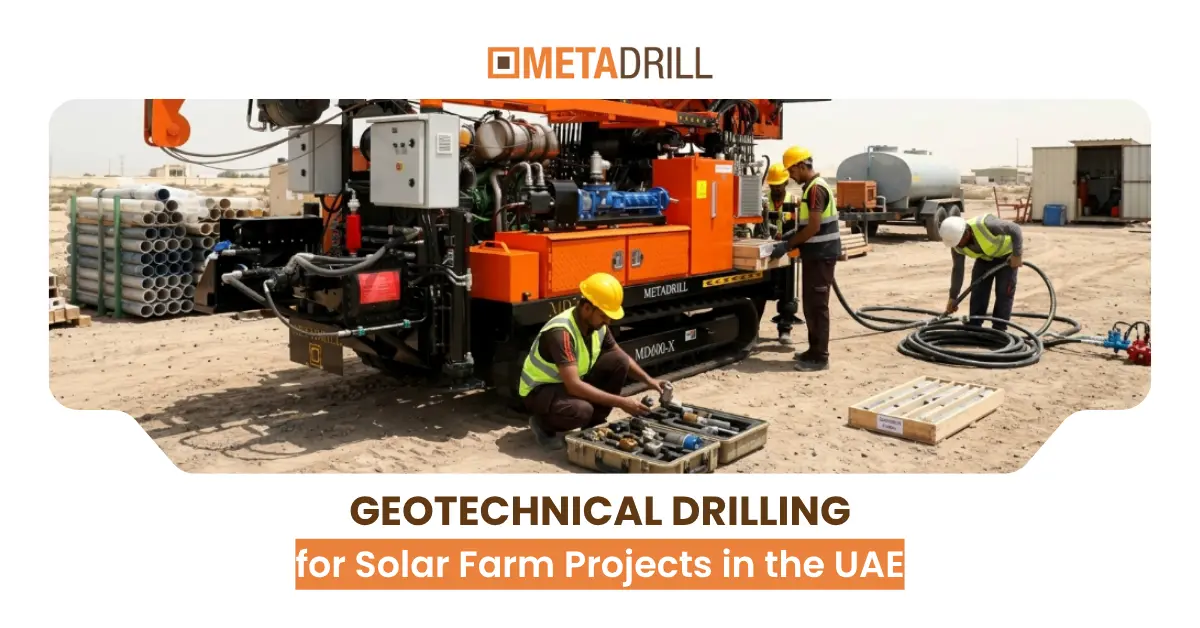
Solar looks simple from the air; the ground tells a different story
Rows of solar panels can stretch across a flat desert site for kilometres, which can make the civil engineering look straightforward. The reality is more detailed. Geotechnical drilling solar UAE projects helps designers understand whether tracker piles can be driven efficiently, where dense or cemented layers may slow installation, how access roads should be built and whether local ground variability could affect foundations or drainage. Because utility-scale solar covers such a large footprint, the site investigation has to balance coverage with cost. Too little information leaves the EPC contractor exposed; too much drilling in low-risk areas wastes programme and budget.
Why solar sites need a different investigation strategy
A high-rise project concentrates load in a small footprint. A solar farm spreads thousands of relatively light foundations across a very large area. That changes how boreholes, trial pits, penetration tests and laboratory samples are planned. The geotechnical engineer is looking for representative ground zones and anomalies that could change pile installation or road performance. A geotechnical drilling company with renewable-energy experience should understand this spatial problem and work closely with the survey and design teams rather than treating every borehole as an isolated task.
Desert terrain is not uniform
UAE desert sites can include loose dune sand, denser layers, gravel, sabkha-type deposits in some regions, cemented horizons and occasional shallow rock. Wind can reshape surface conditions between survey and construction. If foundation testing is based on a few convenient locations near the access road, the results may not represent the full array field. Site investigation services should therefore consider geomorphology, grading plans and likely tracker zones when locating tests. The objective is to identify changes before the pile-driving fleet discovers them the hard way.
Heat affects both fieldwork and long-term design
Summer site investigation on an open solar field can be punishing. The drilling rig operates without shade, access roads may be soft, and crews must follow heat-stress and midday work controls. Equipment cooling and filtration need close attention because dust is continuous. At the design stage, thermal cycles can also affect near-surface soils and site drainage behaviour. Geotechnical drilling does not answer every thermal-design question, but it provides the ground data needed to design foundations and roads with the local environment in mind.
Foundation questions the investigation should answer
Solar tracker and fixed-tilt systems can use driven piles, screw piles, shallow concrete foundations or other systems depending on the project. The investigation should help answer drivability, uplift, lateral resistance, corrosion and settlement questions. Where cemented layers or rock occur, predrilling may be required. Where loose sand dominates, designers may need to verify pull-out behaviour carefully. Borehole and test data should therefore connect directly to the proposed foundation system. A generic soil report that never considers pile installation is not especially useful to the construction team.
Groundwater and corrosivity
Not every UAE solar project is deep in dry dunes. Some sites sit in lower-lying areas near the coast, where groundwater or saline soils can influence foundation durability much like a marine or waterfront project would. Soil and groundwater chemistry may therefore be part of the investigation. Chlorides, sulfates and electrical resistivity can affect material selection and corrosion protection. The drilling team must collect representative samples without contamination, and the laboratory schedule should reflect the materials that will actually be installed. This is one area where coordination between geotechnical, structural and electrical teams pays off.
Access roads and inverter stations need attention too
The panels get most of the attention, but solar farms also include internal roads, drainage features, inverter stations, substations and sometimes battery systems. These areas may impose higher loads than individual panel foundations. Site investigation services should not overlook them. A soft zone beneath a substation platform can become a more serious construction issue than slightly variable pile resistance in the array field. The drilling and testing plan should mirror the civil layout.
UAE approvals and project standards
Renewable-energy projects in the UAE are usually delivered under detailed owner and EPC specifications, with authority requirements depending on location and project structure. Dubai projects may interact with DEWA and local building requirements; Abu Dhabi projects may involve relevant DMT and utility or developer standards. HSE requirements for remote desert work can be particularly strict. The geotechnical contractor should therefore mobilize with approved method statements, calibrated test equipment and clear environmental procedures rather than relying on routine building-site practice.
Equipment selection for wide-area desert work
Mobility can matter more than maximum depth on many solar investigations. A tracked rig that can move across loose ground without constant recovery assistance may save hours each day. Compact dimensions, onboard rod handling and easy maintenance are also valuable when boreholes are spread far apart. MetaDrill's UAE-made range includes tracked options and emphasizes field servicing and remote monitoring, features that make sense for geographically dispersed projects. The right rig is the one that keeps the investigation moving without damaging sample quality.
EPC contractors bidding UAE solar programmes are often chasing similar tenders in Saudi Arabia and Oman, and a large-scale investigation may only need the equipment for a few months. That makes the rent-or-buy decision worth reviewing early, alongside how easily parts and technical support travel across GCC borders if the fleet has to move with the work. Our renting vs buying guide covers that comparison in more detail.
Pilot areas can reduce risk before full rollout
Large solar projects often benefit from treating the early investigation and test-pile work as a learning phase. If one zone shows refusal or highly variable driveability, the team can adjust the broader testing plan before thousands of foundations are installed. Geotechnical data, pile-load testing and installation records should be compared rather than kept in separate silos. That feedback loop can refine predrilling allowances, equipment selection and production estimates. On a project measured in thousands of repetitive foundations, a small improvement in assumptions can have a large programme effect.
Think about construction verification after the investigation
Solar foundation design is often refined through field verification. Test piles, pull-out tests or trial installations can confirm whether the selected foundation behaves as expected in the identified soil zones. The original geotechnical investigation provides the map for that verification. When the drilling logs, laboratory data and trial installation records are reviewed together, the EPC team can adjust predrilling or foundation details before full production. This is especially valuable on large UAE sites where a small percentage of difficult ground can represent hundreds of foundation locations. Early feedback keeps that problem from becoming a repetitive construction delay.
Closing
Geotechnical drilling solar UAE projects is ultimately about reducing installation surprises across a very large site. Good data helps the EPC team choose foundations, plan access, anticipate refusal and protect durability. In the UAE, that investigation needs to reflect desert mobility, extreme heat, variable near-surface conditions and project-specific authority requirements. A capable geotechnical drilling company does more than reach target depth; it helps turn scattered field observations into reliable information the solar project can build on.
For the underlying principles behind planning any UAE site investigation, see our guide on soil investigation before construction. To plan a drilling programme for a solar or renewable-energy site, contact the MetaDrill team.
Question to the public:
How geotechnical drilling supports UAE solar farm projects, including desert terrain, foundation design, access roads, groundwater, testing and site investigation planning.