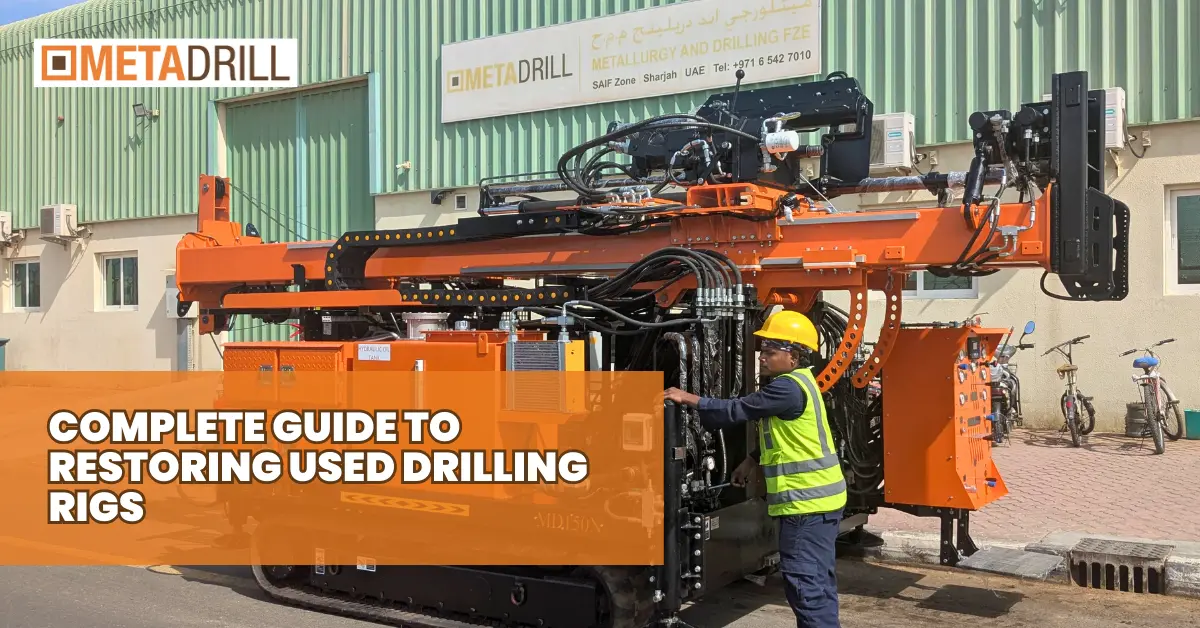
The restoration of a drilling rig starts long before any tools touch the equipment, since the successful rebuilding of a drilling rig requires a clear understanding. Older rigs represent a risk for many companies, but they are an opportunity to extend the performance of old rigs instead of spending money on purchase. When restoration is done in a systematic manner, worn parts become effective systems that sustain the challenging drills. Instead of rushing to repair, the teams are busy with checking, strategizing, and accurate upgrades so the rig can run stably and safely. Our guide will take you through all the steps of rehabilitating used drilling rigs, and you will be confident to transition to the point of full readiness to operate.
Why Restoring Used Drilling Rigs Makes Business Sense
Re-using a worn-out drilling rig makes a functional decision once you understand how systematic reconstruction improves both cost management and effective functions. Restoration is favored by many drilling companies, as it helps them to relieve pressure on capital and maintain the equipment according to the current project requirements. Teams do not have to wait until lengthy manufacturing schedules are completed, as they instead reassemble old rigs and put them back into service in less time, so the drilling can continue without delay.
Technical flexibility is also developed through this method since restoration enables engineers to direct their efforts towards certain areas in the system that require upgrades. The problems that were experienced during the previous operations are frequently addressed by hydraulic upgrades, reinforced structures, and new control panels. The closer the rig can get to a stable and predictable performance, the more each improvement will be related to real field experience. These specific upgrades over the years minimise the occurrence of unwanted downtime and promote the daily drilling production, a reason as to why restoration is still a strategic option among many operators operating used drilling rigs.
Step 1: Perform a Detailed Initial Inspection
Before starting any restoration, it is important to have a detailed inspection that creates the foundation for every decision that follows, because the condition of the rig determines how far the rebuilding process should go. To begin with, teams assess structural integrity to make them aware of whether the mast, frame, and load-bearing parts can support future drilling. When the structural review has given some clarity of picture, the focus is moved to the mechanical systems, where rotary components, gear assemblies, and pumps will show the impacts that have been imposed on the performance in the past.
The mechanical evaluation should also be given the same consideration as the hydraulic and electrical systems, as after restoration, the hidden leaks, old hoses, and old wires tend to bring about unstable operation. The engine performance is also directly linked to the general rebuilding strategy since the level of power efficiency and vibration can tell whether it is more reasonable to perform refurbishment or to replace the engine. All the findings must be recorded in measurements and pictures to transform the inspection into a clear technical road map. Restoration planning is more precise, controlled, and in line with actual equipment conditions when inspection goes beyond surface-level and is an organised evaluation.
Step 2: Plan the Restoration Strategy
As soon as the actual state of the rig is reflected by the inspection, planning is the gate between the judgment and the action, since all decisions regarding the repair must be determined by a specific goal. A formalised restoration plan assists teams to manage budget, schedule, and technical focus rather than respond to issues in the rebuild. Proper planning also minimises the misunderstanding between the engineering teams, technicians, and the project managers because the various phases have a documented route.
The plan to restore needs to divide the complicated work into specialised steps to ensure that the progress can be tracked and systematised. Rather than restoring as one task, breaking it down into certain stages aids in keeping things straight and, at the same time, structural, mechanical, and safety improvements are made in the correct sequence.
Restoration Planning Framework
Restoration Phase | Main Objective | Key Actions | Expected Outcome |
Structural Assessment | Ensure stability and safety | Frame inspection, weld repair, corrosion treatment | Strong foundation for rebuilding |
Mechanical Overhaul | Restore core drilling performance | Gearbox service, pump rebuild, bearing replacement | Smooth mechanical operation |
Hydraulic System Upgrade | Improve pressure control and efficiency | Hose replacement, valve testing, and leak prevention | Stable hydraulic performance |
Electrical Modernization | Increase control accuracy and safety | Wiring checks, sensor upgrades, panel optimization | Reliable monitoring and control |
Safety Integration | Aligning with operational standards | Emergency stops, guards, and system testing |
By organizing restoration into a structured framework, teams move forward with clarity instead of uncertainty. Each phase connects with the next, which allows restoration progress to remain consistent while reducing unexpected delays during later stages.
Step 3: Disassembly and Component Evaluation
When you have a specific restoration plan, it makes disassembly the next logical choice, as in most cases, deeper inspection shows that the details that remain hidden during the surface evaluation are visible. Instead of removing parts quickly, teams follow a structured teardown process, so every component stays traceable during reassembly. When a rig is disassembled into individual parts of mechanical systems, careful labelling, storage, and documentation can be used to ensure order.
As components come apart, cleaning plays an important role because dirt and drilling residue often hide cracks, wear patterns, or alignment issues. Once surfaces become visible, technicians measure tolerances, check rotating parts, and compare component condition against manufacturer standards. This evaluation stage connects directly with earlier planning decisions since engineers can confirm which parts need refurbishment, which require replacement, and which remain suitable for reuse.
Disassembly further provides the time to examine the influence of past operational stress on the rig since asymmetrical wear or broken seals frequently indicate more profound functioning concerns. When teams perceive teardown as both a technical assessment and not a mere cleaning process, the restoration process remains structured and helps to rebuild properly in subsequent phases.
Step 4: Repair and Replace Major Components.
Once the actual state of everything has been revealed by dismantling, the decision-making of repairing shifts more towards action than planning, since every repaired part has to be capable of ensuring safe and stable drilling operations. Teams do not pay equal attention to all damage; rather, critical systems that have an impact on load handling, power transfer, and operational control. This targeted strategy helps to keep the restoration during the real performance objectives and avoid spending money on non-impact repairs.
Step 5: Upgrade Technology Where Needed
After physical strength has been rebuilt through critical repair, the rig can be upgraded by technology to narrow the transition between the existing old equipment and the new demands of drilling due to the increased precision and safety brought by the new monitoring and control systems. There are a high number of drilling rigs that are using old interfaces that reduce performance visibility when in operation. The addition of targeted upgrades enables the introduction of the original mechanical strength of the rig and enhances the interaction of operators with the system.
Step 6: Chassis Reassembly and Alignment.
With the rig redesigned by repairs and technology upgrades to the core systems, when it comes to putting the rig back together, it is the phase where all the parts that have been restored and every component reconnects to each other in the rig, as fine-tuning is the factor that dictates how smoothly the rig will act in the natural conditions of drilling. Technicians work in a controlled series rather than hurry to rebuild the structure lest mechanical balance be lost, and the stress is not unevenly distributed among the parts that are connected. Every reassembly step is tied directly to the data on the inspections collected previously, which allows us to make sure that the restored elements are back where they belong without creating new performance problems.
Step 7: Quality Checks and Testing.
When every system is restored through reassembly, the next level of restoration is testing, since the quality of the restoration is transformed into quantifiable performance, due to the fact that when real operating conditions are applied, it will be known whether the repair and upgrade efforts have been successful. Rather than putting the rig into active drilling, controlled testing can help the teams monitor the response of structural strength, mechanical motion, and hydraulic pressure to load. This cautious step between reconstruction and validation assists in avoiding the sudden problems that may arise after the rig has been brought to the field.
Step 8: Safety Compliance and Certification.
Once testing is accomplished to ensure that the repaired drilling rig functions properly, the last technical check in the process of field deployment is safety compliance, as the functionality of the operational approval requires adherence to the established industry standards. Performance is reinforced by restoration work, but certification is used to guarantee the compliance of every upgrade to the current safety expectations. This phase bridges the gap between engineering work and regulation needs in order to ensure that the rig is within acceptable limits and limits risk to the operators and the surrounding conditions.
You can also check: From CAD to Site How Meta Drill Engineers Rig Performance
The Conclusion: Making Restoration a Long-term Drilling Value.
The rehabilitation of used drilling rigs is more than a technical exercise when each phase of the work is interrelated with an apparent purpose since systematic inspection, planning, accurate rebuilding, and systematic maintenance are all integrated to help to increase the life of the equipment. The steps in this guide are based on the steps that came before it, forming a course of restoration on which the concepts of safety, performance, and operational efficiency are kept on track throughout the evaluation and to the final deployment.
When restoration is not viewed as a patch fix but rather as a long-term investment by the teams involved, the old rigs develop into reliable resources that can withstand the requirements of modern drilling. The technology upgrades enhance the monitoring, balance in the mechanical aspect is also enhanced, and the structured testing ensures that all the systems are functioning with stability. Since maintenance is done after restoration, the rig retains the same degree of reliability that it had during rebuilding.
Question to the public:
The rehabilitation of used drilling rigs is more than a technical exercise when each phase of the work is interrelated with an apparent purpose since systematic inspection