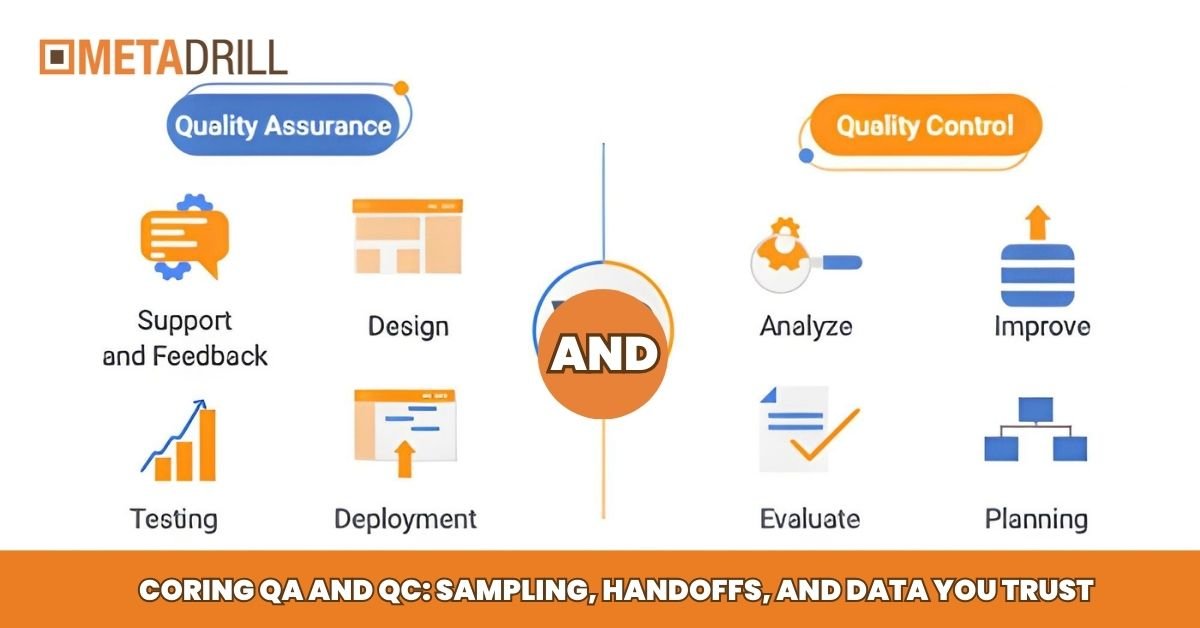
You can drill the “perfect” hole and still end up with unusable results. Not because the ground changed, but because a sample got mixed, mislabeled, dried out, or handed over without the right notes. That is why coring QA and QC matters. In geotechnical drilling, the quality of your data starts long before the lab and ends only when everyone agrees that the sample history is clean, consistent, and traceable.
Why QA and QC in Coring Is Non-Negotiable
In geotechnical drilling, you are not just pulling rock or soil. You are collecting evidence. If that evidence is damaged, rushed, or poorly documented, your design team is forced to guess. Good QA (quality assurance) is the plan you follow. Good quality control) is the proof you did it correctly.
A practical coring QA/QC system should protect three things:
Sample integrity (no extra breakage, loss, contamination, or moisture change)
Traceability (every piece has a clear chain of custody)
Repeatability (the process works the same on every shift)
Sampling That Protects the Core and the Story
Your core is only valuable if it represents the ground exactly as it was. This is where the right geotechnical drilling equipment and habits make a visible difference.
Here’s a field sampling routine that reduces avoidable errors:
Core recovery check: Record recovery and RQD immediately while the run is fresh.
Correct core orientation: Keep top and bottom consistent; don’t “flip” pieces to make the box look neat.
Minimize handling: Excess handling increases fractures and changes the sample narrative.
Moisture discipline: Certain soils and weak rock change fast when exposed cover and protect them early.
Photo proof: Take photos per box and per run before transport, with labels visible.
This is the kind of discipline that separates “we drilled” from “we can defend the results.”
Labeling and Documentation: The Quiet Work That Saves Projects
Most coring mistakes are not drilling mistakes. They are admin mistakes. If you want data you trust, your labeling has to be boringly consistent—every time.
Minimum labeling set for each core box:
Project name + borehole ID
Run depth “from–to”
Date + shift/crew
Any losses, voids, or drilling issues
Sample condition notes (wet, friable, fractured, weathered zones)
Even if your crew uses the best geotechnical drill, the job fails if the box is missing one depth range, or the borehole ID is wrong.
Handoffs and Chain of Custody: Where Data Usually Breaks
The sample handoff is the most common failure point. A simple chain-of-custody process keeps everyone aligned—from driller to logger to courier to lab.
Use a handoff checklist that includes:
Box count confirmed (and numbered)
Depth intervals verified against the driller’s log
Photos captured and stored (date-stamped)
Seal/tape used for transport when needed
Sign-off recorded (who handed over, who received, time/date)
When this process is followed, the lab can trust what it receives, and engineers can trust what they interpret.
Field QC Checks You Can Run Every Day
You do not need complicated systems to run good QC. You need repeatable checks tied to your drilling rig tools and equipment and daily workflow.
Daily QC checks that catch problems early:
Verify the barrel, bit condition, and core lifters before first run
Confirm correct run length and consistent drilling parameters
Track core recovery trends (sudden drops usually mean a tooling or technique issue)
Cross-check depths (driller’s log vs. box labels vs. field logging sheet)
Reconfirm borehole ID on every box before it leaves the rig
These steps protect both productivity and credibility.
Common Mistakes That Ruin Good Coring Data
Even strong rigs and crews can lose data quality through avoidable habits:
“Fixing” core to look continuous instead of keeping it true
Skipping photos because the site is busy
Writing labels at the end of the shift from memory
Mixing runs in one box to save space
No handoff sign-off, so errors can’t be traced
All of these issues become expensive when design decisions rely on the wrong ground story.
You can also check: How to Deploy the MD150N Drill for Geotech Coring Ops Safely
Conclusion: Data You Trust Comes from Process, Not Luck
At the end of the day, reliable coring results are built in the field—not “fixed” later. In geotechnical drilling, QA and QC are what protect the core from avoidable damage, prevent mix-ups during handoffs, and make every depth interval traceable from rig to lab. When your crew follows a repeatable sampling routine, labels everything clearly, and uses geotechnical drilling equipment correctly, your geotechnical drill becomes a tool for trustworthy decision-making, not just progress on a daily log. Add simple daily checks using drilling rig tools and equipment, and you get the real outcome that matters: clean, defensible data that engineers can design on with confidence.
Question to the public:
In geotechnical drilling, QA and QC are what protect the core from avoidable damage, prevent mix-ups during handoffs, and make every depth interval traceable from rig to lab.