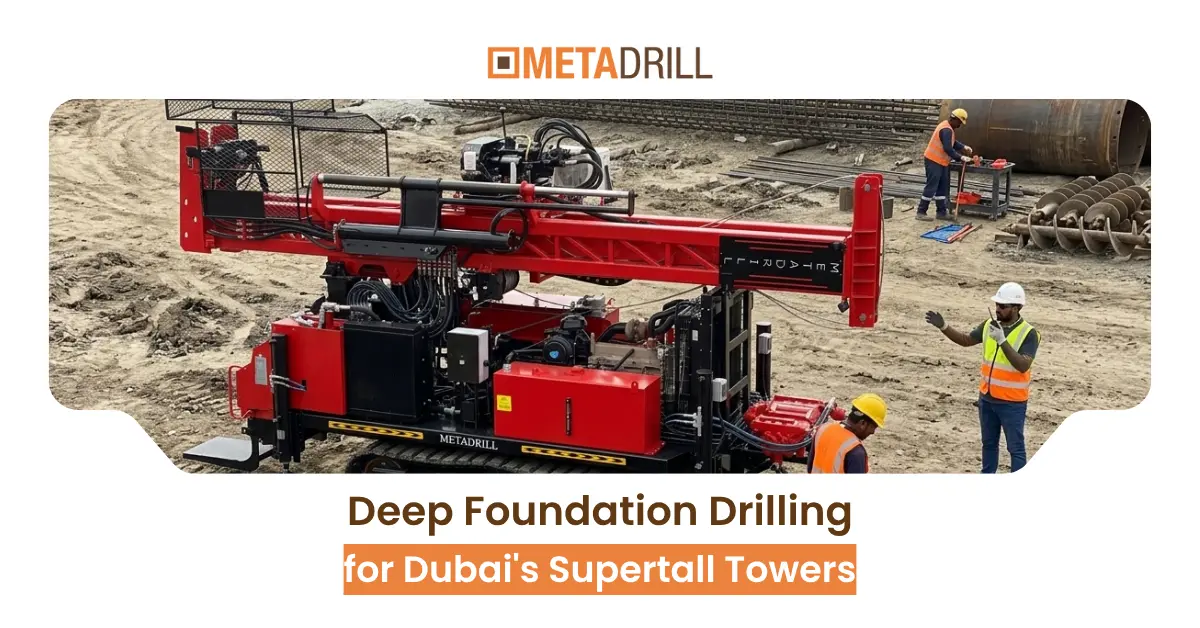
A tall building changes the questions below ground
A supertall tower draws attention upward, but the most
consequential decisions are often made well below the podium. Heavy column
loads, differential settlement and interactions between piles and surrounding
ground demand a carefully planned investigation. Deep foundation drilling for
Dubai’s supertall towers is not simply about reaching a dramatic depth. It is
about understanding how the complete foundation system will perform.
On a UAE project, the specification should say who owns this
decision and what evidence will confirm it. A consultant may need one level of
detail for preliminary design and a much tighter tolerance before construction.
That difference is easy to miss when the programme is compressed. A short
coordination meeting before mobilization often saves a longer argument once the
crew is on site.
Why depth alone is a poor specification
Two boreholes of equal depth can deliver very different
value. One may recover representative samples and document groundwater
accurately; the other may pass through critical layers with little usable
information. Depth should follow the zone influenced by the proposed foundation
and the engineer’s design questions. Where ground conditions vary, additional
locations can be more valuable than drilling one exceptionally deep hole.
On a UAE project, the specification should say who owns this
decision and what evidence will confirm it. A consultant may need one level of
detail for preliminary design and a much tighter tolerance before construction.
That difference is easy to miss when the programme is compressed. A short
coordination meeting before mobilization often saves a longer argument once the
crew is on site.
The role of rock and cemented layers
Dubai projects may encounter sand, calcareous deposits and
locally cemented or rocky horizons. These materials do not always behave
uniformly. Core quality, fracture descriptions and appropriate strength testing
help engineers distinguish apparently hard layers from reliable founding
strata. Exploration drilling techniques can contribute where deeper geological
characterization is needed, but the method must serve the foundation design
rather than dictate it.
On a UAE project, the specification should say who owns this
decision and what evidence will confirm it. A consultant may need one level of
detail for preliminary design and a much tighter tolerance before construction.
That difference is easy to miss when the programme is compressed. A short
coordination meeting before mobilization often saves a longer argument once the
crew is on site.
Testing for settlement and load transfer
Foundation teams need more than an estimated bearing value.
They need to understand stiffness, compressibility, variability and the
potential for differential movement. Appropriate laboratory and field tests
feed pile design and settlement analysis. For a tall tower, a small difference
in predicted movement can have major implications for structural coordination,
façade detailing and serviceability.
On a UAE project, the specification should say who owns this
decision and what evidence will confirm it. A consultant may need one level of
detail for preliminary design and a much tighter tolerance before construction.
That difference is easy to miss when the programme is compressed. A short
coordination meeting before mobilization often saves a longer argument once the
crew is on site.
Selecting the right rig and tooling
A geotechnical drill rig should have suitable pullback,
torque, mast configuration and sampling capability for the specified depths and
ground conditions. Safe working clearances matter on tight urban sites. Tooling
for coring, casing and flushing must be compatible with the planned method. A
rig that looks impressive on a specification sheet may still be the wrong
choice if it cannot recover reliable material in the layers that matter.
On a UAE project, the specification should say who owns this
decision and what evidence will confirm it. A consultant may need one level of
detail for preliminary design and a much tighter tolerance before construction.
That difference is easy to miss when the programme is compressed. A short
coordination meeting before mobilization often saves a longer argument once the
crew is on site.
Urban constraints and authority coordination
High-rise projects sit among roads, buried services and
existing structures. Before drilling, teams need utility checks, access plans,
spoil controls and any permits required by Dubai Municipality, the developer
and other relevant authorities. The Dubai Building Code and project
specifications should guide the design and investigation framework; they should
not be reduced to a generic checklist copied between projects.
On a UAE project, the specification should say who owns this
decision and what evidence will confirm it. A consultant may need one level of
detail for preliminary design and a much tighter tolerance before construction.
That difference is easy to miss when the programme is compressed. A short
coordination meeting before mobilization often saves a longer argument once the
crew is on site.
Coastal plots add another layer of complexity
Waterfront developments may involve reclamation, variable
fill, shallow saline groundwater and aggressive exposure conditions. These can
affect both construction methods and long-term durability assessments. Borehole
logs need to record fill boundaries and groundwater conditions carefully. Where
dewatering or excavation is anticipated, the ground model should address the
associated risks to adjacent assets.
On a UAE project, the specification should say who owns this
decision and what evidence will confirm it. A consultant may need one level of
detail for preliminary design and a much tighter tolerance before construction.
That difference is easy to miss when the programme is compressed. A short
coordination meeting before mobilization often saves a longer argument once the
crew is on site.
What good foundation investigation delivers
The final value lies in fewer surprises during piling, more
defensible design parameters and a clearer plan for testing and verification.
When geotechnical drilling results are integrated early with structural and
construction teams, the foundation becomes a controlled engineering decision
rather than an expensive gamble.
On a UAE project, the specification should say who owns this
decision and what evidence will confirm it. A consultant may need one level of
detail for preliminary design and a much tighter tolerance before construction.
That difference is easy to miss when the programme is compressed. A short
coordination meeting before mobilization often saves a longer argument once the
crew is on site.
A practical next step
Before committing to a drilling method or machine, put the
ground conditions, site access, reporting requirements and project constraints
in one brief. Compare suppliers against that brief rather than a brochure
alone. MetaDrill’s UAE-based team can be consulted about drilling rig
configurations and regional equipment support at metadrill.org;
project-specific engineering decisions should remain with the appointed
qualified professionals.
Question to the public:
Explore deep foundation drilling supertall towers, practical UAE ground conditions, contractor decisions and field considerations for safer, better-planned projects.