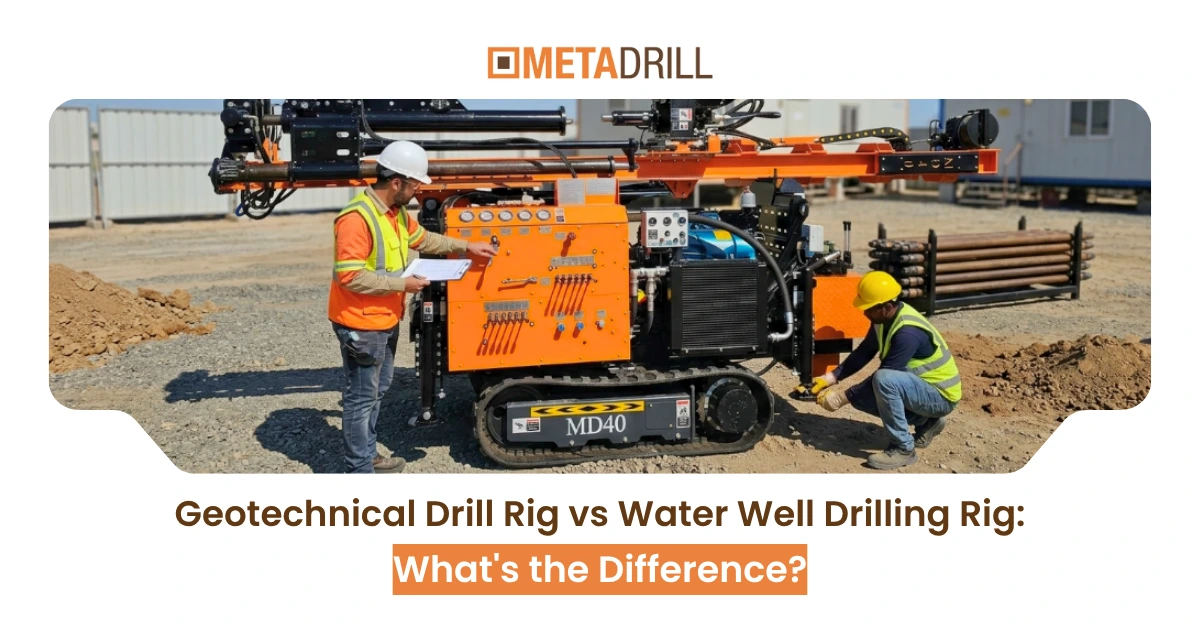
They both drill holes, but the job is not the same
Park a geotechnical drill rig beside a water well drilling rig and the two machines may look similar to a non-driller. Both have masts, rotary heads, pumps and rods. Their priorities, however, can be very different.
Geotechnical work is primarily about collecting information from the ground for engineering decisions. Water-well work is about creating a borehole that can become a productive, stable well. That difference influences drilling method, tooling, depth, flushing, casing and the way success is measured. Choosing the wrong machine can make a straightforward project unnecessarily difficult.
What a geotechnical drill rig is built to do
A geotechnical drilling rig supports site investigation. It may advance boreholes, perform SPT, recover disturbed and undisturbed samples, drill rock core and install monitoring instruments. Control is critical because the geologist needs representative samples and accurate test depths. Many geotechnical holes are modest in diameter compared with production wells, but they can require frequent stops for testing and logging. The rig therefore needs good feed control, safe rod handling and compatibility with sampling and coring systems.
What a water well drilling rig is built to do
A water well drilling rig is optimized around creating a usable well. Depending on geology, it may use mud rotary, air rotary, down-the-hole hammer or other methods. Well diameter can be larger, and the machine may need higher air or fluid circulation capacity. The project continues after drilling: casing, screen, gravel pack, development and pumping tests may follow. Depth can be substantial. In UAE work, water-well equipment is also used for dewatering, monitoring and some groundwater investigations, but the final borehole objective remains different from a standard geotechnical test hole.
Where the capabilities overlap
Modern multipurpose rigs blur the boundary. MetaDrill's MD600N and MD1000N are presented as geotechnical and water-well capable machines, which makes sense for contractors serving several sectors. A rig with adequate pullback, rotary range, pump capacity and tooling can support both sampling and deeper drilling, provided the configuration matches the method. Overlap does not mean every rig is equally efficient at every task. A compact SPT-focused machine may be ideal for building investigations and frustrating for a large-diameter well. Likewise, a heavy water-well rig may be awkward on a tight urban plot.
SPT is one of the clearest differences
SPT is central to many soil investigations and largely irrelevant to constructing a production water well. If your programme requires repeated Standard Penetration Tests, check whether the geotechnical drill rig has an automatic or suitable hammer system, safe sampler handling and enough control to prepare the test interval properly. If the job is a well, your attention shifts toward borehole cleaning, casing, pump capacity and completion. The machine's feature list should follow that end use.
UAE geology influences both types
Loose sand, cemented layers, carbonate rock and shallow coastal groundwater are common concerns across UAE drilling. The methods respond differently. A geotechnical borehole may use casing to stabilize loose sand while stopping for sampling. A water well may prioritize circulation and hole cleaning over a longer open interval. In hard rock, both may use rotary methods, but core recovery can be essential for geotechnical logging while a water well may focus on penetration and productive fractures. The formation is the same; the engineering question changes the drilling approach.
Approvals differ between the two applications
Regulatory expectations are not identical either. A geotechnical borehole usually follows the project's soil-testing scope and the consultant's specification, with Dubai Municipality and other authorities setting baseline testing requirements. A water well, by contrast, can involve separate registration or permitting with the relevant water or groundwater authority, since the finished borehole may be used for abstraction, dewatering or long-term monitoring rather than being sealed and abandoned after investigation. Confirming which regime applies before mobilization avoids a borehole that is drilled correctly but not properly authorized for its intended use.
Heat, dust and saline conditions
Both machine types live in the same climate. Cooling systems work hard in summer, dust loads filters and coastal water can accelerate corrosion. Maintenance therefore matters regardless of application. Rental customers should ask how the rig has been serviced and whether the supplied configuration is suitable for the site. A water well drilling rig rental used near the coast may need especially disciplined cleaning because saline drilling water and spray can attack exposed components.
How to choose for a mixed workload
If your company performs mostly site investigation with occasional groundwater boreholes, a versatile geotechnical platform with deeper drilling capability may be enough. If large-diameter wells are a major part of the business, dedicated water-well capacity could be more productive. Consider rod size, expected depth, casing diameter, torque, speed, pullback and pump or compressor needs. Transport and site access also matter. The best machine is not the one with the longest specification sheet; it is the one whose useful capability matches the majority of your work.
Buying versus rental in the GCC
A contractor testing a new service line may prefer water well drilling rig rental before committing capital. That provides real production data on your own projects. If the workload becomes regular, ownership may make sense. GCC deployment adds another factor: parts and service should be available where the rig will actually work. MetaDrill's Sharjah operation gives UAE contractors local access to rigs, rental, tools, service and spares, while its larger models are marketed for both geotechnical and water-well applications.
Tooling cost can change the answer
When comparing machine types, include the cost and availability of the tooling package. Larger casing, compressors, mud systems and well-development equipment can make water-well work more capital intensive than the rig price suggests. Geotechnical work has its own specialized samplers, core barrels and test equipment. A multipurpose machine may reduce fleet count, but it does not remove the need for application-specific tools. Contractors should therefore compare complete working systems, not bare rigs, before deciding which route provides better value.
Consider crew competence before choosing a multipurpose rig
A multipurpose machine only creates value if the crew can use its different systems correctly. Moving from SPT and soil sampling into deeper rotary or water-well work changes tooling, circulation and operating technique. Training should therefore be part of the commercial plan. If the contractor is entering water-well work for the first time, renting with technical support can be a sensible bridge before buying. The same applies in reverse for a water-well team adding geotechnical testing. Equipment overlap is useful, but competence is what turns overlap into productive work.
Ask which application drives most revenue
If the machine will spend eighty percent of its time on one application, optimize for that work first. Occasional versatility is useful, but everyday productivity pays the bills. Review historic job data, average depths, common diameters and tooling costs before choosing a multipurpose platform. That simple exercise often makes the preferred rig configuration much clearer.
Closing
The difference between a geotechnical drill rig and a water well drilling rig starts with purpose. One gathers engineering information; the other creates a functional well. Their capabilities can overlap, especially on modern multipurpose machines, but the correct configuration still depends on testing, diameter, depth, circulation and completion requirements. For UAE projects, add climate, desert access, coastal conditions and regional support to that list. Once the end goal is clear, the equipment decision becomes much easier.
If a temporary or trial phase makes sense before committing to either machine type, our renting vs buying guide covers that decision in more detail. To talk through which configuration fits your workload, contact the MetaDrill team.
Question to the public:
Geotechnical drill rig vs water well drilling rig: compare purpose, depth, sampling, tooling, pumps, SPT, casing and UAE applications before choosing or renting equipment.