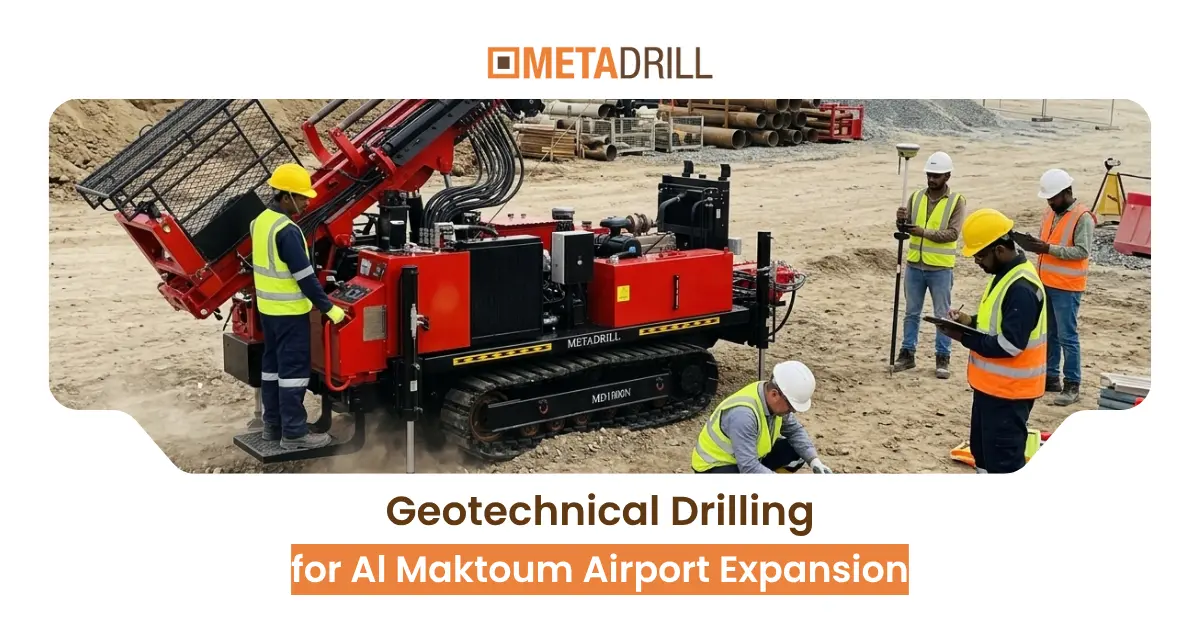
Airport groundworks run on a different scale
Airfield infrastructure spreads across enormous areas.
Runways, taxiways, aprons, terminals and utility corridors each impose
different loads and performance demands. Geotechnical drilling for Al Maktoum
airport expansion illustrates why investigation teams must think in zones, not
treat a large site as one uniform patch of desert. An isolated strong borehole
cannot represent an entire pavement corridor.
On a UAE project, the specification should say who owns this
decision and what evidence will confirm it. A consultant may need one level of
detail for preliminary design and a much tighter tolerance before construction.
That difference is easy to miss when the programme is compressed. A short
coordination meeting before mobilization often saves a longer argument once the
crew is on site.
Pavement performance starts below the surface
For airside pavements, uneven support can become a
maintenance problem long before a structure fails. Investigations need to
characterize near-surface variability, compaction potential, groundwater and
materials likely to affect subgrade performance. Field testing and laboratory
classification help designers identify where ground improvement, replacement or
drainage measures may be needed.
On a UAE project, the specification should say who owns this
decision and what evidence will confirm it. A consultant may need one level of
detail for preliminary design and a much tighter tolerance before construction.
That difference is easy to miss when the programme is compressed. A short
coordination meeting before mobilization often saves a longer argument once the
crew is on site.
Terminals and structures need different evidence
Terminal foundations, bridges and service buildings may
require deeper boreholes and different test programmes from runway pavement
areas. A geotechnical drilling company should work with the designer to
distinguish these requirements. Using one investigation template for every
asset may save time at tender stage but can leave costly gaps later.
On a UAE project, the specification should say who owns this
decision and what evidence will confirm it. A consultant may need one level of
detail for preliminary design and a much tighter tolerance before construction.
That difference is easy to miss when the programme is compressed. A short
coordination meeting before mobilization often saves a longer argument once the
crew is on site.
Working across desert terrain
Open desert sites present mobility challenges: loose sand,
long travel distances, windblown dust and limited nearby services. A
geotechnical drill rig must be stable on the prepared working platform and able
to move safely between locations. Logistics planning should include water,
fuel, spare tooling, emergency access and reliable communications. On large
sites, travel time alone can materially affect production.
On a UAE project, the specification should say who owns this
decision and what evidence will confirm it. A consultant may need one level of
detail for preliminary design and a much tighter tolerance before construction.
That difference is easy to miss when the programme is compressed. A short
coordination meeting before mobilization often saves a longer argument once the
crew is on site.
Heat management is part of productivity
Summer temperatures stress operators and machines. Hydraulic
cooling, filters, hoses and electrical enclosures need attention, while
supervisors must plan safe work-rest arrangements in line with UAE
requirements. The most efficient crew is not the one that works without
stopping. It is the one that maintains consistent data quality without
avoidable breakdowns or heat incidents.
On a UAE project, the specification should say who owns this
decision and what evidence will confirm it. A consultant may need one level of
detail for preliminary design and a much tighter tolerance before construction.
That difference is easy to miss when the programme is compressed. A short
coordination meeting before mobilization often saves a longer argument once the
crew is on site.
Access and aviation-related constraints
Airport work requires more than normal construction-site
coordination. Airside access, security screening, vehicle controls, height
restrictions and interface procedures may apply depending on the work zone and
project stage. Contractors should follow the airport operator’s rules,
consultant requirements and relevant authority approvals. Never assume an
ordinary municipal access pass is sufficient.
On a UAE project, the specification should say who owns this
decision and what evidence will confirm it. A consultant may need one level of
detail for preliminary design and a much tighter tolerance before construction.
That difference is easy to miss when the programme is compressed. A short
coordination meeting before mobilization often saves a longer argument once the
crew is on site.
Getting consistent data from a large programme
Multiple rigs and crews may be working simultaneously.
Consistent borehole logs, test procedures, sample labelling and location
records become essential. A shared quality plan helps prevent subtle
differences between teams from turning into unreliable design comparisons.
Equipment selection should also account for standardization of spare parts and
consumables.
On a UAE project, the specification should say who owns this
decision and what evidence will confirm it. A consultant may need one level of
detail for preliminary design and a much tighter tolerance before construction.
That difference is easy to miss when the programme is compressed. A short
coordination meeting before mobilization often saves a longer argument once the
crew is on site.
Procurement questions worth asking
When comparing geotechnical drilling equipment, ask how
quickly it can be mobilized, how well it handles sand and dust, what support is
available in the UAE and how field data will be documented. For major
infrastructure, availability and repeatability can be more valuable than a
marginal advantage in advertised drilling speed.
On a UAE project, the specification should say who owns this
decision and what evidence will confirm it. A consultant may need one level of
detail for preliminary design and a much tighter tolerance before construction.
That difference is easy to miss when the programme is compressed. A short
coordination meeting before mobilization often saves a longer argument once the
crew is on site.
A practical next step
Before committing to a drilling method or machine, put the
ground conditions, site access, reporting requirements and project constraints
in one brief. Compare suppliers against that brief rather than a brochure
alone. MetaDrill’s UAE-based team can be consulted about drilling rig
configurations and regional equipment support at metadrill.org;
project-specific engineering decisions should remain with the appointed
qualified professionals.
Question to the public:
Explore geotechnical drilling airport expansion, practical UAE ground conditions, contractor decisions and field considerations for safer, better-planned projects.