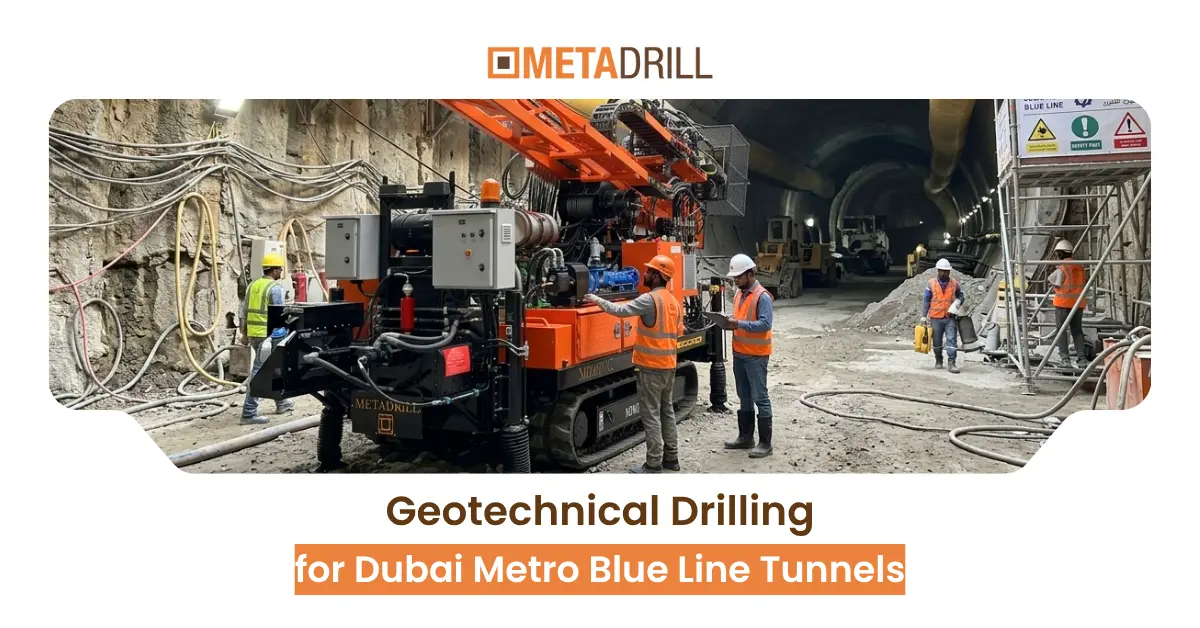
The questions beneath a new rail alignment
A metro route may be drawn as a neat line on a planning map,
but the ground beneath that line is rarely neat. For engineers planning the
Dubai Metro Blue Line, the practical questions begin below street level: where
does dense sand give way to cemented material, how does groundwater move, and
what happens when an excavation approaches existing utilities or foundations?
Geotechnical drilling supplies the evidence needed to answer those questions
before excavation starts. It does not replace design judgement; it makes that
judgement defensible.
On a UAE project, the specification should say who owns this
decision and what evidence will confirm it. A consultant may need one level of
detail for preliminary design and a much tighter tolerance before construction.
That difference is easy to miss when the programme is compressed. A short
coordination meeting before mobilization often saves a longer argument once the
crew is on site.
Investigating a corridor rather than a single plot
A tunnel investigation differs from a conventional building
plot because conditions must be understood along a corridor. Boreholes,
selected in-situ tests and laboratory work need to build a continuous
geological interpretation, not a disconnected collection of logs. At stations,
shafts and transitions, the investigation may need closer spacing because
excavation geometry and adjacent structures change the risk. A good team
identifies those transitions early and adapts the scope with the designer.
On a UAE project, the specification should say who owns this
decision and what evidence will confirm it. A consultant may need one level of
detail for preliminary design and a much tighter tolerance before construction.
That difference is easy to miss when the programme is compressed. A short
coordination meeting before mobilization often saves a longer argument once the
crew is on site.
What Dubai ground conditions can mean for tunnelling
Across Dubai, sands, locally cemented layers, variable rock
and groundwater can complicate excavation. Coastal stretches may present saline
groundwater and ground altered by reclamation. An investigation should
distinguish material that appears competent in a short sample from material
that will behave consistently over a longer tunnel drive. Groundwater
observations also need time and context; a single reading immediately after
drilling may not represent a stabilized level.
On a UAE project, the specification should say who owns this
decision and what evidence will confirm it. A consultant may need one level of
detail for preliminary design and a much tighter tolerance before construction.
That difference is easy to miss when the programme is compressed. A short
coordination meeting before mobilization often saves a longer argument once the
crew is on site.
Choosing the investigation methods
A geotechnical drill rig needs to support the required
borehole diameter, sampling method and depth without damaging the evidence
engineers depend on. Standard Penetration Tests can help characterize suitable
granular soils, while rotary coring may be needed in rock or cemented horizons.
The team should select tooling to match ground conditions and specify sample
handling, logging and recovery criteria in advance. Good equipment matters, but
method control matters just as much.
On a UAE project, the specification should say who owns this
decision and what evidence will confirm it. A consultant may need one level of
detail for preliminary design and a much tighter tolerance before construction.
That difference is easy to miss when the programme is compressed. A short
coordination meeting before mobilization often saves a longer argument once the
crew is on site.
Working safely in a live city
Metro investigation often takes place beside roads,
services, businesses and occupied buildings. Access permissions, utility
clearances, traffic arrangements, noise controls and emergency plans can
dictate the drilling schedule. Contractors should confirm applicable Roads and
Transport Authority requirements and municipal or utility approvals for each
work area, rather than assume one permit covers the entire alignment. An
accurate borehole in the wrong place is not a successful investigation.
On a UAE project, the specification should say who owns this
decision and what evidence will confirm it. A consultant may need one level of
detail for preliminary design and a much tighter tolerance before construction.
That difference is easy to miss when the programme is compressed. A short
coordination meeting before mobilization often saves a longer argument once the
crew is on site.
Heat, dust and operating discipline
Dubai summer heat places a heavy load on crews and
machinery. Cooling systems, hydraulic oil condition and dust filtration deserve
attention before the rig enters a tight work zone. Shift planning must account
for applicable UAE midday-break requirements and site-specific heat-stress
rules. In crowded locations, tidy hose routing, spill containment and clear
lifting zones can prevent routine tasks from becoming major interruptions.
On a UAE project, the specification should say who owns this
decision and what evidence will confirm it. A consultant may need one level of
detail for preliminary design and a much tighter tolerance before construction.
That difference is easy to miss when the programme is compressed. A short
coordination meeting before mobilization often saves a longer argument once the
crew is on site.
From borehole data to construction decisions
The most useful output is not a pile of logs. It is a ground
model that helps the project team assess settlement, dewatering, temporary
works, tunnel-boring conditions and construction monitoring needs. Uncertainty
should be shown explicitly, especially between widely spaced boreholes. A
geotechnical drilling programme succeeds when findings change a decision early
enough to save time, money or risk later.
On a UAE project, the specification should say who owns this
decision and what evidence will confirm it. A consultant may need one level of
detail for preliminary design and a much tighter tolerance before construction.
That difference is easy to miss when the programme is compressed. A short
coordination meeting before mobilization often saves a longer argument once the
crew is on site.
A practical handover for project teams
Before demobilization, verify coordinates and elevations,
sample identifiers, test records, groundwater observations and any departures
from the approved method. Agree on who will close boreholes and how records
will be delivered. For contractors considering geotechnical drilling equipment,
this is also a reminder to judge rigs by the quality and consistency of
information they help produce, not drilling speed alone.
On a UAE project, the specification should say who owns this
decision and what evidence will confirm it. A consultant may need one level of
detail for preliminary design and a much tighter tolerance before construction.
That difference is easy to miss when the programme is compressed. A short
coordination meeting before mobilization often saves a longer argument once the
crew is on site.
A practical next step
Before committing to a drilling method or machine, put the
ground conditions, site access, reporting requirements and project constraints
in one brief. Compare suppliers against that brief rather than a brochure
alone. MetaDrill’s UAE-based team can be consulted about drilling rig
configurations and regional equipment support at metadrill.org;
project-specific engineering decisions should remain with the appointed
qualified professionals.
Question to the public:
Explore geotechnical drilling Dubai Metro, practical UAE
ground conditions, contractor decisions and field considerations for safer,
better-planned projects.