Marine infrastructure begins with difficult ground
Ports and waterfront projects are built where land and water interact, which is exactly where ground conditions can become complicated. Geotechnical drilling marine UAE projects may need to characterize reclaimed fill, loose saturated sand, carbonate rock, dredged materials and shallow saline groundwater within the same development. The engineering questions are also demanding. Quay walls, cranes, breakwaters, warehouses, bridges and utilities can each place different loads on the ground. A site investigation therefore has to support several design teams at once.
Reclaimed land is variable by nature
Reclamation creates land, but it does not create uniform geology automatically. Fill source, placement method, compaction, age and underlying seabed deposits all influence performance. One borehole may encounter dense compacted fill while another finds a looser zone or soft material below the reclamation. A geotechnical drilling company should expect that variability and protect borehole quality through appropriate casing or support methods. The geologist then needs enough borehole coverage to distinguish local anomalies from broader ground zones.
Shallow groundwater changes field operations
On marine-adjacent sites, groundwater can appear very close to the surface and may fluctuate with tide or site conditions. Saturated sand increases the risk of borehole instability. Drilling fluids, temporary casing and controlled advancement may be necessary to maintain a clean test interval. Groundwater observations should follow the investigation plan; a water level seen immediately after drilling is not always representative. For design, monitoring installations or repeat readings may be more useful.
Salt changes the maintenance plan
Saline water is not kind to machinery. A rig working for weeks beside a port needs more aggressive corrosion prevention than one working inland. Wash-down, lubrication, coating inspection and electrical-connector checks should be built into daily or weekly routines. Tooling deserves the same attention. Rod threads, clamps and sample barrels can deteriorate quickly if salt is left on them. This maintenance is easy to postpone when production is busy, which is exactly why it needs to be scheduled.
Heat adds to the marine equation
Port and waterfront sites rarely offer much shade, and summer ambient temperature compounds the corrosion and mechanical stress already at work on a marine rig. Cooling systems have to reject heat while also being kept clear of salt-laden dust and spray, which is a harder combination than either condition on its own. Crews should build extra time into the day for radiator and filter checks, watch for heat-related hydraulic issues on top of the routine corrosion inspection, and avoid scheduling the most demanding coring runs for the hottest part of a summer shift if the programme allows it.
Work platforms and access may control rig choice
Marine infrastructure sites often have temporary platforms, rock fill, narrow causeways or restricted quay access. A heavy rig with excellent drilling capacity may not be acceptable if the platform cannot safely support it. Track width, ground pressure, machine weight and transport method should therefore be reviewed with the temporary-works and HSE teams. Where drilling takes place from a barge or jack-up platform, the planning becomes even more specialized. Rig selection must follow the approved working platform and lifting arrangement.
Environmental controls are tighter near water
Cuttings, drilling fluid, fuel and hydraulic leaks require careful management on coastal projects. Port operators and environmental teams may specify containment, spill kits, waste handling and discharge restrictions. Site investigation services should include these controls in the method statement and daily setup. A small leak that might be cleaned quickly on a dry inland plot can become a reportable incident beside open water. Equipment condition and housekeeping are therefore part of environmental compliance.
SPT and coring still need quality control
Marine conditions do not change the basic need for reliable field data. SPT should follow the specified procedure, and core drilling should aim for representative recovery. In weak carbonate rock, fractured zones and cavities may be especially significant for marine foundations. The drilling crew should communicate any loss of circulation, voids, sudden penetration changes or poor recovery to the geologist. Those observations can be as valuable as the final laboratory numbers because they help explain the ground model.
UAE port requirements can be project-specific
A project at Jebel Ali, Khalifa Port or another marine facility may sit under port-operator procedures as well as emirate-level requirements and the consultant's specification. Access passes, lifting plans, environmental controls, marine safety, equipment inspections and working-hour rules can all affect mobilization. There is no substitute for checking the actual project requirements early. A geotechnical drilling company that regularly works in controlled industrial environments will usually ask these questions before the rig arrives.
Equipment and support
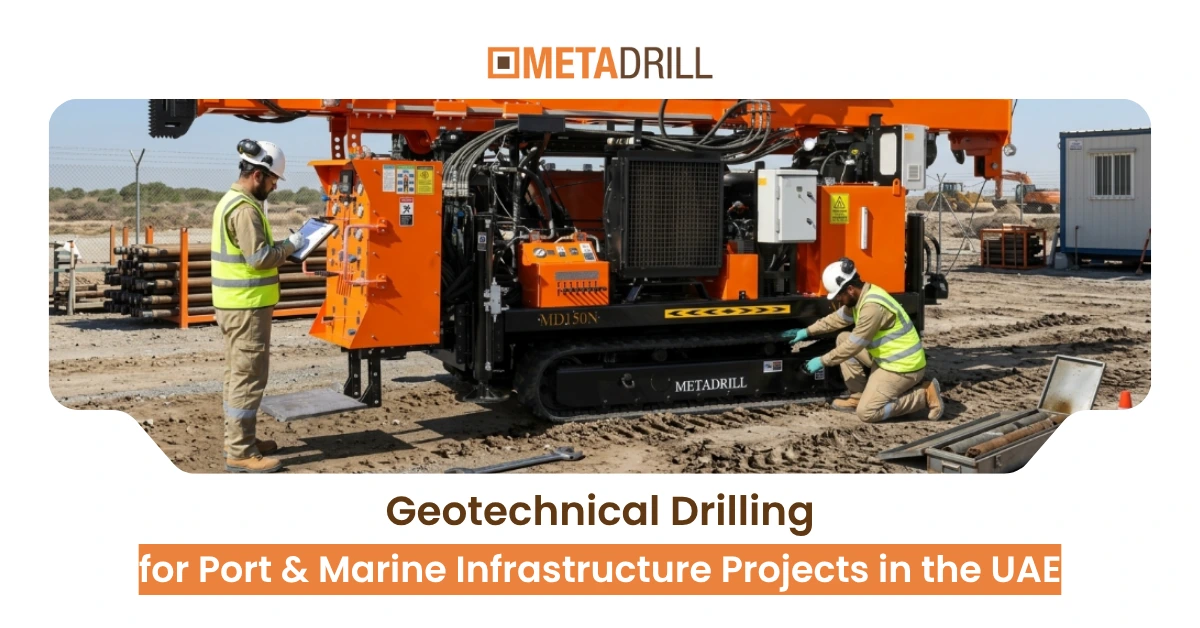
For coastal UAE work, useful rig characteristics include stable tracking, good low-speed control, reliable casing handling, suitable pumps and easy maintenance access. Remote monitoring can also help fleet managers when equipment is spread across several port work fronts. MetaDrill manufactures rigs in Sharjah and offers tools, spares, service and remote-monitoring options, which can be useful for contractors needing regional support. Port and marine contractors in particular often bid work across several GCC coastlines, so a rig that can be serviced consistently in the UAE, Saudi Arabia or Oman avoids being tied to a single project's location. The exact model should still be selected around borehole depth, method, platform loading and access. For ground conditions inland from the coast, our guide to Dubai's sandy and rocky subsurface covers the equivalent equipment questions.
Plan for recovery before the rig reaches the edge
Marine sites should also have a recovery plan for stuck equipment, failed access or sudden platform restrictions. A tracked rig may still need assistance if fill becomes saturated or a temporary surface deteriorates. Agree towing points, lifting information and exclusion zones in advance. The same preparation applies to tooling recovery from unstable boreholes. It is much easier to manage a difficult event when the rig's weight, lifting points, crane access and environmental controls are known before the incident occurs.
Coordinate drilling with marine operations
Port projects rarely give the drilling team complete freedom over the work area. Vessel movements, crane operations, tidal windows, security restrictions and nearby construction can all interrupt access. The daily drilling plan should therefore be coordinated with the port or marine coordinator, not prepared in isolation. If a borehole requires casing or a long uninterrupted coring run, schedule it when the work zone can remain stable. Good coordination also reduces the temptation to rush sampling because another operation needs the area. On busy UAE ports, logistics discipline can be as important as drilling speed.
Sample handling deserves a clean area
Marine sites can be wet, muddy and crowded. Even so, recovered soil and rock samples need a clean place for labelling, photographing and boxing. Protecting samples from seawater, fuel and drilling-fluid contamination is especially important when chemical or durability testing is planned. A small dedicated sample station can improve the quality of the final geotechnical record without slowing production, while also helping laboratory teams preserve traceability and chain-of-custody records.
Closing
Geotechnical drilling marine UAE projects is a specialist form of site investigation because ground uncertainty, saline exposure, working-platform constraints and environmental controls all arrive together. Good site investigation services plan for those conditions before mobilization. If the boreholes are stable, the rig is properly supported, samples are protected and the crew understands the port's procedures, the resulting data can give designers the confidence they need for foundations that will spend their life at the edge of the Gulf.
When evaluating equipment or a drilling partner for marine work, our manufacturer buyer's checklist covers the regional support and durability questions worth asking. To plan a port or waterfront investigation, contact the MetaDrill team.
Question to the public:
A guide to geotechnical drilling for UAE ports and marine infrastructure, covering reclaimed ground, shallow groundwater, corrosion, work platforms, marine HSE and site investigation planning.