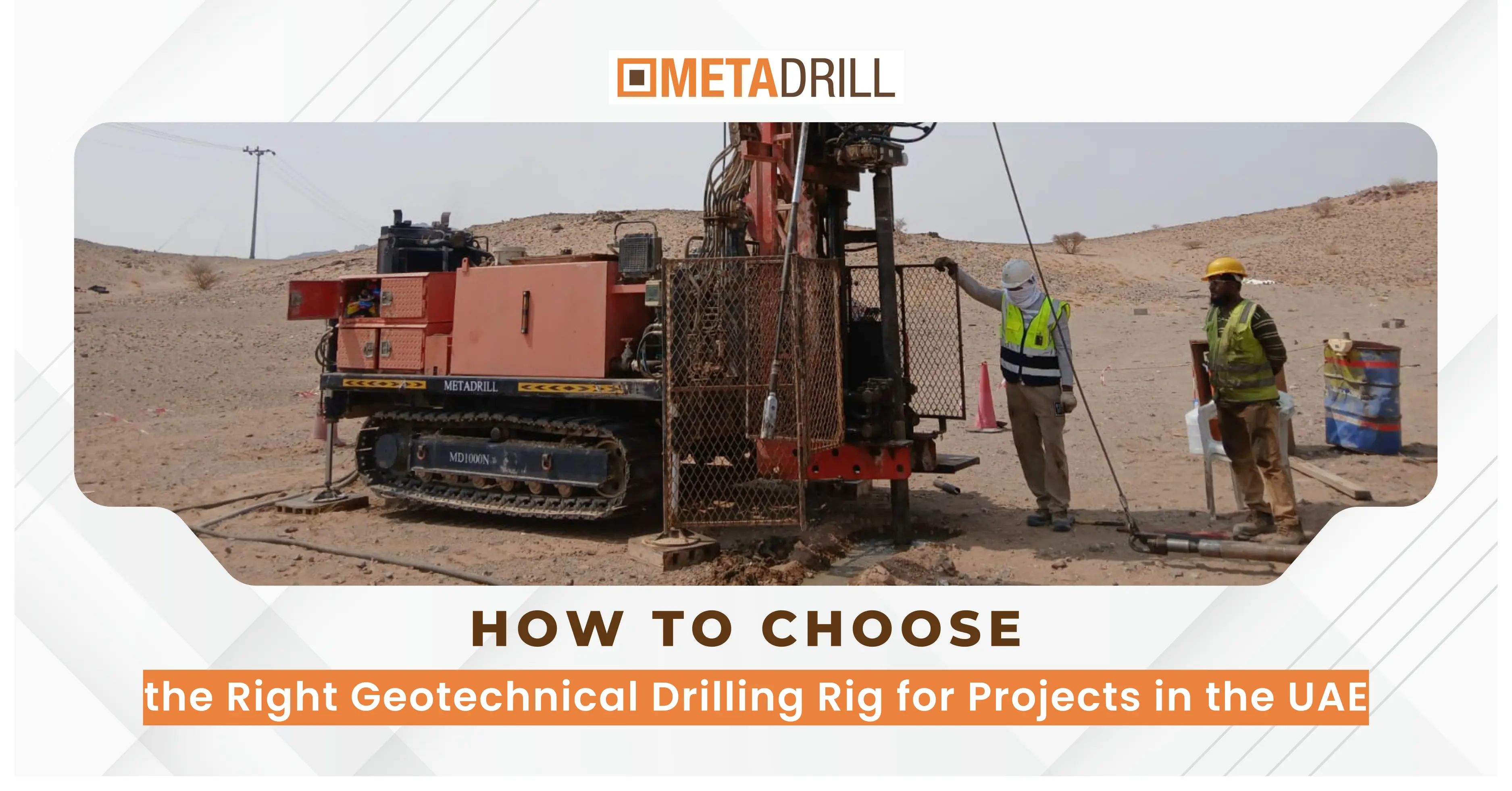
A rig can look perfect on a specification sheet and still be the wrong machine for the job. That becomes obvious very quickly on a UAE site. A crawler that feels comfortable on a prepared plot in Sharjah may behave very differently on loose desert sand outside Al Ain, reclaimed ground near Dubai’s coast, or a congested foundation site where the crew has only a narrow access gate and a few hours to mobilize.
For contractors and site investigation teams, choosing a geotechnical drilling rig in the UAE is therefore less about buying the biggest machine and more about matching the rig to the work you actually do. Depth matters, of course. So do torque, feed control, rod handling and sampling capability. But in this market, heat management, mobility, maintenance access, spare-parts support and the ability to move between geotechnical drilling and exploration drilling can have just as much influence on lifetime productivity.
A good purchase should make the driller’s day easier, not create a new list of problems for the workshop. Here is how I would evaluate the decision before signing a purchase order.
Start with the ground, not the brochure
UAE geology can change sharply from one project to another. Inland sites may involve loose to dense sands, cemented horizons and variable rock, while coastal and reclaimed projects can introduce shallow groundwater, saturated material and stability challenges. In the Northern Emirates, harder formations can put a completely different load on the rotary head and tooling.
That is why the first question should be practical: what formations do your crews encounter most often? If most work is shallow site investigation with SPT and sampling, your ideal geotechnical drilling equipment will not be the same as a fleet built around long wireline core programs. If the company also bids for exploration drilling, you may want a platform that can handle a broader tooling range and deeper coring without becoming unnecessarily heavy for everyday urban work.
This is also where project records help. Look back at the last 20 or 30 boreholes your team drilled. How deep were they? Where did productivity drop? Which formations caused stuck tooling or repeated rod handling? That history tells you far more than a generic 'maximum depth' number.
Treat Dubai heat and desert dust as design inputs
A machine that spends July and August outdoors in the Emirates works in a harsh thermal environment. High ambient temperatures increase the burden on engines, hydraulic oil, seals and cooling systems. Fine dust adds another layer of stress by loading filters and finding its way into components if inspection routines are weak.
When you compare geotechnical drilling rigs for sale, ask how the cooling package is sized, how easily operators can clean heat exchangers, where filters are located, and whether daily checks can be done without dismantling half the machine. Easy maintenance sounds like a small benefit until a crew is losing two productive hours in 46°C heat because a routine service point is difficult to reach.
For desert terrain, mobility matters too. Crawler stability, ground clearance, machine balance and practical transport dimensions should be reviewed against the sites you actually visit. The best rig is the one that reaches the borehole location safely and starts work without a complicated recovery operation.
Coastal and marine projects change the calculation
Dubai and Abu Dhabi continue to develop waterfront, port and marine infrastructure. On these projects, contractors may be dealing with reclaimed fills, saline environments, high groundwater and limited working platforms. The drilling method, casing strategy and flushing system become important, but the rig itself also needs stable feed control and a layout that crews can operate safely in wet, corrosive conditions.
If marine and coastal work is part of your pipeline, do not buy solely for dry-land projects. Ask whether the rig can be configured for the sampling, coring and support equipment your consultants normally specify. Consider hose routing, exposed components and cleaning requirements after saline exposure. A few extra minutes spent planning wash-down and corrosion prevention can protect a much larger capital investment.
Local authority, port operator and client requirements also vary. Depending on the site, mobilization, access, environmental controls, HSE documentation and testing procedures may need to satisfy Dubai Municipality, Abu Dhabi DMT, free-zone or port requirements as well as project specifications. The rig should fit the work method, not force the method to fit the rig.
Match the rig to the drilling method
Geotechnical drilling is not one technique. A contractor may need SPT, disturbed and undisturbed sampling, rotary wash boring, core drilling or water-well capability. Exploration drill rigs may also need longer rod handling, stronger pullback and a rotary head suited to continuous coring.
MetaDrill’s current range spans the MD40, MD75N, MD150N, MD600N and MD1000N. The company’s brochure positions the MD600N and MD1000N as geotechnical and water-well rigs for surface exploration. The MD600N is rated for deeper wireline work up to 600 m with NQ rods, while the MD1000N extends that envelope to 1,000 m NQ, subject to formation, tooling and operating conditions. Those figures are useful, but they should not be treated as the only buying criteria.
If you are specifically searching for an MD600N for sale, look at your expected hole profile, rod size, transport plan, crew competence and percentage of deep work. A machine with unused capacity can be just as inefficient commercially as a machine that is constantly working at its limit.
Think like a GCC fleet manager, not a one-project buyer
UAE contractors increasingly work across Saudi Arabia, Oman, Qatar and other GCC markets. That changes the buying conversation. A rig purchased for one Dubai contract may later be sent to a remote Saudi project where spare-parts delays cost far more than the price difference between two machines.
Before comparing purchase prices, calculate the cost of ownership. Include consumables, preventive maintenance, expected component life, transport, training, service response and parts availability. MetaDrill is based in Sharjah and states that it supports customers with training, technical guidance, distributor-based parts availability, remote monitoring and CCTV systems. For a regional buyer, that local support structure can be commercially relevant because uptime is what ultimately pays for the rig.
Procurement teams should also ask who will support the machine after commissioning. Will operators receive training? Are service manuals clear? Can common maintenance be handled in-house? Is technical help available when the rig is outside the UAE? Those questions deserve the same attention as torque and horsepower.
Use a simple decision test before you buy
I like to reduce the final decision to four checks. First, can the rig complete at least 80 to 90 percent of your expected work without awkward compromises? Second, can your crew transport, set up and maintain it efficiently? Third, is the local support strong enough to protect uptime? Fourth, does the machine still make sense if your business expands into deeper geotechnical drilling or exploration drilling over the next three to five years?
If two rigs appear similar, ask for a demonstration or test them against a representative drilling cycle. Measure setup time, rod handling, penetration, fuel use, sample quality and operator fatigue. Real field data has a way of cutting through sales language very quickly.
Choosing the right geotechnical drilling rig UAE contractors can depend on is ultimately a balance of capability and practicality. Buy for the ground you drill, the climate you operate in, and the support network you will rely on when the schedule gets tight. MetaDrill’s UAE-made lineup gives regional teams several configurations to evaluate; the sensible next step is to match a model to your borehole program rather than starting with price alone.
Question to the public: