You found a rig abroad. The price looks good. Then the questions start. What's the duty? Who clears it at the port? How long until it's on site?
Plenty of buyers only ask after they've paid. Don't be one of them. Here's how importing a drill rig into the UAE tends to work, with a worked cost example so the numbers aren't abstract.
Fair warning: customs rules, tariff codes and fees change. Treat this as a map of the process, and confirm every figure with your customs broker before you commit.
The steps, in order
1. Pin down what you're importing. A rig comes with a chassis, a mast, a power pack, rods, tooling and spares. Each can fall under a different tariff code. Get the commercial invoice to list items separately.
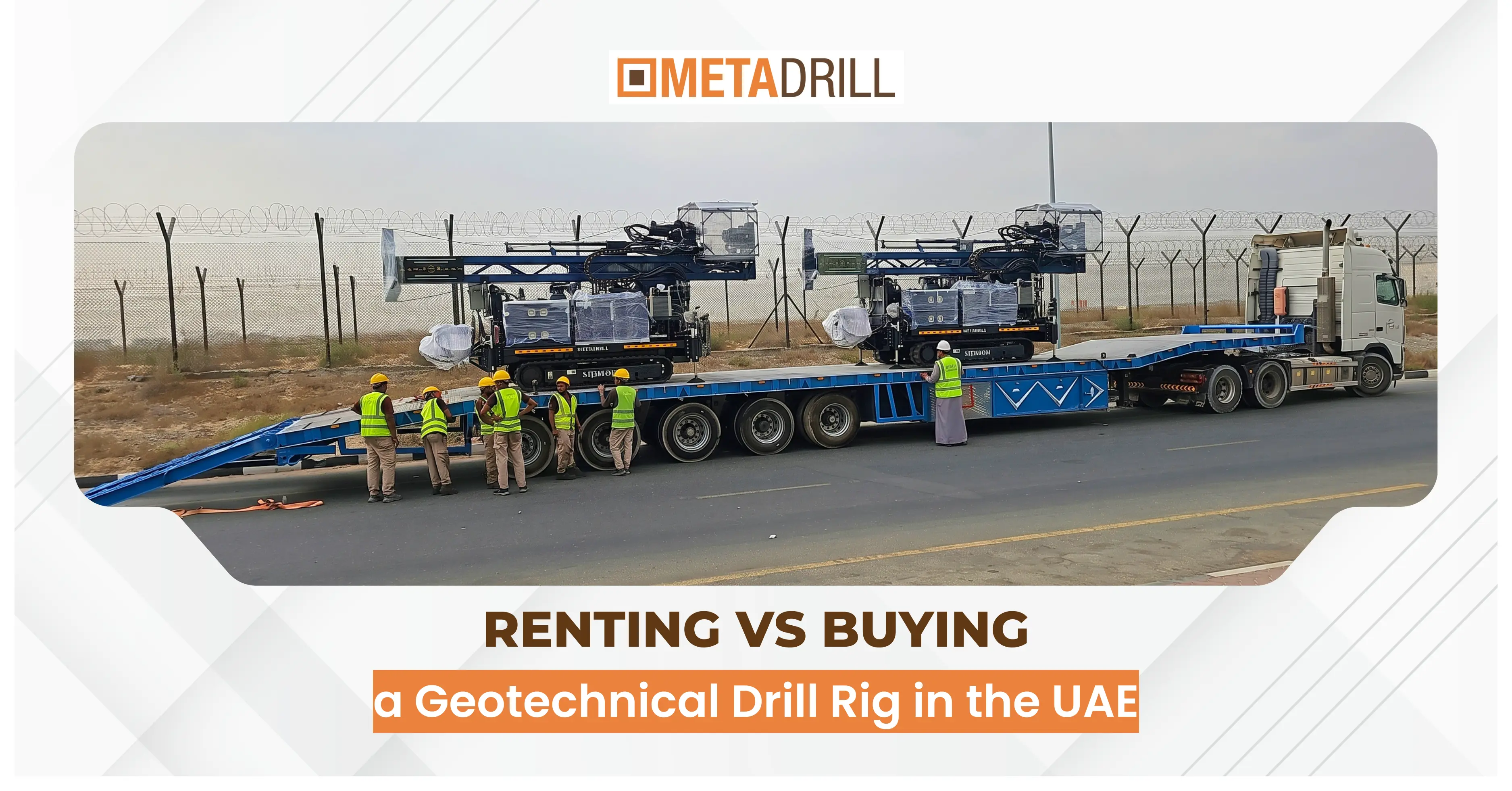
2. Choose the shipping route. A track-mounted rig usually travels as heavy or oversized cargo on a flat rack or in a container, depending on size. Truck-mounted rigs may roll on and off a vessel. The mode changes the freight cost and handling.
3. Get the paperwork ready. The usual set is a commercial invoice, packing list, bill of lading and certificate of origin. Your broker will tell you what else is needed for your emirate and port.
4. Clear customs. Duty and VAT are assessed on the declared value plus freight and insurance.
5. Move it inland. Port to yard, yard to site, with permits for oversize loads if needed.
A worked example (illustration only)
Say you buy a rig for AED 400,000 and freight and insurance come to AED 20,000.
| Item | Amount (AED) |
|---|---|
| Rig price | 400,000 |
| Freight and insurance | 20,000 |
| Customs value (CIF) | 420,000 |
| Duty at 5% | 21,000 |
| Value for VAT | 441,000 |
| VAT at 5% | 22,050 |
| Total on top of CIF | 43,050 |
So duty plus VAT adds roughly AED 43,000 on a rig worth AED 420,000 landed. That's the cost on paper.
Three things stop this being a quote. The tariff code decides the actual duty rate, and some machinery may differ from 5%. VAT is generally recoverable if your company is VAT-registered and the rig is used for taxable business, so the cash cost is often a timing issue. And the table skips broker fees, port charges, local transport and any inspection costs. Ask a customs broker and your accountant before you rely on any figure here.
Where the delays hide
Lead times depend heavily on the supplier. A made-to-order rig can take weeks or months to build before it ships. Then shipping adds more, and clearance more again.
The usual delays aren't glamorous.
- Paperwork errors. A mismatched description on the invoice and bill of lading can hold a container.
- Missing technical documents. Some equipment needs manuals, certificates or conformity papers.
- Port congestion and booking windows. Oversized cargo needs a slot.
- Inland transport permits. Heavy loads can't just drive off.
Hidden costs buyers forget
The invoice isn't the budget. Add these.
- Spare parts you'll need in the first year.
- Training for operators who haven't used this model.
- Calibration, test run and commissioning.
- Warranty terms and what's covered if parts need to come from abroad.
- Currency movement between order and payment.
The last two catch people out. A rig that breaks in month four and needs a part from overseas can sit idle for weeks, and an idle rig is a day-rate loss.
Importing vs buying a UAE-built rig
Here's the honest comparison.
Importing can make sense if a specific machine isn't available locally, or if a particular model suits a unique job. But it brings customs risk, longer lead time and a long supply line for parts.
Buying a rig built in the UAE removes most of the import steps. MetaDrill builds its rigs in the UAE, in SAIF Zone, Sharjah, so for a UAE buyer there's no international freight, and spares and service are close. We wrote about that choice in why MetaDrill is based in the UAE.
Not sure you should buy at all? Read renting vs buying a rig in the UAE and mistakes contractors make when renting.
Questions to ask any rig supplier
- What's the build time, and what's the shipped lead time?
- Which spares ship with the rig, and which can I get locally?
- Who commissions and trains our operators?
- What does the warranty cover, and who honours it?
- What are the published specs, and can I see them on a data sheet?
You can compare MetaDrill's published specs yourself on the drills page: the MD75N, MD150N, MD600N and MD1000N. Bits, rods and samplers are listed under drilling tools.
New or used?
If you're importing, you'll face this choice, and it affects the customs side too.
A used rig can look cheap, but check the history. Ask for the service record, hours on the engine and rotation head, and any past repairs. Ask whether the manufacturer still supplies parts for that model. Some older machines become expensive to keep running once parts dry up.
Customs may treat used machinery differently from new, and some jurisdictions have age or condition rules for imported equipment. Confirm with your broker before you buy. A rig that can't clear customs is a very expensive paperweight.
New rigs bring warranty cover and a clear technical file. That helps with both customs paperwork and your own planning.
Transit risk and insurance
A rig travels through several hands: factory, trucker, port, ship, port again, trucker again. Damage can happen at any step.
Marine cargo insurance is the usual way to cover that. Ask your broker what policy fits and what it excludes. Check that the rig is lashed and protected properly for sea transport, with exposed hydraulic fittings and electrical parts sealed. Take photographs before loading and on arrival, because they're the best evidence if you ever need to make a claim.
Keep an eye on the clock too. Port storage fees can grow quickly if paperwork delays clearance.
A simple timeline template
Every project differs, but most imports follow this shape.
- Order and deposit
- Build or preparation at the supplier
- Factory inspection and acceptance
- Booking of freight and documents
- Sea or road transit
- Customs clearance and payment of duty and VAT
- Inland transport
- Commissioning, training and handover
Ask the supplier for realistic dates for steps 2 and 5, then ask your broker for steps 6 and 7. Add them up. Then add a margin, because one step will slip.
Quick answers
What duty applies to a drilling rig in the UAE? It depends on the tariff code. A 5% rate is common for many goods, but confirm the code and rate with your broker.
Is VAT paid on imports? Yes, at the standard rate, though registered businesses can usually recover it.
Can I avoid importing altogether? Yes, by buying from a UAE manufacturer.
Talk to us about supply
If you're comparing a UAE-built rig against an import, send us your depth and test requirements and we'll tell you what fits and how supply works. See our distributors page, or contact us.
Question to the public:
Duties, VAT, shipping and paperwork for importing a drill rig into the UAE, with a worked cost example and the case for buying locally instead.