Coastal ground can be deceptive. A site may sit only a few hundred metres from a completed waterfront development, yet the subsurface profile beneath it can change from loose reclamation fill to carbonate sand, soft layers, cemented horizons and shallow groundwater within a short distance.
That variability is why marine and wetland site investigation in the UAE deserves its own drilling strategy. The objective is not simply to reach a target depth. The team has to preserve borehole stability, recover representative samples and work safely around water, soft access conditions and saline exposure. The geotechnical drilling equipment selected for coastal UAE work needs to support that process rather than fight it.
From Dubai’s ports and artificial islands to Abu Dhabi’s waterfront infrastructure, coastal investigations reward careful planning. The rigs, casing, fluids, platforms and sampling systems all have to work as one spread.
Why coastal UAE ground is different
Many UAE waterfront projects are built on or near reclaimed land. Reclamation can create highly variable fill, while natural coastal deposits may include loose sands, silts, shells and weak carbonate materials. Groundwater is often shallow, and salinity can influence both field operations and long-term equipment care.
For geotechnical drilling, the immediate challenge is keeping the borehole open long enough to obtain useful data. In loose saturated sand, an unsupported hole may collapse quickly. That affects sampling depth, SPT quality and the ability to advance casing cleanly.
Site investigation services therefore need a method selected around the expected ground profile. A standard dry-land approach may work for the first few metres and then become inefficient once groundwater or unstable material is encountered.
Casing and drilling fluids are often the quiet heroes
On unstable coastal ground, casing is not an inconvenience; it is part of the investigation system. Advancing casing as the borehole progresses can isolate loose zones and reduce collapse. Depending on the formation and investigation objective, rotary wash methods or carefully selected drilling fluids may also help carry cuttings and support the hole.
The choice of fluid needs to respect sample quality and environmental requirements. The team should know what the consultant intends to test in the laboratory before selecting additives. Over-treatment can alter the material being investigated, while under-supporting the hole may lead to repeated collapse.
This is a good example of why geotechnical drilling equipment should be considered as a package. Pump capacity, casing tools, rods and the rig’s feed control all influence whether the method works smoothly.
SPT and sampling need extra discipline in saturated material
SPT is common in site investigation, but the test is only useful when the borehole is properly prepared and the procedure follows the applicable project standard. In loose, saturated sands, poor hole cleaning or heave can distort results. Experienced crews monitor the bottom condition and avoid treating the SPT as a simple production task.
Undisturbed sampling can be even more sensitive. Soft marine deposits may require suitable thin-wall or specialized samplers, careful handling and fast transfer to protect moisture condition. Rock or cemented layers call for a different approach again.
Good site investigation services should be able to explain how they will switch methods when the profile changes. Coastal geology rarely rewards a rigid plan.
Rig selection depends on the working platform
A crawler-mounted rig can be ideal on prepared coastal fill, but wetlands, soft ground or barge work introduce new constraints. Ground bearing pressure, platform stability, lifting points, access routes and tidal conditions can all influence the machine choice.
For short programs, drill rig rental or drilling equipment rental may make more sense than mobilizing a large owned rig from another emirate. The rental decision should still be technical: the machine needs the right torque, feed, mast, pump and tooling for the expected ground.
When reviewing geotechnical drilling rigs for sale for a fleet that regularly works on marine projects, I would give extra weight to corrosion-resistant details, easy wash-down, protected electrics, hose organization and parts support. Salt has a habit of finding every neglected surface.
Heat and salt are a difficult combination
Coastal UAE drilling is not cooler simply because the sea is nearby. Summer heat remains severe, and high humidity can make working conditions harder for crews. Hydraulic cooling, engine airflow and scheduled breaks need to be planned together.
Salt exposure adds long-term maintenance risk. At the end of a shift, cleaning should focus on joints, fasteners, electrical connectors, track assemblies and areas where saline water can sit. Protective coatings help, but they do not replace housekeeping.
The practical rule is simple: inspect more often than you would on a dry inland project. A small corrosion point caught early is cheap. A seized connection discovered during mobilization is not.
Environmental and local project controls cannot be an afterthought
Marine and wetland work often sits inside sensitive or tightly controlled zones. Port operators, free-zone authorities, developers and local government entities may each impose access, HSE, spill-control, waste and working-hour requirements. The exact rules depend on the project, so the drilling method statement should be checked against the relevant authority and client documentation before work begins.
Fluid containment, fuel handling and disposal of drilling returns deserve special attention near water. The fact that a product is commonly used in drilling does not automatically make unrestricted discharge acceptable. Contractors should plan containment and disposal routes before the first borehole.
For GCC projects outside the UAE, the same mindset applies: local environmental approvals and client specifications should lead the method. Do not assume a Dubai procedure can be copied unchanged into Oman, Qatar or Saudi Arabia.
You can also check: New vs Used Geotechnical Drill Rigs for Sale in Dubai: A Buyer's Guide
Building a coastal-capable equipment strategy
Teams that regularly work near the coast benefit from standardizing a coastal kit: casing systems, pumps, spill-control equipment, wash-down gear, corrosion-protection materials, sampling consumables and a defined inspection routine. That reduces the number of decisions made under pressure on site.
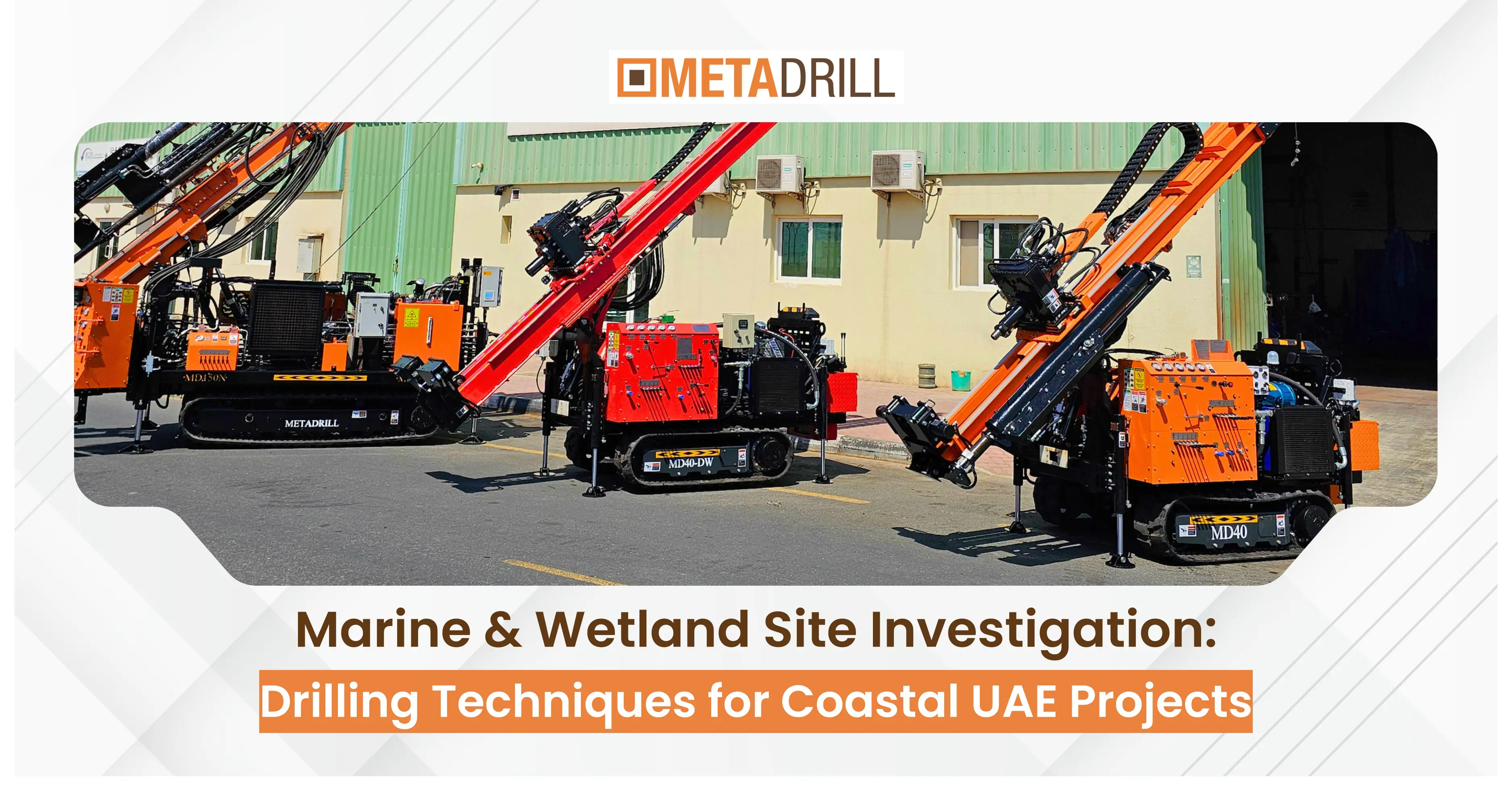
MetaDrill manufactures geotechnical drilling equipment in Sharjah and offers a range from compact rigs to deeper-capacity MD600N and MD1000N platforms, along with tools, parts and support. For a coastal fleet, the best model depends on borehole depth, access, sampling method and whether the same machine will also work on inland or exploration programs.
Marine site investigation is rarely won by brute force. It is won by control: stable holes, clean samples, disciplined maintenance and a rig package that suits the platform. For coastal UAE projects, that combination is what turns difficult ground into reliable engineering information.
Question to the public: