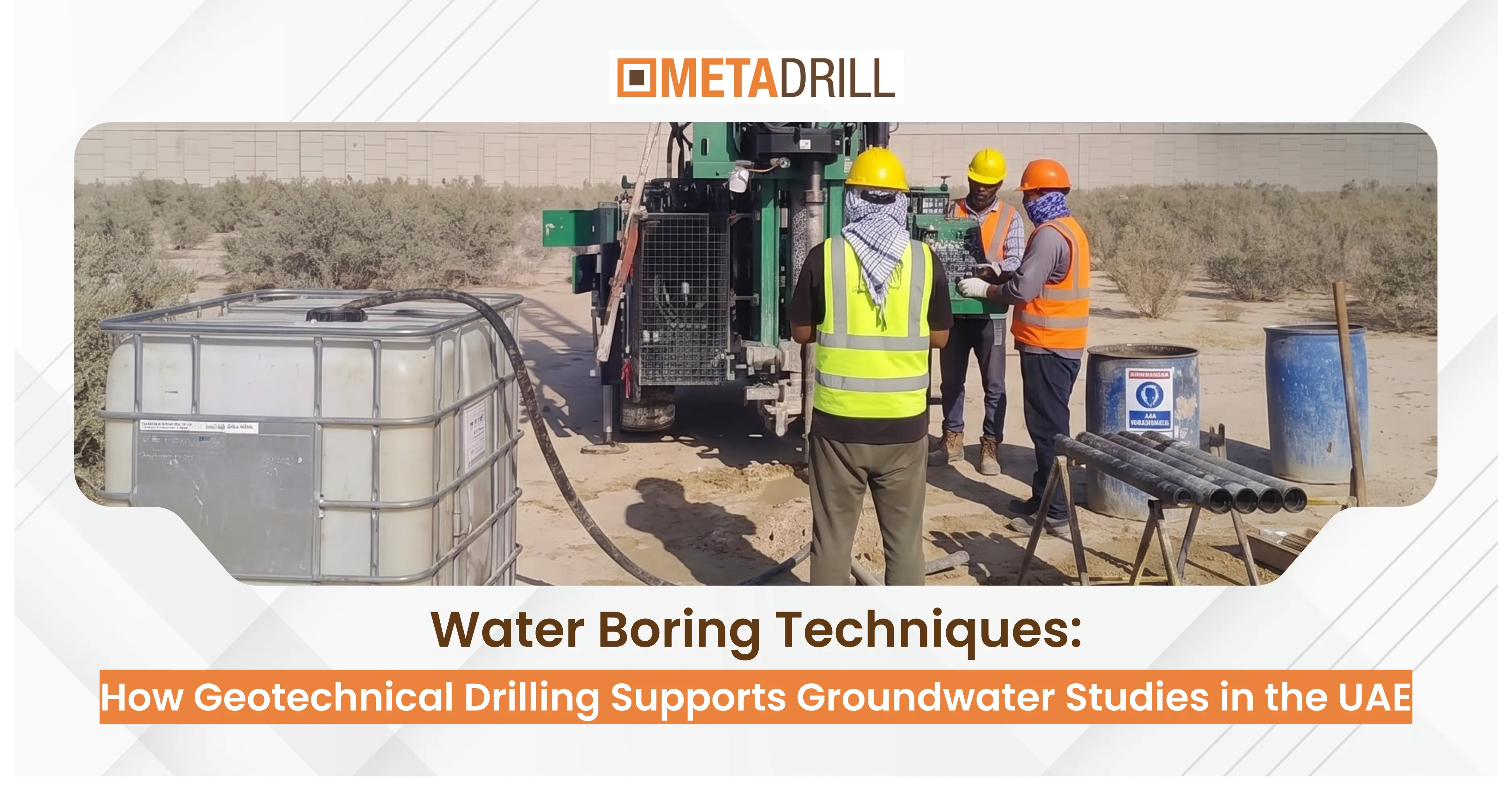
Groundwater is easy to underestimate in the UAE because the landscape looks dry. Then a contractor opens a deep excavation near the coast and water appears almost immediately. Or an inland infrastructure project encounters a water-bearing layer that changes dewatering plans, foundation assumptions and construction sequencing.
Groundwater studies in the UAE are therefore not only about finding water. They help engineers understand where groundwater sits, how it moves, how levels change over time and what its chemistry may mean for construction or environmental decisions. Geotechnical drilling provides the physical access needed to collect much of that information.
The drilling technique matters. A poorly constructed monitoring bore can create misleading readings, connect separate aquifers or clog before the study is complete. The objective should always guide the hole.
Start with the question the groundwater study needs to answer
A groundwater investigation for a basement excavation is different from a regional hydrogeological study. One may focus on shallow water level and expected inflow; another may need deeper stratigraphic information, aquifer testing or water-quality samples.
Before geotechnical drilling starts, the team should define target depth, expected geology, monitoring period and the type of data required. That determines borehole diameter, drilling method, casing, screen interval and whether temporary observations or permanent monitoring wells are needed.
This planning is especially important in the UAE, where coastal aquifers can be saline and inland groundwater conditions may vary significantly with geology and development history.
Common boring approaches for groundwater work
Rotary drilling is widely used when the investigation needs to advance efficiently through mixed formations. Depending on the ground, water, air or drilling fluid may be used to remove cuttings and stabilize the hole. In loose formations, casing may need to advance with the borehole to prevent collapse.
For shallow work, auger-based methods can sometimes provide a relatively clean approach, particularly where groundwater is not too deep. In harder rock, core drilling may be required to understand fractures and identify water-bearing zones.
The right geotechnical drilling equipment is the system that produces the information the hydrogeologist needs without unnecessarily disturbing the formation. Speed matters, but not at the expense of a usable monitoring point.
Monitoring wells need careful construction
Once the target interval is reached, a groundwater monitoring installation typically relies on screen and casing placed at the required depth, with suitable filter material and seals used to isolate the monitored zone. The exact design should follow the project specification and the hydrogeologist’s requirements.
Development after installation is important because drilling can introduce fines into the surrounding formation. A poorly developed well may yield cloudy samples or respond slowly to changing groundwater levels.
Field teams should record installation depths, materials, screen interval, groundwater observations and any unexpected loss or inflow during drilling. Those notes can be as valuable as the final water-level reading when the data is interpreted later.
Coastal UAE groundwater brings salinity and corrosion into the picture
Dubai and Abu Dhabi coastal projects often deal with shallow saline groundwater. That affects drilling equipment, sampling materials and the interpretation of water chemistry. It can also influence foundation durability and dewatering strategy, which is why dependable groundwater data matters early in design.
Rigs working near the coast should be cleaned after saline exposure, and monitoring-well materials should be selected for the intended chemistry and study duration. If water samples are required, the team must avoid introducing contaminants through dirty hoses, lubricants or unsuitable containers.
Marine and reclaimed projects can also have variable fill over natural deposits. A groundwater reading from one layer should not automatically be assumed to represent the entire site. Proper sealing and screen placement are critical.
Desert sites create a different set of problems
Inland groundwater studies may involve long distances between boreholes, limited water supply for drilling and extreme heat. Site logistics become part of the technical plan. A rig that needs constant external support can lose productivity when the nearest service point is hours away.
Cooling systems, filters and hydraulic components need close attention during summer. Crews also need heat-stress controls and safe working arrangements in line with UAE requirements and client HSE rules.
For deep programs, machine capacity becomes more important. MetaDrill’s brochure lists the MD1000N rig as a geotechnical and water-well platform for surface exploration, with an NQ depth rating up to 1,000 m under suitable conditions. A buyer searching for an MD1000N rig for sale should still verify the actual groundwater program, rod size, pump requirements and formation before assuming that maximum depth equals ideal operating depth.
Pumping tests and water quality need good boreholes first
A pumping test can only be as reliable as the well used to conduct it. If the screen is placed poorly, the bore is not developed or separate water-bearing zones are connected, the drawdown response may be difficult to interpret.
The same is true for water-quality sampling. Purging, stabilization, sample handling and field measurements should follow the project’s defined procedure. The drilling contractor may not be responsible for laboratory interpretation, but the way the borehole is drilled and completed directly affects sample quality.
That is why groundwater work sits between geotechnical drilling and hydrogeology. The rig provides access, while the investigation design turns that access into defensible data.
You can also check: What Sets a Trusted Geotechnical Drilling Company in Dubai Apart
Regulatory and GCC context
Groundwater abstraction, dewatering, discharge and environmental monitoring can be regulated differently depending on the emirate, authority and project location. Contractors should check the applicable municipality, environmental authority, developer, free-zone or client requirements before drilling, pumping or discharging water. The same applies to projects elsewhere in the GCC; permits and environmental controls are not interchangeable between countries.
For equipment buyers, regional support also matters. A groundwater rig may travel from a Dubai project to Saudi Arabia or Oman, where the cost of a failed pump or unavailable seal can exceed the saving from a cheaper machine. Geotechnical drilling rigs for sale should therefore be evaluated on serviceability and parts availability as well as depth.
MetaDrill manufactures its rigs in Sharjah and supports geotechnical, exploration and water-well applications. For groundwater studies UAE teams should begin with the study objective, then select the rig and tooling around the data required. A borehole is only useful when it tells the right story about the water below it.
Question to the public: