A drilling crew can lose half a shift because of one missing crossover. Anyone who has worked on site knows the feeling: the rig is ready, the borehole location is cleared, the consultant is waiting—and a small tool that nobody checked is still in the yard.
That is why geotechnical drilling equipment in the UAE should be planned as a complete field system, not as a rig plus whatever fits on the support truck. Heat, dust, long travel between sites and coastal conditions make weak preparation expensive. The core equipment needs to drill and sample accurately, while the support gear needs to keep the crew safe and productive when conditions change.
The following is not meant to be a warehouse inventory. It is the practical equipment stack I would expect a UAE site investigation crew to think through before mobilization.
The rig is the center of the spread—but not the whole spread
The geotechnical drill rig has to match the drilling methods, expected depths and access constraints. Compact equipment may be better for villas, urban plots and restricted basement sites. Larger machines are more appropriate when deep coring, heavier casing or longer rod strings dominate the program.
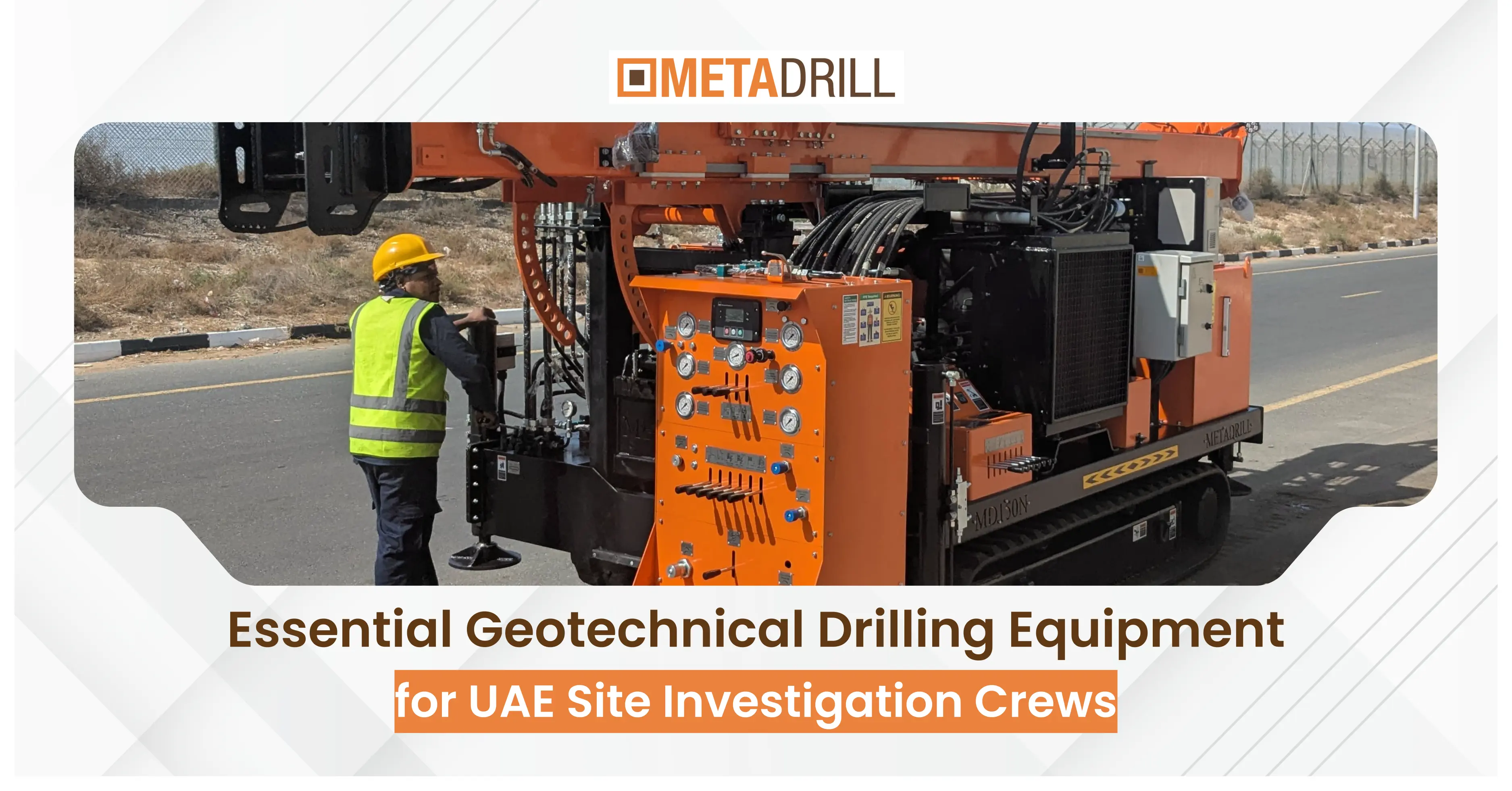
MetaDrill’s UAE lineup currently includes the MD40, MD75N, MD150N, MD600N and MD1000N. Buyers looking at geotechnical drilling rigs for sale should select around actual hole profiles rather than simply choosing the highest capacity available.
Once the rig is chosen, the rest of the drilling rig equipment should be matched to it. Pumps, rods, casing and tooling that are poorly sized for the machine create bottlenecks even when the rig itself has more than enough power.
SPT equipment deserves proper attention
For many UAE investigations, SPT remains a routine part of the borehole program. The system includes the hammer, rods, sampler and the procedures used to prepare the hole and record blows. Automatic SPT systems can reduce repetitive manual work and improve consistency, but calibration and maintenance still matter.
MetaDrill lists an automatic SPT hammer as an optional feature on its MD600N and MD1000N. Whatever system is used, crews should keep the equipment clean, inspect wear points and maintain calibration records in line with the project’s specified standard.
A bent rod, damaged sampler or poorly maintained hammer can undermine the value of a test that looks perfectly normal on a field sheet. That is why the small items around the rig deserve the same discipline as the machine itself.
Rods, casing and core tooling should be organized like critical assets
Drilling rig tools take a beating. Rod threads, casing shoes, core barrels, bits and adapters move through abrasive ground, water and drilling fluids all day. When they are thrown into a truck without inspection or identification, small damage becomes tomorrow’s downtime.
A strong crew separates serviceable and suspect tooling, protects threads, records wear and keeps the common crossovers easy to find. For exploration or rock-coring work, core barrels, reaming shells and bit selection should be planned around the formation rather than carried as a random mix.
On coastal projects, rinse salt-contaminated drilling rig tools and equipment before storage. In desert work, protect clean threads from blowing sand. These are simple habits, but they extend tooling life noticeably.
Pumps, water management and borehole support equipment
Water is part of many drilling methods, but water management is often treated as an afterthought. The pump needs enough capacity for the selected technique, hoses need to be rated and protected, and the site needs a plan for supply, recirculation and containment.
On a remote desert site, the challenge may be getting enough clean water to the rig. On a coastal site, the concern may be containing returns and preventing saline or contaminated water from damaging equipment. If drilling fluids are used, mixing and dosing equipment should be included in the mobilization plan.
For deeper work, pump performance can limit progress long before the rotary head does. That is one reason buyers should look at the complete drilling package rather than comparing rig horsepower alone.
Heat-ready support gear belongs on the equipment list
UAE summer conditions affect both the machine and the crew. Shade, drinking water, heat-stress monitoring, fire extinguishers and appropriate PPE are not accessories. They are part of the operating system.
For the rig, carry the filters, fluids, hoses and common service parts that are most likely to be needed during the program. A clean compressed-air source, pressure-washing equipment and basic diagnostic tools can save hours on dusty sites. Maintenance tools should be organized so operators can complete daily checks without improvising.
Client and authority requirements vary, so HSE equipment should be reviewed against the project method statement, local rules and site induction requirements. A port project in Jebel Ali may expect a different control set from an inland utility investigation.
Do not forget field logging and sample handling
The rig creates access to the ground; the investigation is only useful if the samples and records remain traceable. Crews need sample bags, jars, core boxes, labels, waterproof markers, depth blocks and a disciplined handover process.
Photos should be consistent, and borehole records should capture changes in recovery, groundwater, tooling and drilling behavior. Digital tools can help, but a digital system is only as good as the information entered into it.
This is where supervisors earn their keep. They connect drilling observations with what the engineer sees in the sample. When that loop works, the drilling rig equipment becomes part of a reliable data-production process rather than just a hole-making machine.
You can also check: Marine & Wetland Site Investigation: Drilling Techniques for Coastal UAE Projects
Build a standard UAE mobilization kit
A useful way to reduce missed items is to create a standard mobilization kit for each type of work: urban geotechnical, desert infrastructure, coastal investigation and deep coring. Each kit should have a tool list, consumables list, critical spares and HSE requirements.
For GCC contractors, standardization also makes cross-border mobilization easier. Saudi, Oman or Qatar projects may have different approvals and site rules, but the core equipment stack can remain consistent while the compliance pack changes.
The best geotechnical drilling equipment UAE crews can carry is equipment they know, inspect and maintain. MetaDrill’s rigs, tools and spare-parts support are designed around that day-to-day productivity. Before the next mobilization, do not only ask whether the rig is ready. Ask whether the entire spread is ready to finish the borehole without coming back to the yard.
Question to the public:
A field-focused guide to essential geotechnical drilling equipment for UAE site investigation crews, from rigs and SPT systems to pumps, casing, sampling tools and desert-ready support gear.