Micropiles get specified when a normal piling rig can't get in. A basement with a 3 m ceiling. A courtyard behind a heritage facade. An old block that needs to carry two more floors.
Those same constraints land on the investigation rig first. Before anyone grouts a micropile, someone has to drill boreholes in the same cramped space and find out what the ground is doing. That's the job this article covers.
One note on scope. MetaDrill builds site investigation rigs, not piling rigs. So this is about the borehole programme that comes before a micropile or underpinning design, not the installation.
Why retrofit sites are harder to investigate
On a green-field plot you drill where the engineer asks. On a retrofit you drill where the building lets you.
Access is the first problem. Doorways, lift shafts and low slabs set the maximum rig size, which can mean breaking the rig into small parts. Then there's the building itself. Old foundations, buried services and backfilled basements mean you can hit concrete at 1.5 m on a site the desk study called sand.
Vibration matters too. Next to an older structure, hard hammering is a risk the owner won't accept without a monitoring plan.
And the records are often poor. Drawings go missing between owners. A foundation depth written on a plan from the 1990s may not match what's in the ground.
What the boreholes need to answer
For a micropile or underpinning design, the engineer wants a short list of numbers.
Where the competent layer starts. Micropiles transfer load into a bearing layer, so the first question is how deep it is and how variable. In coastal UAE ground that can be dense sand, cemented sand-rock, or limestone.
What lies above it. Loose fill, old foundations and soft layers all affect how the pile is drilled and grouted.
Groundwater. Level, and chemistry too. Chloride and sulfate attack steel and grout over decades, which matters when the pile is meant to outlast the extension it's holding up.
Strength of rock sockets. If piles will bond into rock, the rock cores drive the design, and good core recovery is the point. See why SPT and coring are used together.
The existing foundation. Sometimes the most useful borehole is the one that proves what the old footing actually is.
Drilling in tight spaces
This is where rig choice stops being a spec-sheet question and becomes a logistics one.
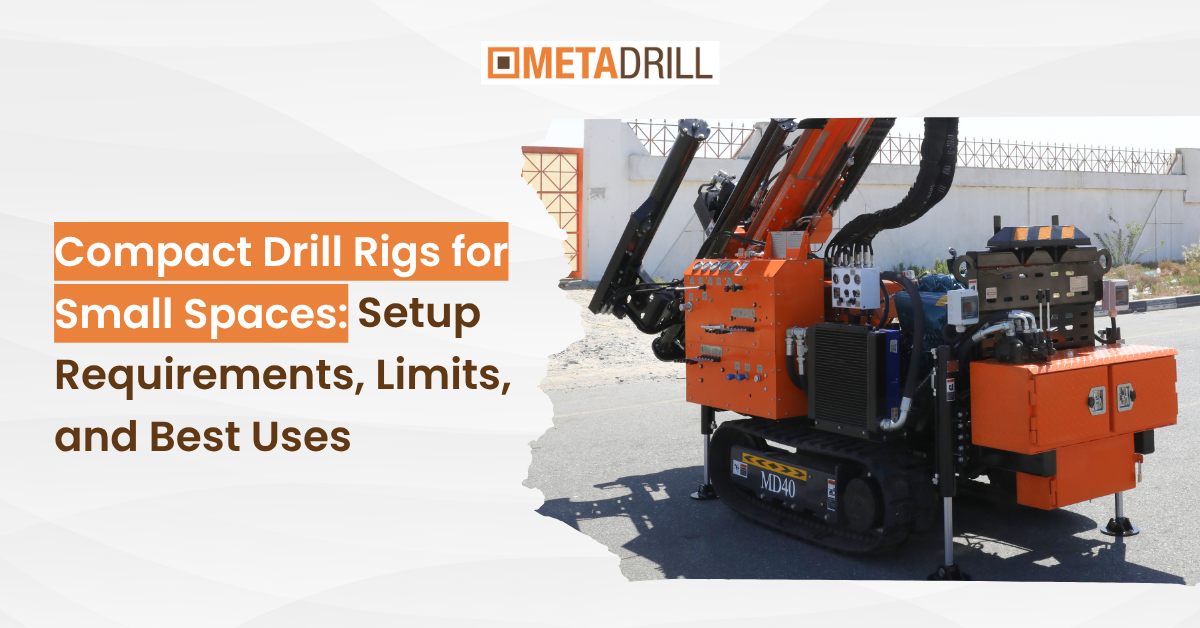
Compact rigs can be broken into smaller sections and carried through openings, then rebuilt in the room. We covered the working methods in drilling in confined spaces and the trade-offs in compact rigs for tight sites. If your access is really narrow, inside the MD40 walks through MetaDrill's smallest rig.
Honest advice: measure the access route before you pick the rig. Doors, stair turns, lift loads, floor loading. Then pick.
Water, dust and noise indoors
Drilling inside or beside an occupied building brings problems that open sites don't have.
Water is the big one. Coring and many drilling methods need flush, and you need somewhere for it to go. A sump and a pump, with the returns controlled. Nobody enjoys a slurry puddle in a lobby.
Dust and noise are easier but still need a plan, particularly if neighbours or tenants stay in the building. Agree working hours with the property manager early. In the UAE, building owners and community managers often have their own rules on top of the authority ones.
Do make sure anything you drill through is surveyed first. Services under old slabs aren't always where the as-built says.
Sampling choices that suit retrofit work
Retrofit boreholes are usually fewer and shallower than new-build ones, so each one has to earn its place.
In soil, SPT gives strength figures and a sample. In rock, wireline coring gives a continuous core, which is the thing a micropile designer wants when sizing a rock socket. You can read more about drilling fluids and hole stability in our note on borehole stabilization.
If the programme is small, it may be cheaper to rent than to buy. The reasoning is in renting vs buying a rig in the UAE.
Matching the rig to the job
For retrofit work, look at the smaller end of the range first. The drills page lists every rig with its published specs, including the MD75N and MD150N. Check depth rating, weight, and whether the rig can be split down for access.
If your programme also includes deeper rock coring on the same site, the MD600N lists an automatic SPT hammer and N-wireline coring to 600 m, but it's a bigger machine, so confirm access first. Bits, rods and samplers are on the drilling tools page.
How the designer uses your data
It helps to know where the numbers go, because it tells you what to protect on site.
For a micropile, load is carried into the ground through the bond between grout and soil or rock, and through end bearing in some cases. The designer takes the layer profile from your logs, picks the bearing layer, and estimates the bond capacity per metre in each layer. A wrong depth to rock, or a missed soft layer, changes the pile length and cost directly.
Rock cores matter because the socket length depends on rock strength. Poor recovery leaves a gap in the data, and gaps tend to get filled with conservative assumptions, which means longer piles. So the quality of the coring is worth real money to the client.
Groundwater data matters for another reason. Grout quality can suffer in flowing water or in aggressive ground. If the borehole logs show strong groundwater flow or high chloride and sulfate, the designer may change the grout mix or add protection.
An example of how it goes wrong (hypothetical)
Take a four-storey building where the owner wants two more floors. The old drawings show shallow footings on dense sand. The investigation team gets one small rig into the basement and drills four holes. Three show dense sand. One shows a pocket of loose fill beside an old service trench, which the drawings never mentioned.
Without that fourth hole, the underpinning design would have treated all corners alike. With it, the designer lengthens the piles at that corner and adds a check on the trench. That one hole, perhaps a day's work, changed the design.
The lesson is simple. On retrofit sites, ground varies in small distances because people have dug, filled and laid pipes there for years. Plan more holes than the footprint seems to need, and place them where the old record is weakest.
Quick answers
Can you drill boreholes inside an existing building? Yes, with a compact rig and a plan for water, dust and noise. Access is usually the limiting factor.
Do I need rock cores for micropiles? If the piles will be socketed into rock, yes. The cores set the design.
What does MetaDrill supply here? Investigation rigs and tooling. Micropile installation is a separate specialist job.
Scoping a retrofit investigation?
Send us the site access dimensions, the structure type and what you know about the existing foundation. We'll suggest a rig that fits through the opening and a tooling set to match. See our site investigation services and solutions, or contact us.
Question to the public:
Planning micropiles or underpinning in the UAE? See what site investigation drilling must find in tight, built-up sites, and which rigs fit.