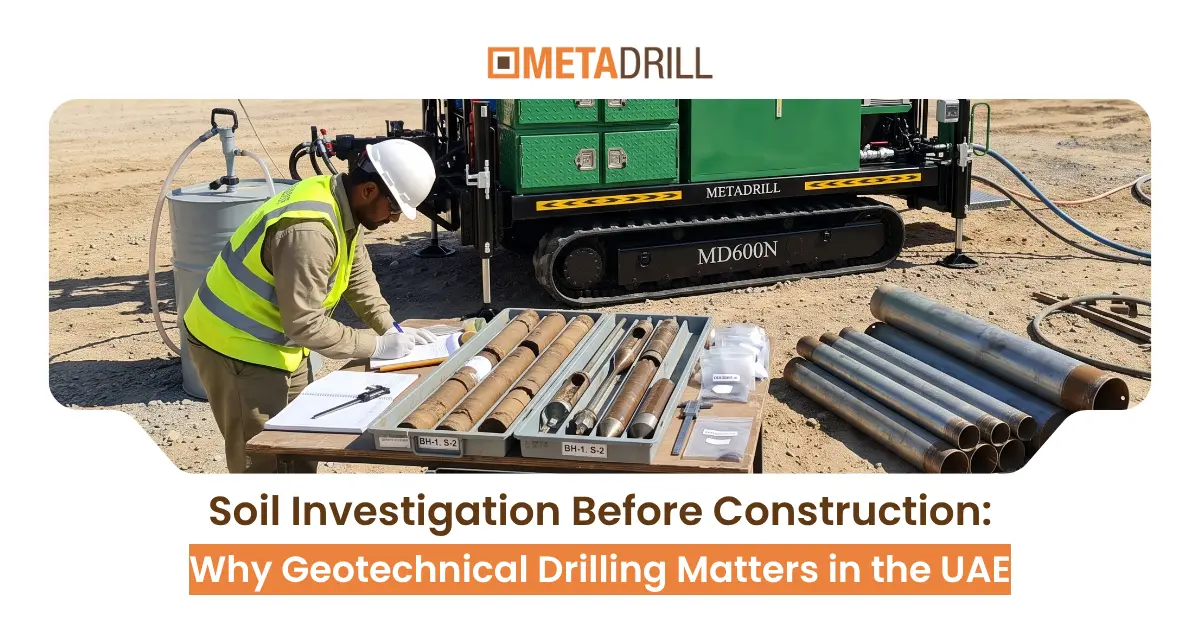
The cheapest uncertainty to remove is the one you find before construction
A project team can redesign a foundation on paper for a
fraction of the cost of changing it after piling has started. That is the
business case behind geotechnical drilling
UAE, soil investigation work. The purpose is not to produce a thick
report for the permit file. It is to reduce uncertainty while the project still
has room to react. If weak fill, shallow groundwater, cavities, soft layers or
unexpectedly hard rock are identified early, designers can adapt the foundation
and contractors can price the work more accurately.
What soil investigation is trying to answer
Every investigation begins with engineering questions. What
materials lie beneath the site? How dense or strong are they? Where does rock
begin? How variable is the ground across the footprint?
Is groundwater likely to affect excavation? Could settlement
become critical? Geotechnical drilling creates the boreholes needed to collect
samples, carry out in-situ tests and recover rock core. Laboratory testing then
adds information on properties such as grading, moisture, density, strength or
chemical aggressiveness. Together, these data allow the geotechnical engineer
to build a ground model rather than rely on surface appearance.
UAE sites are not all the same sand
The phrase 'desert soil' hides a lot of variation. Inland
projects may encounter loose aeolian sands, dense sand, cemented horizons or
gravelly materials. The Northern Emirates can involve more competent rock and
steeper terrain.
Along the coast, reclaimed fill and shallow groundwater
become more common. Industrial areas may have made ground from previous
development. For that reason, a borehole schedule copied from another project
can be misleading. Good drilling services work from the current site's
objectives and geology, not from assumptions about the emirate as a whole.
Why groundwater needs early attention
Groundwater can change excavation methods, temporary works,
concrete durability planning and programme risk. On coastal sites in Dubai and
Abu Dhabi, saline groundwater may sit close to formation level. On deeper
excavations, dewatering and potential ground movement need to be considered
before work starts. The drilling phase provides the first opportunity to
observe water conditions, although engineers may specify monitoring wells or
repeat readings for a more representative level. Treating groundwater as a side
note is one of the easiest ways to create problems later.
Heat and logistics affect the investigation itself
The UAE environment shapes fieldwork. In summer, engines and
hydraulic systems operate under heavy thermal load, crews need heat-stress
controls and sample handling can become more difficult if boxes are left
exposed. Dust quickly loads filters and can contaminate work areas. Remote
desert sites add water, fuel and access challenges; congested city plots add
the opposite problem, with narrow gates and strict working hours. Geotechnical
drilling equipment has to fit those logistics. A rig that is technically
powerful but difficult to mobilize can still slow the investigation.
Coastal and marine development raises the stakes
Ports, waterfront districts, causeways and reclaimed islands
often involve variable fill, saturated layers and aggressive groundwater. On
these projects, geotechnical drilling may support not only building foundations
but quay walls, revetments, dredging assessments and temporary marine works.
Borehole stability, casing and drilling-fluid management can become more
demanding. Environmental controls may also be tighter because fluids and
cuttings cannot simply be discharged. A contractor experienced in coastal
drilling services will plan those details before mobilization rather than
improvise at the water's edge.
Regulations turn data into a formal requirement
Dubai Municipality publishes soil and foundation testing
regulations and refers to soil-test information in building permit procedures.
Other emirates and project owners have their own approval routes and technical
requirements. Large developers, ports and industrial zones may issue additional
specifications. The lesson is practical: the geotechnical consultant should
confirm the governing requirements before setting borehole depths, test
frequencies and reporting formats. A technically sound investigation can still
create approval delays if the documentation does not match the project
authority's expectations.
What a good drilling contractor contributes
The consultant designs the investigation, but field
execution determines the quality of the evidence. A good drilling team
maintains borehole stability, uses suitable tooling, protects samples, records
depths accurately and communicates when the ground differs from expectations.
They also keep the rig serviced so mechanical problems do not dictate the
testing programme. MetaDrill's
UAE operation focuses on rigs, tooling, spares, refurbishment and rental support,
which reflects a wider truth in this market: reliable geotechnical drilling
depends on the equipment ecosystem as much as on the machine itself.
This matters beyond a single UAE site. Many drilling and
consulting firms working here also bid projects in Saudi Arabia, Oman and
Qatar, so equipment that can be supported regionally, not just locally,
protects the programme if a rig needs to move between GCC countries
mid-contract. When comparing rigs or drilling partners on that basis, it's
worth reviewing our new vs used drill rig buyer's guide for
how support and total cost of ownership should factor into that decision.
The cost of skipping investigation
Skipping or under-scoping a site investigation can appear to
save money during early design. The saving is usually small compared with the
cost of a surprise during excavation or piling. Unexpected rock may slow
production.
Weak fill may require deeper foundations. High groundwater
can change shoring and dewatering. Even a few days of delay on a major UAE
project can outweigh the cost of additional boreholes. Soil investigation is
therefore less about satisfying procedure and more about buying information
before uncertainty becomes expensive.
Use the investigation as a decision tool
The strongest project teams keep the investigation tied to
design decisions. They ask what each test is meant to confirm and whether new
field observations change the original assumptions. If conditions are more
variable than expected, the programme can be adjusted while the rig is still
mobilized. That is usually cheaper than discovering the gap during
construction. In that sense, drilling is not simply data collection; it is an
active risk-management process that should stay connected to the engineer making
the final recommendations.
Match investigation scope to construction risk
The number and depth of boreholes should reflect the
structure, footprint and uncertainty, not a generic rule of thumb. A light
industrial building on a well-understood site may need a different programme
from a deep basement beside existing structures. Likewise, roads, bridges,
tanks and marine works impose different engineering questions. The consultant
should explain what each borehole or test is intended to resolve. When drilling
services understand that purpose, crews can flag unexpected changes more intelligently
and protect the samples that matter most. This is one reason experienced site
teams treat the investigation plan as a working engineering document rather
than a list of coordinates to complete.
Closing
For UAE construction teams, soil investigation is one of the
first opportunities to protect programme, budget and structural performance.
Geotechnical drilling turns hidden ground conditions into usable engineering
data, provided the work is planned correctly and executed with suitable
equipment. Whether the project is a desert solar site, a Dubai tower or a
marine facility, the principle stays the same: investigate before you commit.
Good drilling services do not eliminate ground risk, but they make that risk
visible early enough to manage it.
For a closer look at how these principles apply to tall
buildings, see our guide on geotechnical drilling for high-rise foundations in Dubai.
To plan a borehole programme or discuss equipment for your project, contact the
MetaDrill team.
Question to the public:
Why soil investigation and geotechnical drilling matter before construction in the UAE, with practical guidance for desert, coastal and infrastructure projects