The tower starts below ground
When a 40- or 60-storey tower is shown on a rendering, the attention naturally goes upward. Geotechnical engineers look the other way. For geotechnical drilling high-rise Dubai projects, the critical question is how loads will travel into the ground and what settlement, rock quality and groundwater conditions could complicate the foundation system. A deep basement and heavily loaded columns demand more than a superficial understanding of the site. Boreholes, SPT data, rock core, groundwater observations and laboratory testing give the design team the evidence needed to decide whether piled foundations, raft systems or a combination is appropriate.
Why high-rise investigations are different
A low-rise warehouse and a landmark tower may sit on the same general geology, but the investigation intensity is unlikely to be the same. High-rise structures generate larger and more concentrated loads, and their performance can be sensitive to differential settlement. Boreholes may need to extend well below the anticipated founding level to identify weaker zones that could affect pile behaviour. The geotechnical drilling company must therefore understand the design intent, not just the requested borehole depth. A crew that treats every job as a standard twenty-metre investigation can miss the engineering purpose behind deeper work.
Dubai geology can change beneath a single plot
Dubai sites frequently include sand deposits over cemented layers and carbonate rock, with groundwater conditions influenced by location and development history. Reclaimed or coastal plots can add heterogeneous fill and shallow water. Even within one project, rockhead may vary and core quality can change between boreholes. That variability matters to pile design. Engineers need enough information to build a representative ground model rather than selecting a single 'typical' borehole and assuming the rest of the site behaves the same way.
SPT and rock coring need to be treated as data, not routine
SPT values can help characterize granular soils, but they only become useful when the procedure is controlled and records are reliable. Hammer energy, sampler condition, borehole stability and test depth all matter. Once rock is reached, core recovery, RQD and fracture description become central to interpretation. For high-rise work, the drilling crew and logging geologist should communicate closely. If a run is lost, highly fractured or contaminated by poor drilling practice, that is not a minor field inconvenience; it can affect how the engineer interprets founding strata.
Groundwater matters to basements as much as piles
Dubai towers often include multiple basement levels. Groundwater therefore influences excavation support, waterproofing, dewatering strategy and construction risk, not just geotechnical calculations. Borehole observations are useful, but a single water strike during drilling is not always the final groundwater level. Monitoring installations or repeat readings may be required by the investigation plan. Coastal sites deserve particular caution because groundwater can be shallow and saline. Site investigation services should capture these conditions early enough for the structural, geotechnical and temporary-works teams to coordinate.
Equipment capability: depth is only part of the question
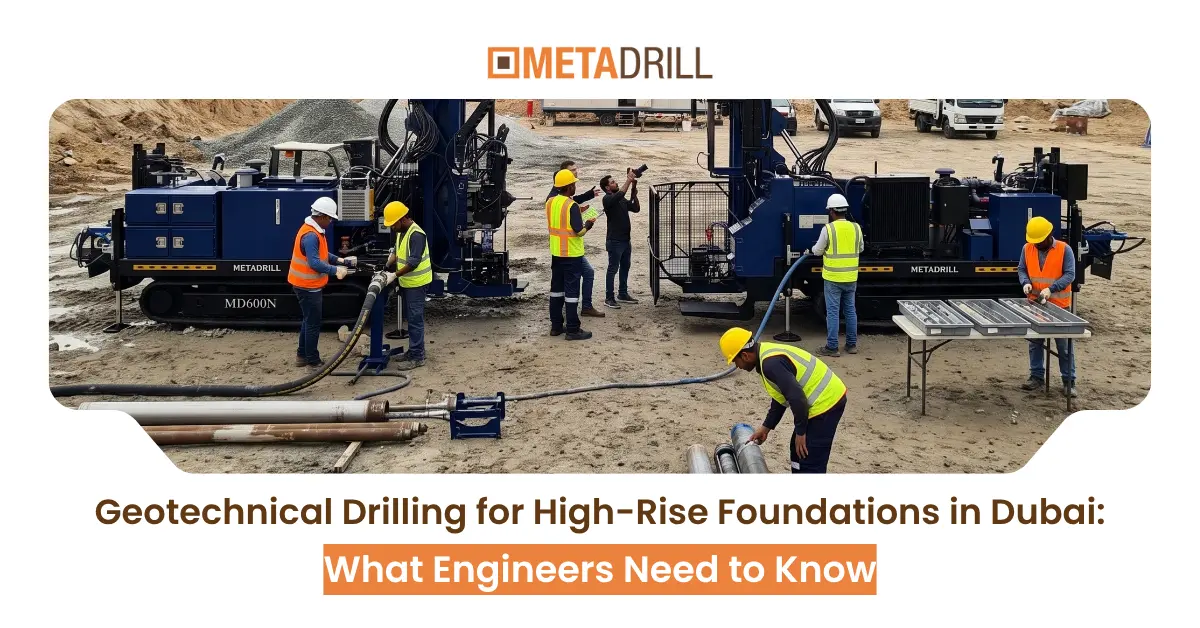
Deep investigations need rigs with enough pullback, rotary control and rod handling for the planned hole profile, but urban tower sites also impose access constraints. The machine may have to work beside hoarding, existing utilities or neighbouring structures. A compact tracked rig can be valuable, while deeper coring may require more substantial capacity. MetaDrill's MD600N, for example, is specified for N-wireline drilling up to 600 m under stated conditions and offers track or truck configurations with optional angular drilling and automatic SPT. That is far beyond many routine building boreholes, but the broader point is flexibility: the rig should cover the actual investigation method without making mobilization unnecessarily difficult.
Contractors bidding high-rise investigations often work across the wider GCC as well as the UAE, and a deep tower programme can tie up a rig and crew for months. When comparing equipment or drilling partners for this type of work, parts availability, technical support and the ability to keep a rig running through a long coring programme matter as much as the headline depth rating. Our guide to choosing a geotechnical drilling rig for UAE projects covers how to weigh that support network alongside technical specification.
Summer conditions influence field quality
Dubai's heat is not just an equipment maintenance issue. It can affect how the whole site investigation is organised. Crews may work around midday restrictions or project heat-stress controls, water supply has to be planned, and equipment checks need to be more frequent. Dust control matters too, especially around hydraulic systems and sample handling. A rushed crew working with an overheating rig is more likely to produce poor records or damaged samples. Good planning protects both people and data quality.
Regulatory context and documentation
Dubai Municipality publishes the Dubai Building Code and separate soil and foundation testing regulations. High-rise projects may also face additional developer, free-zone or master-community requirements. Engineers should confirm the applicable authority and project specification at the start, then make sure the borehole plan, testing schedule and reporting format align with those requirements. The investigation report eventually supports design approvals, so traceability matters. Borehole coordinates, levels, depths, test records and laboratory certificates should be organised as engineering evidence, not as paperwork completed after the fact.
What engineers should ask the drilling team
Before mobilization, engineers should be able to answer a few practical questions with the driller. How will the borehole be stabilised through loose sand? What core system will be used in rock? Is the SPT hammer calibrated or verified as required?
How will groundwater readings be taken? What happens if refusal occurs above the planned depth? Is there enough casing and tooling on site to respond to changing conditions? These conversations save time because they turn the investigation specification into an executable field plan.
Investigation should continue to inform construction
The value of the ground model does not end when the design is issued. Pile records, excavation observations and groundwater behaviour during construction can be compared with the investigation. If the actual conditions differ materially, the geotechnical engineer can revisit assumptions while there is still time to respond. That feedback is particularly useful on complex Dubai sites where deep basements and closely spaced foundations create interaction between permanent and temporary works. A well-run investigation gives the project a baseline against which construction observations can be judged.
Coordinate drilling with the foundation design team
High-rise investigations work best when the structural and geotechnical teams review preliminary findings while drilling is still in progress. If rockhead is deeper than expected in one zone, if core quality falls sharply, or if groundwater behaviour changes near a basement boundary, the engineer may want an additional borehole or deeper termination. Making that decision while the rig is still on site is usually cheaper than remobilizing later. It also helps the drilling contractor understand which intervals need especially careful recovery. On large Dubai towers, this feedback loop can prevent the site investigation from becoming a fixed checklist that continues unchanged even after the ground has shown that the original assumptions were incomplete.
Closing
High-rise geotechnical work is successful when the drilling programme gives the design team confidence, not simply when all boreholes reach their target depth. For geotechnical drilling high-rise Dubai projects, the best site investigation services combine capable equipment, disciplined testing, experienced logging and an understanding of local ground conditions. MetaDrill supplies UAE-made rigs and support from Sharjah, but the engineering principle applies regardless of supplier: choose a geotechnical drilling company and equipment setup that can deliver dependable subsurface information under the real constraints of a Dubai tower site.
For the broader principles behind planning a UAE investigation, see our guide on soil investigation before construction. To discuss rig configuration or crew support for an upcoming tower programme, contact the MetaDrill team.
Question to the public:
What engineers should know about geotechnical drilling for high-rise foundations in Dubai, from deep boreholes, testing and foundation decisions.