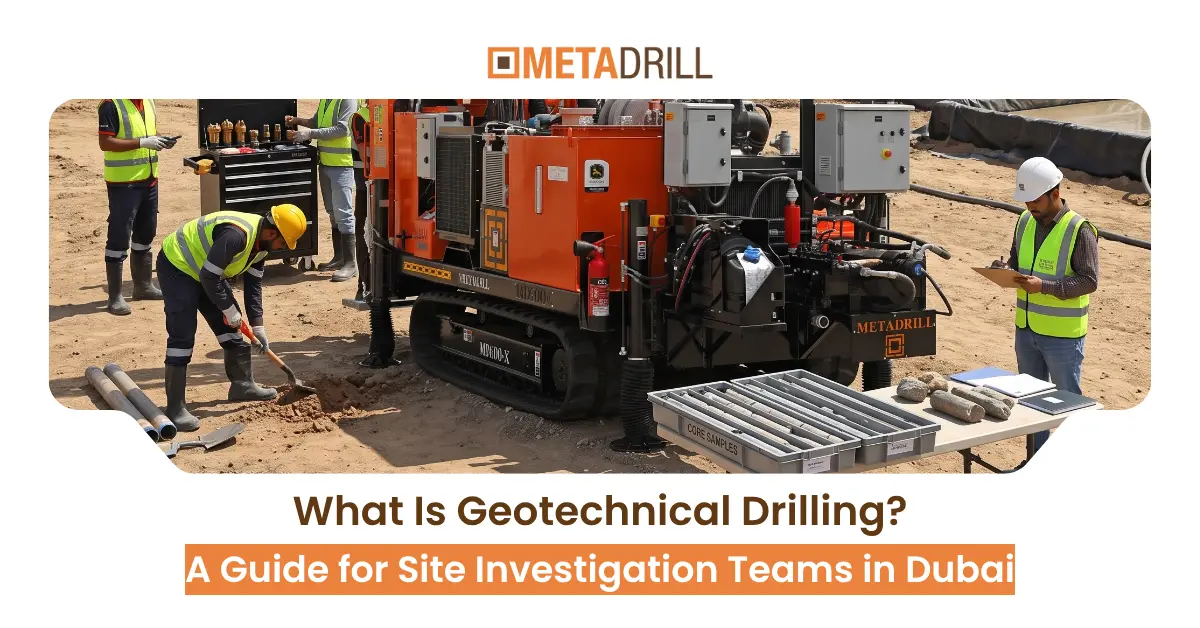
Before the foundation design, someone has to prove what is underground
A plot can look perfectly level and still hide a difficult foundation problem. That is why geotechnical drilling in Dubai happens before piling, shoring or major excavation on many projects. The drilling crew's job is not simply to make a hole.
It is to recover reliable information about soil, rock and groundwater so the geotechnical engineer can decide how the ground is likely to behave under the proposed structure. On a high-rise site that may mean identifying dense sand over weak rock. On reclaimed coastal ground it may mean tracking loose fills and shallow groundwater. The quality of those observations influences foundation depth, temporary works and sometimes the entire construction sequence.
What geotechnical drilling actually does
Geotechnical drilling creates controlled access to the subsurface. Boreholes are advanced to planned depths, samples are recovered, in-situ tests are completed and the borehole log records how the ground changes with depth. Depending on the scope, a team may use wash boring, rotary drilling, core drilling, SPT sampling or a combination of methods. The objective is evidence. Engineers need to know what materials are present, where groundwater sits, how resistant the soil is to penetration and what the rock core says about strength and fracture condition. That data becomes part of the site investigation report rather than remaining a visual impression from the ground surface.
Why Dubai ground conditions deserve site-specific investigation
Dubai is famous for sand, but describing every project as a sand site is too simplistic. Natural aeolian and marine deposits, cemented layers, fill, reclaimed ground and carbonate rock can all appear within the same metropolitan area. Conditions near the coast can change over short distances because of historical shoreline development and reclamation. Inland sites may have dense sand layers or cemented horizons that affect penetration and sampling. That variability is precisely why geotechnical drilling in Dubai should follow the project investigation plan instead of relying on assumptions from a neighbouring plot.
SPT, sampling and coring: what the crew is trying to collect
For many building investigations, the Standard Penetration Test is one of the most familiar field tests. A split-spoon sampler is driven using a standardized hammer system and the recorded blows provide an indication of soil resistance when the procedure is correctly controlled. Where rock is encountered, coring can recover continuous material for logging and laboratory testing. Disturbed and undisturbed soil samples may also be specified. The choice depends on the engineering questions being asked. Good geotechnical drilling equipment should help the crew control drilling, handle rods safely and perform the required sampling method without unnecessary disturbance.
Heat, dust and productivity
The investigation programme may be designed on paper in an air-conditioned office, but the rig works outside. Dubai summer heat changes daily operating routines. Cooling systems, hydraulic oil, filters and hoses need closer attention, and drillers have to watch both equipment temperature and crew exposure. Dust compounds the problem by loading filters and collecting around moving components. None of this changes the principles of soil investigation, but it does affect how reliably the work can be executed. A rig with sensible service access and strong cooling can help the team protect productivity during long summer shifts.
Marine and coastal projects add another layer
Coastal Dubai introduces conditions that inland teams do not always face. Reclaimed land may contain variable fill; groundwater can be shallow; saline water raises corrosion concerns; access platforms may have strict loading and environmental controls. Marine works can also require specialized positioning, casing and fluid-management procedures. That is why coastal site investigation should be planned with the same care as the drilling itself. The rig configuration, sampling method and support equipment all need to match the approved work platform and the geotechnical objectives.
How regulations fit into the work
Dubai Municipality's building framework includes soil and foundation testing requirements, and building permit procedures refer to submission of soil-test information for relevant projects. In practice, consultants and contractors also work to project specifications, approved method statements and commonly referenced standards such as ASTM or BS procedures where specified. The important point for a site team is not to improvise the test method. Sampling intervals, SPT procedure, borehole depth, groundwater observations and reporting should follow the investigation scope and the governing requirements for that project.
Choosing equipment for a Dubai investigation
When teams compare geotechnical drilling rigs for sale, depth is only one line on the specification sheet. Torque, pullback, feed stroke, rod handling, SPT integration, transport dimensions and site access may be more important on a typical urban job. MetaDrill's UAE-made range includes compact and larger rigs for geotechnical and exploration work, with the MD600N positioned as a multipurpose geotechnical and exploration rig with optional automatic SPT capability and track or truck mounting. That kind of versatility can be useful for contractors moving between foundation investigations, deeper coring and regional projects.
Whether that equipment makes more sense to own or rent depends heavily on how often your team actually mobilizes and whether work extends beyond the UAE into the wider GCC. Our renting vs buying guide walks through that decision, including how regional parts and support availability should factor into it.
What a good investigation looks like
A successful investigation is boring in the best possible way. The rig reaches the planned locations. Samples arrive labelled and intact. SPT records are clear. Core recovery is documented.
Groundwater observations are taken properly. The geologist can correlate the boreholes without guessing what happened in the field. That outcome depends on the whole team: driller, helpers, geologist, engineer and laboratory staff. Geotechnical drilling is the physical link between the design office and the ground itself. When that link is reliable, later engineering decisions become much easier to defend.
From field records to a working ground model
A finished borehole log is only useful if every entry can be trusted. Sample depth, SPT blow count, core-run length, RQD and groundwater strikes should be traceable to a specific hole and interval, with no gaps in numbering or missing labels. When the crew hits something unexpected, such as a sudden drop in SPT resistance or a shorter-than-expected core run, the geotechnical engineer needs that flagged immediately rather than discovered when the report is drafted weeks later. Treating the borehole log as a live working record during the programme, not paperwork completed at the end of the shift, is what keeps a Dubai investigation useful when the ground surprises the design team partway through drilling.
Closing
For site investigation teams, geotechnical drilling in Dubai is less about drilling quickly than drilling with purpose. Every metre should answer a question about the ground. UAE heat, coastal development and varied subsurface conditions make dependable equipment and disciplined field procedures especially important. If your team is reviewing geotechnical drilling equipment or planning a fleet upgrade, start with the investigation methods you actually perform and the sites you regularly face. MetaDrill's Sharjah base gives UAE contractors a local point of contact for rigs, tooling, spares and support, but whatever brand you choose, the standard should be the same: accurate data, safe operation and consistent field performance.
For more on how this applies to specific project types, see our guides on high-rise foundation investigations and soil investigation before construction. To plan a borehole programme, contact the MetaDrill team.
Question to the public:
A practical guide to geotechnical drilling in Dubai, covering boreholes, SPT, soil and rock sampling, local ground conditions and equipment selection.