Here's a question that sounds easy. How do you build a plant that pulls in seawater by the million gallons when you don't know what's under the shoreline yet?
You drill. Simple as that, and it's where every desalination job really begins, long before a pipe or a membrane shows up on site. Take Dubai's Hassyan seawater reverse osmosis plant: a AED 3.377 billion project, about 90% through its first phase in January 2026, with every phase due by Q1 2027 (Dubai Media Office). Somebody drilled boreholes for that. Somebody read the logs. The design followed.
So what are those boreholes hunting for, and where do they trip up? Let's walk through it.
A desalination site isn't a normal building plot
On an ordinary commercial plot you drill under the footprint and move on. Desalination doesn't allow that. You've got four or five separate zones, and each one asks the ground a different question.
There's the intake with its pump station, which usually needs a deep excavation. There's the RO hall and pretreatment area. There's the tank farm, which presses down hard and evenly on the soil. And then there are the two long ones, the intake and outfall lines, which run out under the seabed.
The groundwater is shallow and salty. The sediment can be loose sand in one borehole and nearly rock in the next. And you can't dig a trial pit in the sea to check.
What each zone wants from the drilling
For the intake and pump station, you need the depth to competent rock or dense sand, the groundwater level, and some idea whether a deep hole will stay dry and stable or turn into a swimming pool.
Along the pipelines and tunnels, you care about continuity. Does one layer run the whole route, or does a cemented band appear halfway? The RO building needs bearing capacity and a read on settlement in loose sand. Tanks need settlement figures under big, even loads. The brine outfall needs to know what the seabed is made of, all the way down the diffuser line.
Only the RO hall and the tanks look like normal building work. The intake and outfall decide whether a project has a bad month or a bad year.
Shallow groundwater also shapes how the pump station gets built. When the water table sits a metre or two below the surface, a deep excavation means dewatering, and the designer can't size the pumps without knowing how fast water moves through the sand. That figure comes from permeability tests run in the boreholes. Skip them and the contractor finds out the hard way, with a flooded pit and a stalled schedule.
Ground problems that catch crews out
Cemented layers
Gulf coastal ground often swings between loose carbonate sand and bands of calcarenite, which is sand that nature has cemented into weak or strong rock. The sand drills easily. Then you hit a hard band at a depth nobody predicted and the SPT sampler stops going down.
The standard rule says 50 blows without real penetration counts as refusal. After that, you core. A rig that only samples soil is stuck at that point, and the crew is standing around on a day rate.
Sabkha
Near the shoreline you can meet sabkha, a salt-flat deposit that's soft, wet and full of salt. It squashes under load. It's also hard on steel and concrete. We cover the soil behaviour in how rigs handle Dubai's sandy and rocky ground. For the testing side, see SPT testing in Gulf coastal sabkha soils.
Saline groundwater
This one is about samples, not drilling. Chloride and sulfate in the water drive the concrete and steel specification later, so somebody has to take clean samples from the right depths and get them to the lab in good shape. Botch it and nobody notices until the design already rests on bad numbers. Our note on water boring for groundwater studies goes deeper.
Holes that won't stay open
Loose, saturated sand collapses into the borehole. You need casing, or a drilling fluid that holds the wall up. Which one depends on the layer, and we've written up the choices in drilling fluids and borehole stabilization.
The marine leg
Boreholes along the intake and outfall get drilled from a barge or a jack-up platform, since there's no dry ground to stand on. Everything slows down. Weather windows close. Depth gets measured off a deck that moves. A marine borehole costs far more than a land one.
Our take: spend the extra boreholes here. A surprise under the RO hall hurts. A surprise under a seabed pipeline hurts more, because you can't see it, can't easily reach it, and can't redesign around it cheaply once the pipe-laying contractor is booked. For setup and sampling methods, see our marine and wetland drilling guide and the piece on port and marine infrastructure.
What the lab will ask for
Boreholes are only half the job. The samples decide the design, so know what the lab needs before the rig moves.
Soil samples from SPT give you blow counts for strength. Rock cores go for strength testing, and good recovery matters, which is one reason wireline coring gets picked for deeper holes. Groundwater samples get chemical tests, mostly chloride and sulfate. Where a subsurface intake is on the table, someone will also want permeability tests in the sand.
Ask early. A missing sample type can't be fixed after the rig has left.
Choosing the rig and tooling
Size the rig for the hardest hole, not the average one.
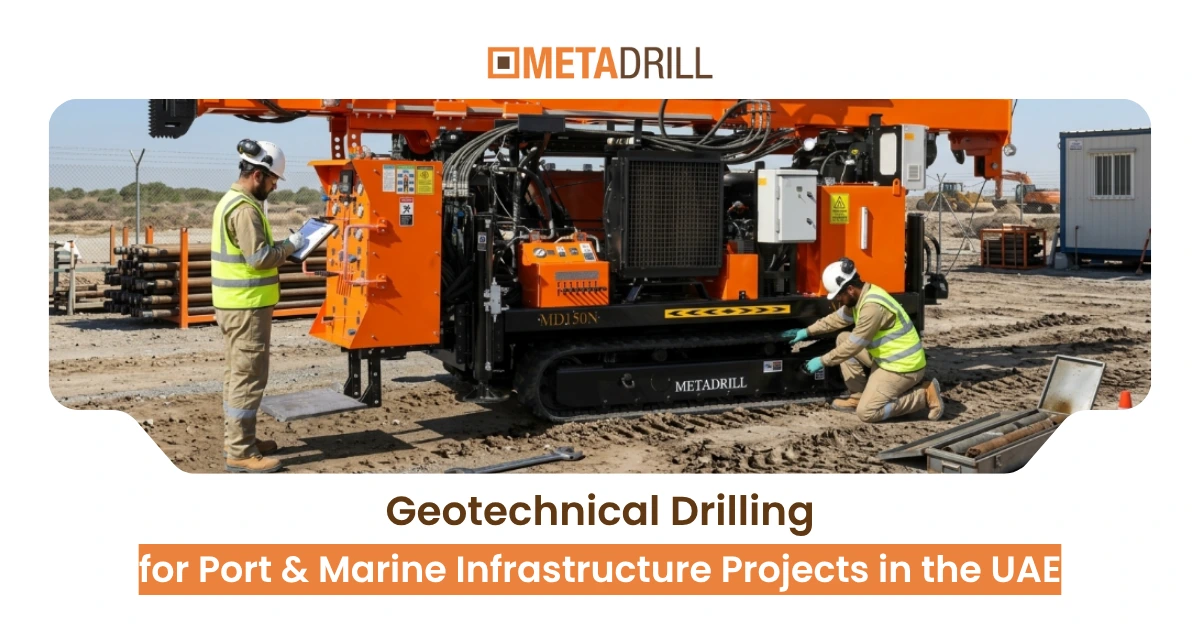
Depth is rarely the deciding factor on a desalination job. What matters is torque for the cemented bands and being able to swap between SPT and coring without changing rigs. The MD600N lists an automatic SPT hammer, 5,000 Nm of torque and N-wireline coring to 600 m, on track or truck. The MD150N is rated to 150 m with N-wireline and suits shallower coring work. The MD1000N goes to 1,000 m with an automatic SPT hammer, which matters only if the programme includes deep exploration. The full range sits on our drills page, and you can compare bits, rods and samplers under drilling tools.
Salt air and summer heat wear hard on hydraulics, so read our desert heat maintenance guide before you mobilise. MetaDrill rigs are built in the UAE, which keeps spares and support close to the job.
Four things to settle before you mobilise
- Get the scope from the client's specification: borehole depths and test types.
- Plan for refusal. Decide in advance what happens when SPT stops.
- Fix how groundwater samples get taken, stored and shipped.
- For marine holes, lock in the platform, weather limits and permits first.
Quick answers
How deep do boreholes for a desalination plant go? The client's specification sets it, based on structure loads. In practice holes run until competent rock or dense strata is proven, and deeper at the pump station where the excavation goes down.
Can you drill boreholes in the sea? Yes, from a barge or jack-up platform. It's slower and costs more than land drilling.
Which tests come out of the programme? SPT in soil, coring with strength testing in rock, groundwater chemistry, and sometimes permeability tests.
Talk to us before the plan is fixed
A drilling plan is cheapest to change while it's still on paper. If you're scoping site investigation for a desalination or coastal water project, or an Abu Dhabi infrastructure programme, send us your borehole schedule and whatever ground information you already hold. We'll tell you which rig and tooling fit and where we see the risk. Look through our site investigation services and solutions, or contact us directly.
Question to the public:
How site investigation drilling works for UAE desalination plants: intake and outfall boreholes, saline ground, cemented coastal layers and rig choice.