A client sends you a borehole schedule. Six holes at 10 m for a two-storey warehouse. Twelve holes at 60 m for a tower. Same city, same sand on the surface. Why the gap?
Because the foundation type decides how deep you have to look. And the foundation type isn't picked from a catalogue. It comes out of what the ground can carry, how much it will settle, and what the water is doing.
This guide lays out how the choice works in UAE ground, and what the drilling programme must deliver for each route.
The short version
Shallow foundations (footings and rafts) spread the load across the upper soil. Deep foundations (piles) pass through weak layers and bear on something better, or hold the structure by friction along the shaft.
If the top few metres can carry the load without settling too much, shallow is cheaper and quicker. If they can't, you go deep. Everything else is detail, and the detail is where the money goes.
What pushes a UAE site toward shallow
Shallow works when the near-surface ground is dense enough. Compact sand, or cemented sand-rock close to surface, can carry light and medium structures: warehouses, low-rise buildings, small plant, solar mounting frames. Our guide on solar farm drilling in the UAE shows the light-load end of this.
Shallow still needs boreholes. The investigation has to prove that no soft layer hides below the footing. A common approach is to take boreholes to a depth well below the footing base, deep enough to cover the zone the load actually stresses. Your consultant sets the number. The point for the contractor: shallow foundations don't mean shallow drilling.
What pushes a site toward deep
A few conditions tip the balance.
Loose or soft layers near surface. Loose sand and sabkha compress under load. Piling through them to a better stratum is often the sensible route. The SPT in sabkha soils guide covers the testing side.
Heavy, concentrated loads. High-rises and towers put loads into the ground that surface soils can't take. See high-rise foundations in Dubai and supertall tower foundations.
High groundwater. A deep basement or large raft means digging below the water table. Dewatering gets expensive fast, and sometimes piles plus a thinner slab come out cheaper.
Aggressive ground. Chloride and sulfate affect concrete and steel in both systems, but a pile sits in that ground for the whole design life.
How the drilling differs
Here's where it gets practical.
For shallow foundations, you'll mostly be doing SPT through soil with a short core run if rock appears. Holes are shallower, more numerous, and finish quickly.
For deep foundations, holes run to depth and the rock matters more. Wireline coring gives continuous core for socket design, and good recovery in cemented layers is the whole point. Torque matters because you pass through hard bands on the way down.
Borehole stability gets harder with depth. Loose saturated sand won't stay open, so you need casing or fluid. We cover those choices in drilling fluids and borehole stabilization.
And the tests multiply. Deep programmes often add permeability tests, groundwater sampling at several depths, and rock strength testing on the cores.
A rough decision flow
- Do the desk study. Geology maps, neighbouring reports, old borehole logs.
- Run a first phase of boreholes to see what the profile looks like.
- Compare load demand with the bearing capacity in the upper layers.
- If the upper layers cope, design shallow. If not, extend the investigation deeper for piles.
- Decide on a second phase only where the first leaves questions.
Notice that a two-phase investigation can save money. A cheap first phase tells you whether you need the expensive deep phase at all.
Rig choice
Shallow-heavy programmes want a compact or mid-sized rig that moves quickly between locations. Deep programmes want torque and depth capacity.
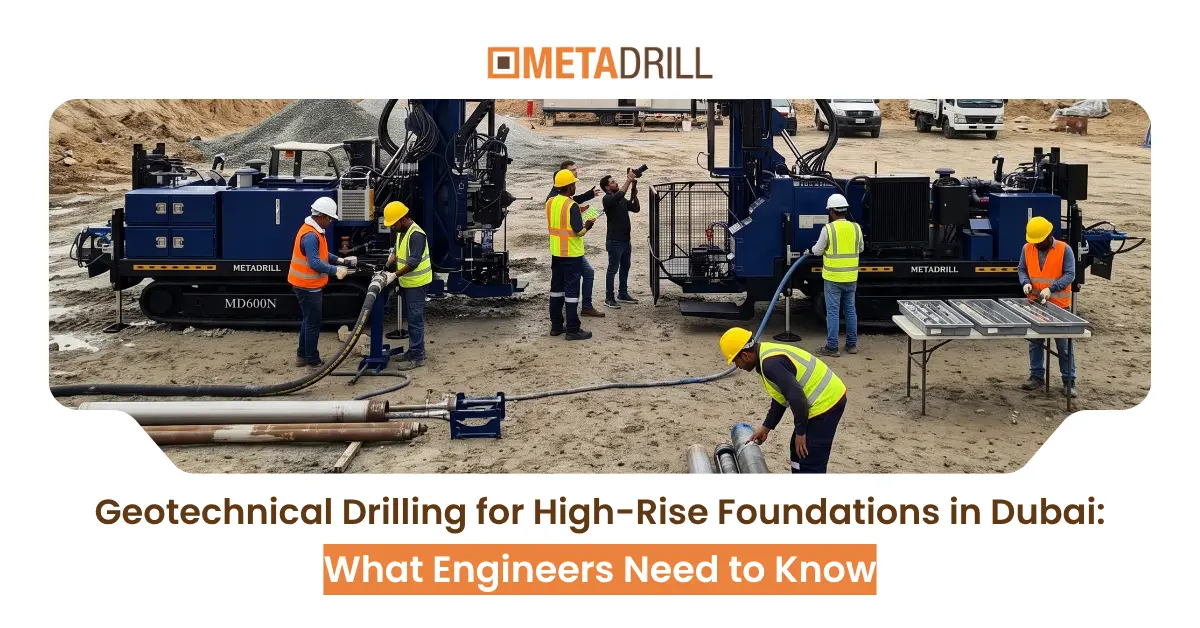
The MD150N is rated to 150 m with N-wireline, which covers many shallow and medium-depth foundation jobs. For deeper pile investigations the MD600N lists an automatic SPT hammer, 5,000 Nm of torque and N-wireline to 600 m. The MD1000N reaches 1,000 m with an automatic SPT hammer for deep exploration. The automatic hammer is worth reading about in our SPT efficiency article. Browse everything on the drills page, and check bits and samplers under drilling tools.
For retrofit sites where a pile design is replaced by micropiles, see ground investigation for micropile projects.
Two sites, two programmes (hypothetical)
Let's make this concrete with two imaginary jobs on similar ground.
Site A: a two-storey warehouse. Light loads on a large footprint. The desk study shows medium dense sand with cemented layers at depth. The consultant asks for a grid of shallow boreholes across the plot, SPT at regular intervals, a few groundwater readings, and a couple of deeper holes to check the layering below. The programme runs a few days. The rig moves fast between holes, and setup time matters more than depth.
Site B: a tall residential tower. Heavy loads on a small footprint, a deep basement and a water table close to the surface. The consultant asks for deep boreholes with rock coring, SPT in the upper layers, permeability tests, groundwater sampling at multiple depths and chemical tests. The programme runs for weeks. Torque, casing and fluid control decide the pace.
The ground looks alike on the surface. The programmes share almost nothing beyond the rig's brand name. That's the point: the structure, not the soil alone, decides what you drill.
Where money gets wasted
A few patterns show up again and again.
Drilling deep everywhere "to be safe". Deep holes cost a lot. If a first phase shows good ground near the surface, the design may only need shallow data.
Drilling shallow to save money. The opposite mistake. A shallow programme that misses a soft layer at depth forces a second mobilization, and the second one costs more than the first.
Skipping groundwater work. Water levels and chemistry decide excavation methods and concrete specs. They cost little to measure and a lot to ignore.
Not phasing. A single large programme feels efficient. Two phases usually cost less overall, because phase two targets only what phase one couldn't settle.
Quick answers
Do I need to decide the foundation type before drilling? No. A good first phase helps decide it. The consultant will adjust the second phase to suit.
What if the ground changes between holes? Add holes where the first phase shows variation. Spacing is a design decision, not a fixed rule.
Is a deep foundation always safer? No. A well-designed shallow foundation on good ground is perfectly safe, and cheaper. Safe depends on matching the system to the ground.
How deep should boreholes go? The structural and geotechnical engineers set it from the loads. Expect deeper holes for piles, and holes that extend well beneath footing level even for shallow foundations.
Can one rig do both? Often, yes. A rig that handles SPT in soil and wireline coring in rock covers most UAE foundation jobs without a second mobilisation.
Start with the ground
Whichever way the design goes, the cheapest time to get the ground right is before anything is built. Send us your borehole schedule and the loads you expect. We'll tell you which rig and tooling suit. See our site investigation services and solutions, read the general guide on soil investigation before construction, or contact us.
Question to the public:
Shallow or deep foundations? How UAE ground conditions, groundwater and loads decide the choice, and what the borehole programme has to prove first.